Shanghai Travelogue
Shanghai Journey (Day 1)
Before the May Day holiday in 2006, our workplace held a sports meet, and our child was due to take the senior high school entrance exam in just over a month. We wanted to take her out for a trip, so we used the few free days during the sports meet to take a five-day self-guided tour of Shanghai. In the early hours of April 28, just after 4 a.m., our family of three arrived at Shanghai Railway Station by train. Initially, I had planned to avoid the touts and find a hotel on our own, knowing the station had a reputation for scammers. But the moment we stepped out, facing the teeming crowds and the hawkers at the exit waving hotel brochures, I began to have second thoughts. They said their hotels were excellent, the prices were rock-bottom, we could take a look first, and there were minivans nearby to shuttle us over. So, with a why-not-try attitude, we got into their vehicle. About five minutes later, we arrived at the Dongshi Hotel on Hutai Road. The hotel was not very large, maybe five storeys high. We went inside to check a room — a triple room, fully equipped, quite satisfactory. I asked about the price and was told the rack rate was RMB 268 per day, but joining their in-house day tours would get us a discount. Downstairs in the lobby, the tout was eager for me to pay up. I looked at the travel agency leaflets advertising a Shanghai day tour at RMB 200 per person and a Suzhou Zhouzhuang day tour at RMB 180 per person. I gritted my teeth and haggled hard: both day tours at the same price, RMB 150 per person, the room at RMB 100 per day, and no price hike during Golden Week. The tout looked shocked, and more than a little angry. I didn't rush to decide. I pulled from my bag the travel guide I had prepared in advance, 'Travel Across China', and showed him the price listed for the Zhouzhuang day tour: RMB 155 per person. He argued that ascending the Oriental Pearl Tower meant going up to the second sphere at a height of 265 metres, and the admission ticket for that alone cost RMB 100 per person. He still wouldn't agree. I said if we couldn't strike a deal, we would go to the Tourist Distribution Centre. He claimed the centre's prices weren't any cheaper. I said: if you agree, I'll pay up; if not, we'll find another hotel. Maybe he thought I wasn't easy to fool; maybe he saw three potential customers and the profit was substantial; maybe he didn't want to waste too much time and miss out on the next batch of arrivals. He gritted his teeth, slapped his thigh, and, putting on an expression of great anguish, agreed. I handed over the money on the spot, he wrote me a receipt, and just like that, within half an hour of entering the hotel, we had sorted out two days of our itinerary. Later, I reflected that they definitely weren't hotel staff — they were dedicated touts who would settle accounts with the travel agency and hotel afterwards. My personal takeaway: when you're out and about, traps are everywhere. You have to dare to bargain, save where you can. Getting the same thing done for less money gave me a genuine sense of achievement.
After eating in the downstairs restaurant, around 8 a.m., we boarded an Iveco minibus. There were a dozen or so tourists, and our guide was Miss Zhou, whose Mandarin was fairly decent. The weather was bright and sunny, the sun just rising; it promised to be a scorching day. Having spent the entire night on the train, my sense of time and space felt jumbled — it honestly felt like midday already. The vehicle soon climbed onto the elevated highway, and Miss Zhou stepped into her role at the front, launching into her commentary. Her narration was authentic and very polished, clearly memorised from a script. She first outlined the day's itinerary: 'Welcome, everyone, to Shanghai. Today our journey begins with ascending the tallest tower in Asia, the Oriental Pearl TV Tower, followed by a view of the first bridge across the Huangpu River, the Nanpu Bridge. We will then take a cruise on the Huangpu River from the Shiliupu Wharf. At midday, we'll head to City God Temple in the old city for lunch. In the afternoon, we'll visit Shanghai's window to the world — the Bund and Nanjing Road. At seven in the evening, when the lights first come on, our vehicle will pick everyone up on time downstairs from the Broadway Mansions at the mouth of Suzhou Creek.' Then she launched into her commentary. It covered the earth-shaking changes in Shanghai over the past twenty-odd years of reform and opening-up. She mentioned that Shanghai currently has four elevated highways: the Inner Ring, Outer Ring, North-South Elevated Road, and Yan'an Elevated Road. She spoke about Shanghai's municipal construction, telling us that every kilometre of elevated highway cost several hundred million yuan to build, and that the Oriental Pearl Tower and Jin Mao Tower had cost billions of yuan each. It was staggering to hear. Among her closing lines was this: 'To see Shanghai today is to marvel at a changed world.' I was holding my DV camera, shooting the scenery outside the window while listening. Suddenly, a row of towering high-rises entered my view. These were unlike the high-rises I had seen in other cities — around twenty to thirty storeys, but looking up along the buildings, their tops seemed to reach right into the clouds.
Amidst the tour guide's narration, the speeding vehicle on the elevated highway suddenly took a sweeping bend. From this commanding height, the view opened right up. High-rises crowded both sides of the elevated road. The guide said we had now entered the Yan'an Elevated Road, and up ahead was the heart of old Shanghai — People's Square, the site of today's municipal government building. I quickly swivelled my camera lens. Looking down from the elevated road, People's Square was a broad, open expanse. At its centre stood a massive, white, square-shaped building of about twenty storeys, radiating authority — that was the Shanghai Municipal Government building I'd known from so many photographs. On one side was the Shanghai Urban Planning Exhibition Hall, and on the other, what looked like the Shanghai Grand Theatre, each with a strikingly unique design. The guide told us that the old Shanghai landmark, the 24-storey Park Hotel, was right at People's Square, which also happens to be the western entrance to Nanjing Road. Pity I didn't actually spot that former tallest building in old Shanghai at that moment — I only saw it the next day, returning from Zhouzhuang and passing through People's Square: a dark brown, ageing structure, conspicuous among the surrounding buildings but not particularly towering. Suddenly, I spotted a very distinctive high-rise ahead on the right side of the car. Its top resembled a blooming lotus flower. The guide said it was the Huangpu District People's Government building. The vehicle descended along the elevated road and soon entered an underground tunnel. The guide said this was the Yan'an Road Tunnel under the Huangpu River, and that passing through this tunnel, we were about to enter Pudong. She explained that before the reform and opening-up, Shanghai's urban area was mostly concentrated in Puxi, while Pudong was very backward. Shanghainese had a saying back then: 'Better a bed in Puxi than a house in Pudong.' With the development of Pudong, the construction of the Nanpu, Yangpu, Lupu, and Xupu Bridges, and the opening of several riverbed tunnels, Pudong had undergone tremendous change, turning into a showcase district for Shanghai's finance, trade, and high-tech. My spirits soared as the car entered the tunnel. Inside, it was dark, gloomy, and cool. Cars and sedans with their lights on drove both in front and behind us, the noise deafening. I hurriedly turned on my DV camera to capture the moment. Just about when the car reached the deepest part of the tunnel, the guide said: 'Ladies and gentlemen, we are now travelling directly under the bed of the Huangpu River. The surging waters and 10,000-tonne ships are passing right over our heads.' We drove through the tunnel, passed beneath the 88-storey Jin Mao Tower, and in no time arrived at the plaza beneath the Oriental Pearl Tower.
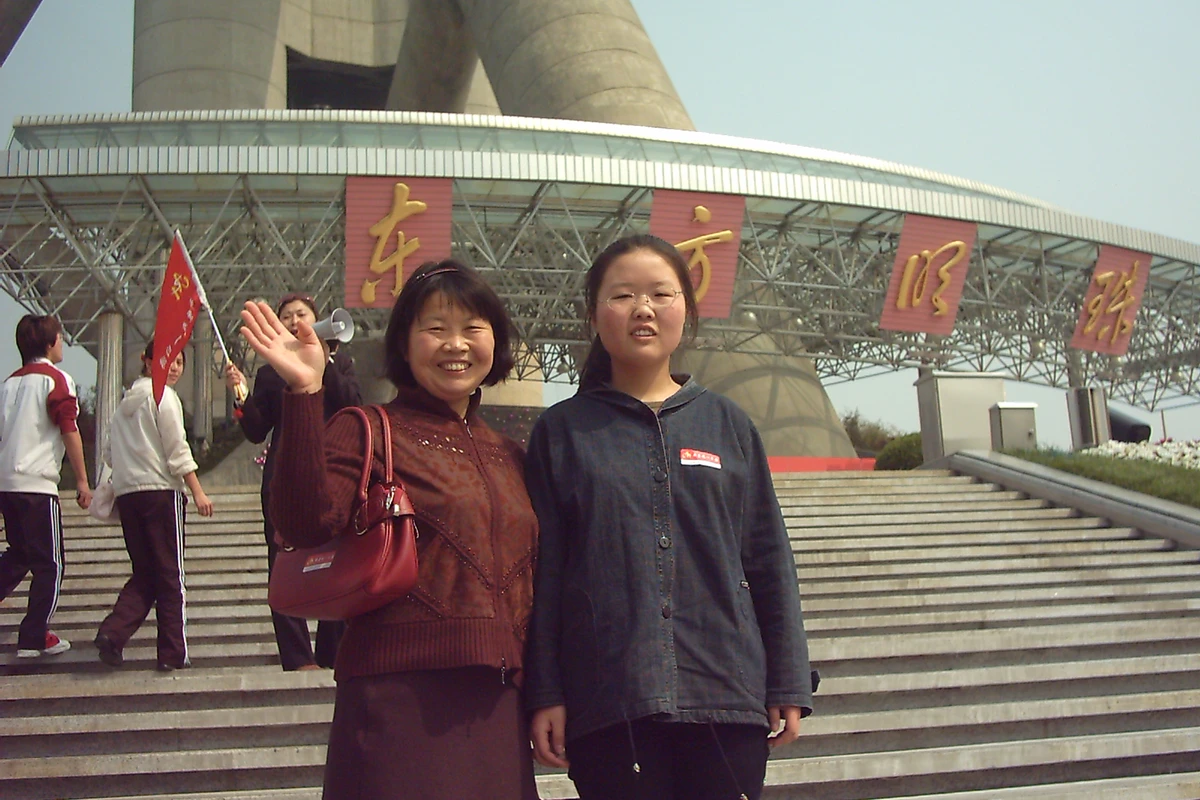
Looking around the plaza below the Oriental Pearl Tower, there weren't many tourists yet since it was still early — just a few international tour groups. We wanted to take some photographs at the base, but I quickly realised it was very difficult to capture the entire tower in a shot. Urged on by the guide, we hastily snapped two photos before entering the ticket hall. Before taking the lift, we had to hand over mobile phones and metal objects for a security check. The lift was huge, capable of holding twenty or thirty people, and there was a dedicated lift attendant in a red uniform providing commentary in Chinese and English. In roughly a dozen seconds, the lift rose to the second sphere, over 260 metres up. Stepping out of the lift, I found the interior space of the sphere to be enormous, about the size of a small sports field. In the middle were counters selling souvenirs like models of the Oriental Pearl Tower. Looking down from inside the tower, I felt profoundly shaken. Both banks of the Huangpu River were spread out before my eyes. How many times had I dreamed of climbing the Oriental Pearl? Now, looking down at the exotic building clusters of the Bund — the Customs House, the Peace Hotel, the Bank of China, the Garden Bridge, Suzhou Creek, and the Broadway Mansions — all scenes I'd previously only seen in picture albums — and watching the 10,000-tonne freighters slowly plying the Huangpu and the ocean liners moored near the Garden Bridge, then gazing at the constant stream of traffic on Century Avenue below, I felt as though I were in a dream.
We lingered in the tower for nearly an hour, greedily snapping an uncountable number of photos. When I checked the time and realised it was running out, we hurried to descend. But getting down was no easy task — we had to queue for a long time for the lift. I got quite anxious, worrying about delaying the tour schedule. Fortunately, the lift had a huge capacity and was very fast; it seemed two lifts were in operation. Before stepping in, I tried greeting a few foreigners waiting for the lift in English. They didn't understand; I later learnt they were Japanese. Down on the plaza, I spotted a group of foreign tourists taking a group photo and went over to join in the picture-taking. Seeing this uninvited guest, they all laughed. I showed off a bit with a phrase from my daily English practice: 'Welcome to Shanghai!' They greeted me back with stiff Mandarin: 'Nǐ hǎo! Nǐ hǎo!' I didn't have time for more pleasantries with them, so I jogged all the way to our tour vehicle parked at the edge of the plaza. The guide was displeased by our lateness and 'punished' me by threatening to make me sing a song.
Leaving the Oriental Pearl plaza, we passed a grand hotel built after the reforms with funds pooled by Pudong farmers — the 'You You' Hotel. Why 'You You'? The guide told us it symbolised that Pudong farmers who once tilled the land finally saw their 'day of emergence'. Afterwards, our vehicle climbed in a spiral onto the Nanpu Bridge, the first bridge over the Huangpu River. The Nanpu Bridge has a very long, spiral approach ramp, with a park beneath it. It took quite a while to reach the main span. On the bridge tower, the four characters for 'Nanpu Bridge', inscribed by Deng Xiaoping, were bold and forceful. The bridge clearance was 50 metres, with dozens of steel cables supporting the deck, allowing 10,000-tonne ships to pass unimpeded below. Looking out from the bridge, the buildings on both banks of the Huangpu were stacked layer upon layer; the 2010 Expo Park planning zone sat there. Descending from the Nanpu Bridge, we returned to Puxi, first passing the 'Great World', once Shanghai's entertainment hub — a four or five-storey old building that had long since lost its former glory. Later we passed a concert hall. The guide told us this concert hall originally stood in the middle of the road. When road widening was needed, construction workers used advanced technology to shift the entire building several dozen metres sideways to the edge of the road. We all marvelled at the magic of engineering.
Next, our tour vehicle took us to the Shiliupu Wharf on the Huangpu River for a river cruise. I remembered that the previous year, Lien Chan had boarded his Shanghai visit cruise from this very wharf, though that had been at night. Once on board, we rushed to the top deck, terrified of missing any photo opportunity. As the tour boat set off, we, along with everyone else on board, furiously snapped away at the Oriental Pearl. When the boat reached the mouth of Suzhou Creek and turned back, we aimed our cameras at the Bund's building clusters for another volley of frantic shooting. Finally we returned to Shiliupu Wharf — the round trip took about twenty minutes. What exactly did we see on the boat? My impression was vague. No matter, it was all safely recorded on my DV camcorder. Before disembarking, I took two more photos inside the cabin.
Around midday, we arrived at City God Temple in Shanghai's old town. We first ate at a restaurant, led by the guide — RMB 20 per person, paid on the spot. Once a table filled up, we started eating. Drinks weren't included. The meal was all right, I suppose. City God Temple was just as I'd imagined: a bustling commercial complex. Inside were a temple, waterside pavilions, the Nine-Turn Bridge, and a garden built by a Qing dynasty official so that his ageing parents could enjoy their later years in comfort and delight — the Yu Garden. What left the deepest impression on me were the shoals of red fish beneath the waterside pavilions. We first viewed the Buddhist statues in the temple, then strolled through the shopping complex, which mainly sold antiques, crafts, and the like. The Yu Garden required an entrance ticket of five yuan, with an inscription by Jiang Zemin at the gate; we didn't go in. Maomao and her mum also went into a nearby two-yuan shop and bought some hair accessories and such.
Leaving City God Temple, we travelled by car to the Bund. Passing the old municipal government building, the Customs House, the Nanjing Road entrance, the Peace Hotel, and the Bank of China, we arrived at Huangpu Park at the northern end of the Bund. The park wasn't large and contained a May Fourth Movement sculpture. The guide told us that Huangpu Park was built by foreigners in the 1920s and 1930s and was the very site where the humiliating sign 'No dogs or Chinese allowed' was displayed. Hearing this stirred up deep anger in all of us.
During our free time in the afternoon, we stepped off the Bund and onto Nanjing Road, just below the Peace Hotel, known in old Shanghai as the 'Ten-Mile Foreign Concession'. Nanjing Road remains Shanghai's most bustling commercial street, but those shopping here now are mostly out-of-towners. Allegedly, Shanghainese never buy things here. I strolled along sightseeing and taking photos, searching for traces of old Shanghai. Meanwhile, Maomao and her mum went into a shop. A few moments later, they came out saying there was a nice black women's trench coat inside, not too pricey at just over two hundred yuan. I went in, and the sales assistant was exceedingly enthusiastic, saying: 'Buying or not is entirely up to you.' I had a look — the style was ordinary, even a bit outdated. The material was nothing special either. Back in our hometown it would cost maybe a few dozen yuan, and besides, with summer just around the corner, it wasn't exactly wearable. Buying it would only bring regret. So I was disinclined. Seeing my reluctance, the sales assistant pulled out all the stops: she helped Wang Ying try it on, lowered the price, flattered us about how well-off we clearly were, and warned that we'd regret not buying clothes on Nanjing Road. But we had made up our minds and wouldn't buy. While she wasn't looking, we fled the shop, and she actually chased us outside, coat in hand! I had now experienced first-hand the legendary zeal of Shanghai sales assistants.
Strolling in the sea breeze along the Bund, we felt unusually relaxed. Watching the cargo ships and tour boats coming and going on the Huangpu, gazing at the Jin Mao Tower and Oriental Pearl Tower soaring into the clouds across the river, we marvelled that we had finally come to Shanghai. The May Day Golden Week hadn't started yet, so the crowds were still manageable. We took photographs from multiple angles and then came to the Shanghai People's Heroes Monument at the mouth of Suzhou Creek, built in memory of the martyrs who sacrificed their lives for the liberation of Shanghai. There we met two elderly foreign tourists. Maomao and I chatted with them in English, learning that they were from Washington, D.C., and they complimented our English, which made us very proud.
Before we knew it, the evening lights were coming on. The multicoloured lights dotting the Bund's architectural ensemble were shimmering to life one after another. It was nearly time for our pickup. Following Zhongshan East Road northwards along the Bund, we reached the Garden Bridge over Suzhou Creek. The Garden Bridge is an iron bridge, very old. From a stone tablet at the bridgehead, I gathered it was built around 1907. Walking on the pedestrian path of the iron bridge, there was a distinct trembling sensation whenever cars drove past. I knew that fierce battles had been fought here during the 1949 liberation of Shanghai, and I had once seen a photograph of Chen Yi's East China Field Army cavalry charging across the Garden Bridge during the city's liberation.
After crossing Suzhou Creek, right before us was the Broadway Mansions, built in 1932 and now called the Shanghai Mansions — one of the tallest buildings in old Shanghai. This building is a witness to Shanghai's history. Before the liberation, this was once a pleasure den where notorious Shanghai underworld kingpins like Huang Jinrong, Du Yuesheng, and Zhang Xiaolin indulged in debauchery. During the Japanese occupation of Shanghai, it housed the supreme command of the Japanese forces. I saw in a documentary that when the People's Liberation Army took Shanghai, it was from the roof of this very building that the Kuomintang's Blue Sky White Sun flag was torn down. After liberation, the building hosted dozens of visiting foreign heads of state, including Nixon, Kim Il-sung, Khrushchev, and Pompidou. From Yang Chen-Ning's essay 'Deng Jiaxian' in my middle school Chinese textbook, I remembered that when Yang visited China for the first time in 1971, the Shanghai municipal leaders hosted a banquet for him right inside this building. During the meal, he received a letter from Deng Jiaxian confirming that China's atomic bomb was built entirely by the Chinese themselves. For reasons he couldn't explain, Yang was so overwhelmed that he couldn't hold back his tears and had to excuse himself to the washroom to compose himself.
At the foot of the Broadway Mansions, I tilted my DV camera upwards and took a photo. We waited ten minutes, and the tour company's vehicle arrived. By now, the lights were all aglow and neon signs were dazzling. The guide directed the driver to return via the Bund so we could once more enjoy its beautiful nightscape. When we got onto the Yan'an Elevated Road, the high-rises on both sides were twinkling with neon lights, and People's Square was especially brilliantly lit. I felt this was one of the most beautiful sights I had seen all day. Back at the Dongshi Hotel, we had dinner, quickly freshened up, and rested, preparing for tomorrow's trip to Zhouzhuang.
July 2007
Huangpu Riverbed Tunnel
Shanghai People's Heroes Monument seen from the Huangpu River
Devout worshippers at City God Temple
Red fish beneath the waterside pavilion
The Garden Bridge and Broadway Mansions
Customs House on the Bund
Nanjing Road entrance on the Bund
Oriental Pearl at night
Old photograph — The Bund in the 1930s
Old photograph — The Liberation of Shanghai
Old photograph — The Huangpu River in the early years of the port's opening


