Explore Songjiang: Shanghai's Lesser-Known Gem – Travel Through Millennia and Feel the Cultural Charm of Shanghai's Roots
Whenever Shanghai is mentioned, the Bund and its towering skyscrapers immediately come to mind. Shanghai is an international metropolis, where the exotic architectural parade of the Bund and the glittering ranks of Lujiazui's skyscrapers both inspire awe. At dusk, multicolored neon lights accentuate the splendor of the Oriental Pearl Tower. The Bund squares are thronged with people, their laughter blending with the lights of cars and tall buildings into an unending scroll of light. The various foreign-style buildings glisten under the illumination, as if crafted of gold, seemingly recounting Shanghai's history. But have you ever seen Songjiang in Shanghai? Songjiang is hailed as the root of Shanghai, boasting not only a long history but also stunning scenery that captivates visitors.
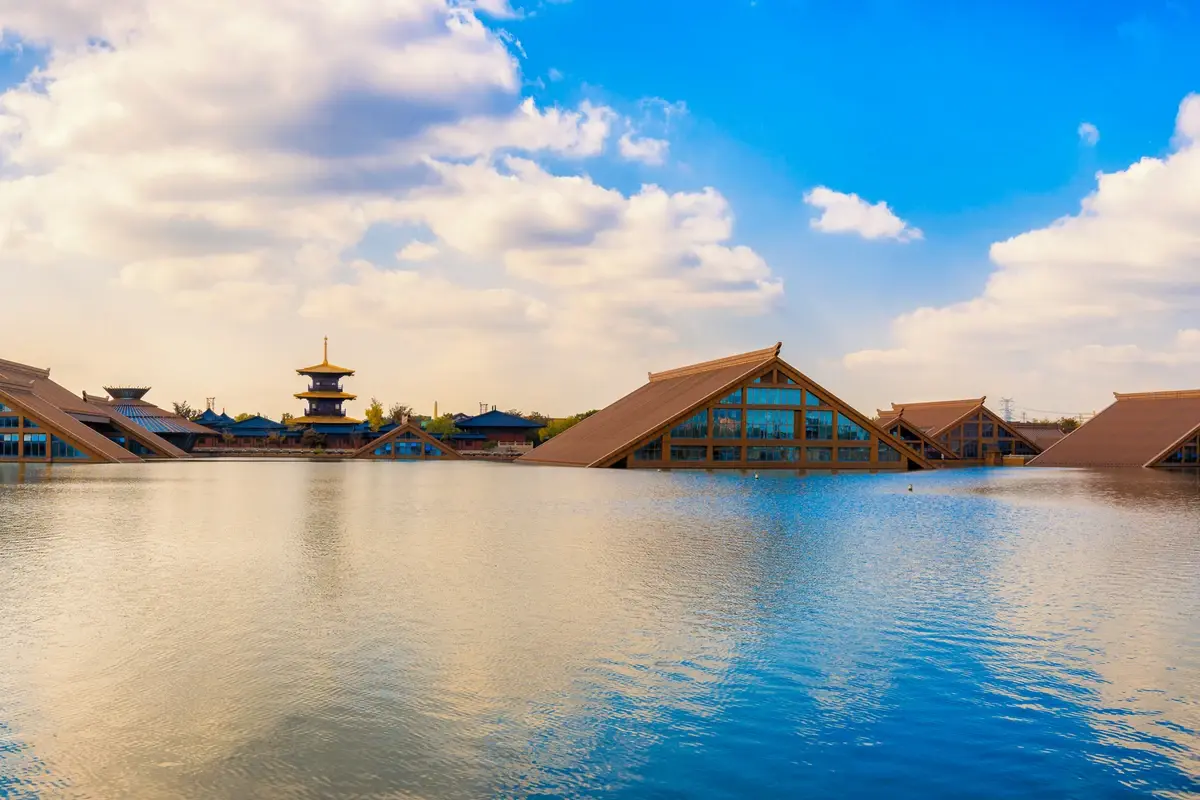
Shanghai's largest archaeological project, the Guangfulin Site, features an incredible underwater museum. Step into the Guangfulin Underwater Museum and travel through millennia to feel the allure of this city.
Rediscover joy at Happy Valley Shanghai, leave all worries behind, and enjoy pure happiness here.
Breathe fresh air at Sheshan National Forest Park, where tree-lined paths wind through lush greenery, and the summit offers a panoramic view of Sheshan.
Zuibaichi, Shanghai's most classical garden, invites you to stroll through and savor the beauty of Jiangnan's ancient garden design.
Yunjian Granary, once an old granary, has been repurposed into a trendy cultural check-in spot.
From the Smurfs on TV to an on-site experience, find happiness with the Smurfs in person.
Shanghai Chenshan Botanical Garden is the largest botanical garden in East China and the second largest in Shanghai.
Rediscover your childlike smile and seek happiness at Happy Valley.
Our first stop in Songjiang was Happy Valley Shanghai. I've been to Happy Valley in other places before, but this Shanghai park felt especially large. Early in the morning, scores of visitors were already queuing at the entrance. I noticed that most were young people, as the rides here are quite thrilling and suit them well—though there are also rides for children.
Inside the gate, we headed to Happy Time, where a host of attractions awaited. Many visitors were already in line—turns out they were queuing for the wooden roller coaster. Getting closer, I saw that this coaster was constructed from timber, not as tall as others, and relatively enjoyable. But don't underestimate it; once on, it's still a bit scary. The speed is intense: at a certain height, you plummet from the peak to the base in a swift rush. If you're afraid of heights, it's best to skip this one.
Moving deeper, we arrived at the Old Shanghai Quarter. Modern Shanghai dazzles with its unique blend of cosmopolitan flair and Chinese tradition. The city's charm is everywhere, from the captivating old Western-style buildings on the Bund juxtaposed with Pudong's modern skyscrapers, to the poetic echoes of Xujiahui's cathedral and the incense-wreathed Jade Buddha Temple. In this recreated old Shanghai, one recalls the bygone dreams of the 1920s and 1930s, while the rhythm of disco and the proliferation of internet cafés pull you back to 21st-century modern life. Within Happy Valley, you can still feel the architecture of old Shanghai from those decades.
Happy Valley is a fountain of joy, with so many fun activities to see. We spotted two bubble masters performing, sending a multitude of bubbles drifting into the air. The colorful orbs, glowing in the light, were spectacularly beautiful. Visitors could join in, using the tools to create their own bubbles—nearby, several children watched the show, utterly fascinated by the lovely spheres.
Crossing a bridge, we heard the screams of riders on the frisbee ride from afar—one of the most popular attractions among young visitors. Those entering the park at opening rush straight here to experience it. The ride swings at high speed, rocketing to the highest point before dropping, leaving you disoriented. The chorus of shrieks says it all about how wild it is.
In the Happy Ocean area, joy is amplified, particularly for children. Many rides here are painted blue, like the color of the sea. I saw numerous parents with their kids enjoying attractions like Water Speeder, Ocean One, and Ocean Star, which are huge hits with the little ones. Come summer, this is surely a kids' paradise—a great spot to play in the water and beat the heat.
Gold Mine Town features Gold Mine Waterfall, Mine Adventure, and other exciting rides. There's a distinctive motorcycle display, a statue of a Western cowboy on a horse, and nearby restaurants where you can rest, grab a bite, and have a drink before continuing. The park is quite large; you could spend a whole day here, and if you aim to try every ride, one day might not even be enough.
到佘山国家森林公园,呼吸清新空气
Sheshan National Forest Park boasts elegant mountains and verdant forests, with rich flora and fauna—notably, the bamboo shoots here have a faint orchid fragrance. Located in the southwestern suburbs of Shanghai's Songjiang District, the park is dense with pine and bamboo, offering beautiful scenery. Besides the most-visited East and West Sheshan, there are 12 other peaks like Tianma Mountain, Phoenix Mountain, and Xiaokun Mountain. Excluding man-made mounds, the Sheshan range is Shanghai's only "real" mountain, with Tianma Mountain, at 98.2 meters above sea level, naturally being the city's highest point.
As you ascend along the path, you'll see the Sheshan Peak Bell Tower. The trail is flanked by lush trees, with high vegetation coverage. However, there are mosquitoes on the mountain, so it's advisable to bring repellent.
Reaching the summit of Sheshan, the whole landscape unfolds before your eyes. You can see many villas, likely worth a fortune in Shanghai. Looking down, the villas at the foot of the mountain are encircled by trees, making life here idyllic for residents who can hike the forest park daily, breathe fresh air, and take evening strolls. At the peak stands the old Sheshan Observatory. Unfortunately, it wasn't open to the public when we visited, so we missed seeing inside. Perhaps next time. In front of the observatory entrance, many stone balusters are carved with zodiac constellations like Andromeda, hinting at the site's astronomical connection.
Halfway up the mountain, there's an ancient pagoda, with stone carvings and horses in front. A cute stone sculpture resembling a cat sits before the pagoda, gazing at it. This is a place to visit on weekends or anytime, especially in the sweltering summer—it's a perfect retreat. You can enjoy the panoramic views of Sheshan while breathing the fresh forest air.
森林宾馆里的美食,满足舌尖上的味蕾
After descending from Sheshan National Forest Park, we were ravenous. Directly opposite the park entrance, there's a hotel called Forest Hotel. We were surprised to discover that its restaurant is open to the public—truly a hidden culinary gem. We had lunch there, and the value for money was excellent, something we wouldn't have known about otherwise. We ordered several dishes, all delicious, and some evoked childhood memories for Shanghai locals. The white-cut chicken looked like ordinary chicken but tasted different—more flavorful and tender, thanks to the restaurant's choice of a different chicken breed.
A novel fish soup, fresh and delicate, was as white as milk. The flavor was superb, so fresh that the whole pot was quickly finished. The braised pork rice was a first for me in terms of preparation—absolutely delicious. The richness of the braised pork infused the rice, with some vegetables added, somewhat like the salty rice from my native Minnan region but distinct. A gentle stir during eating prevents greasiness.
There was also deep-fried pig's trotters, crispy outside and tender inside, with a crunchy skin and the meat's original taste preserved. The soy-braised duck was equally tasty.
After lunch, we browsed the rooms. During this period, the Forest Hotel's rates are half the usual price—a real steal. The rooms are spacious and bright, with balconies facing Sheshan across the street. Transportation is convenient, and parking is easy if you're driving. Nestled at the foot of Sheshan, the environment is beautiful and tranquil. Overall, the price-performance ratio feels high.
广富林遗址,神奇的水下博物馆
"Ten years, see Shanghai in Pudong; a hundred years, see Shanghai in Puxi; a thousand years, see Shanghai in Songjiang." Songjiang is the birthplace of Shanghai's history and culture. As "the root of Shanghai," its historical and cultural depth exudes unique charm. As early as the Neolithic era 6,000 years ago, indigenous people thrived in what is now the Guangfulin area, fishing, hunting, and farming. By 4,000 years ago, the Wangyoufang ancestors from the Yellow River basin migrated to Guangfulin, blending with the local inhabitants to create the "Guangfulin Culture," a fusion of northern and southern civilizations, from which Shanghai's roots flourished. Most visitors come to Guangfulin to see the magical underwater museum. Stepping into the Guangfulin Underwater Museum lets you travel through time and feel the city's appeal. Half of the museum is actually submerged beneath the water.
Across a vast expanse of open water, houses appear to grow out of the lake, floating on the surface. With knife-sharp architectural lines, these structures seem caught in a flood, submerged underwater with only their triangular roof ridges exposed. This is the Guangfulin Underwater Cultural Exhibition Hall.
At the entrance, you first see a recreation of the archaeological site during excavation, with lifelike figures of archaeologists presented before you.
Descending to the lower level, you begin in the Neolithic period and are gradually led through to modern times, tracing the complete journey of Shanghai's roots.
Fujin Tower is a landmark within the site park, its towering spire visible from a distance. This three-story replica Tang dynasty pagoda is square-shaped, unlike the hexagonal or octagonal pagodas of other eras. Fujin Tower serves as a religious art museum. Adjacent to it is the Zhiye Zen Temple, a Buddhist culture exhibition hall. The temple was rebuilt to commemorate the compassionate monk Zhiye, who offered medical aid to the needy. The temple offers vegetarian noodles for 20 yuan per serving—a perfect option if you arrive around lunchtime.
With white walls, dark tiles, and horse-head gables, the scene evokes the picturesque beauty of Hongcun village. In front of the parking lot stands a massive screen wall, its center featuring a large brick carving vividly depicting the lives of Guangfulin's ancient inhabitants, kilns, and trade. There are also statues of historical figures like Xu Xiake and Chen Zilong, so lifelike they seem real. Historical carvings include Emperor Kangxi's dragon boat during his southern tour and his landing here. These exquisite reliefs offer valuable insights into Guangfulin's history and culture.
上海醉白池,江南最著名的古典园林
Zuibaichi is one of the most renowned classical gardens in the Jiangnan region and a celebrated tourist destination in Shanghai. Tracing back to its predecessor, the garden has a history of over 900 years. Covering 76 mu (about 12.5 acres), it features ancient trees, numerous pavilions, and many historic sites. After more than 300 years, Zuibaichi still preserves ancient buildings like halls, pavilions, boats, and gazebos, maintaining the architectural style of Ming and Qing Jiangnan gardens. Its winding balconies, curved walkways, and antique charm are truly captivating.
On the day we visited, it started raining heavily. Browsing this famous classical garden in the rain offered a novel experience. The downpour dressed the entire park in a unique beauty, with picturesque scenes at every turn. If you've been to the Humble Administrator's Garden in Suzhou, you'll recognize the charm of Jiangnan's classical gardens. Here, you can experience that artistry without traveling to Suzhou.
When the owner completed the garden, he mused that if the great poet Li Bai were reincarnated and strolled here, he would surely be enchanted by the pond's scenery and intoxicated by the garden's beauty. Hence, he named it "Zuibaichi" (Drunken Bai Pond). He further recalled that Han Qi, a high-ranking official and poet of the Song Dynasty, was so enamored with the Tang poet Bai Juyi's works that he built a classical hall called "Zui Bai Tang" (Drunken Bai Hall) in his hometown of Anyang, Henan. The owner, Gu Dashen, likewise revered Bai Juyi and was often lost in the beautiful imagery of his poems, so he emulated Han Qi's gesture and named his garden "Zuibaichi." The name is novel, profound in meaning, and evocative—truly captivating. After surviving various upheavals and hardships, Zuibaichi has finally welcomed a vibrant spring.
云间粮仓,变身文艺打卡地
Yunjian Granary is located at 327 Songhui East Road, originally an abandoned grain warehouse and factory complex. Covering 98 mu (about 16 acres), it comprises numerous single-story slope-roofed granaries built between the 1950s and 1990s. The old granaries have been transformed into a new cultural landmark, with every brick and tile still bearing the marks of time. Transparent glass facades infuse the site with a contemporary artistic vibe.
Now, these former granaries have become a fresh cultural icon in Songjiang. Some exhibition halls are already open, with others under preparation. Upon entering Yunjian Granary, you're greeted by a large trumpet-shaped iron structure. Many areas remain unopened, and some are under renovation, but I believe this will surely become a go-to spot for culture and the arts in the future.
不能错过的上海老底子民间美食味道
If you're traveling somewhere, local cuisine is a must. We went to Xiaoyeshu to savor authentic local flavors. This restaurant is quite spacious, specializing in traditional Shanghai home-style cooking, where the tastes of Shanghai are woven into everyday life. As soon as you enter, the food draws you in. In the ordering area, you can see the day's dishes displayed, and just looking at them sparks a craving. The restaurant's signature dish is a crabmeat pie, shaped like a crab shell. It's flaky, tender, and bursting with a fragrant aroma.
Another local specialty is a large fish, with fresh, tender meat and a clear, sweet broth. It's one of the house signatures, generously portioned, and highly recommended.
The soy-braised duck here is the best I've ever had. It's a classic Shanghai dish that varies from restaurant to restaurant, but this one stood out. A cold dish made from watermelon rind is another highlight—crisp and refreshing.
上海蓝精灵主题乐园,几代人的童年记忆
Belgian cartoonist Peyo's classic "The Smurfs" was introduced to China in the 1980s, becoming a shared childhood memory for several generations. The first Smurfs theme park in the Asia-Pacific region has been launched, bringing the animation's scenes to life. Classic characters like Papa Smurf, the goddess Smurfette, Brainy Smurf, the troublemaker Clumsy, the inventor Handy, and the evil Gargamel all appear as park characters. As I entered the Smurfs Theme Park, I was captivated by the architectural environment. The entrance features a huge blue arched hall, with play areas for children in the center.
Following the floor arrows, we walked toward the Smurf Village area, spotting cute Smurf statues nestled in various corners.
The Gargamel's House forest zone is at the entrance to the Smurf area. The dense forest blocks out the modern world, instantly immersing visitors in the fairytale realm the park creates. In the Village zone, you're transported to the Smurfs' daily life, with mushroom houses of all sizes as their homes, allowing you to live out scenes from the cartoon. Inside Gargamel's House, visitors become members of a Smurf rescue team, taking on challenges to save Smurfs captured by Gargamel.
The outdoor Adventure King zone is connected to the Smurf area by two motion-simulator cinemas. The Adventure King zone includes eight children's play attractions, such as a flying theater, 6D cinema, children's experience hall, and earthquake simulator. Additionally, the park offers Smurf-themed parades, live performances, and themed merchandise. It's a fantastic destination for taking the kids.
上海最美的公园,辰山植物园
Chenshan Botanical Garden is currently Shanghai's largest comprehensive botanical garden, spanning 207 hectares at the foot of Chenshan Mountain in the Sheshan range of Songjiang District. Shanghai's terrain is flat and lacks mountains, so even though Chenshan is only 71.4 meters high, it's quite a rarity. According to Ming Dynasty records by Dong Qichang, Chenshan got its name because it lies "southeast of the surrounding mountains, in the position of 'chen' (the Earthly Branch)."
The garden has a well-designed touring route, with a central exhibition area that includes the East China Garden, Quarry Garden, Rare Plant Garden, Aquatic Plant Garden, and 26 other specialized gardens. If you were to tour each one, a day wouldn't be enough. Flowers bloom in every season: cherry blossoms and peach blossoms in spring, lotuses and hibiscus in summer, chrysanthemums and dogwood in autumn, and wintersweet and orchids in winter. More often, there are uncommon, unnamed flowers. With blooms year-round, every visit to Chenshan Botanical Garden lifts your spirits.
Following the steps up the mountain, you'll find dense vegetation and an observation deck at the top that overlooks the entire garden. The Chenshan Pagoda stands tall and prominent on the summit. If you visit in summer, the scorching outdoors might feel overwhelming, making the greenhouse area the most appealing and essential place to go. The greenhouse complex is vast, housing several gardens like the Desert Plant Garden and Rare Plant Garden, with a pleasant temperature throughout the year. Summer here is a season bursting with color.
住宿推荐上海开元名都酒店
During this trip to Songjiang, Shanghai, we stayed at the New Century Mingdu Hotel, which is conveniently located near many attractions and offers easy transportation. The rooms are spacious, with oversized windows that let you take in the distant views. As someone who often needs to work, having a desk was incredibly useful—I could upload the day's photos online to share. The room's warm lighting creates a cozy ambiance, and the bathroom is large, featuring a bathtub and a separate shower area.
The hotel's dining shouldn't be missed. That evening, we ate in the hotel's Chinese restaurant. The osmanthus-flavored ribs, beef, and lobster were all delicious. The lobster was prepared differently from what I'm used to, with the meat being tender and smooth. The beef was also one of my favorite dishes.
Shanghai is an international metropolis. For over a century, it has been China's commercial hub and a gathering place for wealth, serving as the nation's business card to the world. The city's brilliance lies in its seamless fusion of past and present, and its knack for creating popular trends. Pudong, once a sleepy farmland, has been replaced by maglev trains and one of the world's most international airports. Songjiang, as the root of Shanghai, holds so much culture worth exploring—and along with it, the exquisite Shanghai pastries, the graceful Shanghai women, and the charming local dialect—all come together to form Shanghai's unique flavor, so enchanting it can make you swoon.


