A Day Out at Fengxian Four Seasons Ecological Garden and Shanghai Fish Park
The COVID-19 pandemic continues to trouble people worldwide, but fortunately China has managed it well, and Shanghai has done an excellent job with border controls, preventing mass infections. As long as you wear a mask outdoors, it’s still fine to go out and walk around. Being cooped up at home by the pandemic for so long, I couldn’t wait to get out, stroll around, and breathe fresh air.
On June 19th, I woke up to clear skies and brilliant sunshine, feeling incredibly refreshed. Earlier this month, I had planned to visit Xian Garden (Fengpu Four Seasons Ecological Garden) in Fengxian, Shanghai, with a photography-loving colleague, but rain forced us to postpone. Now we were finally able to go.
Fengpu Four Seasons Ecological Garden was designed by the Shanghai Modern Design Institute. Over 70% of the park is covered in greenery, giving it an exotic atmosphere. Tall trees and mid-level trees with colorful foliage and flowering small trees are planted throughout. Apricot trees were chosen as a signature species, complemented by other flowers and plants, creating a scene where one bloom stands out amid a riot of blossoms. The park features various architectural styles, including a cultural corridor, an Islamic garden, a European-style castle, and French buildings, all complementing the castles and villa neighborhoods outside. It’s been dubbed 'Shanghai’s Downton Abbey.'
The park is at No. 515 Hanyi Road, Fengxian. We left home at 7 a.m., took the metro with several transfers, eventually boarding Line 5 from Xinzhuang to Huanchengdong Road Station. Exiting from Gate 1, we met up, then walked east for over 200 meters. In total, it took two hours to reach Xian Garden, where entry was free.
The sky was truly blue—even bluer in phone photos. Follow the pictures for a tour!
No reservation was needed, and it wasn’t crowded. We had our temperatures checked before entering.
From the Sixian Seal and Songxian Wall at the entrance to the statue of Yanzi, the displays follow a chronological thread, illustrating how 'Xian culture' evolved over Fengxian’s long history. As visitors move through the scenery, they gradually learn about this culture step by step.
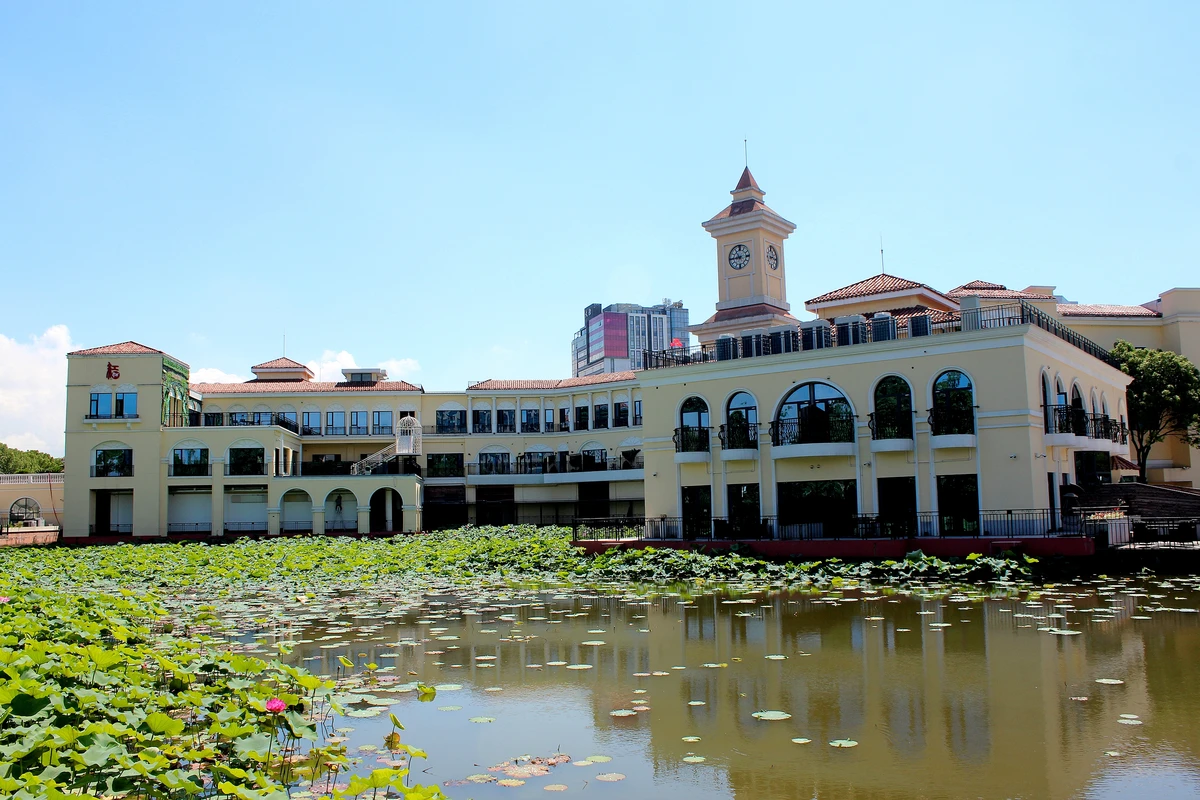
Oh, so Xian Garden was named by Emperor Yongzheng of the Qing Dynasty. Forgive my ignorance! We first went to the Water Garden, strolling along the pondside, surrounded by lush greenery. Lotus flowers were in full bloom, rising pure from the mud. It was a scene straight out of the poem: 'Infinite green lotus leaves stretching to the horizon, and lotus blossoms catching the sun in a uniquely vivid red.' The clock tower of the European castle outside reflected on the lake’s surface, with willows swaying in the breeze along the bank. Walking in the dappled shade was incredibly comfortable.
Then the beauty-loving photography enthusiasts switched into click-click-click mode, striking poses under the scorching sun and taking frantic shots.
A serious photography enthusiast.
We adjusted the focus, set the self-timer, and took a group photo—nice result!
Since we had gotten up early, we were feeling hungry. We ate the snacks and drinks we had brought along, lightening our load so we could move more easily.
After a short rest, we headed to the French Garden, with its European castle, bridges, sculptures, and lawns.
We passed by the Islamic Garden, but it was closed because of dangerous structures—tiles were falling from the roof—so we couldn’t go inside and see it for ourselves.
Pastoral scenery with a Dutch windmill.
To the north were garden villa complexes.
In the afternoon, the sky turned overcast with thickening clouds. We set out again, taking Line 5 to Jinhai Lake Station, then walked to Shanghai Fish Park (Nianfeng Park). The main draw was the lakeside scenery. The sunflower field wasn’t here, and you couldn’t reach Bubble Park or the museum from there—you had to exit and re-enter from the main entrance.
It was already past 2 p.m. when we came out. The sunflower field was still two bus stops away. Actually, you could take Fengxian Bus No. 21 from the Line 5 station; it was only three stops. Since the bus didn’t run frequently, we decided to walk. On the way, we passed the Kaiser Weiting Hotel. Its entrance had a lovely atmosphere, so we stopped to take photos.
Not far past the hotel, we reached the spot where cosmos and sunflowers were blooming. Across Hubin Road was a field of verbena flowers. After walking two bus stops, we finally arrived. Forgetting the soreness in our feet, we hurried to snap pictures.
This old man is getting on in years—I felt a bit tired, so I didn’t take many photos of the verbena. I just rested for a while first.
After resting, we went to Lovers’ Knot and took another group photo.
We started heading back around 4 p.m., taking Bus No. 21 to the Line 5 metro station. We caught the 5 p.m. train and arrived home at 7 p.m. In total, we walked 20,000 steps that day. We got tanned, exhausted, but immensely happy.


