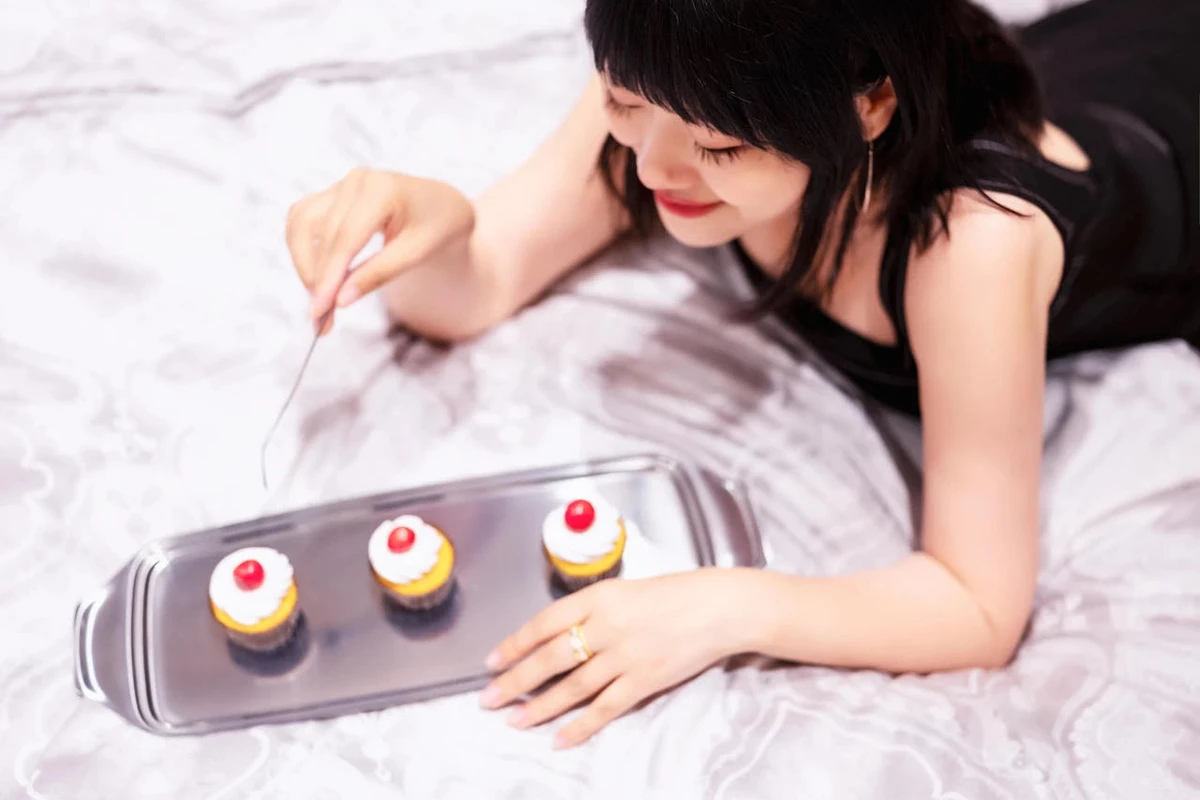
Home: A Place for Yourself—and the Genius and Madman Within
[ Home ]
The pandemic changed work and life for many, but for creators it hardly made a difference—we're home most of the time anyway, unless something urgent demands we step out.
My ideal home is: a CBD office, a family vacation zone, a hermitage, a den for boozy gatherings with friends, a G‑spot of inspiration, and a museum of obsessions...
Home is a space that holds all my roles, a place where even my most secret split personalities feel at ease.
The many “mes” and a life of idiosyncratic gastronomy.
Lately I’ve been delving into ancient European cookbooks and made focaccia, the Italian quick bread. The word focaccia comes from Latin focus, meaning ‘hearth’ or ‘center’, because the fire was once built in the center of the home. It’s an old European bread, very simple, quick-baked at high heat. I used heavy oil—a blend of olive oil and flaxseed oil, as I wrote in my 2016 book Guide to Vegetable Oils. High heat is actually a great way to retain nutrients, but sadly most ovens heat slowly and lose accuracy at high temperatures.
The earliest focaccia recipe may come from the Etruscans or ancient Greeks. It was usually seasoned with olive oil and herbs, sometimes topped with cheese, meat, or vegetables. Focaccia is really the ancestor of pizza, baked in wood‑fired earthen ovens that could reach several hundred degrees in an instant.
I first realized the importance of this feature when making Basque burnt cheesecake—otherwise it’s impossible to get that runny center with a fully cooked exterior! So far, I only know that ASKO can satisfy this: its pyrolytic oven can reach 275°C.
The biggest advantage of this oven is its chemical‑free cleaning. It has a built‑in pyrolytic self‑cleaning program that heats to 465°C, reducing all food residue to ash, which can be easily wiped away.
But not all food needs to be ‘burnt’. For a beginner, a no‑burn safeguard is a godsend! So I specifically compared ASKO’s microwave oven with a standard oven, and the key difference lies in ASKO’s inverter system.
ASKO inverter system:
◆ Works continuously at lower power – energy saving
◆ Microwave amplitude is lower and more even
◆ Achieves perfect cooking; no overcooking
◆ Operates at full power, max or zero, no intermediate levels
◆ Food is prone to overcooking because it only pulses at one maximum power, never precisely matching the set power
There are so many breads that mustn’t burn. This week, I used a liquid starter to make Italian ciabatta and panettone, both deeply traditional.
The ancient Egyptians started baking bread 3,000 years ago, but they had no idea that today’s people don’t want to eat a big batch of the same bread; we’d rather have multiple flavours at once. A crude earth oven can’t do that, but how can an ordinary home oven bake different breads in one go? The headache: each bread has a different proofing time, baking temperature, and duration.
Ciabatta is one of Italy’s iconic breads. It bakes relatively quickly: 220°C to 200°C for about 30 minutes. Fresh from the oven, its shape resembles a slipper. Made with a long, cool-proofed liquid starter, the crumb is riddled with shiny, uneven holes—crusty outside, chewy inside, the more you chew the more flavour you get. I have a million reasons to eat it. Traditionally, it’s dunked in Italian oil and vinegar. Europeans also make it into sandwiches. An American friend told me about kalamata olive ciabatta; once I get good cured black olives, I’ll definitely try.
Panettone is for Christmas. My liquid starter was very soft. When poet Zhao Ye tasted it, he said, “The moment I ate this cake today, everything was right.” Baked with top and bottom heat at 160°C for 30 minutes. For these two breads, I’d have to start the oven twice, while making sure the waiting bread doesn’t over‑proof. It’s a nightmare.
So, for ovens, I have a lot of unreasonable demands: I wanted a traditional multifunction oven that can also handle pyrolytic cleaning, steam baking, and microwave baking. At the very least, I should be able to proof and bake different breads simultaneously, so no one’s time or taste is compromised. If the temperature control is precise enough, it can double as a proofing box. And ASKO delivered.
In 1918, Aukusti Asko‑Avonius (1887–1965) founded the ASKO furniture factory in Finland, armed with the industrial ideas he learned in Sweden.
The reasons to love ASKO are endless. It can bake on five levels at once. The 60 cm / 45 cm height means I never worry about a tall loaf touching the upper heating element. The segmented baking function suits my light cheesecake—bake through, then colour. Even if I run out of recipe ideas, there are over a hundred built‑in automatic programs. The combi‑steam oven is huge, and its steam function doesn’t interfere with baking, so temperature control is precise to 1°C—no more griping about inaccurate thermostats like with many domestic brands. The 1.3‑litre water tank allows 80 minutes of full‑steam cooking; I can steam a whole 1.5 kg fish. The combi‑microwave oven also has a generous 50‑litre capacity and can use microwave and oven simultaneously—total freedom!
The essence of creating is to treat everything as ‘alive’. Once I chatted with my friend Liu Zhanyun, a celebrated photographer while I’m a photo klutz. I watched him obsess over details—how he waited for the light, for the mood, for something to happen. He valued that trusting relationship with the subject. It’s the same feeling in the kitchen: when temperature, humidity, and mood align, the dough feels just right. The moment of inspiration for writing arrives only when you’ve waited for enough inner stillness to write in one go.
There are too many moments to wait for. At home, to live a truly luxurious life, many things need to be tailored—ideally, you don’t have to wait. For example, coffee, which I can’t live without. At home, I’m either wandering by the stove with a coffee cup or reading and writing beside it, so I need a variety of brews throughout the day. ASKO’s built‑in coffee machine offers eight coffee options and can make two cups at once, so guests are no problem. The key is its professional conical grinder with 13 grind levels, satisfying the most particular tastes.
For a lazy person like me, fingerprints on the gas hob are a real bother. The EuroKera glass ceramic hob panel has an anti‑fingerprint stainless steel surface. It also has independent timers for automatic cooking. High heat means you can whip up a dish fast without anxiety.
If I didn’t have a dishwasher, when the pandemic kept our housekeeper away, I’d have cried my eyes out in the bathroom. The ASKO dishwasher loads more than any other brand; it’s the largest and most flexible dishwasher in the world, holding up to 17 standard place settings. The ultra‑fine screen means no need for pre‑rinsing!
Last week, I had the honour of being a food experience officer at the ASKO Luxury Living Elite Gathering, listening to three top luxury home design masters talk about ‘The Art of Living’—the real beauty is beyond the plate. While listening, I also thought of those moments discussing lifestyle with the editorial team of AD China.
All the food that day was made with ASKO equipment, and I want to try it at home.
Bread / BREAD
German-style whole wheat bread with butter and cheese
Soup / SOUP
French classic chicken mushroom soup
Appetizer / APPETIZER
Muslim crystal shrimp salad
Main / MAIN
Imported black truffle rib‑eye steak with a secret French reduction sauce
Entrée / ENTREE
Fragrant baked Boston lobster with vegetables
Dessert / DESSERT
Simmy's pie with fruits and prune sauce
That evening, I was honoured to meet three genius designers, who, like me, are also fans of ASKO and have a wonderfully picky heart about life. “Eastern Collector” style – Lai Jian’an (Botta Lai), who won gold at the German iF and Italian A’Design awards in 2019, and was voted the most favoured designer by Chinese luxury consumers in the 2018 Hurun Report. From Taiwan, Lai Jian’an, design director of Shifangyuan International Engineering, is famous for luxury homes, yet his works rarely show conventional opulence. Instead, they exude a warm Eastern aesthetic. By studying masterpieces, he deeply understands human scale and life details, and weaves them into his ‘homes’, making each one a unique artwork. For Lai, a supremely luxurious home must have “sunlight, air, life, and art”.
I also love the work of Italian designer Stefano Piontini, who fills his talks with childlike expressions and brims with out‑of‑the‑box creativity. Stefano Piontini graduated with a master’s from Milan Polytechnic in 2011. While studying, he worked on two major Milanese innovations: Residenze Corso Como and Bosco Verticale (the Vertical Forest). In 2017, with the support of the Italian Consulate General in Shanghai, he founded the “China-Italy Architects and Designers Alliance”. In 2019, his “Gymboree School and Office” project earned him a spot on the AD100 list of the 100 most influential Chinese architectural talents, as awarded by AD China; the project was also voted the most popular in its category.
The designer I personally adore is Godfrey Lam. His walk‑in closet looks like a boutique; he says the women in the family love that feeling. The ceiling is the bottom of their swimming pool, so while choosing clothes you can enjoy a view and keep an eye on the kids. Studio Glam was founded in 2017 by Godfrey Lam and Bryce Cai, with the motto “Life needs a little humour.” As creative director, Godfrey studied in Hong Kong, the UK, Canada, and the US, earning his Master of Architecture from Columbia University in New York. Never one to follow trends, he’s stunned the design world again and again with original personal designs and bold ideas. Over more than 20 years in the US, he worked for I.M. Pei, Rockwell Group, and HOK Asia Pacific, among others, on projects from North America to Asia—including the 2009 Oscar stage, Trump’s New York hotel, and Michelin‑starred chef Alain Ducasse’s restaurants in New York and Washington.
Godfrey and Bryce use colour, materials, and lighting with exquisite sensitivity, creating dramatic ‘life stages’ for their clients. Hearing him speak made the banquet dishes come alive.
We all need to appear at formal occasions from time to time, and dealing with clothes is a headache. In private chat, Godfrey became a fan of the ASKO washing machine. It’s the only domestic drum washer in the world with a four‑shock‑absorber suspension structure. All models use top‑end parts and have a lifespan of over 20 years. The washer‑dryer combo has so many advantages. The drying cabinet may have originated because the Nordic countries have long winters and countless snow activities. Often, clothes aren’t dirty but get damp from melting snow, making them uncomfortable to wear. So the drying cabinet was born. It’s found in homes, schools, and some public spaces for quick drying. Amazingly, it works for all garments: sportswear, outdoor gear, workwear, cashmere, leather, silk shirts, velvet, satin, sneakers, boots, rain boots. It has the drying options I’ve dreamed of: hot air, normal temperature, low temperature, and cold air, to suit different fabrics. The interior is flexible; laid out, it gives the equivalent of a 16‑metre clothesline. The cabinet allows hanging, so many clothes come out naturally wrinkle‑free, no ironing needed.
I’m a person of contradictions: idle, I’m in pain; busy, my whole body aches. Coming home is my cure, especially for the ‘zuo’ disease caused by obsessing over details. If every detail at home is to my liking, there’s no need for vigilance or tension. Even the most stubborn genius or madman wouldn’t mind.
What do you think makes a home comfortable?
Home is the only place in the world that hides human flaws and failures while holding sweet love.
Food Bless You!
Consultant, China International Food Expo
Producer, The God‑Like Table


