Sails, Ocean Voyages, and History – A Family Visit Guide to the China Maritime Museum
The Age of Sail, that was once the best of times, an indelible highlight in the brief history of humankind.
That era is also the one I yearn for, and interestingly, my family’s work has more or less been connected to seafaring. So a visit to the China Maritime Museum is, of course, a must—it’s an inextricable bond.
Longgang Express (Huanhu West Third Road, Shengang Avenue stop), Sangang Special Line (Huanhu West Third Road, Shengang Avenue stop), Shengang No.1 bus (Huanhu West Second Road, Shengang Avenue stop), Shengang No.3 bus (Huanhu West Third Road, Shengang Avenue stop).
Take Metro Line 16, get off at Dishui Lake station. Then take the Shengang No.1 inner circle bus (2 stops), and alight at Huanhu West Second Road, Shengang Avenue stop.
Outer Ring Road S20 (towards Pudong Airport) → transfer to S2 Expressway (towards Donghai Bridge) → exit at Dishui Lake to reach the China Maritime Museum.
The parking lot is quite large, so driving is recommended.
9:30–16:00 | last entry at 15:30 | closed on Mondays, except public holidays.
Also, due to special circumstances recently, reservations are required and visitor numbers are capped. Remember to book in advance via the “Huyouma” (Shanghai Tour Code) app.
There are discounts at the moment.
Adults: 30 RMB; students with valid ID: 15 RMB; seniors aged 60–69 with valid ID: 10 RMB; there are also many free admission categories, especially free entry for seafarers, which is rare among museums.
In this plum rain season, I sometimes feel like I’m not in Shanghai but at sea—everything is a bit damp. Finding a day to go out without rain seems like a miracle. But on the day we visited the maritime museum, we were lucky: no rain, and the weather was fine.
The Shanghai float from the 70th anniversary military parade can also be seen here.
You can take the elevator up these steps, or walk up yourself, as if treading the seafaring path walked by generations past.
Suggested visit order:
Ming Dynasty Treasure Ship – Maritime History Gallery – Seafarers’ Gallery – Shipbuilding Gallery – Temporary Exhibition Hall – Waterfront Platform Activities – Navigation & Ports Gallery – Maritime Affairs & Maritime Safety Gallery – Military Navigation Gallery – Cultural & Creative Center
Upon entering, you are actually on the 2nd floor, and you immediately see the exterior of the Ming Dynasty Treasure Ship. But this ship is so huge that to take in its full grandeur, you need to examine it floor by floor. You can also board the ship; currently, only 10 people are allowed on board at a time.
This is one of the most popular exhibits. During summer, many kids come to the maritime museum specifically for this ship.
It is a full-scale 1:1 replica of a giant Ming Dynasty treasure ship, truly seaworthy, making us feel as if we’ve returned to the age of sail, the era when Emperor Zhu Di of the Ming Dynasty approved Zheng He’s voyages—a glorious chapter of feudal China.
Though we missed out on the Age of Discovery, we have our own traditions and our own culture.
Maritime History Gallery (key highlight)
If you opt for a guide, you’ll probably spend quite a long time here.
This gallery narrates the history of navigation, from skin rafts and dugout canoes to sails and mechanization.
Here you’ll find the costliest exhibit in the museum, the Spring and Autumn Period Great Winged Warship, arguably one of the museum’s treasures.
Its high value isn’t just because it’s crafted entirely in pure gold, but also for its astonishing detail: on this two-deck warship, soldiers, oarsmen, and even the bows and arrows for battle are clearly discernible.
This artisanal spirit is evident at a glance.
This place is truly perfect for children, especially older kids, because they’ve begun to learn history and are eager to discover the world.
My daughter paused in front of this gigantic rudder, feeling its size—and through that, she could imagine just how massive the ships were back then.
Here you’ll also find the “Amalgamated Map of the Great Ming Empire,” the largest, oldest, and best-preserved colored world map known to have been drawn by Chinese hands. It is also the earliest surviving world map depicting Africa.
Sails from different periods.
And models of ships from different times and regions.
The SS Yidun (a historic steamship). The exhibits come with descriptions; you can take your time to read them carefully.
Then there’s the Jiaolong deep-sea submersible.
A family member once worked as an ocean-going seafarer, responsible for radio and GPS systems, so I’m quite familiar with ships and navigation myself.
The most fun part of the Seafarers’ Gallery is the navigation simulator. You can put on 3D polarized glasses and step into a virtual ship’s bridge; currently, 5 people can enter at a time. The Huangpu River channel and the former Expo site appear vividly before your eyes.
There are also various introductions about seafarers, and even a display of a seafarer’s cabin. It’s very interesting—this must be the captain’s cabin, because junior crew members like sailors or mechanics usually share bunks in a room of several people, with beds only about 70 cm wide, especially on tugboats; on ocean-going cargo ships they might be a little larger.
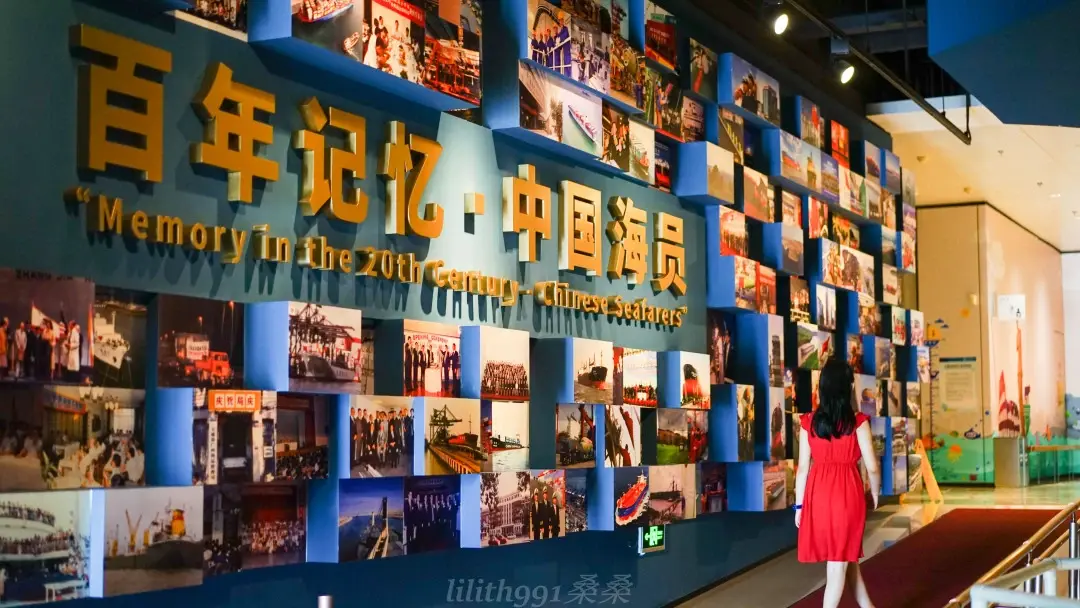
Walking past this wall with my kid, it’s like traversing a century of seafaring history.
The Shipbuilding Gallery mainly showcases modern ship structures and equipment, as well as shipbuilding techniques across different eras. Some ships have cross-sections, or bows, or whole-ship introductions, and details on engines and other components. From ancient times to the present, there are also different propellers on display.
Here you can even see the internal structure of a Type 033 submarine—really fascinating.
Why not try your hand at being the helmsman?
See what all these instrument panels are for, and what equipment is actually aboard a ship.
To truly look closely and enjoy everything here, you’ll need at least 4 hours.
The Navigation & Ports Gallery, Maritime Affairs & Maritime Safety Gallery, and Military Navigation Gallery each deepen your understanding of navigation and ports in different ways.
The Navigation & Ports Gallery is on the museum’s second floor, mainly displaying the marine environment and the various instruments and technologies that ensure safe ship travel.
From ancient khamal (a celestial navigation tool) to modern sextants, octants, and then radio and GPS—navigation instruments from all eras are on view.
For naval enthusiasts like me, the Military Navigation Gallery is a favorite. It’s divided into two major sections: the development of the Chinese People’s Liberation Army Navy and knowledge about warships. It displays many artifacts reflecting major historical events of the Chinese navy, with a great variety of ship models—even the Musashi, sister ship of the largest battleship ever built, the Yamato, which was sunk before leaving port.
Flags of various navies flutter here, quite spectacular.
There are also models like the destroyer Anshan, the guided-missile destroyer Jinan, and the guided-missile nuclear submarine Ohio…
Maritime Affairs & Maritime Safety Gallery
Made up of two exhibition areas: maritime affairs and maritime safety.
As for temporary exhibitions, a new one called “Jinghai Shenji” mainly about firearms just opened, and I plan to visit again. When I went, it was a joint exhibition by the China Maritime Museum, the Shanghai Ocean Management Affairs Center, and the Shanghai Archives titled “Port for the City, City Thriving by the Port: The Integration of Modern Shanghai City and the Sea.”
The exhibition has three parts: “A River and Sea Thoroughfare,” “A Shipping Metropolis,” and “Pioneering Spirit.” With nearly a hundred artifacts, documents, models, and other exhibits, it showcases the profound impact of the sea and navigation on Shanghai from multiple dimensions: shipping, economy, culture, urban construction, and citizens’ lives.
Shanghai municipal emblem, and a model of a sand boat.
Here you can not only learn about Shanghai’s history, but it’s also a great spot for photos.
Shanghai-style qipao dresses.
There’s a rickshaw; seeing it feels like stepping back into Shanghai’s 1930s golden era.
And icons like the Paramount Ballroom, a landmark of the city. Stand beneath the stage and capture your own silhouette.
Before you leave, don’t forget to write your name on the blackboard, witnessing the changing face of Shanghai.
Of course, it’s not just about looking—you can get hands-on and play, too.
For example, on the ground-floor waterfront platform, we encountered the Maritime Life Festival.
On the main stage of the festival, there were signal flag performances, sailor’s knot interactive sessions, and children’s nautical plays.
There were all sorts of games, fun for both big and small kids, and adults could join in too. I particularly recommend the “VR Rowing Challenge,” “Remote-Control Boat Experience,” “Giant Paper Boat Folding,” “Bottle Christening Ceremony,” “Navigation Maze,” and “Maritime Mini Triathlon.” My little one absolutely loved the remote-control boat and the bottle christening—she couldn’t stop playing.
Also, remember to get your passport stamped at each stop; you can exchange stamps for gifts. And if you complete all the activities, you might even win a set of a Liaoning aircraft carrier model! I was so envious.
By the way, there’s a model of the Liaoning right nearby.
There’s also a café and dining inside, so you can eat without leaving the museum.
Before you go, drop by the cultural and creative center.
The souvenirs here are distinctive, many ocean-themed—nautical chart series, “Chaozong Yuhai” (paying tribute to the sea) washi tapes, notebooks, hand-account books, Zheng He series penholders, and more, all incredibly charming and right up my alley.
There are also brass magnifying glasses and triple-folding telescopes, full of antique charm. I immediately bought them.
The China Maritime Museum is truly a treasure trove. My daughter’s classmate only found out about it after we got home and said she regretted not coming along.
We’re already planning to come back when there’s another special exhibition. Learning through fun!


