Yangpu New Jiangwan City Park – a Real ‘Gem’ for Lotus Viewing~
Summer is the season when lotus flowers bloom. 'Boundless green lotus leaves stretch to the sky, while sunlight turns the blossoms a distinct red.'
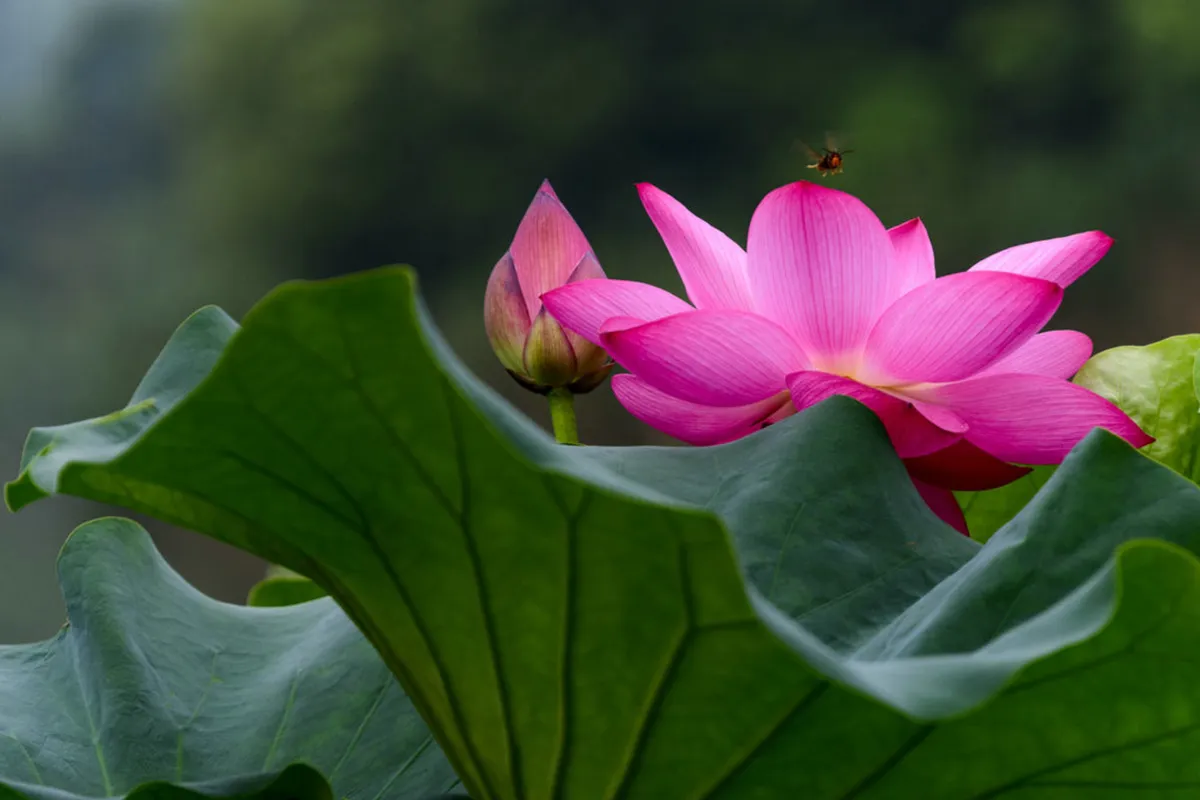
The vast, glossy green leaves set off the pinkish-white lotus blossoms.
The vivid petals look even more charming and fragrant.
Lotuses bathe in sunlight, swaying gently as if dancing.
Through the dappled shade of the leaves, thousands of flawless white blossoms seem to leap out of nowhere.
The air is filled with the subtle fragrance of lotus. 'A gust of wind sends emerald waves surging, pearls scattered, hard to gather.'
Sunlight sprinkles on the water’s surface; a soft breeze ruffles it into ripples.
Pearl-like droplets tremble on the delicate lotus leaves.
The lotus belongs to the water lily family and is a common name for two species of the genus Nelumbo. It’s also called water lily, water hibiscus, etc. The lotus is a traditional Chinese favourite. Its blossoms and leaves are elegant, its fragrance spreads far, refreshing the heart. It meets the blazing sun without fear and has the quality of emerging from the mud unsoiled.
In Buddhist legend, the Western Pure Land is filled with blooming lotuses. In Buddhist thought, dust represents worldly afflictions; the lotus’s ability to rise from mud cleanly breaks people’s attachment to those troubles, guiding the mind to eternal purity and oneness.
The lotus’s cleanliness captivates the Chinese eye for beauty—thanks to its special water‑repellent cuticle structure. Its spiritual symbolism has kept the Chinese love for it alive for 1,500 years.
Since ancient times, the lotus has been beloved by scholars and artists. Today it’s loved by all, appearing in lotus‑themed urban tourism festivals and summer lotus festivals everywhere, using the flower’s beauty to draw tourists, residents, and photography enthusiasts who come to admire and photograph lotuses.
The lotus blooms from June to September (peaking in July and August), and the best times to enjoy them are early morning and after rain.
When Shanghai locals think of lotus viewing, the first place that comes to mind is probably Guyi Garden, but many don’t know that admiring the graceful, breeze‑swayed lotuses at Yangpu New Jiangwan City Park is also a fine choice.
We had originally planned to visit Guyi Garden for the '2020 Lotus and Water Lily Exhibition', but we missed the entire exhibition period because of this year’s 'violent plum rains'—and the rainy season just wouldn’t end. So we headed to the nearby Yangpu New Jiangwan City Park to enjoy the lotuses there.
Shanghai New Jiangwan City Park is located in New Jiangwan City, which was once the site of the old Jiangwan military airport. As a former military installation, over sixty years of restricted access preserved the area’s original ecology: lush vegetation, crisscrossing ditches, and rich wildlife. It’s the only remaining original‑ecology wetland in urban Shanghai.
The name 'New Jiangwan' comes from the first great bend where the Huangpu River enters the estuary. The estuaries of the Yangtze and Huangpu Rivers happen to overlap right over the old airport and some adjacent plots.
Jiangwan is a thousand‑year‑old town, with 9,000 mu of prime land, crisscrossed by living water from the Huangpu River. It has deep historical and cultural roots: the famous Southern Song general Han Shizhong once garrisoned troops here; the renowned Jade Buddha Temple originally stood here; scholars Zhu Ziqing, Ye Shengtao, and Xia Yan founded the Lida Academy here. Because of this, Jiangwan was a bustling commercial hub in history—a coveted spot for merchants, famously known as 'Copper Jiangwan'.
The park has very few visitors; it feels quiet and relaxing—like a giant natural oxygen bar!
Walk straight in from the main gate, and soon you reach the lotus‑filled waters. The water surface is quite broad, and a waterside platform with steps gently curves around the lake in a graceful arc.
Affected by the violent and seemingly endless plum rains, this year’s lotus bloom wasn’t particularly impressive.
There are many small wooden platforms close to the water and plants. Approaching the lotus pond, what strikes you first is an endless sea of lotus leaves, like a green ocean.
Some leaves have just poked out tiny, tender tips—adorable.
Some have grown as big as a hand, swaying in the breeze, standing tall;
others have already become big jade‑like discs, full of life.
The leaves crowd together, like brothers and sisters, heart to heart, inseparable.
A gust of wind turns the 'green ocean' into rolling waves, leaves tumbling one after another—a stunning sight.
When the wind stops, the 'green ocean' falls calm again. Water droplets on the leaf surfaces roll around, sparkling like beautiful pearls. Truly, 'A gust of wind sends emerald waves surging, pearls scattered, hard to gather.'
The lotuses assume countless postures: Some are only a greenish‑white bud, bashful and about to speak.
Some are half‑bloomed, with a few petals fallen and others clustered around the stamen, like a beauty in disheveled clothes;
the fully‑opened ones dance gracefully like young maidens.
Gorgeous, full‑blown lotuses pass through their brilliant moment, and after the petals fall, they reappear as seed‑laden lotus pods.
There are also those where all petals have fallen, revealing emerald‑green pods whose holes look like tiny mouths shouting, 'I’m ripe, come pick me!'
Besides the elegant lotuses, little birds, frogs, dragonflies, and bees dart around the pond, adding extra delight and filling it with life.
The lotuses give off a fresh, subtle fragrance that attracts dancing bees—a joy to the eye.
Mischievous dragonflies flutter from flower to flower, playing happily with the lotuses. I was enchanted, feeling that each lotus before me was a graceful lotus fairy performing a dance.
'A little lotus bud just showing its pointed tip, a dragonfly has already perched upon it.' This line comes from the Southern Song poet Yang Wanli’s Little Pond. It expresses the poet’s love of life; through the spring, shade, tender lotus, and dragonfly, it paints a vivid scene of simple, natural vitality full of life’s charm.
Throughout the summer pond, dragonflies glide so elegantly. One flower, one world; one scene, one paradise. These beautiful dragonflies fly gracefully under the blue sky, like pretty nymphs displaying the allure of beauty and proclaiming the brilliance of life this summer.
'A little lotus bud just showing its pointed tip, a dragonfly has already perched upon it.' So the poet’s heart gave forth wonderful musings and beautiful verses; thus the dragonfly flew into Tang and Song poetry. In June’s dawn and dusk, dragonflies hover over the lotus pond—on the tiny tips, on the emerald leaves—bobbing, glancing about, skimming the water, playing to their heart’s content.
Dragonflies are invertebrates of the phylum Arthropoda, class Insecta, subclass Pterygota, order Odonata, suborder Anisoptera, divided into dragonfly families and darner families. Dragonflies can be divided into the Anisoptera (true dragonflies) and the Zygoptera (damselflies). They are one of the most ancient insects; fossil dragonflies over 60 cm long prove they have existed on Earth for more than 100 million years.
Dragonflies have more eyes than any other insect. Their eyes are huge and bulging, occupying most of the head, with three simple eyes and compound eyes made of about 28,000 tiny facets. Their vision is excellent, and they can look up, down, forward, and backward without turning their heads. What’s more, their compound eyes can judge speed. When an object moves in front of them, each tiny eye reacts in sequence, and the information is processed to determine the target’s speed. This makes them ace predators in the insect world.
Unlike many other insects, dragonfly eggs hatch in water, and the larvae live in water. So 'dragonfly skimming the water' is actually egg‑laying. The female dragonfly touches the water surface with the tip of her tail during flight to release eggs. The common scene we call 'dragonfly skimming' is her egg‑laying performance.
Dragonflies are typical hemimetabolous insects: they go from larva to adult without a pupal stage. They have only three life stages: egg, nymph, and adult. Nymphs are aquatic, while adults are terrestrial flying insects. Every time I read 'A little lotus bud just showing its pointed tip, a dragonfly has already perched upon it,' an image of dragonflies dancing over a lotus pond comes to mind.
'A little lotus bud just showing its pointed tip, a dragonfly has already perched upon it.' 'Boundless green lotus leaves stretch to the sky, while sunlight turns the blossoms a distinct red.' The lotuses face the sun; leaves and blooms embrace. Those already open blaze with the most gorgeous beauty under the fierce sun, sending out a delicate fragrance that lifts the spirit. Perhaps the most vibrant place in summer is this blooming lotus pond—home not only to beautiful flowers but also to dancing dragonflies.
Indeed, dragonflies are the dancers of the lotus pond. The lotus is still; with a dragonfly, the frozen landscape comes alive. Dragonfly skims, lifting ring after ring of ripples. Perched on a bud, it makes the flower sway lightly. Movement and stillness play a harmonious melody. The red‑gold of the dragonfly’s wings, the green of the leaves, the elegance of the lotus—they together form a unique vista.
A dragonfly is like a tiny aircraft, light and nimble, flying freely through the air, sometimes even hovering like a helicopter. Its flying skills are truly astonishing—no wonder it’s called 'little overlord of the skies' or 'king of flight'. It can make a 180‑degree hairpin turn with a slight quiver of its wings while tracing a figure eight.
In my mind, the dragonfly is the finest pilot and dancer. Its flight speed is incredible, 5 to 10 metres per second, and in a high‑speed sprint it can reach tens of metres per second while flying for long stretches. If dragonflies raced bees or butterflies, the dragonfly would surely be champion.
'Like a flower unfolding its wings, beautiful dragonfly, light‑bodied, paired with lotus. Love lingers on the red, thin shadows fly; affection pours on the green, graceful shoulders lift. Tilting to skim the water, playing ripple strings; spreading wings to ride the breeze, carrying thoughts. Drunk with ripples, a pleasant dream born; hovering devotedly around the bloom, trusting its heart.' Yes, the lovely lotus pond and the many‑postured dragonflies: in the song 'Dream‑Drunk Lotus Pond,' the dragonfly shows off its 'water‑walking' skill, performing a ballet on the water—truly, lovely lotus charms the dragonfly, dancing enchantingly, teasing the rosy rainbow.
In the pond there are also damselflies. Damselflies (Caenagrion) belong to class Insecta, order Odonata, suborder Zygoptera, commonly called 'cōng'. They are small and delicate, resting with wings folded above their backs. Common types in our country include large and small species. They are slender, weak‑flying insects, resembling small dragonflies but not the same.
Damselflies are brightly coloured carnivorous insects with long, slim bodies; their compound eyes are well‑developed on the sides of the head; they have chewing mouthparts and bristle‑like antennae. Forewings and hindwings are similar in shape, wing‑vein cells square, and the wings have stalks. Like dragonflies they belong to the order Odonata, but when resting damselflies hold their wings together lengthwise, and all four wings are nearly identical in size, whereas dragonflies’ hindwings are slightly longer and broader than their forewings. Most are smaller than dragonflies, the smallest being 1.5 cm and the largest up to 6–7 cm. Because of their graceful form, vivid colours, and variable wing colours, they are loved by enthusiasts worldwide.
When you see 'damselfly skimming the water' by the edge, it’s because the female damselfly, like most dragonflies, lays eggs by touching the water surface—usually releasing them into the water. Some use an ovipositor to inject eggs into submerged aquatic plants or plant stems. Some swim along plants to insert eggs into stems underwater. Since damselfly nymphs live in water, most females habitually rest on stones and debris at the water’s edge, like the short‑bellied damselfly. As with dragonflies, the male’s reproductive organs are on his abdomen, while the female’s are at the tip of her tail. During mating, the female bends her abdomen to reach the male’s organs.
In the river, a family of common moorhens—one parent and four chicks.
Common moorhen: order Gruiformes > family Rallidae > genus Gallinula. Also called red‑crowned moorhen, red‑bone top, red bird, or river chicken, it is a medium‑sized wading bird. Overall mainly black. Bill red with a yellow tip, legs green. Found worldwide, wintering south of latitude 32° N. Often seen in lakes, ponds, and canals; poor fliers, they need a long run‑up on the water before take‑off. The common moorhen is listed as a nationally protected species (Three‑Have list).
Moorhen chicks are black, with a small bare patch of flesh‑colour on the crown, red bill with a yellow tip. (Most rail family chicks are entirely black.)
Juvenile and sub‑adult moorhens turn greyish‑white, with grey‑brown upperparts, very different from the fully black adults. Flight feathers are dark brown. Throat greyish‑white, upper breast chestnut‑brown, lower breast and belly greyish‑white. The bill is duller, with no red crown.
Adults revert to black, with a red crown.
I hope the babies grow up quickly; I took several more shots.
On the other side of the lotus pond, another moorhen—I wonder if it’s related to that family of five.
Standing on one leg, dozing.
In the lotus pond there are spot‑billed ducks.
The spot‑billed duck (Anas poecilorhyncha) is a large duck, similar in size to the mallard, 50–64 cm long, weighing around 1 kg. Male and female plumage is alike. Upper bill black with a yellow tip, legs orange‑yellow. Face to upper neck sides, lores, supercilium, chin, and throat are pale yellowish‑white, appearing white from a distance, in marked contrast to the dark body. Typically they inhabit freshwater lakes, also gathering in groups on rivers, reservoirs, bays, and coastal salt pans. Their toes are webbed but they seldom dive; when swimming the tail is held out of the water. They are skilled at foraging, playing, and courting in water. They enjoy cleanliness, often preening and grooming on water or land, and keep watch for each other while sleeping or resting. They mainly eat plants, but also take invertebrates and crustaceans. Distributed in southeastern Siberia, eastern Mongolia, Sakhalin, China, Korea, Japan, Indochina, Myanmar, India, Nepal, Bangladesh, Sri Lanka.
Water striders are aquatic hemipteran insects, order Hemiptera, family Gerridae. Scientific name Aquarius elongatus. They live on still water surfaces or gentle streams. Body is long and very light; front legs short, used to catch prey; middle and hind legs long and slender, covered with oily hairs that repel water. Colour dark brown, body length about 22 mm. They can also survive on land for a while.
The platform in the northeast corner is closest to the flowers and birds. I met a photographer who had come specially to shoot birds, with tripod and gear bag; he stood in that spot all afternoon, delighted with the wonderful moments he captured. That sort of life, when you think about it, is wonderfully peaceful and beautiful.
In the green areas, hibiscus flowers bloom.
The hibiscus is the national flower of South Korea, also called the 'mugung' (endless) flower. Many Korean people have the character '槿' in their names—I wonder if there’s a connection with hibiscus? The hibiscus’s flower language is 'gentle persistence'. It blooms at dawn and falls at dusk, but each withering is for the sake of blooming again even more brightly.
On the hibiscus tree, a 'pazha'—a term people from Henan use for cicada larvae, considered a delicacy in Henan, Shandong, Hebei, and other regions. The main producing areas are now Henan and Shandong, but in recent years more and more places have joined the feast, leading to lower yields and rising prices.
The pomegranate trees are laden with fruit.


