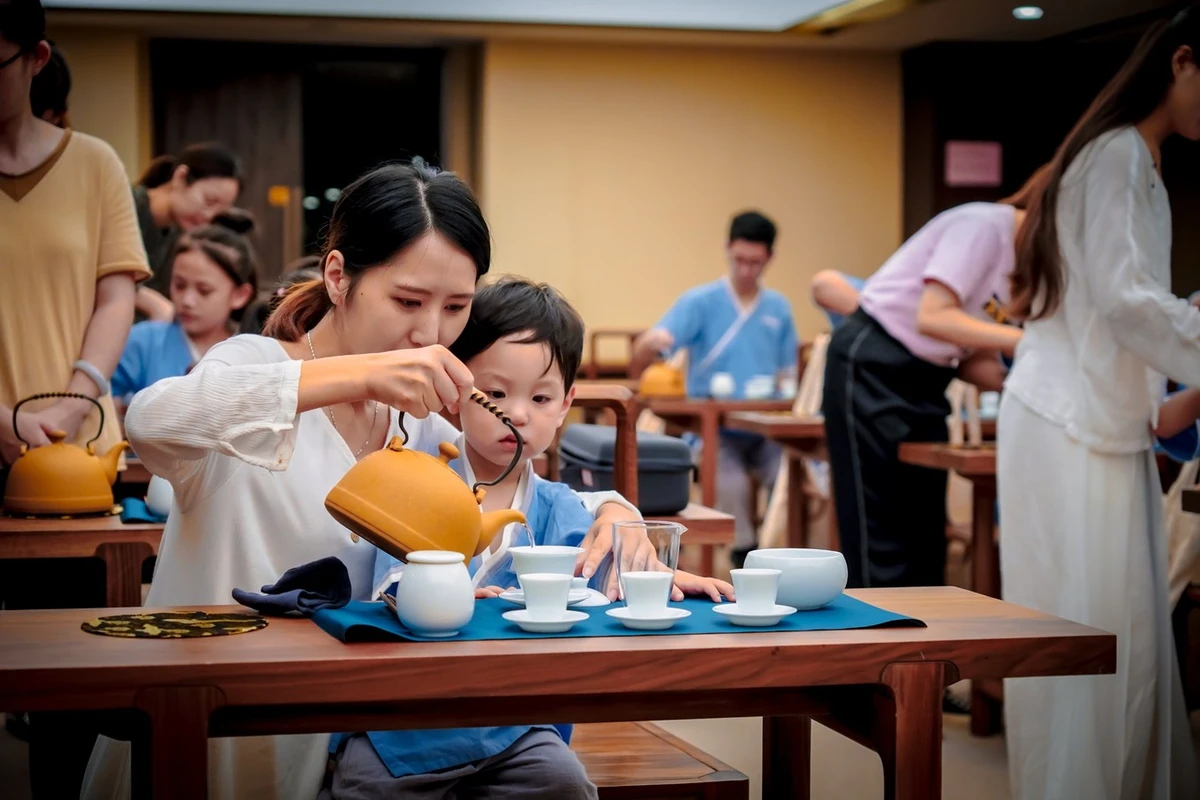
Planting a Seed in a Child’s Heart – A Two-Day, One-Night Kids' Tea Ceremony Journey
“Mom, where does tea come from?”
“A leaf, falling into water, changed the taste of the water, and from that moment, tea was born.”
Perhaps it’s an obsession with traditional Chinese culture. Whenever I plan outings with my child, I always try to weave in elements of Chinese heritage. So when a friend invited us for tea, I gladly accepted. China is the homeland of tea, and naturally, I wanted to plant a tiny seed in his heart from an early age—waiting for it to slowly sprout and fill the air with the fragrance of tea.
And so, a journey tracing the traditions of Chinese tea etiquette began. It was a two-day trip. More than teaching my child about tea, I hoped he would learn about courtesy. The rituals of tea and Chinese etiquette are intertwined. For me, I wanted my child to train his focus through hands-on tea practice, and at the same time, add a layer of cultural refinement.
In the morning, we left downtown Shanghai. About an hour’s drive, and we arrived at Taihui Life Culture Garden. As a Shanghai native, I was surprised I’d never heard of the place. But once inside, I was amazed—this is truly a hidden gem in the city. I regretted not discovering this earthly paradise sooner.
The moment we drove in, the antique charm of the whole cultural garden captivated us. Jingang Museum, Mingyue Tea Fairy, ancient architecture, a world of colored glaze... Here, traditional Chinese culture is gathered in one place. From art exhibitions to tea culture to historic buildings, blending tea, Zen, and artistry, the garden feels like a sanctuary for cultural and artistic cultivation.
We drove straight to the hotel. Tai Hotel is part of Tehui Life Culture Garden, and the children’s tea etiquette class is also held here, so it was very convenient.
Stepping into the hotel lobby, the modern Chinese design is simple yet elegant, and the whole air is scented with tea. Tea culture elements are everywhere in the room—from small things like tea-scented fragrance and tea soap to larger decorations like tea wares—bringing the refined elegance of Chinese tradition to life.
At the front desk, we picked up the course materials, and to my surprise, there was a set of tea ceremony robes for the kids. In the room, I changed my little one into the robe, officially kicking off our two-day, one-night children’s tea ritual journey.
Tea Etiquette – The Rites Chapter
Before the class started, children trickled in one after another, all dressed in their tiny tea robes. They had already sneaked into the classroom and started playing. For them, this wasn’t just a class—it was a place to make friends. Children are so innocent; after a few rounds of chasing each other, they were all warmed up.
The class began punctually at 10 a.m. The teacher called them to line up outside the classroom. The students, from short to tall, formed four neat rows, all in tea robes with their little backpacks—quite a ceremonial sight.
But getting into the classroom wasn’t that easy. In everything, courtesy comes first. As a land of rites, China places great importance on etiquette, especially during tea-related activities. So “tea etiquette” became their very first lesson. And the bow was the first gesture they learned. A bow, literally meaning to bend the body in salutation, is a formal way to show respect. The children mimicked the teacher’s movements, bowing and cupping their hands. Though not perfectly synchronized, they did it with real earnestness.
Once the children had a basic grasp of the bow, the door to “children’s tea ceremony” officially opened. The teachers took each child by the hand and led them into the classroom one by one to take their seats. The children sat at their places, while parents could observe from a nearby area. Our group ranged from under 2 years old to 16, so multiple teachers were assigned. Influenced by tea culture, all the teachers spoke softly and gently, caring for each child with grace.
Many were first-timers, but some had already been here two or three times. Those parents had also planted a small seed of tea culture in their children's hearts long ago, and now that it was beginning to sprout, they came for deeper learning. The newcomers were full of curiosity, their eyes brimming with excitement. The teachers said that students who performed well in each segment would receive paper slips; three slips could be exchanged for a specially prepared tea bag. The reward system worked wonders on the kids—they became even more eager.
First Scent of Tea – Discovering Tea
She walked onto the platform in a plain-colored dress, her long hair flowing to her waist, steps light and graceful. The children gasped, “Wow! It’s the Tea Fairy!” The regulars of the etiquette class recognized her first.
She gave a gentle smile. Every gesture exuded poise and elegance. True to her name, the Tea Fairy: when she lifts a teapot, she is as graceful as a celestial being. But once she puts it down, she seems to descend back to the human world, more like a mother, mingling warmly with the kids.
The children stood by their desks and bowed to the Tea Fairy with the bow they had just learned.
This session was a tea recognition class. The kids took out a book from their backpacks: 《Tea Fairy | The Joy of Drinking Tea》, written by the Tea Fairy herself. Easy to understand with cute illustrations, the children read it like a picture book.
Starting from a single leaf, Teacher Tea Fairy led the children into the colorful world behind tea.
Some might wonder: can children really understand tea culture when even adults barely scratch the surface? I had my doubts before coming. But seeing the kids answer the Tea Fairy’s questions fluently, I realized their potential is truly boundless.
From over 700 aromas of tea leaves to the five basic flavors, and then to tea varieties, they grasped it all in a surprisingly short time. To make the book knowledge more vivid, the Tea Fairy brought six types of tea: green, white, yellow, oolong, black, and dark tea, and invited the children to identify them on stage.
She also personally brewed green, yellow, and black teas for the children to taste. I didn’t know whether tea nourished her or she softened the tea, but the tea she brewed always carried a delightful fragrance.
The tea scent clung to the gaiwan. The Tea Fairy let the aroma flow past the children’s noses. Smelling it for the first time, they couldn’t help exclaiming, “So fragrant!”
Smelling the tea, observing the liquor’s color—the interactive session clearly fascinated the kids. The only exception was my two-year-old, who was starting to get a bit restless. But luckily, lunchtime was near.
At noon, we ate at the hotel restaurant. The dishes were carefully designed for the children: a balance of meat and vegetables, well-suited to their tastes. The power of environment is striking. Surrounded by older brothers and sisters, my little one, who usually refuses to eat by himself, actually picked up a spoon and ate happily, bite by bite.
After lunch, we returned to the room for a nap. A nice sleep, and then off to the afternoon class. Meanwhile, the Tea Fairy was sitting at the tea table, planting a little seed of tea culture in each child’s book.
First Encounter with Tea Wares – The Arrangement Chapter
“Brewing tea is lifting the pot with earnestness five hundred times, so you can set it down with grace just once.” These were the words the Tea Fairy gave the children.
If the morning was all theory, the afternoon was all practice. The children, now with a basic knowledge of tea, had their own name tags and a new identity: little tea fairies.
Each child received a tea set, which became their treasure, and they carried it carefully back to their seats. The Tea Fairy explained and demonstrated the basic brewing procedures and etiquette on the podium.
Slowly, she scooped tea leaves into the gaiwan, poured water, lifted the kettle, let the leaves steep, then poured the tea… everything flowed seamlessly like clouds and water. Every move revealed the gentle, graceful Oriental temperament.
As I watched from the side, I suddenly realized how much nuance lay behind these seemingly simple tea art steps. The amount of tea, the water temperature, the steeping time—all affect the flavor of the tea.
When the children eagerly opened their tea sets, parents were asked to assist their own children on site. The first thing to learn was the arrangement of the tea utensils. For practice, the teacher prepared cold water, so the novice children didn’t have to worry about getting burned.
The Tea Fairy chose Phoenix Dancong ‘Yashixiang’ (Duck Shit Aroma) for the kids. The odd name is as precious as Kopi Luwak coffee. Seeing the good tea being handled clumsily by the children, my heart did ache a bit. But the Tea Fairy explained that she wanted their taste buds to capture the tea’s aroma and memorize this first impression, so that later they would have a benchmark for discerning tea quality. Phoenix Dancong is known for its fragrance; even cold-brewed, its scent still bursts out, making it perfect for this.
When the children focused on the world of tea art, the whole world grew quiet. Their dispositions softened, their minds calmed. Their concentrated little expressions turned them into true tiny tea fairies. Though still somewhat childish, the teachers would personally come to each child, correcting and guiding their brewing procedures and hand gestures.
My little Kaikai also imitated the movements solemnly. After brewing, he didn’t forget to smell the tea, then took a small sip and said in his milky voice, “Fragrant!”
Brewing tea is no easy task, just as the Tea Fairy said: “Brewing tea is lifting the pot with earnestness five hundred times, so you can set it down with grace just once.” To achieve an elegant and poised demeanor, practice is the only choice. And for a child, repeating the same movements soon made their arms a bit sore. So the mid-session break became a wonderful breather. Every day, the children looked forward to what new snacks would appear. After eating, they had time to play together; the rest area was filled with happy chatter.
Parent-Child Party – The Interaction Chapter
The evening was dedicated to parents and children. How long has it been since you put aside work and quietly accompanied your child? This moment, let time secretly pause before you.
Each child was like a sprite with hidden talents, taking the stage with natural poise. From poetry recitations to singing and dancing, they could perform several acts in a row. My two-year-old—I thought he was too young, so I didn’t sign him up. But he got upset and insisted on getting the microphone from the teacher, eager to show off his skills on stage.
These children put on a whole show by themselves. The parents in the audience beamed with joy. It was a performance dedicated to their parents, and to their own childhood.
Journey of Awakening – Reading the Tea Classic
The next day’s class moved to Jingang Museum, one of the biggest highlights of the entire garden. Unlike ordinary museums, it’s the largest private museum in Shanghai. The museum comprises ten exhibition halls: Modern Masters Hall, Oil Painting Hall, Ancient Stone Carving Hall, Study and Antique Hall, Glass Art Hall, and more. It houses over 40,000 rare collections, including paintings, calligraphy, and sculptures.
The children’s morning class started in one of those ten halls—the Mingyue Tea Museum. Walking in, the strong Chinese national style felt like opening a history book of Chinese tea. From natural civilization and craftsmanship civilization to its evolution and development, everything was displayed in the most intuitive way before the children.
From tea tables and tea utensils to tea leaves, the children gained a new understanding of tea culture, realizing just how many intricacies tea art holds.
Passing through the tea’s evolutionary civilization exhibition area, we arrived at the Awakening Zone, which showcases the natural civilization of Chinese tea. It gathered ancient tree tea samples from over a hundred tea mountains. Each tea had crossed mountains before reaching a tea lover’s hands. More than a cup, it’s a vessel of China’s tea-land natural civilization.
The children sat on the floor, surrounded by tea culture, sitting still, smelling the tea, feeling the life of tea. Led by the teacher, they read aloud together from China’s most famous tea classic, The Classic of Tea. To the children, it was a bit tongue-twisting and obscure, but at that moment, they all calmed their minds and read along. Even if they couldn’t fully understand the meaning, the cultural atmosphere had already imprinted a mark of tea culture on their hearts. And for us listening on the side, it was perhaps another profound awakening. This was not just a tea etiquette class for the children; it also let parents set aside the worldly noise and quietly feel the wisdom of tea art and Zen.
Cultivating the Delicate Heart – The Tea Serving Chapter
After the reading, the young learners returned to the classroom with the Tea Fairy to continue practicing the tea ceremony brewing, preparing for the graduation performance in the afternoon. The children had the process memorized, but to truly embody elegance and propriety still took many more practices.
The day before, they had all used cold water. Today, the difficulty was raised: older children could choose to use warm or hot water to brew tea, as the right water temperature releases the tea’s aroma. Eager to brew good tea, the kids were all chomping at the bit.
My little Kaikai was rarely so focused. His tea preparation and serving had quite the style. When this old mother drank the tea he offered, I felt deeply gratified.
At 2 p.m. was the graduation performance of the youth tea etiquette training. The young learners would take turns on stage to demonstrate tea preparation and serving. The children transformed into little tea fairies, fully showcasing the knowledge and skills they had learned over the two days.
They were divided into small groups and took the stage one by one. Sitting upright before their tea sets, they tried their best to imitate the Tea Fairy’s graceful posture. From the opening bow and cleaning the utensils to brewing, every tea ritual was infused with full concentration—this is also the way to cultivate the composed stillness of a tea person.
The Tea Fairy sat in the audience, quietly watching these young learners’ every move, occasionally reminding them to hold their posture properly, and offering each child suggestions and encouragement.
Each child served two cups of tea: one to the Tea Fairy, and the other to their own parents. When the children lifted the tea to eyebrow level, offered it to their parents, and softly said, “Please have tea,” the pride and joy in the parents’ hearts were beyond words.
Finally, the most touching moment: the classroom lights dimmed, and on the big screen appeared a montage of each child’s moments over the past two days. One by one, the children went on stage to share their feelings.
If the children’s expressions were still a bit naive, then the parents’ confessions were the highlight summary of these two days. Some of us, because of work, don’t spend much time with our children; others always hold our children in the palm of our hands, underestimating their abilities. One mother said that at home, she never dared let her child touch hot water, afraid of spills and burns. But today, when she lifted the teapot and poured out cups of fragrant tea, the child’s potential proved limitless. Each parent witnessed their child’s transformation and growth during these two days.
I brought my two-year-old Kaikai here, originally just hoping he could feel the atmosphere of Chinese tea culture and gain a bit more discipline and restraint. But to my surprise, he actually learned the whole brewing process. Though his hands are still small and he can’t yet handle the gaiwan skillfully, he has already started secretly imitating. From running wild all over the classroom at the start to now quietly sitting in a chair brewing tea—the classroom environment and the cultural vibe of tea etiquette have already spread in his tiny heart.
After the graduation performance, every young learner received a certificate of completion for the youth tea etiquette training. For the children, it was not just a recognition, but also an expectation. Although the children’s tea etiquette course lasted only two short days, the “tea” seed planted in their hearts is deeply rooted. What grows from it is not just a “tea” tree; it carries within it the essence of Chinese rituals.
After the graduation performance, every young learner received a certificate of completion for the youth tea etiquette training. For the children, it was not just a recognition, but also an expectation. Although the children’s tea etiquette course lasted only two short days, the “tea” seed planted in their hearts is deeply rooted. What grows from it is not just a “tea” tree; it carries within it the essence of Chinese rituals.
My phone’s WeChat by the computer kept buzzing. Though the course had ended, the children’s passion for tea hadn’t waned. The tea sets they brought home are taken out every day for practice, brewing a cup of tea. A tiny seed is sprouting in their hearts...


