November 2013 – Suzhou, Kunshan
Before we knew it, November had arrived and the autumn wind turned cold. Without a long holiday, we decided to use the weekend to explore nearby. As the saying goes, 'Heaven above, Suzhou and Hangzhou below.' Our target was Suzhou. I arranged with Miss Ling and we clicked immediately. Renting a car for a short self-drive trip was casual and relaxing.
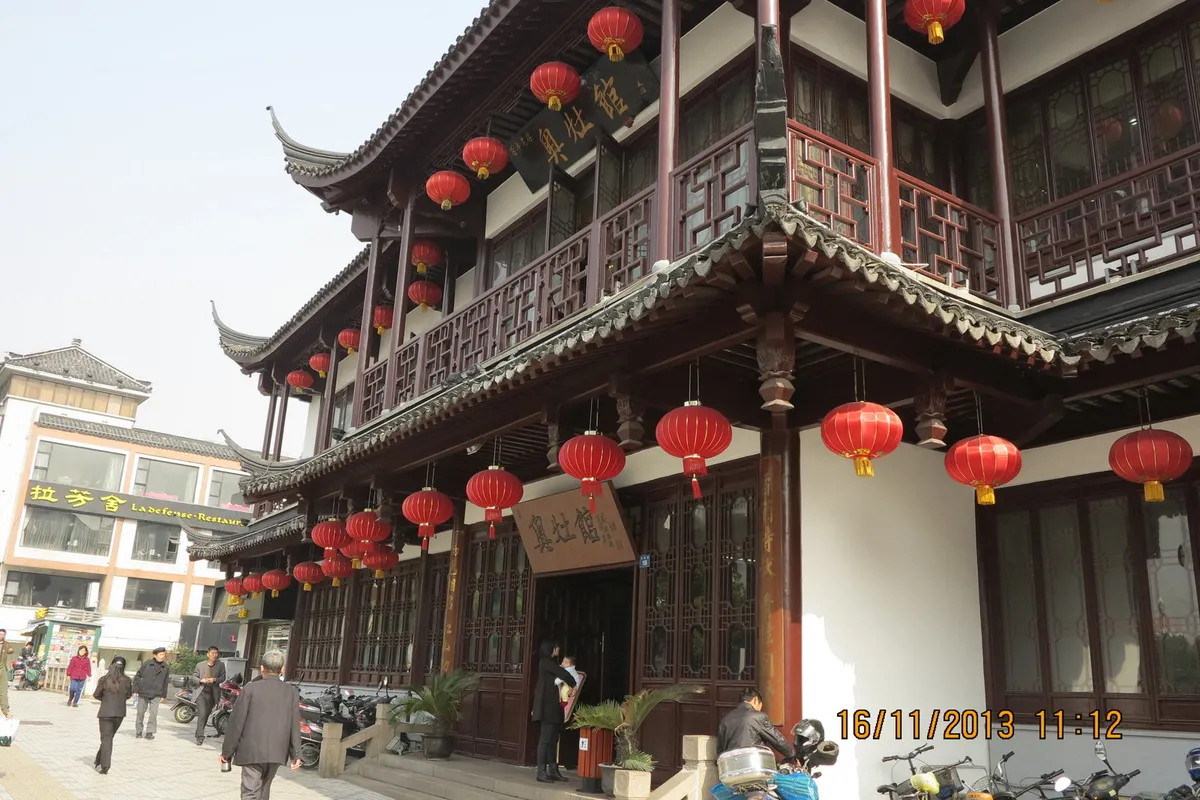
We set off early in the morning. Despite a minor hiccup with refueling the rental car, everything went smoothly. Our first stop, as decided by Miss Ling, was Aozhaoguan in Kunshan for breakfast. The highway wasn't too congested; we only queued for a bit at the toll gate, and arrived in Kunshan before the midday rush. Kunshan is no stranger to most Shanghai people. Aozhaoguan is located at the South Gate of Kunshan Tinglin Park (Gu Yanwu's literary name was Tinglin), by the Banshan Bridge. It's the oldest traditional noodle house in Kunshan. Legend has it that the owner had poor eyesight, so his noodles were a bit unclean, and old customers jokingly called it 'aozao noodles'.
'Aozao' is a local Kunshan dialect meaning 'not very clean'. Who knew that this strange name would actually help it spread quickly. The noodles were Su-style: fresh broth and smooth texture. We ordered a 'four-topping noodle' directly. The shop was packed with people. We ate heartily, feeling quite satisfied.
After eating, we drove straight to Suzhou, a few dozen kilometers away. With the GPS guiding us, our first stop was Huqiu (Tiger Hill). Both Miss Ling and I, her secretary, had visited Huqiu as children, but our memories had faded. In the last century, for Shanghainese, Suzhou was the absolute top choice for family trips with kids or for tomb-sweeping ancestors during Qingming. This time we came to Huqiu to see the Huqiu Pagoda and relive the Sword Testing Stone, which we vaguely remembered. Huqiu is not large. Before entering the scenic area, the roadside was already surrounded by wedding dress shops—this is the famous Wedding Dress Street. Legend has it that King Helü of Wu was accidentally wounded in the Battle of Zuili against the Yue Kingdom, and he died soon after. His son, King Fuchai, buried him here. Three days after the burial, a white tiger appeared on the tomb, so the place was named 'Huqiu' (Tiger Hill). Passing through the memorial archway inscribed 'The Foremost Scenic Spot in Wu', the Huqiu Pagoda came into view. Crossing the small river at the entrance, we entered the scenic area.
It is said the hill here is only 36 meters high. Upon entering the scenic area, free guides were available—the service in Jiangnan is quite considerate. Walking along, we caught faint glimpses of childhood memories: the Hanhan Well, the Sword Testing Stone. Listening and looking around was rather pleasant. The Sword Pond before the Qianren Stone exuded mystery; it's said there are three thousand swords at the bottom. Climbing the steps, we reached the Twin Wells Bridge. Looking down at the Sword Pond through the twin wells on the bridge made me a bit vertiginous. After crossing the bridge, we arrived at the core of Huqiu: the Huqiu Pagoda. The pagoda is actually called Yunyan Temple Pagoda, and it looked a bit dilapidated. It is an octagonal, imitation-wooden, seven-story brick pagoda in the pavilion style, and the only surviving multi-story building in Jiangnan originally built during the Five Dynasties period. Because half of the pagoda's foundation was on sand and half on rock back then, the top of the pagoda now tilts north-east. It is said that even before completion, it was already leaning to the northeast. Standing for a thousand years, it is known as China's 'Leaning Tower of Pisa'. Standing beneath it, the slant felt enormous. The ancient pagoda's charm is something modern architecture cannot rival.
Huqiu is small. We took photos, admired the ancient pagoda, and ticked off our visit. Leaving Huqiu, we drove straight to Zhuozheng Yuan (Humble Administrator's Garden), the most renowned Suzhou garden. Miss Ling said she had never been here, and now that it's a World Heritage site, she definitely wanted to visit. As her secretary, I had only been here in primary school. In the heart of the city center, parking was extremely tricky. Thankfully, we managed to enter Zhuozheng Yuan without a hitch. Admission was 50 yuan in the off-season, and free guide service was available. Zhuozheng Yuan was built in the fourth year of the Zhengde reign of the Ming Dynasty. It is one of the four great gardens of China. Originally the residence of Tang Dynasty poet Lu Guimeng, it became Dahong Temple in the Yuan Dynasty. During the Jiajing reign of the Ming, censor Wang Xianchen, frustrated in his official career, retired to Suzhou and bought the property. He hired Wen Zhengming to participate in designing the blueprint, and construction took 16 years. Soon after the garden was completed, Wang Xianchen died, and his son lost the entire garden in one night of gambling to the Xu family, who were then the owners of Liuyuan (Lingering Garden). Today, Zhuozheng Yuan covers 70 mu (about 11.5 acres) and by the late Qing Dynasty had formed three relatively independent smaller gardens (East, Middle, and West). Walking along while listening to the guide's explanations, we passed through corridors and courtyards, all delicate and elegant. From a small lake, we could see Suzhou's Beisi Pagoda. The government's protection of Suzhou's old city forbids buildings higher than three stories of Beisi Pagoda, making the whole city look very pleasant. In the garden, the original Ming Dynasty design in the eastern part felt more enchanting, while the Qing Dynasty additions seemed a bit inferior. Strolling through the double corridors and viewing the rockeries, ponds, and pavilions—it's hard to describe this kind of Jiangnan garden in words. My impression is that it takes a simple courtyard and complicates it: no path is straight, no window lattice pattern repeats, with alternating heights and intriguing charm, yet without appearing cluttered. After circling around, Miss Ling wondered why there was no residential area for the master. The guide explained, 'This part is just the garden area; the living quarters were separated and are now the Suzhou Museum and the Prince Zhong's Mansion (Taiping Heavenly Kingdom Prince Zhong's Mansion).' Probably the original appearance is gone. Fortunately, the garden is the main attraction—even the emperors in the far north adored these gardens, and imperial gardens in the capital copied Jiangnan gardens everywhere.
Exiting Zhuozheng Yuan, we walked just 200 meters to Suzhou Museum. The exhibits there weren't particularly outstanding, but the museum building itself is quite impressive, designed by I.M. Pei. It is said that Pei is a native of Suzhou, from a prominent family, and he lived for a time in his childhood at the Lion Grove Garden. As one of the world's top architects today, it's a way of giving back to his hometown. Naturally, to complement the garden designed by Wen Zhengming, only the master Pei could pull it off.
Suzhou Museum retains the white walls and black tiles typical of Suzhou, blending modern elements with classical gardens perfectly. The interior spaces and natural lighting are both rational and comfortable. As a layman, I could only admire the spectacle. Leaving the museum, we walked through Prince Zhong's Mansion, thus completing our tour of the Zhuozheng Yuan area.
Driving across downtown Suzhou was an incredibly painful experience. The ancient city is crisscrossed by many small waterways, with almost no through roads. Plus, due to government protection, there are basically no wide streets. We just followed the GPS as it guided us through twists and turns, slowly reaching the hotel. We chose the Nanyuan Hotel because it's the only hotel where you can stay in a Suzhou garden villa. As it was getting dark, we decided to explore the hotel the next day. After parking, we set out to Songhelou Restaurant for dinner. On Taijian Lane, we were surprised to find that a wealthy tycoon had booked the entire Songhelou. So we had to try the opposite Deyuelou Restaurant. Deyuelou, with its very small frontage, became widely famous thanks to the 20th-century film 'Little Deyuelou'. We took a number and queued; amazingly, despite two wedding banquets and one birthday banquet going on, they still served individual diners. After a short wait, we got a table. The interior was huge, almost labyrinthine. We ordered squirrel-shaped mandarin fish, sizzling eel shreds, and jujube paste cake—all exquisite. We couldn't finish everything and packed the leftovers, even taking the fish head. The mandarin fish sauce was incredibly delicious: slightly sour, slightly sweet, and not greasy at all.
The only regret was that the waitstaff were mostly from out of town, and the diners were also outsiders. We didn't hear the soft, mellifluous Suzhou dialect; instead, it was all Shanghainese and Mandarin. After eating, we went out onto Guanqian Street and only heard two city management officers speaking the sweet Wu dialect.
We said nothing of the night. The next morning, we got up, had the hotel breakfast, and started exploring the Nanyuan Hotel grounds. First, we visited the former residence of Chiang Wei-kuo, a three-story villa, elegant and still available for guests to stay. The top floor has only one room, likely priced steeply. Next to the villa is the site of Lin Biao's Project 571, smaller than the 704 Project in Hangzhou but similar in layout. We walked around, then passed through an underground tunnel that leads directly to the swimming pool area.
Leaving the 571 secret passage, not far away was Mingxuan, known as the 'Little Wangshi Yuan (Master of Nets Garden)'. The courtyard was small but complete with rockeries, a tiny lake, corridors, and pavilions—a classic Suzhou garden. Inside the lakeside pavilion, a banquet table could be set; it's said many officials have dined here, and the banquet is famed as 'the No.1 Wu-style banquet'. After Mingxuan, we strolled around the hotel's scenery. A short distance away was Shanqing Zen Temple, a small temple we casually looked around, thus finishing our hotel tour.
The hotel gave us two tickets to Hanshan Temple, so we went to check it out. The road wasn't too congested. Both Miss Ling and I had been to Hanshan Temple before. Its fame doesn't come from ancient relics but mainly from Zhang Ji's poem 'Mooring at Night by Maple Bridge'—that's indeed a super-effective advertisement! Added to that, the Japanese have a high regard for the temple, making it Japanese territory every New Year's Day. The slots for striking the bell are booked by Japanese long in advance, and locals can't get a chance. Standing on the stone bridge in front of the temple, we sensed the poetic mood of Zhang Ji's ancient verse about Maple Bridge. We passed the screen wall and entered the temple, where incense burned vigorously. For five yuan, we climbed the bell tower and each struck the bell three times, praying for peace and safety.
Hanshan Temple isn't very large, and most buildings are modern reconstructions. With plenty of time, Miss Ling fed the fish and watched the devotees praying. We viewed the Guanyin Peak Taihu stone, then exited through the back gate back to the parking lot, picked up our car, and headed straight to the nearby Liuyuan (Lingering Garden).
Liuyuan is smaller than Zhuozheng Yuan and less famous, with far fewer visitors. We missed the free guided tour that departs every half hour, so we rented an electronic guide to start our visit. Let me say, this guide device was very advanced; it even displayed corresponding images. Suzhou gardens are so refined that the guide played almost non-stop, and it was extremely useful. Although Liuyuan isn't as renowned as Zhuozheng Yuan, it is actually equally famous: a key national cultural relic protection unit since 1961, one of China's four great gardens, and a World Heritage site. The only slight difference may be that Liuyuan was allegedly modeled after Zhuozheng Yuan, but both have profound cultural depths. With fewer tourists, there was no noise like in Zhuozheng Yuan. Miss Ling spent a lot of time among the pavilions, terraces, and rockeries. The garden boasts the largest living hall in Jiangnan, enormous Taihu stones, and various marbles the owner loved. Everything is delicate and intricate; the position of every pavilion in the courtyard was chosen to enjoy different seasonal views, which is absolutely exquisite.
As we walked, we savored the ambiance created by the garden's master. Liuyuan, as the last stop in Suzhou, was well worth visiting. Perhaps because we looked more closely, Miss Ling preferred Liuyuan over Zhuozheng Yuan. As we were leaving, a staff member seemed to suggest that Zhuozheng Yuan was still more impressive, and that Liuyuan is only half its size.
Leaving Suzhou, we headed straight to another highlight of the trip: Yangcheng Lake Lotus Island. Shanghainese have a special fondness for hairy crabs. Previously we used to go to Bacheng more often, but Bacheng had become too commercialized; here it's more pristine. This time we wanted a zero-distance encounter with Yangcheng Lake. Since it was peak season, Miss Ling and I had to eat crabs at off-peak hours, so we booked lunch at 2 p.m. Following the owner's directions and GPS, we smoothly arrived at the ferry dock to Lotus Island. Although the island is connected by road, cars aren't allowed on, not even for locals; you can only take a shuttle bus or boat. Because weekend shuttle buses were crowded and unreliable, the restaurant owner sent a boat to pick us up, saving us the trouble of waiting at the North Dock. It wasn't meal time yet, so the speedboat was just for the two of us. The boatman steered across the lake, surrounded by aquaculture nets—presumably full of crabs. The scenic lake and water, it was my first time touring Yangcheng Lake like this. The boatman also told us that in the past, islanders were poor and could only grow watermelons and cabbages; now, with crab farming, they've become well-off and live a moderately prosperous life. Before long we arrived at the shore. Country eggs, whitebait fish, plus fresh vegetables, and of course two big crabs per person—we ate blissfully, and Miss Ling was utterly satisfied. From the afternoon with the warm sun in the courtyard, we ate until sunset, moving the table indoors to escape the wind. It was truly a satisfying afternoon, an afternoon of indulgent eating and drinking.
Under the sunset of Yangcheng Lake, we left Lotus Island, bid farewell to the boatman, and drove home. There was a slight traffic jam on the highway, but it wasn't a big deal. We returned to the city in the night. This is exactly what a weekend leisurely getaway should be like.


