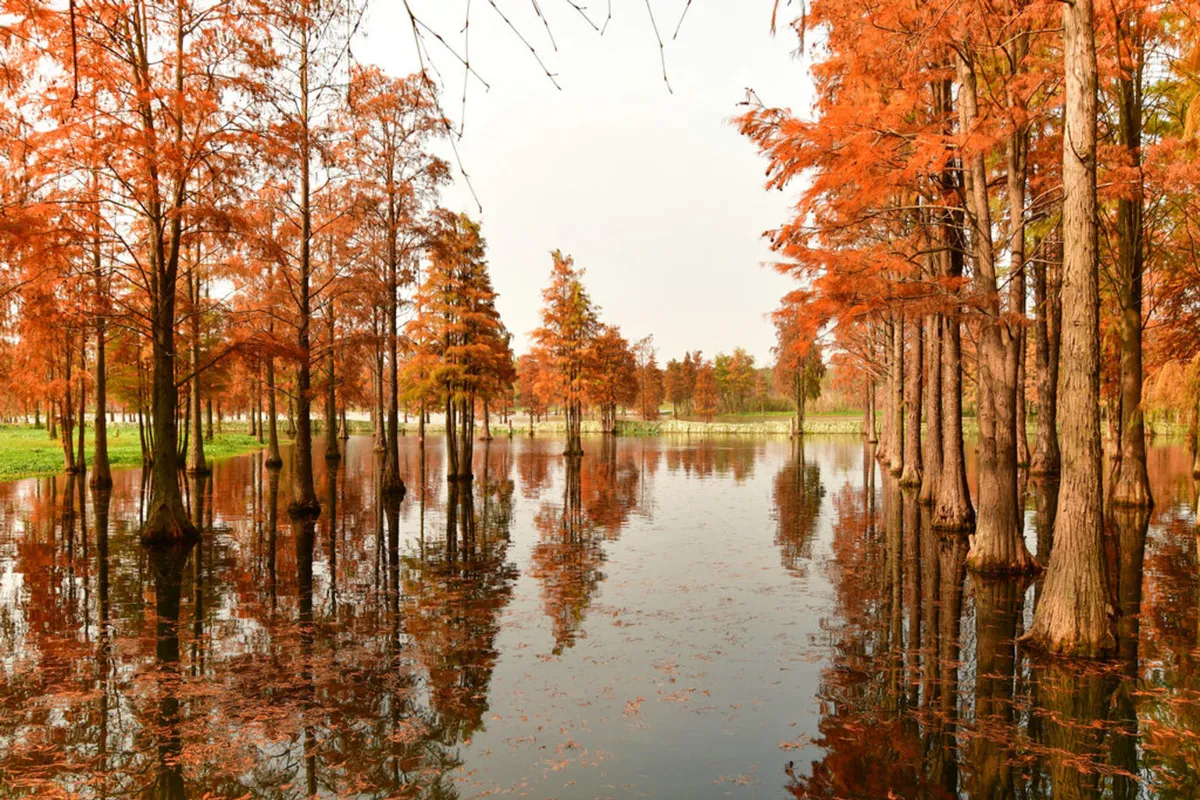
Qingxi Country Park, a Perfect Autumn Outing
Qingxi Country Park is conceived as a far-suburb wetland country park—the only one in Shanghai defined by its wetlands. Its remarkably diverse aquatic life makes it a natural native aquatic gene bank for Shanghai, earning it the nickname 'the Kanas on the water'! The park’s design philosophy is 'woods as the body, wildness as the soul, water as the melody'.
Showcasing the concept of 'Qingxi in dreams, a wetland rippling with water', the whole area circles the Dalian Lake wetland in Qingpu District. The scenery is charming, natural, and refreshing, fulfilling city dwellers’ longings to return to idyllic waterside countryside and rediscover the romance of Jiangnan.
In Qingpu, Shanghai’s 'land of fish and rice', hides the city’s only wetland country park. With a water pine forest planted 38 years ago as its crown jewel, and thanks to the Dalian Lake ecological restoration project, Qingxi Country Park unfolds with glistening waters, pines mirrored in the lake, and an intricate weave of 'lakes, shoals, backwaters, and islands'.
Water covers one-third of the park, supporting a wealth of aquatic species. With themes of wetlands, ecology, nature, and relaxation, the park has three functional zones: a Water Town Farmland Demonstration Area, an Ecological Conservation Area, and a Fishing Village Leisure Area. Key sights include the Water Forest, Pines & Egrets, Qingyun Wild Trail, Silver Grass Zone, Rippling Wetland, and Peach Blossom Ferry. Among them, the 4-hectare Water Forest is unique in Shanghai and celebrated as a wonder of pond cypresses.
The name Qingxi sounds identical to 'clear stream' (清溪), and the Water Forest, the park’s treasure, is brimming with the grace of water. An ancient poem would fit perfectly to describe its ethereal tranquility:
The water pine is a tree species unique to China, a Class-1 protected plant, often dubbed the 'giant panda of the plant world'. In late autumn, its graceful silhouette reflected on the water astounds every visitor.
From late autumn to early winter, the water pines’ emerald needles turn a striking reddish-brown, rising straight from the water—a spectacular sight. This 'Water Forest' in Qingxi Country Park, Qingpu District, is the only one of its kind in Shanghai.
Centered around Dalian Lake, it covers 83 mu (about 5.5 hectares). In the morning light, masses of water pines stand in the water, the surface like a mirror reflecting their straight trunks. After 38 years, the trees have adapted perfectly to growing in water, their thick roots firmly anchored. The deep red pines tower above, dazzling in the sunlight; occasionally a waterbird pauses, creating a picture worth treasuring. The prime viewing season is early winter, roughly from November 20 to December 20—the most beautiful time for the water pine forest in magical Shanghai. Come and experience Qingxi Country Park!
Autumn in Qingxi Country Park isn’t just golden—it’s a riot of every color. There are lakes, rivers, and all sorts of birds: Daurian Redstart (male), Daurian Redstart (female).
The park is vast. Parking lots and bus stops are a long way from the entrance, so you can take the electric shuttle. During peak season, be prepared to queue. Also, once inside, there’s a lot of walking. On our first visit, we wanted to see everything along the way, so we skipped the shuttle. That turned out to be the right call—the path was lined with photogenic spots.
Getting off the bus at Zilian Road, you need to walk north over 900 meters to the visitor center. The road is a straight, smooth asphalt lane, its dark surface cutting through the surrounding farmland—strikingly beautiful. Along the roadside, hundreds of meters of sturdy, square-timber wisteria trellises line the way. Though it’s autumn and the wisteria blooms are long gone, the vines still intertwine, lush and vivid green, filling the long corridors that stretch in layers as far as the eye can see. Next spring, when the wisteria cascades in purple clusters, it will form a purple 'time tunnel'—what a magnificent sight that will be!
Beside the main road a river is filled with withered lotuses. Just imagine how beautiful it must be in summer, with emerald lotus leaves rippling on the water. We made a pact to come back then. On the river, egrets dive for fish, herons soar—Dalian Lake in autumn may be a bit less vibrant than in spring and summer, but it has its own charm. Little grebes paddle leisurely.
Once inside the country park, a picture of new countryside in Shanghai’s Jiangnan water town style unfolds. Our spirits lifted immediately, and the weariness of travel vanished. White walls, dark-tiled roofs, farmhouses scattered harmoniously—a scene of peace, quiet, and contentment. Because the park is so large, it still encloses the original village of Lianhu. A network of rivers and lakes, idyllic pastoral scenery, well-spaced houses, and a rustic, elegant village landscape… On 3,200 mu (213 hectares) of farmland, premium rice, green vegetables, and lotus roots thrive in an ocean of deep green.
In 2014, Lianhu Village was included in Qingpu District’s first batch of beautiful village demonstrations. In 2015 it became a Shanghai Municipal Beautiful Village, in 2018 a National Eco-Cultural Village, and in the same year one of Shanghai’s first Rural Revitalization Model Villages. 'Lotus threads wrap around the wrist, water caltrop tendrils tug at the clothes.' Here are a thousand mu of lotus ponds, leaves spread wide, fish playing beneath. 'A river of misty waters mirrors the clear peaks, houses along the banks touch painted eaves.' White walls, dark tiles, lazily flowing clear water—a poetic paradise. This is the village market.
From the village market, walk about 700 meters west along Lianxie Road, and the vast expanse of Dalian Lake, where water meets sky, comes into full view. The entire Qingxi Country Park is arranged around Dalian Lake, a body of water shaped roughly like an isosceles triangle. Famous for its shimmering surface and vast lotus blooms, the lake is a highlight.
Strolling along the 5.5-kilometer lakeside trail, you’ll find blissful silence and panoramic views. Dalian Lake is a natural lake covering one square kilometer; wild lotuses flourish in the surrounding wetlands, creating the Wetland Lotus Pond scenic spot.
Alas, early autumn is not the season for lotus flowers. From a distance, they’ve already faded, and the leaves have turned yellow and dry. Come back next June or July, and this will be a scene of moonlit lotus ponds, stunningly beautiful—it’s said that’s the best time to visit Qingxi Country Park.
In summer, it was a pond of vivid green and red; autumn arrives, and after a night of wind and rain, only 'withered lotus leaves remain to listen to the rain.' Under a bright moon, the autumn wind stirs, leaves float on the pond, flowers gone, stems bare. Dewdrops glisten on the decaying leaves, bringing back memories of their splendid summer. Yet I clearly see a proud, desolate beauty hidden in the lotus pond’s decline.
The former opulence and vivid bustle have faded into a tangle of withered stalks and leaves. Far out in the middle of Dalian Lake, three tiny islands, each about 500 square meters, are collectively called Lianxin Islands. They are thickly vegetated. Strangely, there seem to be no buildings or residents on them.
Just across the road on the western side of Dalian Lake lies an endless expanse of rice paddies, like a giant golden carpet spread between earth and sky. In the distance, white farmhouses dot the fields, turning the whole scene into a richly textured oil painting—utterly breathtaking.
Here they grow a premium single-crop late rice called 'frog rice', using a superior thin-grain variety from Qingpu. The fields are within the upper Huangpu River drinking water source protection area. A 'frog-rice symbiosis' method is used: frogs protect and nurture the rice by naturally controlling pests, ensuring food safety, reducing pollution, and promoting sustainable agriculture.
Heading northeast from the south, we arrived at Jinkoumen Harbor. Cross it, follow signs, and pass the Dalian Lake Service Station. A hundred meters beyond, you reach Reed Snow Maze—best admired from a distance.
A bit further is Lianxin Bridge, a complex of two arch bridges, a wooden pavilion, and winding boardwalks. From here you can see vast reed beds in the wetland swaying in the wind. Standing on the boardwalk, especially on the first arch bridge, you can frame the twisting walkway, the lake pavilion, the distant Reed Snow Maze, the Yongjing Nunnery, and the blue sky with white clouds—a truly atmospheric shot.
The map shows that opposite Lianxin Bridge and Reed Snow Maze is Rippling Wetland, but it’s fenced inside the main 'Ecological Conservation Area'. Through the wire mesh, we spotted a lotus pond and a worker harvesting lotus roots. In the morning, he was pulling them from the mud; by afternoon, he was sorting and bagging them on the bank. Such long roots, carrying the joy of harvest home.
Continuing along the lakeside trail, you reach the Ecological Conservation Area. Due to the pandemic, only one entrance was open; you just show your health QR code and have your temperature taken to enter.
Inside, to the right is the Rippling Wetland; to the left is Pines & Egrets, a forest of pond cypresses on land surrounding a clear pond, where now and then an egret circles overhead. The trees here wear a mix of colors—some already red, some still lush green, others touched with yellow—and their branches are heavy with round cones. Scattered in the lake are a few water cypresses standing in the water. This area is home to lakes, streams, and birds: egrets and night herons among them.
With the blue sky, warm sunlight, tranquil lake, and vibrant cypress woods, every view is like an oil painting, making you pause involuntarily. The boardwalks, little bridges, and the forest itself are all perfect photo spots. Alongside the walkway you’ll find small bridges over flowing water, a two-story bird-watching tower, thatched pavilions, and bright flowers, all adding charm to the majestic Water Forest—making the trip truly worthwhile.
Next to a wooden bridge is a two-story bird-watching tower, designed so visitors can stay hidden and let wild birds move about freely. Inside are telescopes for spotting birds and display cases with local bird specimens.
We turned onto the Qingyun Wild Trail boardwalk, which winds through the wetland bends and cypress woods.
Following this forest path, you soon arrive at Peach Blossom Ferry. Though we missed the full bloom, a few blossoms still clung to the trees, bursting with life. Here the pond cypresses stand tall and proud, their needles turning from green to yellow to red—another breathtaking sight.
Crossing the boardwalk at Peach Blossom Ferry brings you to the 'Water Forest'. Take a deep breath, and your heart lifts. Towering water pines stretch into a sea of reddish-brown, like strings of crimson beads. Water surrounds the trees, and trees stand in water—a true forest wonder!
Ripples spread, mist veils the pond, and the evening glow dyes the cypresses red. The pines rising from the water blush against the sky. Water surrounds the trees, trees stand in water—a miraculous forest indeed.
Varying shades of red shimmer in the water’s reflection, rosy and blurred, as intensely colored as an oil painting. The mirror-like surface reflects the straight trunks, thick roots gripping the water bottom—it’s dreamlike, marvellous. The part of the trunk just above the waterline is especially swollen, about 10–20 cm across, like an elephant’s foot—or as if the trees are wearing shoes. Quite a novelty.
In the deeper parts of the Water Forest, the boardwalk transforms into a thatched corridor with a rustic charm. Walking on planks above the water feels like strolling in a wonderland. Seeing that heart-stopping splash of red, you can’t help but marvel at how heaven favors the pond cypresses. Every spot—the boardwalk, covered bridges, wooden pavilions, waterside platforms—is impossibly photogenic.
In places the cypresses are still deep green; the water ripples softly, reflections blurred. Sunlight filters through the treetops, casting dancing patches of light on the surface. On the other side of the spot shown (turn right at the conservation area exit and walk about 200–300 meters), you can get a different view. Most visitors stay inside the conservation zone to admire the Water Forest, so few come here. It’s quiet, with a wide vista that reveals the whole Water Forest panorama.
A wetland bay weir helps slow the flow of water, lengthening the lake’s circulation cycle and enhancing purification. A 2010 study by the Wildlife Protection and Management Station on ecological planting in the Dalian Lake restoration area showed that through eco-friendly cultivation and aquaculture, water quality improved markedly: ammonia nitrogen removal reached 89%, COD removal 67%, and the water went from Grade V back to Grade III, boosting biodiversity.
This spot sees few visitors. It’s a large wetland area—if you’re short on time, you can skip it.
Silver Grass Zone (not marked on the map, but you can’t miss it in person), with roads named Silver Grass Road 1 and 2, intersecting Cherry Blossom Avenue. Along the shore and roadsides, vast stands of silver grass (Miscanthus) have been planted.
The waters here host many waterbirds: moorhens, little grebes, and more. Many people aren’t familiar with silver grass and often mistake it for reed. The confusion isn’t without reason: they look alike, both clean water, and the well-known verse 'Jianjia cang cang, bai lu wei shuang' (from the Book of Songs) refers precisely to immature silver grass and young reeds. In sunlight, the white silver grass plumes shimmer silver, dancing in the autumn breeze like silken threads. Their reflections in the water, with blue sky and white clouds, compose a beautiful autumn tableau.
Thus, the scene naturally evokes the classic line: 'Reeds and grasses lush and green, white dew turns to frost; a lady fair so serene, on the water’s side she’s lost.' When the wind lifts the silver grass, it’s equally lovely. A breeze sweeps across, and from afar it looks like waves of grain. Tang Dynasty poet Bai Juyi used 'maple leaves and silver grass flowers quiver in autumn’s chill' to paint a bleak autumn picture.
Paired with the silver grass, the pond cypresses are now blazing red, while the grass grows wild and exuberant, as if vying for attention with the pines.
Leaving the conservation area, we crossed Lianxin Bridge again. A full loop around the lake would have been perfect, but time was short—so we’ll have to save that for next time. This autumn visit to Qingxi was on November 30; the cypresses would become even redder in another two weeks. A bit of a regret, but it leaves us something to look forward to. We had planned to return around the 15th and then write this travelogue, but the weather forecast isn’t looking great, so I’ll post this now. If we manage to come back, I’ll update—pray for sunshine!
Address: 500 Zilian Road, Jinze Town, Qingpu District
🚗 By car: Navigate to 'Qingxi Country Park Parking Lot'. There are four lots (P1–P4); currently only P1 and P2 have shuttle buses and bike rentals. P1 is closer to the park entrance. Parking fee: 15 yuan per entry.
🚌 By public transport:
1. Take Metro Line 17 to Zhujiajiao Station, then transfer to Qingpu Bus 28 to Lianxi Road Xisong stop, followed by a 20-minute walk to the entrance.
2. Take Metro Line 17 to Dongfang Lvzhou Station, transfer to Jinze Bus 7 to Qingxi Country Park stop, then walk 20 minutes.
🚲 Getting around inside:
1. On foot: It’s about 3.8 km from the entrance to the Water Forest, roughly a 30-minute walk.
2. Electric shuttle: 20 yuan round trip.
3. Bike rental: Yong’anxing station-based bikes are available throughout the park. Rent via app or Alipay/WeChat scan. Rates: single 15 yuan, parent-child 20 yuan, tandem 30 yuan per hour.


