Strolling Along the Yangpu Riverside: A Century of Industrial Heritage
Shanghai is the birthplace of China’s modern industry, and Yangshupu can well be called its cradle. Located on the lower Huangpu River, with cheap riverside land and easy transport to the foreign concession centers, foreign firms flocked to build factories along Yangshupu Road from 1902 to 1937. Japanese merchants established 17 textile mills—including Yufeng, Dakang, and Gongda—and 4 metallurgical plants; British interests set up 3 shipyards (Moller among them), 6 textile mills (Jardine, etc.), 14 light industry factories (such as the China Soap Company), and the Shanghai Gas Works; American and German investors added 10 more factories. The Yangpu waterfront stretches about 15.5 kilometers. In October 2017, the 2.8-kilometer section from the Yangpu Bridge west to Qinhuangdao Road Pier was opened to the public; on September 28, 2019, the 2.7-kilometer eastern section south of the Yangpu Bridge was also opened, completing the entire 5.5-kilometer southern Yangpu riverfront. Pedestrian paths, jogging tracks, and cycling lanes run side by side, blending a belt of industrial relics, a belt of native landscapes, and a vibrant belt of intertwined trails into a world-class waterfront space.
Today, the Yangpu riverfront has gradually transformed from a working shoreline dominated by factories and warehouses into a lifescape, an ecological shore, and a scenic bank of parks and green spaces—an industrial rust belt turned into a living showpiece.
We entered from Pingding Road, starting at the site of the Yangshupu Power Plant and walking west along the 5.5-kilometer Yangpu riverfront for about over 4 kilometers. Highlights popped up along the way, one pleasant surprise after another.
Two towering chimneys (100.65 meters and 89.5 meters) have become landmarks of the Yangpu riverside. Once seen as the emblem of entering Shanghai, the soaring chimneys live on in the memories of several generations and stand witness to the city’s inclusive spirit. The original two chimneys and two main turbine halls have been preserved.
The Yangshupu Power Plant was built in 1913 with British investment. Its initial capacity was 10,400 kW; by 1924 it reached 121,000 kW, making it the largest power plant in the Far East at the time. When Shanghai was liberated, this plant produced 10.7% of the nation’s electricity and supplied nearly 80% of Shanghai’s power, earning it the title “cradle of China’s electric power industry.” In 1985, total capacity reached 264,150 kW. To give Shanghai “bluer skies and cleaner water,” it was shut down by the end of December 2010 under a national policy of replacing small energy-intensive units with larger, more efficient ones.
Now, a heritage park centered on the riverside coal conveyor corridor has been created on the site.
To reveal the role of two transfer structures near the bank in the original process flow, foundation pits were dug under the demolished buildings, forming three ponds for aquatic plants. These define the basic landscape framework of the Relic Square and provide new leisure spaces for citizens.
The heritage park fully preserves a coal conveyor corridor and related buildings.
The towering chimneys were long regarded as the sign of entering Shanghai, etched in the memory of generations of locals and witnessing the formation of the city’s open and embracing spirit.
Factory walls with exposed steel structures, mottled surfaces, and rust colors display the authentic “century-long rust belt, industrial heritage.”
The plant’s former No. 3 transfer building has been transformed into a rest stop for visitors.
Its third floor features a suspended steel staircase that is particularly impressive.
The coal conveyor corridor leading to the Huangpu River has been converted into a pedestrian boardwalk.
Gazing westward from the power plant rest stop, the Yangpu Bridge appears in the distance. Nearby lies the Power Plant Heritage Park.
East of the rest stop, the heritage park unfolds.
Industrial-era structures mingle with contemporary buildings.
At the rest area, the roof radiates from eighteen shell-like cylindrical buildings, resembling a blooming cornflower when viewed from above.
Old pipelines stand upright like rocket launchers.
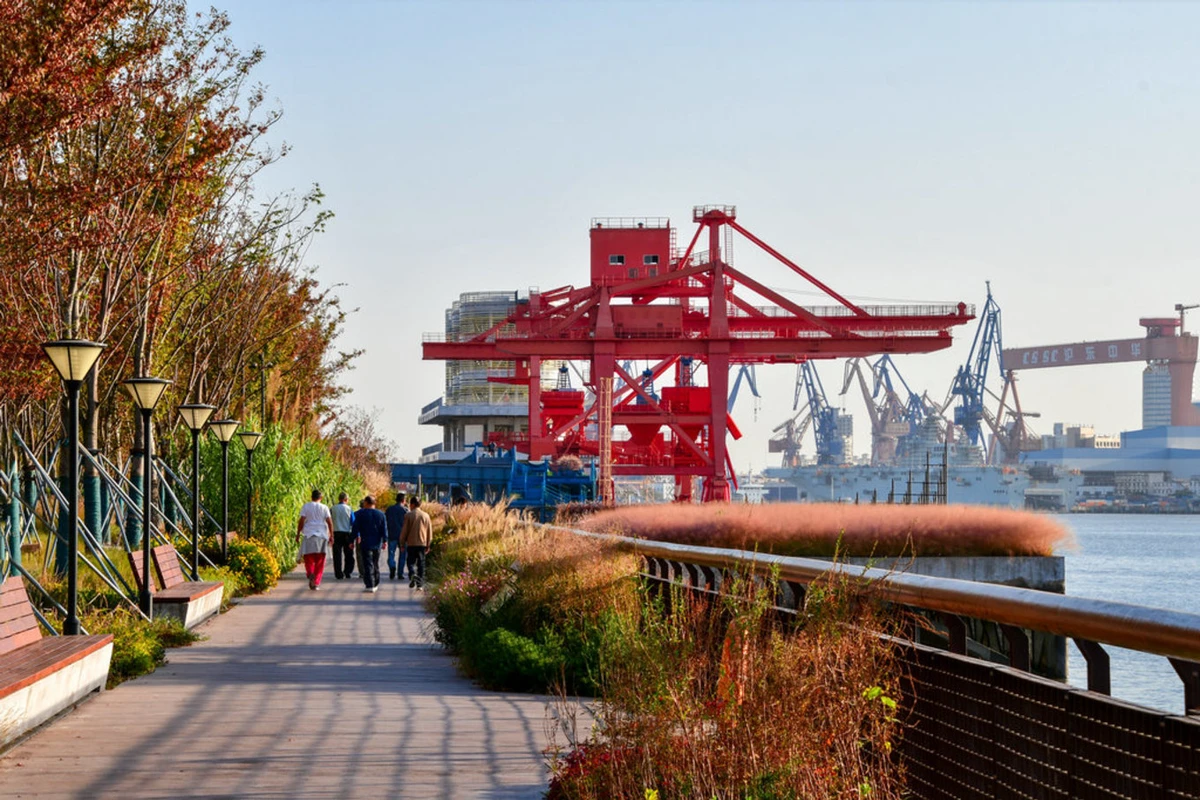
Two tall cranes still tower by the river.
The heavy-duty cranes have gained a surprising sense of movement thanks to the creativity of renowned Swiss artist Felice Varini. A bold collision of red and blue: cranes along the Yangpu riverfront have been painted with white stripes over their orange-red frames, creating a sharp contrast with the blue steel stairs and enriching the waterfront’s palette. Among them, three cranes form Varini’s work “Diagonal of Cranes.” It runs through the three machines; while the lines and shapes appear fragmented, when one stands at a precise spot—one and only one—the straight lines suddenly align, yielding a moment of clarity.
Varini’s “Diagonal of Cranes” sits right on the riverbank, “passing through” a set of three orange-yellow cranes. At first, many people only notice the white lines on the cranes without realizing it is a public artwork. But when they find a specific position (slightly different depending on the viewer’s height), it dawns on them that the three-dimensional cranes have been transformed into a two-dimensional plane through the artist’s “diagonal.”
Meandering Ash-Silo Art Space: an exploration.
Originally three closed ash silos facing the river, the Ash-Silo Art Space now connects the previously separate cylinders by adding two viewing platforms. A semi-transparent enclosure approach was used to remodel the formerly sealed 15-meter-high silos. The spatial experience is imagined as a fully public wandering path, zigzagging from the concrete base all the way up to the silo tops.
“Huangpu Cargo Hold” is a work by British artist Richard Wilson. He took 42 pieces and parts from a derelict sunken vessel and mounted them at both ends of 21 stacked steel pipes. He initially wanted to create a piece along the ship’s waterline, but after searching Chongming Island, Hengsha Island, and elsewhere without finding a suitable vessel, he finally noticed a long-abandoned ship moored at the Shanghai Shipyard.
This ship was designed and built in 1975 by workers of the Shanghai Shipyard. When the shipyard moved to Chongming District in 2005, the vessel was decommissioned. Its rust and period-era parts fascinated Wilson. Forty-two parts—round or oval—were cut from the ship. These industrial remnants gained new life and continue to connect with the Shanghai Shipyard, where they once belonged, belong now, and will belong in the future. Wilson uses a ship to present a ship, history to recount history. In his view, part of an artist’s duty is “to show the world that ordinary people cannot see, without forcing the public to accept anything, simply telling them that such existence is there.” He once introduced this work in an interview in this way.
To the Chinese team from Xinzhifeng who worked with Wilson, the artist’s choice of a discarded ship from the Huangpu River and pipes—a material originally used for transportation—seems to subtly echo the power plant behind the artwork. His habitual approach of changing an object’s original content or relationship, stripping away people’s perception of mundane reality through a grand narrative, uses a ship to present a ship and history to understand history.
The greenery here is exceptionally beautiful.
Variegated leaves and fruits of the tallow tree.
Pine needles resting on flowering reed heads—white, red, and green together, lovely.
Reed catkins in backlight.
“Wandering” by Shen Lieyi: An empty chair, like fading memories drifting in with the moonlight, leaves traces on the mirror-like river. If someone sits here facing another, they encounter not only a part of cultural experience but also themselves and others, while the river embraces all and flows on forever.
“Light Boat through a Gap” is a boat-shaped architectural sculpture “floating” in mid-air, offering a contrast between stillness and emptiness and the busy boat traffic on the Huangpu River. The upper half is a “boat house,” presenting a space of contemporary architectural structure, inviting viewers to recall and imagine the buildings that once stood along the riverbank.
A “Time Arrow” runs through the piece, modeled on the meandering form of the Huangpu River, symbolizing an abstract timeline that connects and narrates past, present, and future. By artist Xiang Yang.
Foxtail grass and pink muhly grass.
This section originally housed the Shanghai No. 12 Cotton Mill, famous for its khaki fabric and nicknamed “Khaki King.” The khaki color is the color of the earth, of loess land. The children’s playground here is named “Khaki,” using earth-yellow and red as its basic colors to “weave” together the past and children’s bright present.
Walking further, at the former Gasworks Pier, you’ll find a cleverly transformed “Edge Garden” built around ruined walls—a small gesture producing a big effect.
Continue west, and you’ll pass a caged basketball court and a beach volleyball court. Even out of season, the white sand lets you imagine the vigorous figures of tanned beach volleyball players.
You may feel a bit tired by now, but look up: the landmark Yangpu Bridge is just ahead. To your right, waves lap the shore bringing river breezes; to your left, industrial heritage buildings are gradually being given new life. Along this stretch are more artworks.
A bit farther stands Baigi Café (open daily 10:00–20:00). “Baigi” combined means “soap” in Chinese. Clever visitors will guess that this is tied to the history of the soap factory.
The site of the old Shanghai Soap Factory surprises with its spatial layout and artistic landscape. The “Soap Dream Space”: advertising images on the walls display soaps once made in Shanghai, evoking memories of the past.
This exhibition and experience center is renovated from the former production auxiliary area of the Shanghai Soap Factory, facing the Huangpu River to the south and comprising a land landscape and a water pier. When we went on a Monday it was closed, so we didn’t enter.
The western land section originally held the production and auxiliary areas. The design uses original wall foundations as clues, building low red-brick walls to restore the historical spatial pattern and create semi-open courtyards. Floating steel walkways connect different spots, creating shifting views with every step. The eastern section consists of the original production workshop, the hydrolysis building, and sewage purification pools (regulating pool, grid pool, biological rotating disc pool, air flotation pool, sodium hypochlorite pool, and observation building).
Colorful flowers and plants are arranged throughout, like a charming little garden.
The artist used the concept of “bonsai” to collaborate with the surrounding environment, history, and culture in creating a contemporary park called “Ruochong Garden,” whose name comes from the Dao De Jing line “Great fullness seems empty, yet its use is inexhaustible.” Old door frames carrying history and memory, everyday objects, waste materials, myriad household lights, and slightly curved reflective mirror panels form a landscape system of “abstract realism.”
These bonsai-like structures, seemingly incorporating mountains, buildings, goods, and boats, originate from broken old door frames. They act like pieces of “empty” magnets, absorbing and reflecting surrounding scenes and life. This is a bridge connecting life, reality, and art under a concept of “borderlessness.” It is a “living” artwork: many objects bearing the imprint of daily life come from nearby communities, and more will be added over time. It is also a versatile garden space where various cultural activities can take place—a platform for ongoing creativity.
Materials: old door frames, steel, glass, colored mirror panels, concrete, broken ceramic tiles, collected lamps, residents’ everyday items, old and discarded objects from the original factory.
Here stood the original State Cotton Mills No. 9 and No. 10, though we could not tell the boundary between the two. This area later became “New Cotton No. 1.” By scanning a QR code provided by the binjiang authority, we could read more about its historical changes.
Here the leaves of tallow trees are turning red.
The State Cotton Mill No. 9 traces its roots back to the Dachun Cotton Mill founded by Sheng Xuanhuai. In 1908, the Japanese trading company Mitsui Bussan Kaisha acquired Dachun and other mills to form Shanghai Textile Co., Ltd., setting up workshops on Yangshupu Road. In August 1945, the Nationalist government took over the factory and renamed it No. 14 Textile Factory; at the same time it took over the neighboring Japanese-owned “Tongxing No. 2 Factory” and renamed it Shanghai No. 10 Cotton Textile Factory. In 1949, the Shanghai Military Control Commission took over both and renamed them No. 9 Cotton Textile Factory and No. 10 Cotton Textile Factory. In October 1958, the two were merged into a new state-owned Shanghai No. 9 Cotton Textile Factory, which quickly became a large enterprise with nearly ten thousand workers.
The basic shape of the buildings remains, but they are dilapidated. The riverside walls are covered with dense, lush ivy.
Warehouses nestle amid pink muhly grass.
The Mark Garden occupies part of the original riverfront site of Cotton Mill No. 9. Through historical research, the pattern and texture of the factory site have been restored. Two existing factory buildings with historic features are preserved, and selected ruins of characteristic warehouses and workshops have been transformed into themed “mark gardens” that exude a contemporary experiential atmosphere. The gardens are inscribed along the contours of the former ruins, either by the river or embedded in green spaces.
In an industrial-style building named “Wei Pavilion”—once the gatehouse for waterway logistics—visitors can now rest. Not far away stands a similar building called “Zhi Pavilion,” converted from the former environmental logistics duty room into a public space housing the artwork “Mountain.”
The Shanghai Power Station Auxiliary Equipment Plant originated from the Yangshupu workshop of the American firm Andersen, Meyer & Co., founded in 1921. The founder of the firm’s China branch was the Dane Vilhelm Meyer. A double-curved vault factory hall without beams in the West Plant dates back to around 1960, a time of national hardship and resource scarcity; to save materials, the East China Architectural Design & Research Institute employed a “beamless” design.
At 1900 Yangshupu Road, on the former site of a workshop of the West Plant, the original steel roof frame has been preserved as an indoor-outdoor landscape framework, creating what is now the Daqiao Park Rest Station.
“Green Hill” is a renovated former tobacco warehouse. Originally massive—occupying a 60-meter-wide by 250-meter-long riverside zone—it visually blocked the connection between the city and the waterfront and obstructed a planned new road. The old warehouse seemed destined for demolition. But by weighing the pros and cons of demolition versus retention and trying mixed land use while linking the riverside open space with the urban hinterland, the designers created an inclusive, multifunctional urban complex combining municipal transport, parkland, and public services.
It’s not only a must-visit vantage point for photography enthusiasts but also captivates visitors with its round central atrium and spiral staircase. Yangpu Riverside’s “Green Hill” has become an internet-famous landmark.
Climb the open-air stairs to reach the top of Green Hill. The exposed reinforced concrete frame gradually shrinks from the second floor upward, forming layer upon layer of terraces. A spiral staircase in the center connects the exhibition halls on each floor, leading all the way to the rooftop garden. From there you can gaze at the Yangpu Bridge and surrounding scenery. It was closed due to the pandemic; when it reopens, be sure to go up and check it out.
A massive “Shanghai Oriental Fisherman’s Wharf” integrating culture, exhibitions, entertainment, leisure, and commerce will stretch nearly 700 meters along the Yangpu riverfront. It maximizes river views while adding a new highlight to both banks of the Huangpu. The project aims to create a landmark urban waterfront and historical-cultural area, a new pearl along the river that will provide an excellent example for the more than ten-kilometer-long Yangpu shoreline. Fisherman’s Wharf symbolizes the rise of the Yangpu riverfront.
Esther Stocker’s work “Block Universe” turns the outdoor porch of a building into a canvas that visitors can walk through. Black squares combine with a white arcade structure, making one feel as if entering a black-and-white geometric world.
Gantry crane pier: the designers repurposed retained industrial facilities to create a pier landscape.
Meanwhile, the artwork “Urban Wild” by Japanese artist Yusuke Asai has become another distinctive scene along the riverfront.
Yusuke Asai’s “Urban Wild” is a large “heat-transferred” ground piece. The artist first drew plants, animals, and other images on tape with markers, then used a white-line material similar to that for zebra crossings to tattoo these images into the site.
Viewed from a bird’s-eye perspective, the piece on the Yangpu riverfront actually forms two huge animals. But at human scale you can only see, from a close-up view, tiny flowers, trees, birds, and insects nested inside large animal figures—like the small yet indispensable creatures that make up the natural world. It explores how nature exists within a city.
In the summer, Asai spent over a month “crawling” on the riverside creating the work. Unlike pieces completed independently by artists, “Urban Wild” involved the highest degree of public participation. Because the waterfront was already open during the creation period, many nearby residents brought their children on walks and joined in the creative process: they drew patterns on paper, and the artist then “heat-transferred” them into different spots according to his composition. As introduced by Wang Bin, many local residents left their own motifs here and would proudly tell friends which “small component” came from their hands. They probably never imagined they would participate in an artist’s creation and have it permanently preserved in the place where they live.
On the 4th floor of the Oriental Fisherman’s Wharf, the Pujiang Yuese Panoramic Restaurant faces the Huangpu River, with a balcony overlooking the waterfront.
Looking across to the east bank of the Huangpu, the Minsheng Wharf has a history of over a hundred years. The massive eight-million-ton silos, once proudly titled “Asia’s largest grain silo,” are now a protected cultural relic and important industrial heritage site in Shanghai.
The Eight-Million-Ton Silo Art Center.
From afar, the eight-million-ton grain silos exude a rough aura sharply contrasting with Shanghai’s modern vibe. Thirty large cylinders form a continuous, imposing facade 140 meters long and 48 meters high, exuding majesty. At a distance, the old, lonely warehouse stands silent by the river—without the glory of its heyday but embodying the sediment and weight of history.
Built in 1995 and designed by the former Shanghai Civil Architecture Design Institute, these two connected towering cylindrical structures—with capacities of 8 million and 4 million tons—once served rice and sugar, two commodities vital to Shanghai citizens’ lives. (The 4-million-ton silo was built in 1975.)
The New Ewo Cotton Mill (Jardine Mill).
At 1056 Yangshupu Road. In 1915, Jardine Matheson established the “British New Ewo Cotton Mill” in Shanghai—the earliest foreign-owned cotton mill after the city opened as a port. It later became the Shanghai No. 1 Wool Top Factory.
This small old Western-style building sits beside a rain garden on the riverbank. Built in 1918, it is a two-story brick-and-wood structure in British country villa style. Originally the “Yangshupu Cotton Mill Manager’s Residence,” it was the home of the British manager. This nearly century-old house has witnessed the rise and fall of a hundred years of industry in Yangpu.
At the site of the former Ewo Cotton Mill, factory traces are almost invisible. Only the low remnants of a wall—perhaps the original gate—and clusters of large textile-themed sculptures remain.
On the inner side of the riverside boardwalk, go up a gentle slope and you’ll see a pool below.
A “zigzag bridge” made of steel pipes and grating winds over the pool, flanked by tall metasequoia trees. Tucked behind them, shaded by tall camphor trees and dense bamboo, stands the three-story bungalow.
Sponge city concepts and wetland parks form a green lung here.
The reed pond and metasequoia path are charming.
Liu Jianhua’s “Object from Beyond”: a sculpture of stainless steel with baked paint and laser lights. Standing on the ground, it’s often called the “Anchor of the Earth,” an 8-meter-tall piece.
Heading to 830 Yangshupu Road brings you to China’s first modern water plant—the Yangshupu Waterworks. Completed in 1883, it is Shanghai’s oldest and once largest waterworks. The castle-style British classical buildings within the plant are protected modern architectural relics of Shanghai.
In 1880, Shanghai’s British merchants established the Shanghai Waterworks Co., Ltd. in London and began building the plant beside the Huangpu River the following year. The plant at 830 Yangshupu Road was designed by British engineer J.W. Hart. Construction started in August 1881 and was completed two years later. On June 29, 1883, Li Hongzhang, then Minister of Beiyang and Trade, turned on the valve, officially marking the completion of China’s first modern water plant.
Covering 129,000 square meters, the Yangshupu Waterworks is one of the oldest and most productive surface water plants in the country. Its architecture resembles a traditional British castle: load-bearing walls of plain brick with red brick string courses, parapets with crenellations, and cement mortar used for the coping, window frames, and string courses to form raised lines. Corners are finished to look like stone quoins, evoking a medieval English castle.
By the 1930s, the plant had expanded threefold to become the largest waterworks in the Far East. The total floor area of its various buildings reached 12,800 square meters, with brick-concrete structures of different orientations. These buildings are still well preserved today and were listed as a National Key Cultural Relics Protection Site in 2013. After more than a century, the Yangshupu Waterworks still supplies Shanghai residents, delivering over 400 million cubic meters annually—about a quarter of the city’s total water supply.
A 550-meter-long trestle allows visitors to stand above the Huangpu River and admire the century-old buildings up close.
On the trestle, “box pavilion frames” are formed by folding steel plates into shade-giving boxes, turning the riverside scenery into a picture captured within a “viewfinder.”
Walking along the trestle feels like being on a ship’s deck, experiencing both the Huangpu River vistas and the historical charm of the waterworks.
The water tower—a landmark of the waterworks.
Turn onto Yangshupu Road and you’ll see the main entrance. The newly built Water Science and Technology Museum opens on Tuesdays; unfortunately, I missed the chance to visit.
The Yangshupu Waterworks buildings are uniquely distinctive and well preserved—a rare sight in China.
Engraved on the ground is the history of the Ewo Cotton Mill. Two Ewo mills were set up by the British firm Jardine Matheson: one at 1056 Yangshupu Road, near Huaide Road—the site of the New Ewo Cotton Mill (also called Yangshupu Cotton Mill, later Shanghai No. 1 Wool Top Factory), founded by Jardine Matheson in 1915 with an investment of 1.5 million taels of silver; the other at 670 Yangshupu Road—the Ewo Cotton Mill (later the No. 5 Wool Factory), Shanghai’s earliest foreign-invested factory, built by Jardine Matheson in 1896. Covering 12,700 square meters with a floor area of 22,400 square meters, it included workshops, air-compressor stations and warehouses, waste textile workshops, and the manager’s residence. The factory was a brick building with corrugated iron saw-tooth roofs formed by three-span gable roofs. The warehouse was of reinforced concrete with saw-tooth roofs and long strip windows.
Founded by Jardine Matheson in 1896 as Shanghai’s earliest foreign-funded factory, it produced the then well-known “Blue Dragon” brand cotton yarn. After setting up the Ewo Cotton Mill, the British merchants successively established the Yangshupu Cotton Mill and the Gongyi Cotton Mill. In 1921, the three merged into Ewo Textile Co., later renamed Shanghai Yuhua Cotton, Wool and Jute Mill, and in 1964, Shanghai No. 5 Woolen Mill. After a century of history, the nation’s largest woolen mill closed around 1996. In 2002, the mill was officially registered as an immovable cultural relic of Yangpu District.
We then entered the grounds of the former Shanghai Shipyard. In the past, big ships came here for repair, and new ships were launched from here. The original wooden sleepers that the ships rolled over during launches have been preserved as historical relics.
Shanghai Shipyard Riverside Green.
At the Old Ship Cradle Plaza, a clever landscape brings industrial heritage to life: a ship’s bow tilts upward as if sailing boldly into the distance, capturing the spirit of “setting sail and riding the wind.”
Shanghai Shipyard Riverside Green.
At 540 Yangshupu Road, a Runner’s Rest Station.
Shanghai Shipyard Riverside Green.
A café named Yangshupu; from its top floor you can enjoy the river scenery.
Shanghai Shipyard Riverside Green.
The tabletops reflect a mirror-like image of the sky.
Shanghai Shipyard Riverside Green.
From here you can see a brick-red building—the Maoma (Wool & Jute) Warehouse.
Shanghai Shipyard Riverside Green.
Built in 1920, the warehouse first belonged to the German firm Rhenish Trading Co. and later became Shanghai No. 1 Silk Weaving Mill, a national leader in silk and artificial silk production. In 2003 it was transferred to the Shanghai Shipyard.
Shanghai Shipyard Riverside Green.
This nearly hundred-year-old building has witnessed countless historic moments by the Huangpu River. It is the largest beamless-slab warehouse still standing on the Yangpu waterfront and a testament to the boom of Shanghai’s national industry. Currently an exhibition hall, it was closed when we visited because the exhibition had ended and pandemic restrictions remained.
Shanghai Shipyard Riverside Green.
Next to the Maoma Warehouse is the site of the Sui Fung Shipyard. The buildings here were successively used by Wanlong Iron Factory, Sui Fung Shipyard, Allied Shipyard, and the repair division of Shanghai Shipyard, witnessing the century-long evolution of shipbuilding and repair in Shanghai.
Shanghai Shipyard Riverside Green.
The ship dock of the former Shanghai Shipyard—one of Shanghai’s oldest docks—lies here.
Shanghai Shipyard Riverside Green.
Excavated in 1900 by the German-funded Sui Fung Shipyard, it merged in 1936 with Xiangsheng Shipyard and J. & P. Coats Shipyard to form the Allied Shipyard, then the shipyard with the most docks in China. It was incorporated into Shanghai Ship Repair Factory in 1954 and renamed Shanghai Shipyard in 1985. On November 6, 2007, China’s only third-generation polar icebreaker research vessel, Xue Long, was upgraded and delivered from this very yard.
Shanghai Shipyard Riverside Green.
Today, the more-than-200-meter-long dock lies exposed before visitors. The rust and patina of industry lose none of their power even in the glow of the setting sun—truly awe-inspiring.
Shanghai Shipyard Riverside Green.
A sealed memory artwork.
Shanghai Shipyard Riverside Green.
As light and shadow shift, you can almost still hear the ships once sailing from here onto the Huangpu River, whistling and pushing through rolling waves.
Shanghai Shipyard Riverside Green.
When speaking of century-old factories, the Tianzhang Recording Paper Mill deserves mention. I worked there for many years. At 408 Yangshupu Road.
The predecessor of the Shanghai Tianzhang Recording Paper Mill dates back to the start of the Yangshupu industrial belt in 1882, when Li Hongzhang approved the establishment of the government-supervised and merchant-managed Shanghai Machine Paper Mill. That year, Cao Zihui, Cao Zijun, Zheng Guanying, and others raised 155,700 taels of silver with the intention of founding a Chinese machine paper company. They submitted the plan to Beiyang Minister Li Hongzhang, got approval, and chose 408 Yangshupu Road as the site—China’s first Chinese-owned paper mill. Its main equipment included a multi-cylinder Fourdrinier paper machine with eight drying cylinders, made in 1877 by James Bertram & Co. of Leith, Scotland. In 1915, Liu Bosen rented and later purchased the mill along with the Baoyuan Paper Mill. In 1920, he bought the Huazhang Paper Mill from the Japanese Mitsubishi Corporation for 820,000 taels of silver and named it East Baoyuan Mill, with the Yangshupu Road plant becoming West Baoyuan Mill. In 1925 it was renamed Tianzhang Paper Co., Ltd. In 1983, his son Liu Mengjing partnered with Japanese interests and temporarily renamed it “Tianzhang Changji Paper Mill.” The Nationalist government redeemed it in 1947. After liberation, it was nationalized as Tianzhang Paper Mill. In 1981, Tianzhang Paper Mill merged with Shanghai Recording Paper Mill to officially become Tianzhang Recording Paper Mill—China’s first and largest producer of instrument recording paper and computer printing paper.
A road in Yangpu riverside is named Tianzhang Road after the factory. Workers on site told us the factory building will soon be demolished. Take one last look!
Yuan Feng’s “Window of Projection.”
The “Window of Projection” installation offers us a chance to “see” the city anew. Whether gazing at urban landmarks through a grid or sweeping the skyline through a colored field, it provides a moment of mutual observation between viewer and city, constantly urging us to rethink the everyday meaning of the urban landscape.


