Shanghai's Famous Buddhist Temple – Zhenru Temple
Zhenru Temple is located at No. 399 Lanxi Road, Zhenru Town Subdistrict, Putuo District, Shanghai. It covers nearly 20 mu (approx. 1.33 hectares) and has a building area of 1,370 square meters. Originally named 'Wanshou Temple' and commonly known as 'Great Temple', Zhenru Temple was rebuilt by the monk Miaoxin in the seventh year of the Yanyou era of the Yuan Dynasty (1320).
Zhenru Temple is an ancient Chan Buddhist temple. After its reconstruction by Miaoxin in 1320, incense burned vigorously, and the area around the temple gradually developed into a market town, which has continued to this day as Zhenru Town. Hence the saying: 'First there was Zhenru Temple, then came Zhenru Town.'
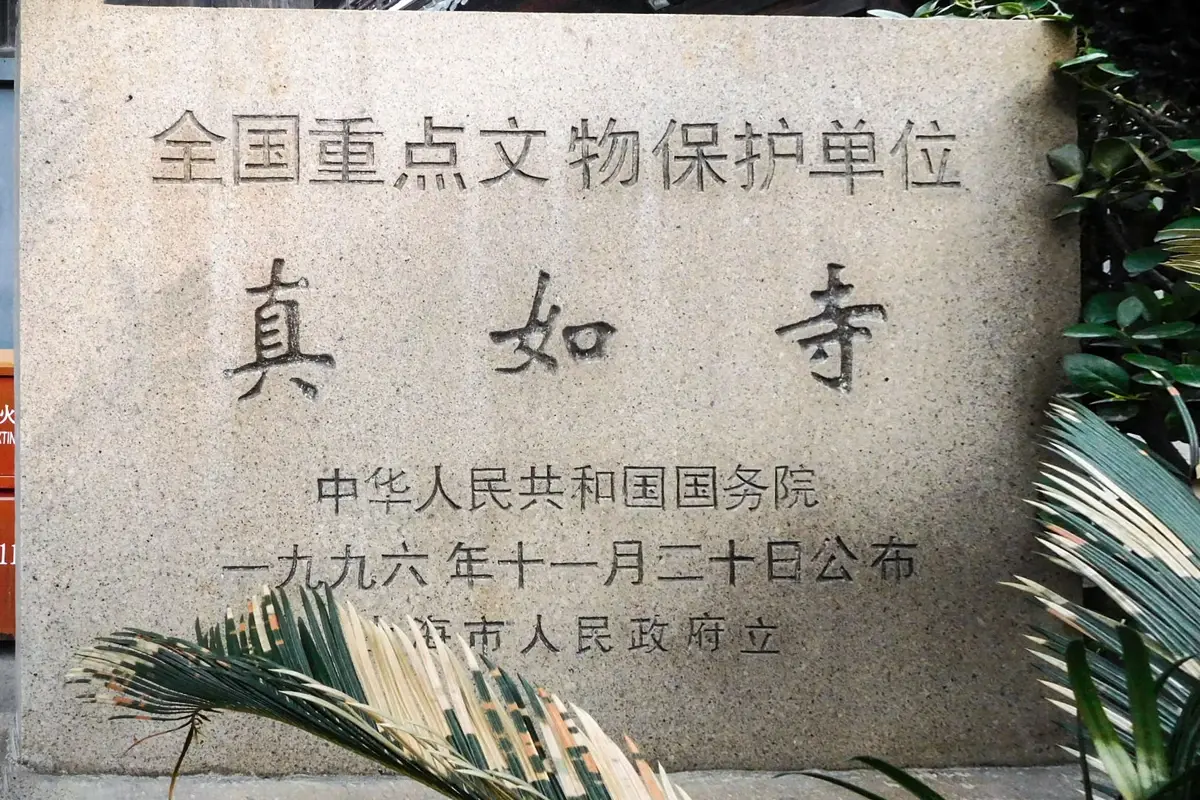
Built during the Yuan Dynasty, the temple was expanded during the Hongwu and Hongzhi reigns of the Ming Dynasty and once flourished. During the Anti-Japanese War, the temple was destroyed, leaving only the main hall from the Yuan Dynasty in a dilapidated state. After multiple renovations and expansions, in 1959 Zhenru Temple was designated a Shanghai Cultural Heritage Site, and in 1996 it was elevated to the fourth batch of National Key Cultural Relics Protection Units. It was officially reopened to the public in 1992.
In the main hall, on the large beam under the inner plaque of the central bay, there is an inscription: 'Built at the auspicious time on the 21st day of the last summer month of the guiwei year, the seventh year of the Yanyou era, gengshen year of the Great Yuan Dynasty.' It is said to be the record carved when the temple was completed. This double-outline incised inscription matches historical documents, confirming that this unassuming little hall in Putuo District is the oldest surviving wooden structure in Shanghai and a rare early architectural relic in the Jiangnan region.
New structures have been built in the temple, including the east-facing new mountain gate archway, Hall of Heavenly Kings, Yuantong Hall, Sutra Repository, Buddha Recitation Hall, and Rebirth Hall. The original old mountain gate across the river (No. 15 Siqian Street) has been sealed and preserved; a wooden temple plaque hangs on the old gate's archway.
The old mountain gate, located at No. 399 Lanxi Road, Zhenru Town Subdistrict, Putuo District, Shanghai, features three large Chinese characters '真如寺' (Zhenru Temple) written by Zhao Puchu, president of the Buddhist Association of China, in the center.
On the left and right sides of the entrance are representations of 'Wishless Liberation' and 'Signless Liberation', along with the wooden gate and a dragon motif on the ground.
The new Buddha Recitation Hall is cleverly connected to the east wing by a sky-bridge, forming an integrated whole. All buildings are based on the style of the Yuan Dynasty main hall, uniformly featuring grey tiles and white walls, single-eave hip-and-gable roofs, and dragon-head ridge ornaments. The decorations predominantly showcase natural-finish wooden structures. The entire complex, with its upturned eaves and simple elegance, exudes an ancient charm.
The main hall of Zhenru Temple, built in the Yuan Dynasty, is three bays wide and three bays deep, with an extremely complex interior structure. It has been repeatedly repaired over the centuries.
During the Hongwu reign of the Ming Dynasty (1368–1398), the monk Daoxin, and during the Hongzhi reign (1488–1505), the monk Falei, each carried out restorations. In the 20th year of the Guangxu reign of the Qing Dynasty (1894), Yang Yaowen, Gan Shilin, and others, together with the monks Nian'an and Nianlun from Shanghai's Shousheng Nunnery, jointly launched a fundraising campaign to repair the temple and extensively restored the main hall. The existing main structural components—beams, columns, brackets, etc.—and most of the elements are original Yuan Dynasty pieces, making this one of the very few surviving Yuan Dynasty buildings in Chinese Buddhist temples.
The first hall facing south is the newly built Hall of Heavenly Kings, designed in imitation Yuan style. Completed in November 1993 and inaugurated in 1994, it is a three-bay hall with a single-eave hip-and-gable roof. Its front plaque is uniquely named 'Tushita Inner Court'. Inside the hall, new additions include a bronze-cast Maitreya statue, clay sculptures of the Four Heavenly Kings and two Vajra Guardians (popularly known as 'Heng and Ha Generals'), and a wooden statue of Skanda.
Beyond the Hall of Heavenly Kings is the temple courtyard, with a ginkgo tree on each side. The one on the west side was planted by the monk who founded the temple, making it as old as the temple itself—over 700 years old—and a treasure of Zhenru. Today, the ancient tree is lush and thriving, protected by a fence. The fence is often covered with red wish ribbons tied by devotees praying for peace and happiness.
I visited in winter. To truly appreciate the beauty of this ancient ginkgo, come in autumn when the tree is ablaze with golden leaves, set against the temple buildings—a rare sight within the temple.
It is said that the tree has an extraordinary story. During the Cultural Revolution, when the ancient temple was damaged and abandoned, the ginkgo also suffered and gradually withered, showing no green leaves for years. Everyone thought it was dead. In 1992, when the Venerable Miaoling was assigned to revive the temple, the incense fire was rekindled, and the ancient tree, as if understanding human affairs, miraculously revived, sending out new branches and leaves—a Buddhist miracle. Believers spread the word and called it the 'Sacred Tree'. As more people came to bow and make wishes before it, it became known as the 'Wishing Tree'.
A Shanghai Protected Ancient and Famous Tree plaque: Ginkgo, No. 0067, 650 years old, First-Grade Protection.
Upon entering the inner courtyard, you immediately see the treasure of Zhenru Temple—the Yuan Dynasty Main Hall. It is one of the best-preserved Yuan Dynasty wooden temple structures in the Jiangnan region and the oldest surviving wooden building in Shanghai. Of immense historical value, it is listed as a national cultural relic.
The Yuan Dynasty Main Hall retains its single-eave hip-and-gable roof structure from the Yuan Dynasty. The roof ridge and hip ornaments—figures, beasts, and more—were recreated following Yuan Dynasty architectural manuscripts. In front of the hall is a dragon on the ground.
In the center of Yuantong Hall stands a 1.2-meter-high round blue-stone lotus platform, its waist supported by vajra pillars and adorned with high-relief carvings of the Eight Legions of Devas and Nagas. Enshrined on the lotus platform is a 5.2-meter-tall white marble four-faced Guanyin statue invited from Singapore, weighing 3.5 tons. The crown is carved with the Five Directional Buddhas, all from a single piece of jade—a very precious work. In the center of the checkered ceiling is a caisson featuring a thousand-hand, thousand-eye motif, symbolizing Guanyin’s all-seeing eyes and all-protecting hands to save sentient beings. Around the caisson are wooden carvings of the Thirty-two Response Bodies, arranged like a canopy. Inlaid on the walls are stone carvings of the twenty-eight divisions of Guanyin’s retinue, each with distinct expressions. Above them are inscriptions of the 'Universal Gate of Guanyin' chapter, written by Zhao Puchu.
Behind the Yuantong Hall is the Zhenru Pagoda Court. The 51-meter-tall, nine-story square pagoda, modeled after Song and Yuan styles, is dignified, towering into the clouds, and truly spectacular. Construction of the pagoda began in September 1998 and took one year and three months to complete. On December 24, 1999, the temple held the inauguration ceremony for the Zhenru Pagoda. Its style harmonizes perfectly with the rest of the temple complex, so its completion not only adds the perfect finishing touch to the temple’s appearance but also creates an iconic landmark for tourism, commerce, and the community of Zhenru Old Town.
The Zhenru Pagoda has nine exterior floors, ten interior floors, and an underground palace, making eleven stories in total. Zhenru Temple was the first temple in Shanghai to enshrine the Buddha’s physical relics. On November 14, 2004, Venerable Miaoling and a delegation personally went to Pudong International Airport to welcome the Buddha’s true relics to the temple, where they were placed in the pagoda’s underground palace.
Someone once wrote an article about the Zhenru Pagoda: 'The towering Zhenru Pagoda is like a giant dragon soaring among the clouds. The two black marble stones in the lotus pond are its eyes, the dhvaja (stone pillar) its whiskers, the two osmanthus trees its horns, the pagoda itself its body, and the cloud-patterned path in front its scales.'
The stone pillar in front of the pagoda is carved with many small lions and bodhisattvas, symbolizing protection for the pagoda and the bringing of good luck.
On both sides of the steps are imitation Tang-style Sumeru stone lanterns, exquisitely carved, symbolizing sublime illumination. Standing 3.5 meters tall, there are eight such lanterns circling the pagoda.
In the courtyard in front of the pagoda, to the left and right stand two blue-stone steles erected in 2002 (on the 8th day of the 4th lunar month of the renwu year). The one on the left is the 'Record of the Zhenru Pagoda', and the one on the right is the 'Record of the Restoration of Zhenru Temple'.
Around the square pagoda is a ring of 108 prayer wheels. Walking clockwise once around the pagoda while turning them is said to invoke the bodhisattvas' blessings for all things to go as one wishes.
The lions beside it are the guardian deities protecting the pagoda. There are a total of 108 prayer wheels at the base of the pagoda.
Behind the pagoda is the abbot's quarters and the Sutra Repository. The repository is a three-story wooden structure with double eaves and five bays per floor. The first floor serves as the abbot's quarters, decorated with natural-finish wood and furnished simply yet solemnly with a complete set of rosewood dharma seats, armchairs, and tea tables, exuding old-world charm. The second and third floors house over 12,000 volumes of Buddhist scriptures, including more than ten editions of the Tripitaka, and over a thousand calligraphy and paintings by famous artists. It is a tranquil and auspicious place for lecturing, propagating the Dharma, writing, and teaching.
The entire Sutra Repository features natural wood doors, windows, balustrades, and columns, giving a solemn appearance.
Starting from the Hall of Heavenly Kings, on the left and right sides respectively are two-story bell and drum towers. Extending northward on the east side are the Bell Tower, Ksitigarbha Hall, Manjusri Hall, Medicine Buddha Hall, Buddha Recitation Hall, and East Corridor. On the west side, starting from the Drum Tower, are the Sangharama Hall, Samantabhadra Hall, Reception Hall, and Meditation Hall.
To the west of the main temple buildings, along the east bank of the Taopu River, a 200-meter-long wooden covered gallery of calligraphy and painting has been built. In the northern section of the corridor, stone steles of various shapes—pagoda-style, table-screen style, drum-style, dhvaja-style, screen-style, and more—are embedded in an artistic arrangement, rich in Buddhist significance.
The themes of the steles were chosen by combing through a millennium of Buddhist cultural heritage, selecting the essence, and featuring the calligraphy of many famous ancient and modern masters. This makes them highly enjoyable for their Buddhist culture and art. Newly built stele corridors are rare today unless they are ancient; this one shows the abbot's foresight.
Under the eaves of the corridor, contemporary Zen-inspired calligraphy and paintings are hung. This Buddhist cultural corridor is a major feature and highlight of Zhenru Temple.
In the southern section of the corridor, 13 ancient bells are lined up, dating from the Wanli reign of the Ming Dynasty to the Republic of China period.
The pigeons in the temple are the most intuitive; they can understand when you speak. If one flies up to you, it means you are a kind-hearted person.
Here, an irregular strip of land has been meticulously designed as a Zen garden with artificial hills, flowing water, a winding bridge, spherical seats, flower trellises, and a release pond. The entire landscape represents harmony and fulfillment.
Along the northern edge of the temple, a long corridor has been built beside the Taopu River.
At the confluence of the Taopu River and Liyuan Creek, a bridge named Zhenru Bridge was built.
Though located in a bustling city, Zhenru Temple remains serene, making it a perfect place for worshippers who prefer quiet to pray and seek blessings.
Zhenru Temple is one of the four famous ancient temples in Shanghai (Jing’an, Longhua, Jade Buddha).
Zhenru Temple is tranquil and elegant, with pleasant scenery, lush trees, and green grass, far from the hustle and bustle of the city—a rare peaceful haven.


