Plum Blossom and Flower Tour in Shanghai While Travel Is Limited This Spring
The COVID‑19 pandemic has completely changed our lives. Our Spring Festival overseas trips, a tradition for over ten consecutive years, came to an abrupt halt this year. Because of sporadic domestic cases, the government encouraged us to stay put for the holiday, kicking off our first “confined‑to‑Shanghai” Lunar New Year in ages. For the first time in more than a decade, our family of three had New Year’s Eve dinner at home, watched the Spring Festival Gala, then visited relatives, shopped and saw a movie on the first two days. After a few days in this concrete jungle, the holiday started to feel a bit stifling and boring.
On the third day, with nothing planned, I looked out at the bright sunshine but felt empty inside. I decided to head into the countryside to soak up some sun and fresh air. Close to home, the newly opened driverless Metro Line 15 had its terminus right at Gucun Park. The whole city knows Gucun Park as a cherry‑blossom mecca—when the sakura are in full bloom, it’s packed. Besides cherry blossoms, I’d heard they have quite a few plum trees too. The plum flower, one of the ‘Three Friends of Winter’, is a gorgeous herald of spring, and it was primetime for viewing them. So I decided on Gucun Park. From Exit 5 of Line 15’s Gucun Park station, a roughly 500‑meter walk along Jingbo Lake Road brings you to Gate 2 of the park. Gucun Park spans about 430 hectares—a big urban‑fringe forest park blending ecological protection, scenic views, leisure, culture, and tourism.
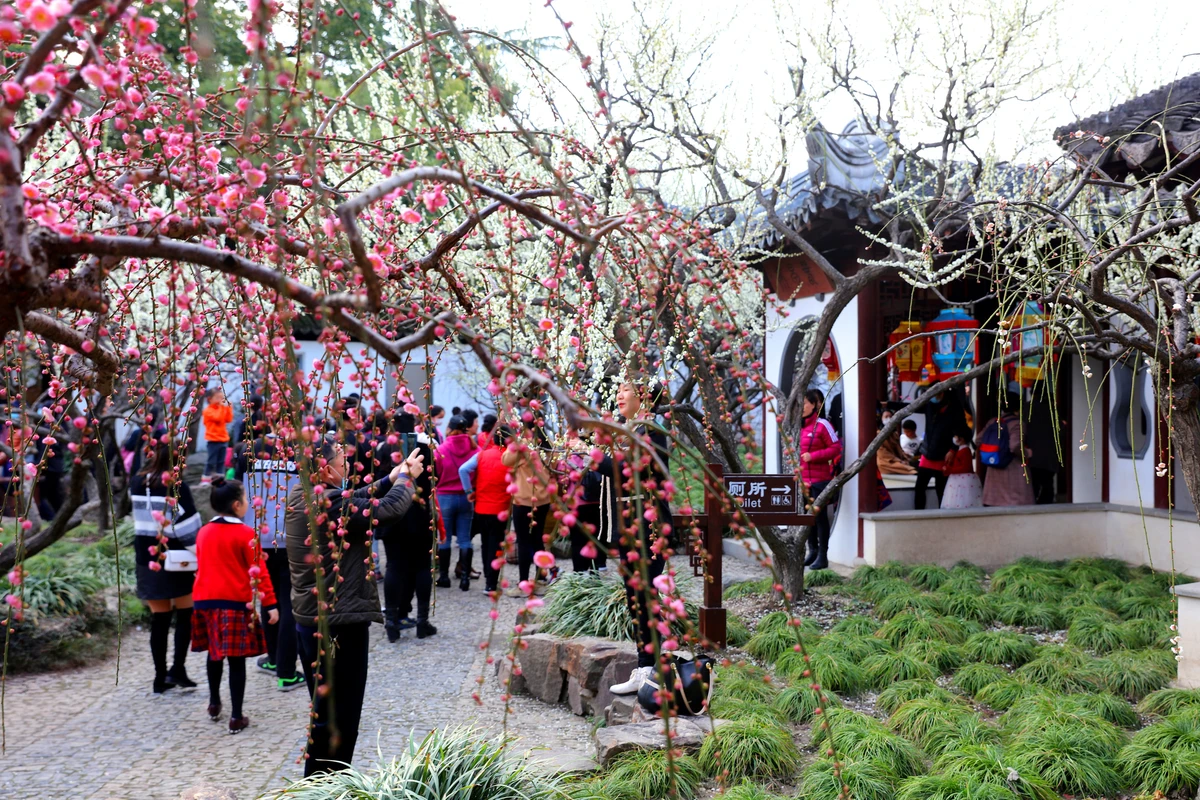
The weather was lovely that day: blue sky, white clouds, clear and boundless. In the morning there weren’t many visitors yet, and it lifted our spirits. Going left from Gate 2, we ambled along, breathing in the crisp air, chatting and laughing. We passed the Dinosaur Castle, the Children’s Playground and other cultural facilities, then reached a grove of plum trees. The blossoms were in full show, branches bursting with buds. As we drew closer, a faint fragrance of plum hit our noses, refreshing and soothing. Up close, red plum flowers stood proudly on the branches, their delicate pink petals set off by yellow stamens, eagerly waiting to welcome spring. In the warm sunshine, they looked bold, quiet, deep, or coquettish—each one displaying its charm and luring many visitors to stop for photos.
We kept walking. The whole park was like a beautiful painting, with flowers glowing prettily. Since the Start of Spring had already passed, a few early cherry blossoms at Gucun Park were already putting out buds—some had secretly opened. As spring draws nearer and temperatures slowly rise, before long the park will once again be swirling with cherry blossoms, giving visitors a dreamy visual feast. Beyond the floral beauty, Gucun Park also has the ‘elegant modesty’ of a Jiangnan garden. Streams meander through the park, crossed by bridges of all styles, while pavilions and terraces dot the waterside, hillsides and rockeries. Around the rocks, calamus, slender‑leaf miscanthus, Shirley poppies and other aquatic plants and ornamental grasses and flowers are planted. ‘Wild charm’ is another feature deliberately created here. The park preserved some of the original hamlet’s watercourses, and their natural banks, with a little refining, now look like wetlands. Walking on the riverside paths, a breeze carrying the scent of grass blows gently. Looking across the banks, even in winter, the dense vegetation attracts plenty of birds—sparrows, blackbirds, light‑vented bulbuls—darting among the thickets. The historical vibe is strong too: over a dozen bridges, large and small, many centuries old. Strolling on these ancient spans, touching their weather‑worn balustrades, you feel history right under your feet as each tale‑rich bridge stretches over the green water.
Wild‑feeling as it is, Gucun Park is still a cherry‑blossom‑themed park. The plum flowers are beautiful but not abundant. After wandering for over two hours, we decided to leave and head to Nanxiang Guyi Garden—picturesque in every season—to enjoy plum blossoms in a classical Jiangnan garden, continuing our New Year plum‑blossom tour.
We exited Gucun Park, took Line 15 back home, switched to our car, and drove straight to Nanxiang Guyi Garden. Lunchtime had passed, so we first went to Nanxiang Old Street next to the garden for the famous Nanxiang soup dumplings. This Spring Festival, with everyone encouraged to stay in Shanghai, the narrow old lanes were a sea of people. Standing on a bridge, all around was a dense crowd, moving forward involuntarily. Seeing that, I had no wish to join the hullabaloo and knew we shouldn’t bother with the well‑known dumpling shops today. We randomly ducked into a small eatery that still had seats to fill our stomachs. To be honest, for soup dumplings you really need a famous old house; this one’s version only got a “ha‑ha” from us.
After eating, we went across the lane to the northwest gate of Guyi Garden on Guyi Road. I’ve been there many times: it’s a classical Jiangnan garden where you can enjoy peonies in spring, lotus in summer, colourful leaves in autumn, and plum blossoms in winter—every season has its charm. Today we went straight for plum‑blossom viewing. A year’s days are like a book of poetry, and the first lunar month is its colourful cover. Stepping into Guyi Garden, you’re wrapped in festive spirit: rows of lanterns hang high in the corridors, lending a gentle, serene glow to every building.
“Year after year, my promise to flowers is left to the red plum, on the riverbank again about to bloom.” After the Start of Spring, the most anticipated floral event is the plum’s opening. Right now in Guyi Garden, the plum trees are stretching their sparse twigs, ready to flower. Clusters of branches carry different coloured plums. Plump buds look like irresistible smiles; some can’t hold back and have already bloomed, releasing the fragrance nurtured so long; others still have red‑flushed cheeks, making you wonder whether they’ll open tomorrow or the day after; and a few dots still show no colour, delicate as water droplets. As the foremost of China’s ten traditional famous flowers, the plum, with its purity, resilience and humility, embodies the spirit of facing hardship with courage, and is one of the plants that best represent backbone. Historically, scholars adored it for its virtue and unyielding character. In the elegant Guyi Garden, rich varieties of plum, densely flowered, look especially enchanting on strong branches, set off by the flying eaves, bracket sets, and understated pavilions.
Guyi Garden has many plum varieties. All winter, early and late plums bloom in succession: green calyx, palace pink, jade butterfly, each with its own grace. The best spots are inside the Bonsai Garden, behind the ‘Cannot Be Without Bamboo’ Studio in the new section, in and around Dark Fragrance Garden, and near the Plum Blossom Hall. As we wandered among pavilions and corridors, each step revealed a different view, and by following the scent to seek plums we saw varied scenes—plus the Plum Blossom Hall, Plum Path, Plum Window and Plum‑Inscribed Corridor, all heightening the mood and elegance. At this time, Guyi Garden’s sparse, quiet winter views perfectly complement the plum’s temperament, adding a cultured air to the flower‑watching, letting us appreciate extraordinarily beautiful scenes. Everywhere you see the ‘Three Friends of Winter’—pine, bamboo and plum—combined in harmony of colour and spirit. Evergreen pine and bamboo, plum ushering in five blessings, all braving the cold with unyielding dignity. Plums planted by windows and water’s edge, with their dappled shadows and subtle fragrance, pair perfectly with white walls and elegant embankments, and their clear reflections in the quiet waters form a lovely picture.
This year, with the government calling for staying put, locals not leaving the province and outsiders not returning home, Shanghai’s Spring Festival was bustling. Even in little Guyi Garden, visitor numbers were high, especially in and around Dark Fragrance Garden, the most scenic spot—it was shoulder‑to‑shoulder and noisy. Any place this beautiful loses its charm when crowds descend; that’s the greatest problem with domestic tourism. Seeing this, after a few quick photos we hurriedly left. We went to the Yinren Tang tea house inside the garden, ordered a pot of tea, and watched the throngs pass by as we inhaled the faint plum fragrance, lazily soaking in the bright New Year sunshine. At that moment, this year’s holiday mode didn’t seem half bad.
We kept enjoying the lovely holiday—but no sleeping in. Waking early the next morning, I saw an overcast sky outside. The weather wasn’t great, but it couldn’t dampen my anticipation of spring. Today we decided to go to Shanghai Botanical Garden, famous for its diverse flowers. Driving from home, we took the Middle Ring Road—smooth all the way—and in about 20 minutes reached Longwu Road. Entering through Gate 2, the garden has two ticket types: a ¥10 general admission, and a ¥40 combo that covers two indoor conservatories, the Orchid Room and the Bonsai Garden. We bought the ¥40 combo. The weather was poor, but there were plenty of visitors.
Welcoming spring, revelling in the tips of spring—Shanghai Botanical Garden has long been the go‑to place for curious flora. Although there’s now the larger Chenshan Botanical Garden with even more species, Shanghai Botanical Garden is in the city, easy to reach, and packed with rare plants, making it attractive in every season.
Being a specialised garden with a huge variety of plants, during the Spring Festival holiday it runs a distinct exhibition, offering visitors a wide array of festive flowers to create a rich New Year atmosphere. This Year of the Ox, the exhibition incorporated many plants with ox‑related elements to highlight the zodiac. These were displayed in the indoor conservatories. Since the two conservatories are close to Gate 2, I went straight in. Entering Conservatory No. 2 first, a wave of warmth washed over me, followed by a blaze of blooming flowers. Both conservatories held many plants and blossoms I’d rarely seen. Checking signs, I paid particular attention to the “ox‑themed” plants: ones with leaves like ox horns (Ceratostylis oxyphylla), leaves like an ox tongue (Dendrobium linguella); plants with “ox” in their names like variegated Ardisia, petunia (also called “Purple Winter Eggplant”), Ox‑tongue Orchid, ox‑tongue Begonia; also tasty and pretty oregano and avocado; and those without “ox” in the name but famously “ox”‑like — Darwin’s orchid (Angraecum sesquipedale), Indian ghost pepper, Nepenthes x Dyeriana. Besides these, symbolic plants like “great luck” kumquat trees, “everlasting harmony” lilies, “longevity” Kalanchoe, “pure heart and soul” Cymbidium were also in full display, along with Phalaenopsis orchids, Oncidium, and Christmas cactus—all popular festive flowers gathered together. The exhibition design was steeped in New Year flavour, with Chinese red as the main colour: from red oil‑paper umbrellas overhead to red silver willow, to florid Rhododendron and vivid anthurium… the whole place oozed festivity. In short, the conservatories gave my eyes a wonderful feast—I was utterly dazzled and lingered.
From childhood we’re taught not to be greenhouse flowers. Reality shows us that greenhouse flowers are mostly tender, bright, and endearing. So be a person who doesn’t live in a greenhouse, but the flowers in there are certainly worth seeing.
Stepping out of the warm indoor exhibition, the temperature difference was a shock, jolting me back to reality. But around the conservatories, you could see plum blossoms, early cherry buds and magnolia about to bloom. This scene instantly made me feel spring was already here.
Welcoming spring, revelling in fresh shoots—Shanghai Botanical Garden exuded New Year atmosphere everywhere. With our combo ticket we entered the Orchid Room, a large classic‑style Chinese garden for orchid appreciation and cultivation. Antique and elegant, its corridors were lined with glossy root carvings, embraced by greenery, with courtyards linked by covered walkways. Chinese orchids represent the gentleman’s spirit—pure, elegant and refined—so the entire layout revolves around that theme, distinct from ordinary garden design. Orchids are a traditional Chinese flower that embodies millennia of culture; the Orchid Room’s architecture is classical. The late Commander‑in‑Chief Zhu De personally inscribed the room’s name. It now houses a large collection of famous orchids gifted by the patriotic General Zhang Xueliang and Japanese friends—over 300 varieties in total, displayed in potted, natural and courtyard zones, recreating their original habitat. Unfortunately, the peak orchid season hadn’t arrived yet, so we could only stroll around this deep Jiangnan courtyard and admire the garden landscape.
Not far from the Orchid Room is the must‑see Bonsai Garden, also accessible with the combo ticket. It’s divided into trunk bonsai and rock bonsai areas. In the trunk area, a winding 563‑square‑metre mixed‑structure corridor splits the space into several small courtyards, showcasing over a thousand potted trunk specimens. The corridor is open on both sides with railings; each courtyard has two facing doors. On rainy days or under scorching sun, visitors can view the bonsai on either side while staying under cover. In the Vigorous Pine Courtyard, you’ll find pine and cypress bonsai: five‑needle pine, Podocarpus, black pine, Shimpaku juniper, Chinese juniper, golden larch, and Japanese yew—all deep green, ancient and elegant. The Flower‑and‑Fruit Courtyard displays plum, elm, wisteria, crabapple, pomegranate, red maple, firethorn, thorny elaeagnus, and wintersweet. Miniature and micro bonsai were originally exhibited in a Ming‑Qing‑style building called Sijing Pavilion (322 sq m). Those tiny potted tree stumps look like palm‑sized objects from afar but reveal forest‑like vigour up close. In 1995, the mini and micro bonsai were moved into an octagonal mixed‑structure conservatory (443 sq m). The rock bonsai area’s water‑and‑stone bonsai hall is a Ming‑Qing‑style building (449 sq m). At the entrance, a 7‑metre‑long landscape using axe‑split stones evokes Guilin’s scenery, imposing and grand. Inside, 28 miniature landscapes crafted from axe‑split stone, Yingde stone, stalagmite, stalactite, Taihu rock, pumice, sand‑stored stone, sea‑mother rock, and reed‑tube stone capture all manner of mountain and water wonders within a tiny space. The natural beauty of Chinese bonsai comes from the inherent shapes of plants and rocks. As is well known, the Shanghai school of bonsai stands out globally for its refined modelling and meticulous care, aligning with today’s healthy, positive aesthetics. Like the sea that accepts hundreds of rivers, it assimilates strengths from many traditions to grow into greatness. The Bonsai Garden was also brimming with New Year vibes, and its wintersweet and plum were blooming just right. Bonsai plums, with their restrained, sparsely shadowed shapes, complemented the white walls, black tiles, flying eaves and bracket sets perfectly. The architecture is a still backdrop, the flowers a living picture; each season’s cycle of blooms and leaves becomes a painting. If you’re into horticultural art, you won’t be disappointed here.
The best plum‑viewing spot within Shanghai Botanical Garden is the Rose Garden (near Gate 3 on Baise Road), but by now the sky was getting darker, the wind stronger, and rain seemed imminent. After admiring the rare greenhouse blooms and the gorgeous landscapes of the Orchid Room and Bonsai Garden, we decided to leave.
Although COVID‑19 has stopped us from venturing out of ‘Hu’ (Shanghai), it can’t stop our yearning for a beautiful life. This unusual spring flower tour filled us with joy and warmed us with the rich atmosphere of the Year of the Ox. It seems this different kind of New Year holiday mode isn’t bad at all.
Travelogue Contents: 1. 2021‑02‑14 morning, Shanghai Gucun Park; 2. 2021‑02‑14 afternoon, Shanghai Nanxiang Guyi Garden; 3. 2021‑02‑15, Shanghai Botanical Garden Travel Information Hotel Index Guide Index Flight Index Website Navigation Tour Index Cruise Index Corporate Travel Index Affiliate Cooperation Distribution Alliance Friendly Links Corporate Gift Card Purchase Insurance Agency Agency Cooperation Hotel Joining Destination & Scenic Area Cooperation More Affiliate Cooperation About Ctrip About Ctrip Ctrip Hot Topics Contact Us Career Opportunities User Agreement Privacy Policy Business License Security Center Ctrip Content Center Intellectual Property Trip.com Group Algorithm Announcement


