A Self-Drive Day Trip to Jinshan and Songjiang
A few days ago, Zhuzhu invited me and Xiaoxu on a self-drive day trip. There were five of us—the other two were Zhuzhu's boyfriend Xiaozhou and her younger sister.
Xiaoxu, Zhuzhu, Zhuzhu's sister, and I met at People’s Square subway station entrance, then headed to Putuo to pick up Xiaozhou. Xiaozhou had rented an electric car, a Roewe four-seater. It was a bit cramped for the five of us. Xiaozhou drove, with Zhuzhu in the passenger seat.
Our first stop was Fengjing Ancient Town in Jinshan District. Apart from Zhujiajiao, this is Shanghai’s most famous ancient town. I’d been wanting to visit Fengjing for a while but it never worked out.
Jinshan has no subway; it's quite far, and taking a bus would be very slow, so self-driving was much more convenient. In about an hour we arrived at Fengjing. This was my first time in Jinshan District—among Shanghai’s administrative districts, only Fengxian still remains unvisited.
The ancient town has a ticket office, but you can enter without buying tickets. Inside, a few small attractions require tickets.
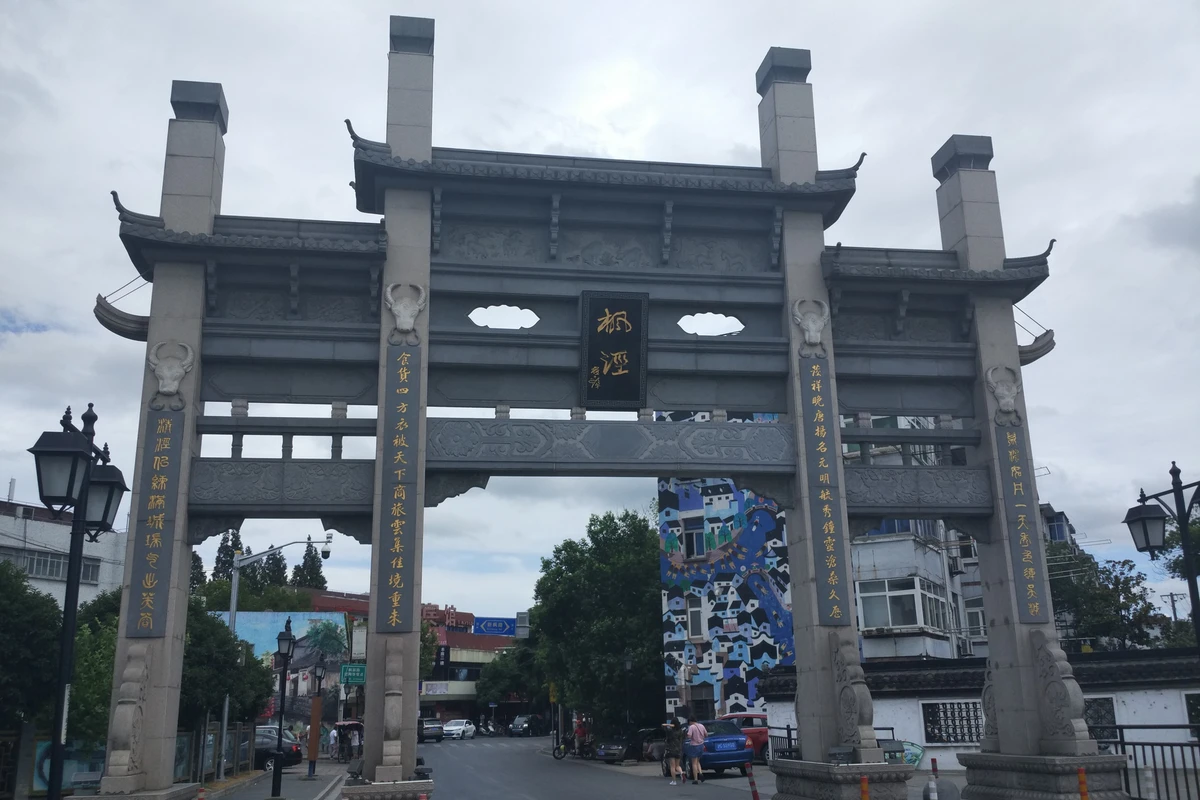
We entered through a memorial archway. On the map, the old town looked tiny. The first attraction was a covered corridor along the water called Fengxi Corridor. One side of the corridor borders a creek, which is probably Fengxi; the other side is lined with shops, mostly restaurants and specialty snacks. Since we arrived quite early, many shops hadn’t opened yet. There’s a Wuyue Stele in the corridor—it originally marked the border between the Wu and Yue states in the Spring and Autumn and Warring States periods, and later became the boundary between Jiangsu and Zhejiang provinces. Next to it is a stone tablet inscribed with “Record of the Wu-Yue Border,” which recounts the historical evolution of this boundary.
At the end of the corridor are the Fengjing Three Bridges: Qingfeng Bridge, Zhuhang Bridge, and Beifeng Bridge. The bridges are close together, so you can capture all three in one photo. Taking pictures on Qingfeng Bridge gives that classic “small bridge, flowing water” feel. Too bad the weather was lousy—overcast, no blue sky or white clouds, just dark clouds. The river water was greenish, murky, a bit dirty. The riverside houses had whitewashed walls and black-tiled roofs, but many were run-down: walls not quite white, tiles not really black. All this dampened the charm quite a bit.
Off the bridge, we walked into a narrow lane. The lane was very narrow, flanked by those same white-wall, black-tile houses. At the foot of the walls, there were green plants, mostly creeping jenny, and some wild purslane and a type of gourd—not cucumber, perhaps loofah. That was rather interesting.
We had come at the wrong time—many small attractions in the old town were under renovation and closed. It’s a shame the town didn’t advertise this. Even though there’s no admission fee, we felt a bit cheated.
By the river, there’s an old stage, the ancient opera stage, said to be very historic but quite small. There was no performance at the time, so we sat in the audience area to rest and have some snacks. The seating was all wooden benches and wooden chairs with backrests, the kind you rarely see nowadays.
Cheng Shifa’s Former Residence was just up ahead, but none of my friends were interested in visiting it. So we crossed Taiping Bridge and headed back. At the bridgehead, there’s the Eastern District Firefighting Society, an old fire station that now serves as a small museum. Inside, there are vintage firefighting equipment and exhibits about the world’s ten worst fires, China’s ten worst fires, and major Shanghai fires.
On our way back, we bought some zongzi (sticky rice dumplings) to eat. They were huge and tasted pretty good. It was already lunchtime, but we didn’t want to eat in the old town—there wasn’t much good food, and prices were a bit high. Exiting the old town, we found a small eatery not far from the entrance and ordered a few dishes. The food was okay, but the dining conditions were really poor.
We got back in the car feeling like we hadn’t seen enough. There’s Donglin Temple nearby, but nobody was interested in temples. Checking the map, we saw Sheshan wasn’t far off. Zhuzhu and I had been to Sheshan before and didn’t want to revisit. So we ended up choosing Tianma Mountain, not far from Sheshan.
Tianma Mountain is one of the Twelve Peaks of the Sheshan Nine Peaks, once the highest point on land in Shanghai (now it's West Sheshan), and a famous Taoist mountain. The mountain has many historical sites. We entered through the south gate, and the first site we came across was Huzhu Tower, a leaning pagoda. The base of the pagoda has collapsed into a big hole, yet it stands firm. Zhuzhu liked this tower, saying it protects her (a pun on her name). Not far from the tower is a ginkgo tree, said to have been planted during the Song Dynasty, over 700 years ago. Its trunk is sturdy, branches and leaves lush, with clusters of ginkgo fruits hanging from the branches—no sign of old age.
Leaving Huzhu Tower, we continued climbing along the mountain path. A white cat with a black tail accompanied us for quite a distance. Because of its small size, it didn’t need to walk on the rough, rocky path; it nimbly stepped along the narrow stone curbstones, keeping up with our pace.
Halfway up, Zhuzhu and her boyfriend sat down to rest, eat snacks, and refused to go any further. The cat, drawn by the snacks, stayed with them. So we split into two groups: Zhuzhu and her boyfriend stayed to feed the cat, then returned to the south gate to get the car and drive to the east gate to pick us up; me and the two “youngsters” continued climbing, then exit through the east gate to meet them.
Tianma Mountain has the largest forested area among the Twelve Peaks of the Sheshan Nine Peaks. Both sides of the path are thick with trees, especially bamboo groves that are exceptionally verdant and soothing to the eye. No wonder the ancients said, “One cannot live without bamboo.”
Near the summit, there’s an ancestral hall under renovation. We went in but came out quickly, then started descending.
On the way down, there’s a pavilion called Wosong Pavilion (“Reclining Pine Pavilion”), but I didn’t see any pine trees nearby, so I have no idea how it got its name. Next to Wosong Pavilion is a burial site, the San Gaoshi Tomb, where three Yuan Dynasty literati—Yang Weizhen, Qian Weishan, and Lu Juren—are buried.
Leaving San Gaoshi Tomb, we arrived at the uniquely shaped Liuyun Pavilion. It’s called a pavilion but looks more like a two-tiered structure, with the top resembling a pavilion and the bottom a hall. This was the first time I’d ever seen architecture of this shape. There’s very little information about this building, even online, so its origins remain a mystery.
Zhuzhu and her boyfriend had already driven the car to the east gate and were urging us to come down. So we quickened our pace and exited through the east gate to meet up. The two youngsters ran and jumped the whole way, not the least bit tired, while I, the old-timer, was struggling a bit.
Tianma Mountain isn’t huge, but our quick visit was still too rushed—we missed many sights. We’ll have to save those for another time.
We drove away from Tianma Mountain and headed to Songjiang University Town, planning to find a place to eat there. Passing the Guangfulin Site, we were all drawn to its unusual architecture, so we stopped to take photos.
Guangfulin is where Neolithic-era relics were unearthed, bringing it widespread fame. Now a park and exhibition hall are being built at the discovery site. The architecture here is extremely distinctive: buildings stand in the water, with only their roofs exposed, as if the whole structure is submerged. The site isn’t finished yet and hasn’t opened to the public. I’d love to see what the inside looks like.
Leaving Guangfulin, we gathered for a meal at the Wanda Plaza next to the university town. Since it was summer vacation, there were very few students around; the streets were empty. Xiaoxu, who had just gotten her driver’s license, got to practice driving under Xiaozhou’s guidance.
After dinner, we drove back to the city center, ending our day’s self-drive trip. The day went smoothly, though poor weather, the closure of many spots in Fengjing Ancient Town due to renovations, and our too-brief visit to Tianma Mountain left us with some regrets. But overall, we had a lot of fun, and we all said we’d love to go on another self-drive trip sometime.
Travel Journal Contents
1. Foreword
2. Fengjing Ancient Town
3. Tianma Mountain
4. Guangfulin Site
Travel Information
Hotel Index
Guide Index
Flight Index
Website Navigation
Travel Index
Cruise Index
Corporate Travel Index
Partnership & Cooperation
Distribution Alliance
Partners
Corporate Gift Cards
Insurance Agency
Agent Cooperation
Hotel Franchise
Destination & Scenic Spot Cooperation
More Partnership
About Ctrip
About Ctrip
Ctrip Hot Topics
Contact Us
Careers
User Agreement
Privacy Policy
Business License
Security Center
Ctrip Content Center
Intellectual Property
Trip.com Group Algorithm Disclosure


