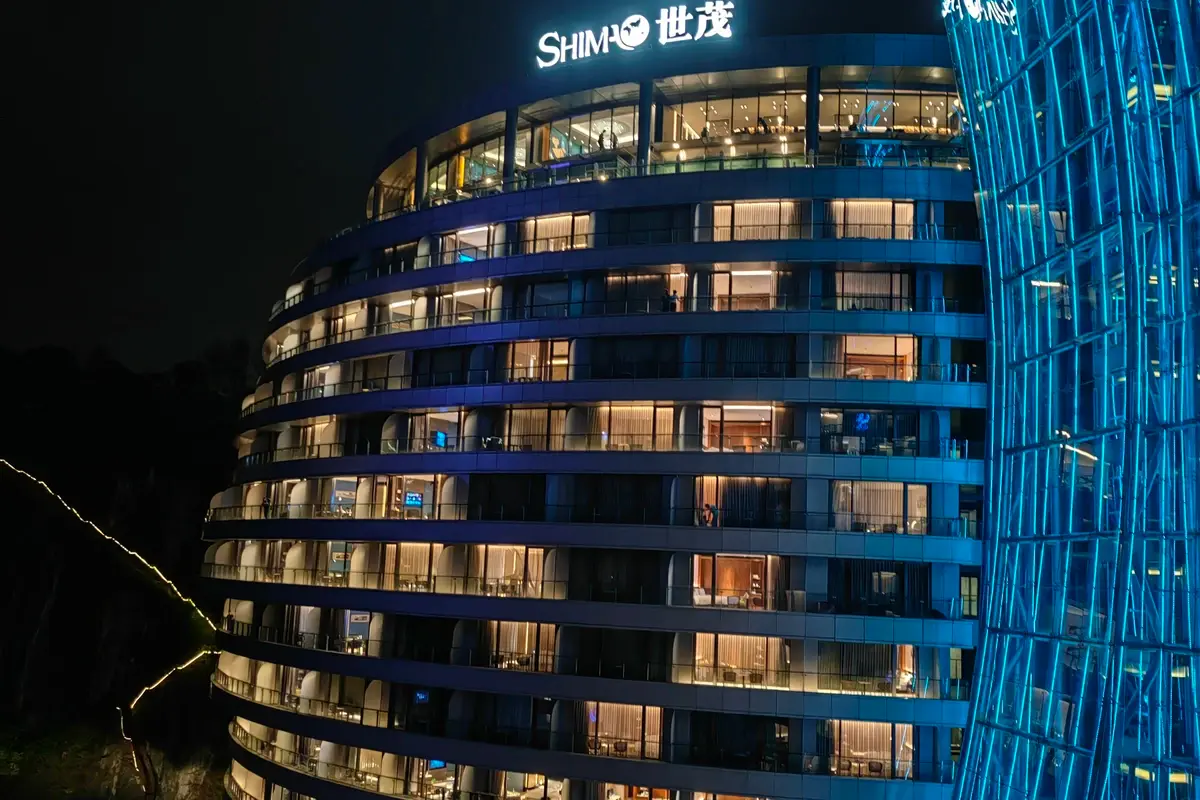
National Day Getaway: How I Lured You into the InterContinental Shenkeng
Where to go for the National Day holiday? Many ideas had floated around, but we finally fixed on the InterContinental Shenkeng in Songjiang for the 3rd to 5th of October. We ate in the pit, played in the pit, and slept in the pit. This whole-family bucket—wang spearheaded it, and the group included ying, ping, ting, lan, and me.
October 3, Monday. Guangfulin Cultural Relics Park was the first attraction we encountered. Ping and I, who lived farthest away, became the earliest pathfinders. By 9:15 we had parked in the lake-bottom car park at Guangfulin, and by 9:25 we were sitting in Duoyun Academy, savoring coffee and the fragrance of books. For wang and the others, we left behind just time and the academy’s location.
At the Fulin Screen Wall, ping and I only took note of the introduction to Guangfulin’s layout before turning around to the Duoyun Academy housed in a tall Ming-dynasty mansion, with a signature semi-subterranean waterside dwelling just beside it. We merely snapped a photo.
The tall Ming mansion is a quintessential old Huizhou residence, with lofty halls, deep courtyards, bright central spaces, and side chambers. Not just whitewashed walls and dark tiles, but also horse-head gables and exquisitely carved gateways. Many wooden elements had been replaced by brick and stone carvings—bracket arms, rafters, eaves tiles, hanging lotus columns—so that the plain pink walls came alive with the three-dimensionality of fretwork and relief. Now the plaque bears the name Duoyun Academy, a perfect match for a scholarly home: Hanlin Mansion, Dafu Residence, ʻBamboo and Pine Thrive, Purple Air Comes from the East.ʼ We were moved by our own academy. Duoyun Academy, where within books you’ll find golden houses and faces like jade.
We made a highly ritualized entrance, scanning our codes like individuals of precision. The first hall’s entrance distinguished entry from exit, and we began our Duoyun reading mode from the right.
The right side was entirely open; you could no longer see the traditional wing-room separations. The immovable carved beams and painted rafters stood in the middle. Hereon display were mostly books and a few pieces of calligraphy, popular titles on open shelves, niche ones in alcove showcases.
Unconsciously, ping and I reached the academy’s turnaround point and spotted tea and coffee for sale. We guessed this must be the third hall of the old compound. Where was the second? We’d only find out after ordering.
An unavoidable hurdle. We ordered a latte and an Americano, stepped over a high threshold into a courtyard, and then another step into the tea-and-coffee lounge. The central C-spot was already occupied by snacking couples; we chose a spot to the right, away from the doorway, and sat back with the richness of coffee.
Leisurely, we sized up our surroundings. This should be the second hall of the mansion, set between two courts: the front one named Pine-Stone Realm, the back one Water-Cloud Haven. Beyond the poetic similes, the implied meaning was easy to guess—Songjiang, the old “Cloudy Realm.”
Remembering that wang, ying, ting, and lan hadn’t yet arrived, I casually sent a WeChat message. Lan replied: “Stuck on the access road.” And ting casually said: “Overslept, just set off now.” Haha, overslept, dreamed, arrived, time slipped by.
Then came reading time. I read two books: Hockney’s Pictures and This Is China. At random, I felt Hockney’s refreshing decorative flair. A cup of bitter coffee, bitterness dissolving, filling my eyes with his bright, clean colors. At times I thought of Gauguin, at times of Van Gogh.
Just then wang’s WeChat buzzed: “We (wang, ying, lan) are here.” I checked the time unconsciously—10:40. We’d already been sitting in Duoyun Academy for an hour.
Tea time, tea time. The seats suddenly became cramped. Phoenix Dancong tea, plus snacks and pastries. Teacups, teapots, tea pitchers, tea presentation vessels, tea strainers, tea scoops—instantly covered the whole tea table. My book had to move.
Wang warmed the cups, awakened the leaves, and brewed. The fragrance filled the cups. One sip, bitterness and astringency separated. The bitterness remained, but the astringency faded; someone even detected the sweetness of osmanthus.
This Is China shifted in front of ping, then into ping’s hands. After a few pages, they sighed that our country’s GDP ranks second in the world, but per capita ranking still lags. Wang casually remarked, “It’s not easy—we’re already in the top 60.”
Ting, the last to arrive, was full of confidence because she knew someone inside—the waitstaff couldn’t stop her at all.
At 11:45, we left Duoyun Academy. The Ming mansion’s gateway became our focus again. The same scene moved us twice. Duoyun Academy, we really admire you!
Our next stop wasn’t specified in the plan; everyone agreed to go with the flow—what we met was what we got. It was a scorching day; we needed to take it easy, answer nature’s call first, and travel light.
Heading north, past the “Cloud-Tinted Rosy Dawn” archway, we came to a long bridge. The scenery wasn’t on the bridge; we took photos to the east.
For the scenery to the west, we had to walk a bit further. After crossing two small bridges in succession, the brick-red Guangfulin Archaeological Exhibition Hall appeared before us. The building, shaped like a cluster of pots and jars, had a volume of 7,788 square meters and even lured us into paying for a visit—feeling as if we’d been put under a spell.
As we walked, wang gave an archaeology primer. Shanghai’s roots are claimed by both Qingpu and Songjiang. Songze culture and Guangfulin culture: chronologically, Songze is earlier, connecting the Majiabang culture above and Liangzhu culture below. Guangfulin culture is merely a node between Liangzhu and Maqiao cultures. Today’s Songjiang has seized on it and made the most of it—so you could say they’ve got hold of the root.
So much knowledge gained! All treasures—jade cong, jade bracelets, stone plows, stone molds. Wang added: “A jade cong is round inside and square outside, connecting heaven and earth. A stone mold is a stone model, both female and male molds; maybe that’s the earliest origin of the term ‘mofan’ (model).” And House Site No. 12: intuitively it should be a ground-level dwelling, not a semi-subterranean one.
Seeing us in high spirits, wang gave lan a one-on-one tutoring, talking about geological eras and Chinese chronology.
We’d entered the exhibition hall at 12:15 and left at 12:45. Half an hour of archaeological enlightenment was hugely rewarding. That spell was worth it!
It was already lunchtime, but we were still on the scenic trail. Our third scene required little effort and little time, yet it was deliberate. We pretended we were in Kyoto—the Fulin Pagoda could be mistaken for the three-story pagoda of Kiyomizu-dera. The long corridor of Sanyuan Palace looked exactly like the one at Sanjusangen-do. We were Japan-crazy. Actually, we also wanted to pretend we were in Chang’an or Yiluo, but Tang-dynasty architecture is too wooden, unlike brick and stone, and hasn’t survived. “Ten years on the long road to Yiluo; not seeing Chang’an fills one with sorrow!”
A little tip: Pagodas can be categorized by type—multistorey, dense-eave, lama, diamond-throne, and tomb pagodas. By material: wood-shaped, brick-stone, metal, glazed. The number of stories is often significant—usually odd numbers, each with different meanings. Seven stories represent the seven treasures: gold, silver, crystal, tridacna, agate, pearl, rose. Thirteen stories represent the thirteen Buddhist schools, and in Buddhism thirteen is an auspicious number, signifying complete merit. As the saying goes: saving a life surpasses building a seven-story pagoda, which refers to a seven-tiered tower. The plan is usually square or octagonal, sometimes hexagonal, dodecagonal, or round. Pagodas generally consist of an underground palace, base, body, and spire.
The Fulin Pagoda, a three-tiered pagoda, with its spire pointing to the clouds, is the standout sight in Guangfulin. The whole pagoda is dignified and elegant, restrained and grounded. Three tiers symbolize the three realms of existence. We mortals sail an endless sea of bitterness; we who practice and seek enlightenment wait for the day when sincerity pierces stone. By then, we would have journeyed from the kingdom of necessity to the kingdom of freedom. Quietly thinking about it—pain and happiness together—it’s a joy. Haha, we can still laugh. Our state isn’t high; we can’t go far—still stuck in the three realms.
At that moment, my phone buzzed: “Need to reserve seats at West Bank Steakhouse?” No, we had a meal appointment at Lushan Ren Japanese Restaurant in Songjiang Impression City. After enduring many hardships, we still hadn’t given up our love for refined cuisine!
Where was ying? Our six-strong family bucket was missing just ying. She was probably still in Sanyuan Palace. Lan dropped her own business to search. To be honest, ying loves taking photos, but we rarely got to see her finished shots. Strange, isn’t it?
At 13:00, we finally gathered everyone to leave. One last photo, a little nostalgia—goodbye, Guangfulin!
We’d thought about reserving a table, but never imagined we’d need to reserve parking spaces too. After a long time circling, our three cars each squeezed into different spots scattered north, south, east, and west of Songjiang Impression City. This time ting and lan got to the front first, followed by wang and ying; ping and I caught up and took our seats only after 13:50.
Our family feast began. Lan, confident, ordered. The restaurant offered a great-value set menu for four, which we could buy as a group deal! So that was swiftly decided: we started with that four-person set, plus two extra stir-fried dishes. My drink was cola; the rest poured their own oolong tea.
We noticed the tableware. Japanese tableware is always exquisite, comfortable to hold: sushi chopsticks, dipping plates, dinner plates, and bowl-shaped bowls. Everything we saw, except the wooden chopsticks, was ceramic. I’d once seen another way to write “bowl”—using the character meaning “wood”—which gives the bowl an entirely different air of elegance, sensuality, even spirituality, truly a great vessel for the pleasures of the table.
The waitress served dish after dish. I forgot the sequence, but remember two highlights.
One was the climax of gustatory satisfaction: live sea bream + assorted sashimi platter of seven + red-wine foie gras. The softest mouthful was the red-wine foie gras—melt-in-the-mouth, with a hint of alcohol and a rich creaminess even surpassing cheese. Old gourmand wang commented: “Good flavor, but this red-wine foie gras isn’t whole pieces; it’s all trimmings, saved up little by little, like patching together a robe from many rags.” The toughest part was the herring roe sashimi—aside from the snowstorm sensation of the roe, the rest was sheer firmness. Yellowtail was delicate, salmon fatty, and there were tuna, sea bream, botan shrimp, and surf clam. Junior gourmand lan noted: “When it comes to salmon, if you love it, go for the belly.” Later, toward the end of lunch, on top of the ice cream we did order an extra serving of salmon belly—a bit challenging, but lan and I finished it off.
The other climax was when our inner child ran wild: wagyu sukiyaki hotpot. The pot arrived too early; we called the server to turn up the heat. The wagyu arrived late, and after some frantic scrambling, the wagyu, shiitake mushrooms, tofu, konjac, and baby cabbage all became boiled ingredients. By then it was 15:40; most servers were on break. At this hour, eating and drinking were no longer important. The only dish left was the sea bream—a whole live fish, of which barely ten percent had been used for sashimi. Unable to see waste, we dropped the raw bream into the pot to cook. Wang led, ying, ping, and ting egged on, lan watched coldly, and I had sought the server’s permission: yes, you really can cook this fish! Others laugh at me for being too crazy; I laugh at them for not seeing: our inner children aren’t old yet, our curiosity arrives just in time.
Paying the bill, the waitress smiled while processing Alipay. We’d eaten far too much this meal!
Too full, we had to stir up trouble. We agreed to work out and swim after checking in.
InterContinental Shenkeng Hotel
Our booked hotel, the InterContinental Shenkeng, also known as the Deep Pit Hotel, is a mega internet celebrity. It opens its arms year-round, letting non-staying visitors enjoy its facilities and services, like Caifenglou Cantonese cuisine or afternoon tea at Yunjian Jiufeng.
We didn’t care—if it was a pit, we’d still jump in! Our three-car convoy: wang’s car got in early, the other two were blocked. The inner lane was backed up. My car was next to ting’s. Beside her, lan was frantic, uploading the hotel reservation and urging us to cut in if possible, to circle around. This trick worked well; simple things needn’t be complicated. We slotted in like fish into the deep pit. Time: 16:50.
Wang and lan checked in at the lobby; the rest of us waited in the long corridor, watching the lobby water-screen show while feeling the disdainful glances of snacking couples. We were in their way! As soon as the water show ended, our check-in was done too.
We officially entered the pit. The InterContinental Shenkeng truly is a pit—no empty hype. The check-in time was stingy and European-style: strictly 15:00 or later, no early birds possible. At the hotel gates, many non-guest vehicles clogged the driveway; we had to violate the rules just to get in. After finally checking in, the last few steps were blocked at the elevator. This enormous hotel, with fifteen underground floors plus G and UG, at peak dining and lodging times, had at most four elevators operating. We were gentlemanly, deferring to others, and made our way to our respective garnet-themed rooms. Ting and lan, room 621; ping and I, room 627; wang and ying had it tough—their promised room 628 was still being cleaned.
Our room 627: tidy, facilities standard. Though a superior room, it lacked the imagined sense of superiority. The room’s smart Xiaodu system could voice-control the curtains, air conditioning, and music. Stepping onto the terrace, we could sit, chat, and watch the sunset. Opposite, the sheer cliff presented a living landscape painting of Hengshan with waterfall, from which we could read reds, oranges, yellows, greens, and forecast wind, rain, and rainbows.
Today was meteorologically the hottest October 3rd on record. After the great heat, we returned to the air-conditioned comfort. Good news from lan’s WeChat: “Drinks in the fridge, free!” Gospel truth—a real “fido dido,” crystal clear, heart-stopping coolness. We spread the word!
As for the bathroom, to be honest, I’m not a fan of rectangular washbasins—too shallow. On a hot day, even washing your face can’t be done thoroughly.
After a shower, ping and I rested briefly. Around 18:00, wang knocked asking about swimming; I backed out. The InterContinental Shenkeng offers a wide range of sports: rock climbing, paddle boarding, go-karting, gym, swimming. Wang chose swimming.
Later, ping and I went down to the 14th-floor Earth Heart Viewing Platform, the stage for the light-and-water show and drone performance. At first just a handful of people; when ting, lan, and ying joined, things suddenly got lively.
Photos were a must. At that moment, wang was splashing in the pool pictured above—such a vivid mental image. Afterwards, wang said they swam ten laps in one go. Awesome, my king! To be continued tomorrow!
At 19:30, the water-screen light show started on time. Amid the bizarre sound and light, I nearly called a deer a horse, then focused, came back to my senses, and saw it really was a deer—suddenly, a magical deer, a children’s favorite. The kids ran around, overjoyed. As adults, our sentimentality gives way to reason, so we lack a little of that whimsical, immersive experience. Keeping some distance may be our last stubbornness.
The drone show followed, geometric patterns in the sky—reportedly a group exercise of forty-two drones, a square dance. Could they take us along? I could contribute a DJI drone to share.
All in jest, of course. It was nearly 20:00. The priority was to get our dinner sorted. I shared Caifenglou’s six-person set menu on WeChat; everyone felt our hearts were willing but our stomachs couldn’t handle such a rich banquet. In the end, we decided on Caifenglou on UG level for a light drink and a bite.
Caifenglou wasn’t a walk-in. We had to wait until the cows came home. Finally, at 20:20, a host led us to a table. We each ordered a dish or rice: soon the table was filled with truffle-sauce roasted seasonal greens, grain-alcohol jade-like tender pea shoots, bran dough, bamboo shoot and chicken broth with Maqiao tofu, Caifenglou’s New Year rice cake with braised pork, taro and cured meat rice, and beef floss fried rice—though one extra dish appeared mysteriously. Wang, ying, and I each had a beer; ping, ting, and lan went with tea. In this meal, we tasted the burnt bitterness of truffle, the grain fragrance of pea shoots, Maqiao tofu’s beany earthiness, and the fatty but not greasy rice cake with braised pork. Finally, we emptied our glasses, our cups, packed the leftover braised pork, pre-ordered tomorrow’s dinner, and most importantly, wang charged the meal to his room card.
We arranged to meet for the breakfast buffet at 8:30 tomorrow, then each went back to our rooms. Time to rest! Ping and I truly rested. Others might not have settled down—guessing their states: some gymming, some writing articles, some chasing TV dramas, some making money.
October 4, Tuesday. Wang got up early; ping and I caught the late market. Wang had finished the breakfast buffet by 8:00—two small bowls of century egg porridge and some Aozao noodles. In the deep pit, someone in summer gear walking on the Earth Heart Viewing Platform, wang thought it was me. But our dawn was still quiet; ping and I were still asleep. That wang should be so mindful woke us up. Ting was puzzled: “So unusual—this isn’t your usual style! Has the wind changed? Northwest wind? Is it getting cold?”
At 8:30, ping and I queued at the G-floor Source Coffee restaurant, waiting for a breakfast table. All around were those high-end faces, coquettish and pampered. Soon a table was ready. Not far away, we saw ting and lan already eating; we greeted them and went about our own business. Ying arrived for her token breakfast at 9:00.
In the lens, the young lady was fairy-like, composed. We envied and hated that!
Calm down, do what needs doing. We dined. Eye-feasts are no match for real food. We started Chinese: century egg porridge + pickles + spring rolls + fried dough sticks. Tasted, not bad! Then Western: croissant + oatmeal milk + coffee—a bonus, happiness overload! Was there Japanese? Natto + sunny-side-up egg—adequate, better than nothing!
Finally, with the fruit plate cleared, we each finished our breakfast buffet.
At 9:45, we booked afternoon tea at Yunjian Jiufeng on the G floor. This is the ritual that best embodies the hotel’s sense of occasion—not optional, a bonus item you must experience! And we agreed to set off at 11:00 to climb Sheshan.
We still had time, so we explored the hotel’s secret realm on G floor: a glass walkway, a suspended cableway, and a Ferris wheel. We saw the beginning of the glass walkway but not its end.
Today was the Double Ninth Festival, not great weather, cool with occasional drizzle. Our focus was climbing heights to mark the festival, up West Sheshan. At 11:00 sharp, we set off. It wasn’t far, but reaching the Sheshan car park took a full hour—National Day plus Chongyang, two holidays overlapping, tourists as thick as weaving, exactly what we’d expected.
Sheshan is divided into east and west. Our trip was to West Sheshan, a majestic 98.8 meters high, its main structure the hilltop Catholic church, easily visible to the naked eye. We followed the crowds, detouring to the east gate, the entrance path being the North Gate on Waiqingsong Road. Health codes, travel codes, venue codes—layer after layer, plus temperature checks and a visual inspection. We were at leisure; with plenty of time and energy, none of this mattered, all could be treated as consumables.
Ascending the steps, ping had a trekking pole for support, the rest relied on leg power. Wang walked ahead, I at the back, with ying, ping, ting, and lan strung in between. As we walked, a Xiaodu voice prompt wafted into my ear. Hallucination? I asked ping—this sound was real and clear! Following the sound, the mother holding her little girl’s hand smiled: “Ohayō, The Voice of China, Xiaodu’s original voice acting.”
Wang stopped at Xiudaozhe Pagoda, a scenic spot halfway up. Xiudaozhe Pagoda and the Xiuhua Temple it nestles in: the pagoda is a thousand-year-old relic, seven stories high, far surpassing the Fulin Pagoda we saw at Guangfulin. The temple is an empty shell now, only a bell tower remains, with a couplet at the door: “Cultivating virtue and the Way, one has wooden-stone thoughts; benefiting the world and state, one has cloud-water delight.” Catchy, yet brimming with flowing, natural sentiment.
At a resting spot, famous figures from ancient Songjiang were displayed, the most notable being Lu Ji and Lu Yun from Kunshan, known as “jade emerging from Kun.” My mind wandered to the earliest celebrities of Songjiang and Shanghai: the Songze people, the Liangzhu people, the Guangfulin people, the Maqiao people—these ancient forebears who created the radiant Songze, Liangzhu, Guangfulin, and Maqiao cultures. For named individuals, things start from the Three Kingdoms and Western Jin. The Spring and Autumn’s Lord Chunshen, Huang Xie, was not originally a Shanghai native; his fief was shifted from north of the Huai River to Wu, thus connecting him to Shanghai. From the Two Lus of the Three Kingdoms and Western Jin, the spark that started a prairie fire, passed through Lu Zhi and Huang Daopo, until later luminaries shone like stars: Xu Jie, Dong Qichang, Xu Guangqi, the father-and-son Xia Yunyi and Xia Wanchun, Chen Zilong, Qian Daxin, and more.
Continuing upward, we reached the Sheshan Astronomical Museum, the old observatory. Closed down because too much light pollution deprived it of darkness, its current role is solely science education. The Sheshan Observatory was the first of its kind in China, a Western scientific outpost spreading eastward.
During the visit, we debated. Among Shanghai’s many historical figures, wang held Xu Guangqi of Xujiahui in highest esteem. Xu Guangqi’s supreme merit was that he transcended the inevitable logic of a feudal empire and pointed to another possible path for China’s development—from conservative, introverted stubbornness to open, flexible progress. That was a soul-level reform. Civilization’s most terrible enemy is closure. Though it stopped halfway, it was fortunately picked up again in the late Qing, launching an era of continuous awakening.
Xu Guangqi was a scholar-official, a Christian, and a pioneer ahead of his time. Wang expounded at length; we all first gaped, then were struck by sudden enlightenment, as if anointed.
Xujiahui is Xu Guangqi’s native land, then a poor backwater. He was an epoch-making trailblazer. Tianyaoqiao Road, bridging Zhaojiabang Creek, was the bridge and thoroughfare he carved toward heaven and light. The key to opening lies in our hands.
Someone asked: “Why are early churches all in remote areas?” Generally, highly secularized city centers were hard to reach for early missions; they could only touch marginalized areas. If you love travel, you’ll find many churches in western China, mostly built by missionaries. They didn’t necessarily scatter seeds for a meager harvest; many wore several hats—while preaching, they doubled as explorers, archaeologists, and sported halos as naturalists and geographers.
We reached the highest level: Sheshan Catholic Church, a miracle on a tiny patch of land, also known as the Basilica of Our Lady Help of Christians, the main pilgrimage site for Chinese Catholics. Today we didn’t make a formal pilgrimage; we could use our hearts. We’ve visited Sheshan Church many times before, but never with so many reflections—perhaps from listening to wang’s account of Xu Guangqi. In a group of three, one can be my teacher; in a group of six, I have my sea of stars.
At that moment, ping’s foot pain was set aside. We all remembered one name: Xu Guangqi.
Back at the car park by 13:00, looking back at Sheshan: the hill, still beautiful; the people, well-exerted!
Ting searched for the next attraction on her phone: Shanghai Poly Yunjian Theater, in the old city of Songjiang, ten kilometers away, a half-hour drive. Also on the phone, a parking violation notice from yesterday at Impression City. The earliest birds at the Japanese restaurant had paid a price. Still go to Yunjian Theater? Lan was decisive: “Yes, of course!”
Shanghai Poly Yunjian Theater’s official name is Yunjian Hall Culture and Art Center, encompassing Songjiang District Cultural Center, Library, District Cultural Resources Distribution Center, Yunjian Theater, Yunjian Hall Art Exhibition Hall, and a small theater. At 14:10, we parked in the center’s underground garage. Finding no clear exit, we followed a security guard through the not-yet-opened library—breaking out, so to speak.
On one side was the Zuibaichi entrance of Metro Line 9; Yunjian Theater was to the east. The architecture here was like a slowly unrolling bamboo-slip book from the pre-Qin era: substantial, cultured, with a sense of age. Crossing the central man-made pond, we reached the theater. Ting, lan, and I only took in the exterior; wang, ying, and ping went inside to probe the finer details, even though the ticket checker shouted that the children’s play had started—go in quickly! They weren’t moved.
Some fur-kid was indifferent to the children’s plot, preferring the fun of pebbles sinking in water. Good theater was still on the way, but the security guard promptly stopped them.
Our good theater was yet to come: The Count of Wulong Mountain, I Wanna Rob You, Guess How Much I Love You, and A Dream of Fleeting Life. One good show is nice, but four at once! This was a burst of good karma!
Someone asked why we skipped lunch—were we iron men? No worries; this was a deliberate plan. We’d resolve lunch back at the Shenkeng, during afternoon tea.
InterContinental Shenkeng Hotel
Setting aside half an hour on the road, by 15:20 we were seated at Yunjian Jiufeng on the G floor of the InterContinental Shenkeng, enjoying the long-awaited afternoon tea. Red tea, coffee—each took what they wanted. I remember my drink was an Americano. Afternoon tea culture originated in Britain, so there should be more British touches, but ours wasn’t British at all—no gleaming silver or delicate English bone china. The atmosphere was off too: a noisy crowd of guests waiting to check in. Only now did we empathize with the disdainful glances we received yesterday.
Our messy table: the server kept topping up fresh fruit and drinks. The three-tier stand, even the pastries weren’t properly dressed; from time to time we had to prop up a toppled macaron. At 15:30, we officially began eating. Wang, ting, and lan were fierce tea-hunters. Wang started from the bottom tier with Ferrero-style crispy puffs. Ting and lan gave us a tea-drinking guide: sweets, savories—generally go from savory to sweet.
So complicated, we three novices just stared at each other—forget Britain, chowing down any which way is still eating!
Lan said the crab meat tart, with the exquisite salmon roe, was superb. Wang declared the hazelnut crisp cones outrageously crispy. Ting thought the mascarpone balls were smooth and silky—each bite pure bliss. Ping found the sweets cloying. Ying slyly slid the last macaron onto my plate. I ate the most, seemingly coming out ahead, but my experience was just so-so.
Today at Yunjian Jiufeng, our family’s afternoon tea was different from others’: we spent the least time. At 16:10, we bid farewell to our next-door old wang and each returned to our rooms to rest.
After a heavy meal, you’ve got to move. Ping and I digested on the terrace, enjoying the view and reading, and chatting through the partition with ying. The idle book at hand was Under the Tuscan Sun; reading it, I shared a thought in our family bucket:
At leisure, I read a passage from Under the Tuscan Sun: “The world gets smaller, we become more alike. Can we keep the pace of a thousand years ago? We come to Tuscany. In Tuscany, warmth is everywhere. Actually, you don’t need to go that far—right here at Sheshan Shimao, we can feel warmth waiting.”
Knock, knock. Open the door: ting and lan barged in. “Want some Viennese? Or Xifani?” Even for five-star pastries, there’s a limit! Fine, leave them; we’ll eat when we feel like it. Thanks! After a brief sit, ting and lan delivered warmth to next door, room 628, to wang and ying.
At 17:30, wang invited me to swim. This time I couldn’t back out. Down to the 14th-floor pool: after registering, I warmed up. Wang rinsed with hot water and dry-saunaed first. I wet myself with cool water and entered the pool first, casually asking another swimmer: water temperature was 28 degrees. After thanking them, I slipped into the pool.
The pool was too small and too shallow. I swam four laps; by then wang had also entered. I swam one more lap, then excused myself to rinse off; wang continued.
At 18:00, passing the gym, I saw ying and ting brisk-walking on the treadmills, lan on the exercise bike. I said hello. A little girl nearby noticed and gave up her treadmill, saying her workout was done for the day. I felt embarrassed, looking like a fool on the treadmill, brisk-walking.
Ying and ting walked for over half an hour. I lasted fifteen minutes. When we finished exercising, lan was still going. That little girl looked on enviously, muttering: “Wow, miss, you’re awesome!” Exercise is addictive; it produces dopamine; it makes you more beautiful!
Dinner—the six-person set at Caifenglou on UG floor we’d booked last night? The enthusiasm had cooled. We all remembered the leftover braised pork and backed down. Ting said we’d order takeaway later.
After working out, we freshened up back in our rooms. Ping told me Caifenglou had called about the set meal; we’d turned it down.
It was 19:30. The hotel’s light show started again. This time, it felt like they’d cut corners compared to last night—soon there was sound but no visuals.
Down below from ting and lan’s room, someone set off handheld fireworks. We had pictures to prove it.
“Takeout’s ordered!” ting messaged. “Takeout’s here, everyone! Come to room 621 for our family feast!” ting messaged again. It felt just like a student dorm potluck. Our digestive juices, from cephalic phase to gastric phase, had delayed a full hour.
Digging in, ting chose two restaurants for the takeout: Haling Noodle Shop and Jiangnanli New Zhejiang Cuisine. From Haling: their signature baby bok choy with bullfrog noodles, plus tomato beef noodles, and fried pork cutlets. From Jiangnanli: black truffle beef fried rice, plus garlic broccoli, and home-style braised green beans. We ate noodles and rice while watching the light show, laughing and joking, surrounding pots and pans, eyeing what’s in our bowls and dreaming of what’s in the pot. The atmosphere was way more relaxed than last night. We swapped our various food worries: wang feared overeating; ying feared it wasn’t spicy enough; ping feared grease; lan feared gaining weight; I feared not getting enough. Ting summed up: “So hard to please everyone; none of you are easy to satisfy. Next time, you do your own ordering!”
Eating takeout in a five-star hotel—a first in my life. From the initial doubt that takeout could even get into the deep pit, to eating our fill, completing a delivery order, we troublemakers who also fear trouble experienced the joy of takeaway: a low threshold, many choices, the ability to order single dishes or do fusion cuisine. Sure, it slightly lowered the tone and lacked the aesthetics of plating, but it saved us from the pain of washing up and bought us precious time to do what we love. Why wouldn’t we enjoy that?
This topic among us could also become a subject for someone curious: conducting research, writing a report. A proposed title could even go viral: “After the Betrayal: How Five-Star Hotels and Takeout Food Get Along.”
If that wasn’t satisfying enough, those with the skill could go to the bar. And so, ying and I were about to head to the Red Bar on the 14th underground floor, so abruptly that even a TV drama wouldn’t dare write it this way! You sure? Ying and I—absolutely sure! This shocked wang, ping, ting, and lan, the whole takeout-eating gang.
By the time we got to the Red Bar, it was already 21:40. Aside from the servers, there were only three or four patrons, including ying and me. Ying just wanted beer; we each started with a Heineken, and the bartender obligingly filled our glasses.
We sat indoors, picked a window seat at random. Ying said she’d never been to a bar; I only come occasionally. This is a place to relax and to listen. The topics seemed plenty, but what I clearly recall was barely one-tenth. Family trivialities are forgotten; the emotional ups and downs with children vaguely remembered—but these touch on privacy, so they won’t be in this account.
It seemed we ordered another Heineken, split between two of us. At 23:00, we settled the bill; ying charged it to her room card.
October 5, Wednesday. Ping and I woke naturally, freshened up, and at 7:30 I posted a thank-you note in our family-bucket WeChat group:
“Every journey infused with passion—what we see, hear, think, feel, everything within sight and reach—is a gentle extension of self and an unrestrained indulgence, as long as it’s not overdone and mindful of our differences and commonalities. Thoughts can soar to the heavens; the heart remains as serene as a mirror. Thank you to all my dear ones on this trip, and especially to the one who started it all. Who is that initiator? Our own wang, that’s who!”
At 8:00, our breakfast buffet began. This time we didn’t split into separate tables; all six of us sat around one large table—a breakfast family feast heavy with ritual. Each of us felt the close-knit protection and care of family, as tight as the constellation Cancer. This is affinity, this is cohesion. We share sweetness and bitterness; together we build our own home, the very root of our emotions.
After breakfast, we each did our own thing, planning to check out at 12:00. Today’s highlight was visiting Pujiang Zhishou—the Headwaters of the Huangpu River.
At 12:00 sharp, we checked out, set the route, and our three-car convoy set off toward Pujiang Zhishou, a newly popular internet-famous spot in Songjiang. The Songjiang area is long known as the “Root of Shanghai” for its ancient civilization, and geologically it’s a low-lying land crisscrossed by rivers and dotted with lakes. We drove along Chenhua Road, Kungang Highway, Songzheng Highway, Sanxin Highway, Minta Road, and Yingshi Road for 45 minutes. After some difficulty, we parked in a farmhouse alley. Ting left her phone number; it was still a 20-minute walk to Pujiang Zhishou.
Quick tip: About ten kilometers from Xiaokunshan Town, in Shihudang Town, lies the scenic spot Pujiang Zhishou, a national 3A-level attraction. Xietang, Yuanxiejing, and Hengliaojing are the three major tributaries of the upper Huangpu River. Among them, Hengliaojing, a Class B inland waterway, runs through the town and can accommodate 500-ton vessels. It leads east to downtown Shanghai, south to Zhejiang, and north to Suzhou-Wuxi. The source of the Huangpu River once had two claims: one at 1,350 meters above sea level on Longwang Mountain in Anji, Zhejiang; the other at Dianshan Lake in the Taihu basin. In fact, the main stream of the Huangpu forms in Songjiang, Shanghai. Two of its three major tributaries—the Yuanxiejing from the Jiangsu-Zhejiang area and the Xietang River—converge at Dongxia Village in Shihudang Town, forming a delta commonly called Sanjiaodu (Triangle Ferry), like a giant warship thrusting into the river. After converging, Yuanxiejing and Xietang grow into the 300-meter-wide Hengliaojing, which is the Huangpu River. This is the starting point of the Huangpu’s main stream—Kilometer Zero of the Huangpu—now called Pujiang Zhishou.
Along the walk, crowds thronged, but the scenery was never monotonous. In the natural oxygen bar of the woodland, a slow trail led directly to the scenic area. There were windmills—made of paper. A climbing wall—miniature. Even if it’s kids’ stuff, go ahead! The little ones loved it, the little mamas loved it, the little families loved it. On the path, a trotting horse clip-clopped past, but even more pleased was the mounted police officer. Beside him, a big-butt corgi barked furiously at the horse. What’s its name? Watermelon! We watermelon-bystanders were amused: a round, pert rump, big ears pricked—such a cute big watermelon!
To the right, offshore, Yuanxiejing was busy with boats coming and going all year round. Through our lenses, we shortened the distance to Pujiang Zhishou—so familiar, not the slightest unfamiliar.
Casually, the buildings that appeared in our frames: straight ahead, the Shuliu Liyun Pagoda, also called the Fenshui Dragon King Temple, and the Chunshen Hall. Looking back, the Xuanxingjing Bridge spanning Yuanxiejing.
Passing the “First Banner of Pujiang” archway, we formally entered the scenic area. Along the path stood stone statues of ancient water-control heroes—those I remember: Qian Liu, Ren Renfa, Hai Rui, Lin Zexu.
A side path linked flower trails and boardwalks. We hesitated briefly, but our overall goal remained the Shuliu Liyun Pagoda and Chunshen Hall.
As we walked, a long motorcade took a shortcut and parked directly at Chunshen Hall—apparently leaders on an inspection tour, and it was Pujiang Zhishou’s turn.
Chunshen Hall, as its name implies, commemorates Lord Chunshen, Huang Xie. The central plaque reads “Chunshen Hall”; the left and right lintels are inscribed “Forever Remember the First Wave” and “Receive Grace’s Mighty Currents.” As the grandest building at Pujiang Zhishou, it is entirely in the grand Tang style: a single-eave hip roof with five ridges and four slopes, an extremely short main ridge, with chiwen ornaments at each end. A hip roof is the highest architectural rank in China, reserved only for royalty and Confucian mansions. Lord Chunshen remained a minister of the Chu king to his death; the king of Chu was merely a viscount under the Zhou Son of Heaven. That Lord Chunshen “enjoys” the honor of a hip-roofed main hall is clearly a breach of protocol found only in times of collapsed ritual and music. Perhaps today, without such hierarchical restrictions, people are accustomed to hyper-scale operations. But since this is a painstaking high-fidelity reproduction enshrining a famous ancient figure, we felt Pujiang Zhishou went a bit overboard.
Inside, Chunshen Hall serves as a water culture exhibition center, telling how Shanghai’s ancestors drew water, managed water, controlled floods, and settled by water, with a focus on Lord Chunshen’s dredging of the Huangpu. A large wood carving depicting Huang Xie’s water-management deeds sits at the center, flanked by couplets: “Immortal peaches bear fruit regardless of years; dawn air blends with the clouds of Taihu Lake.” Other displays include reconstructions of a Han-dynasty well, Tang-dynasty polder fields, a Song-dynasty ancient boat, a Yuan-dynasty water sluice, and Qing-dynasty city scenes.
The Shuliu Liyun Pagoda stands at the very tip of the delta at Pujiang Zhishou. Besides honoring the dragon king, its most crucial role is as the brightest lamp in the dark, guiding vessels coming and going. Wang signaled for a group photo. Lan, who normally guards her image so carefully, actually led the way to the front. “Who says autumn clouds bring endless worry? Misty woods and hills, thoughts unhurried. Now in these days when the whole world is our home, old ramparts rustle with reed flowers in autumn.” When the young are strong, we are strong!
The whole family bucket assembled; “Qiezi!” the shutter released, and a fellow tourist helped capture the moment.
Shanghai has two mother rivers: Suzhou Creek and the Huangpu River. Standing at the Garden Bridge, watching the confluence of the creek and the river, my heart inevitably swells. We sigh that time flows on like this, yet we also long for the vastness of great rivers and oceans.
Geographically, Suzhou Creek has a longer course. After the confluence, the name should logically follow the creek—but that logic only held before the Ming dynasty. After that, the Huangpu tributary suddenly grew into the main stream; with one character difference, it ascended to godhood, becoming the top flow. Flow volume played the biggest role—an almost providential arrangement. Suzhou Creek connects only Shanghai’s past; the star-influencer Huangpu anchors Shanghai’s future.
History had a great collision here. The global tide surges mightily; those who follow it prosper, those who resist perish. The ancient empire’s vessel, overloaded, broke its oars and sank in the sands; through nirvana, our great nation was reborn, riding wind and waves into a new Chinese era.
Many idle thoughts occurred in an instant; many sparks of inspiration appeared at Pujiang Zhishou. Let us witness, witness again and again, the ongoing growth of the Huangpu, the progress of Shanghai, the development of China.
Walking back along Xietang, I joked with lan: “You dwell at the river’s head, I dwell at the river’s tail.” Lan retorted poetically: “I oppose fakes; stick to the original.”
The rest was relaxation. This spot, not yet Shenyuan Lake, was a pond with willows and reeds, transformed by the arch of Anlong Stone Bridge and the zigzag of Jiuqu Stone Bridge into a south-and-north lake.
Ting’s phone rang, and though she tried to ignore it, the ringing grew urgent—a car-moving call. Ting had to rush off to deal with it. Wang had to wait for the lagging ying and lan. And so our journey drew to a close at Pujiang Zhishou—with a slight flaw, but overall a success!
—Shot from the driving recorder on the way to Sheshan:
—Shot from the driving recorder on the way to Yunjian Theater:
—Yunjian Theater, driving recorder shot:
2022-10-20


