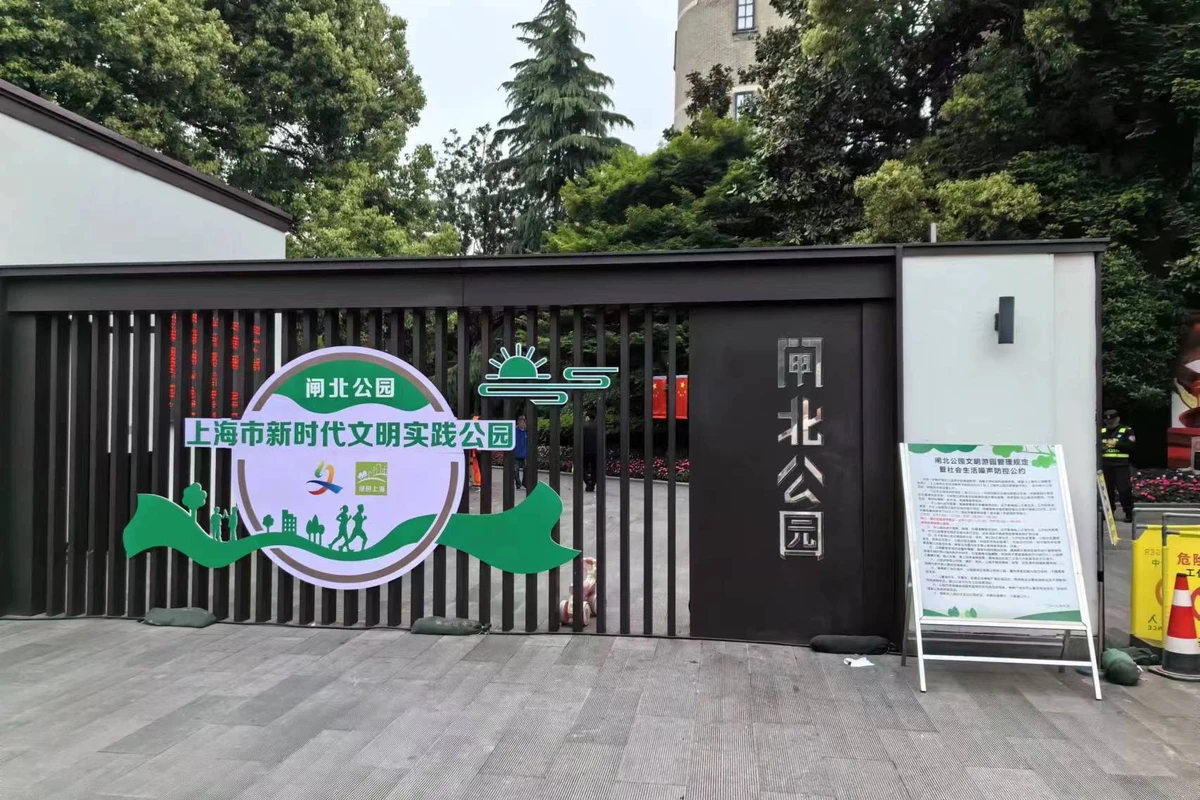
Zhabei Park, Formerly Known as Jiaoren Park
Here is a self-introduction from Zhabei Park:
Welcome to Zhabei Park. Zhabei Park is located at 1555 Gonghexin Road, covering an area of 13.35 hectares. Opened in 1946, it is the oldest park in Jing'an District. The park originated as a memorial cemetery for the democratic revolutionary Song Jiaoren, commonly known as Song Park, and later renamed Jiaoren Park. On the eve of liberation, a group of revolutionary patriots were shot and buried alive here. After liberation, the Shanghai Municipal People's Government renamed it Zhabei Park. The park has undergone many renovations and expansions. The Song Jiaoren Tomb and the Qian Family Ancestral Hall (Qianshi Zongci) within the park are both Shanghai Municipal Cultural Relic Protection Units. In 2018, the park underwent another comprehensive renovation. While preserving the large trees, the layout was adjusted and the classical Chinese garden character was strengthened. The West Gate was rebuilt, the Twin Maple Courtyard (Shuangfeng Shuangyuan) was newly built, and the architectural style was unified. The central lake landscape was reshaped, water quality was purified, more waterside spaces were added, and plant diversity was enriched. Recreation, fitness, and rest facilities were upgraded, and infrastructure such as security, water supply and drainage, power supply, and emergency shelters was improved. The park's historical heritage was highlighted, creating a high-quality comprehensive park that integrates ecology, leisure, scenic appreciation, and cultural functions. Zhabei Park is roughly rectangular from west to east, with a natural layout. The western section centers on the Song Jiaoren Tomb, with Yangshu Square along Gonghexin Road. The central section is the main scenic area, with Duiming Lake covering over 10,000 square meters; the water surface varies in width and the shoreline winds intricately. To the west of the lake are the Twin Maple Courtyard (Shuangfeng Shuangyuan) and the Waterfront Plaza. In the lake are three islets—Jinyou, Cuiyou, and Xige—featuring varying terrain, distinct seasonal plant displays, and pavilions scattered among them. The islets are connected by bridges, among which the Tianguang Bridge and Yunying Bridge are particularly distinctive. East of the lake, the Qian Family Ancestral Hall is surrounded by ginkgo, green maple, and plane tree woods, creating a harmonious scene. The eastern section includes Banmu Pond, a children’s playground, a fitness trail, and other attractions.
As a free downtown park, you shouldn't set your expectations too high.
I feel that the color scheme of the gate and the lettering at Zhabei Park isn't very prominent. The park's name also doesn't highlight its biggest draws—its connection to Song Jiaoren and the Qian Family Ancestral Hall.
Zhabei Park originated as a memorial to Song Jiaoren. Let's talk about this man first: When I was in school, his assassination was included in the history textbook—the PEP (People's Education Press) edition. Anything related to Song Jiaoren is the park’s biggest cultural IP.
The construction of Song Jiaoren’s tomb and the beginning of Zhabei Park: Song Jiaoren (1882–1913), a native of Taoyuan, Hunan, courtesy name Dunchu, pseudonym Yufu (Old Fisherman), was a modern democratic revolutionary and an early leader of the Kuomintang (KMT). In his early years, he actively participated in bourgeois revolutionary activities. After Yuan Shikai obtained the presidency, Song Jiaoren, building on the Tongmenghui, formed the Kuomintang and served as acting executive director. He planned to use parliamentary politics and a party cabinet as weapons, based on the Provisional Constitution, to limit Yuan Shikai’s power. He campaigned in Changsha, Shanghai, and elsewhere, advocating for a responsible cabinet system and party politics, and pushing for a democratic constitution. In the February 1913 parliamentary elections, the Kuomintang won an overwhelming majority in both houses, becoming the largest party. In the Republic of China’s 1913 national assembly election, the KMT triumphed. Song Jiaoren was about to follow the European “cabinet” convention and form a government as party leader when, on the evening of March 20, at around 10:40 p.m., he was shot at Shanghai Railway Station. The assassin Wu Shiying and the mastermind Ying Guixin (a member of the Green Gang, appointed by Yuan Shikai as the Jiangsu station inspector in Shanghai) were soon exposed, but the ultimate instigator has remained a mystery for over a hundred years. Yuan Shikai, Zhao Bingjun, Hong Shuzu, and even Sun Yat-sen, Huang Xing, and Chen Qimei have all been suspects. After being shot, Song Jiaoren was in excruciating pain; he slumped over a chair, pulled Yu Youren’s head to his chest, and gasped, “I’m in such pain, I fear I will not recover...” Those who had seen him off at the station—Huang Xing, Yu Youren, Liao Zhongkai, and others—rushed him to the Shanghai-Nanjing Railway Hospital. In the hospital, he left a will with Yu Youren: “I have three things to entrust to you: First, all the books I have stored in Nanjing, Beijing, and Tokyo should be donated to the Nanjing Library. Second, I come from a poor family, and my elderly mother is still alive. After my death, please ask Keqiang (Huang Xing), you, and other old friends to look after her. Third, you must all carry on with resolve; do not think of me and abandon your sense of duty. I exhausted myself mediating between North and South, yet rumor-mongers and many people, not knowing the truth, often misunderstood me. It’s only right that I suffer; what regret is there in death?” He then instructed Huang Xing to draft a telegram to Yuan Shikai: “To President Yuan in Beijing: I was traveling by the Shanghai-Nanjing night train to the capital to pay my respects. At 10:45 p.m. at the station, a villain suddenly shot me from behind; the bullet entered my lower back and lodged in my abdomen, and death is certain. I have always conducted myself with propriety and self-respect since I began my education; though I have not achieved many merits, I have never held personal grudges. The Qing government was corrupt, so I rose up for reform, always valuing humanity and justice, never harboring the slightest thought of personal power. Now the foundation of the republic is not yet solid, and the people’s welfare has not improved. To pass away so suddenly—I have lingering regrets even in death. I earnestly hope the President will open his heart, uphold justice, and do his utmost to protect civil rights, so that the nation may establish an unshakable constitution. Then, even on the day of my death, it will be as if I am living anew. These are my last sorrowful words; I beg you to accept them. Song Jiaoren. Jia (jiā, indicating the telegram was sent on the 20th). (At the time, telegrams were expensive; you would convey meaning in the fewest possible characters. In the late Qing, each telegram was charged per seven characters; within seven, it was a flat rate, and any extra characters were billed separately. A single character could cost several taels of silver. It is recorded that Guo Songtao, minister to Britain and France, submitted a memorial to Emperor Guangxu impeaching Liu Xihong, the minister to Germany, for ‘wasting funds’ and ‘squandering extravagantly.’ Guangxu sent investigators and, upon learning that Liu’s embassy in Germany had sent seven or eight trivial telegrams in four months, dismissed him—a glimpse of how costly telegrams were. After the imperial examinations were abolished in 1904, scholars gradually lost familiarity with the rhyme schemes. But even after telegraph fees dropped, this custom of using rhyme characters to denote dates persisted until the early years of the People’s Republic, lasting over 70 years.)
After surgery, his condition did not improve; he suffered severe bleeding in his urine and stool. On the afternoon of the 21st, Song Jiaoren was sent to the operating room again, but he died at 4:48 a.m. on the 22nd, at only 31 years old. After his death, Fan Hongxian took photographs of his body. First, a half-nude photo was taken, showing the wound. Then a photo of the body in a Western suit was taken, posed on a high sofa. Today, Song Jiaoren’s tomb rests in Zhabei Park. The identity of his killer remains a mystery. Yuan Shikai learned of the assassination on the 21st and expressed great surprise... He immediately sent a telegram: “To Mr. Song Dunchu in Shanghai: I read the Reuters telegram and was shocked to hear that you were wounded by a ruffian, deeply alarmed. I have just received your jia telegram and learned the details. In building this republic, talent is precious; your learning is outstanding, and you are respected by the world. Anyone with any sense would protect you—how could it be that in a place so public, a villain dared to carry out an assassination? Human hearts are treacherous, and what has become of law and order? I can only pray that Heaven will bless a good man and that you recover. Please do not speak of decline, as it only fosters pessimism. I have ordered the Jiangsu governor, civil administrator, Shanghai commissioner, county magistrate, and Shanghai-Nanjing Railway general office to offer a heavy reward and set a time limit for capturing the culprit. I also send my personal regards.” These words, written when the situation was still unclear, were meant to put on a proper front, fulfilling all formalities. At the time of the assassination, Sun Yat-sen was in Japan; he immediately telegraphed the KMT headquarters in Beijing and the Shanghai communications office from Nagasaki, urging comrades to investigate the cause. On March 25, Sun returned to Shanghai from Japan; that very night, he met at Huang Xing’s residence to discuss countermeasures, with Chen Qimei, Ju Zheng, Dai Tianchou, and others present. Ying Kuicheng and Wu Shiying had already been arrested. Sun had completely lost his illusions about Yuan and advocated quick military action. Huang Xing, however, believed that since the Republic had already been established, the law had some force, and “the Southern military strength is insufficient; if we act rashly, it will ruin the overall situation” (Complete Works of Sun Yat-sen, Vol. 3, p.165). Sun and Huang argued fiercely. In April, Yuan Shikai signed the Reorganization Loan, preparing to launch a civil war and eliminate the Southern forces. In July, Li Liejun officially declared Jiangxi’s independence and called for a punitive expedition against Yuan; Southern revolutionaries rallied and fought the Beiyang Army. In September, Nanjing fell; the “Second Revolution” was defeated, and Sun Yat-sen and Huang Xing fled to Japan. A passage from an online video narration about Song Jiaoren is worth quoting: “In the Republic of his day, Song Jiaoren was debonair, spirited, and eloquent—a man of rare genius, far-sighted, free from selfish desires, intent only on building a true republic and entering the ranks of civilized, prosperous nations. Just as he was about to spread his wings, he was assassinated. This is one of the most heart-wrenching events in modern Chinese history. Over the following hundred years, where could we ever find another ‘Old Fisherman Song’?” On April 1, 1913, the Shanghai newspaper Minli Bao published Tan Renfeng’s “Remarks on the Grave of Song Jiaoren After His Death,” which included: “Mr. Song is a great man of the Republic, not a figure monopolized by Hunan Province. Some now propose to rebury his remains on Yuelu Mountain, but I disagree. Would it not be better to raise funds in Shanghai, open a spacious plot, first build a park, and bury Mr. Song there, as a cemetery for us Kuomintang members?” After Song Jiaoren was killed in Shanghai, Yuan Shikai, acting on a petition from Feng Ziyou, head of the Provisional Bureau of Meritorious Officials (and a KMT member), personally wrote: “Grant generous compensation, and record his lifelong achievements in the national history office for posterity. Also, have the bureau ascertain how many sons the deceased chief councillor had and send them abroad for education, to foster their development.” Subsequently, at the request of Song’s senior fellow townsman Tan Renfeng, Yuan allocated an extra 100,000 silver dollars for funeral expenses to build a tomb for Song Jiaoren.
The current tomb: In front of the tomb are two large characters: Yufu (Old Fisherman), written by Zhang Binglin (also known as Zhang Taiyan). Some background on Zhang Taiyan: Zhang was once sentenced to three years in prison by the Shanghai International Settlement for the Subao case, while Zou Rong (author of The Revolutionary Army) received two years. They were forced to do hard labor; after their terms, they were “expelled from the Settlement.” Although they escaped the death penalty, they could not escape the prison’s abuse. In jail, Zhang Taiyan’s nearsightedness made him work slowly, and he was frequently beaten by the guards, nearly dying several times. He and Zou Rong wrote poems to express their resolve and encouraged each other, but the frail Zou Rong was brutally tortured and died in prison at only 21. After Zou’s death, Shanghai revolutionaries held a memorial service to denounce the Settlement authorities and the Qing government. The Settlement authorities, claiming to uphold humanitarianism and fearing Zhang Taiyan might also die in prison, reassigned him to light duty, a “cushy job” of serving meals. Later, Zhang Taiyan remarked with emotion: “I owe my life to Wei (Zou Rong’s other name, Weidan); his death gave me mine.” On the back of the statue:
On September 23, 1916, Shanghai’s Republican Daily published Tan Renfeng’s “Origin of Song Garden and Account of Its Construction Expenses.” It stated that after Song Jiaoren’s death in 1913, he petitioned the government for 100,000 silver dollars. Initially, they bought 40 mu of land in Xujiahui, but people thought it too narrow to expand and too far from the station where Song was killed. So they purchased another 103 mu in Xiangyigang, Baoshan County, about ten li from the Settlement, and entrusted Wang Yiting and Long Zixiu with construction. (Now at 1555 Gonghexin Road, Jing’an District, inside Zhabei Park.) They set aside over 10 mu for the tomb. Covering 0.6 hectares, the tomb was completed in June 1914. It is roughly square, enclosed by a stone balustrade of 24 round-headed square pillars. The tomb chamber faces south, with a semi-cylindrical vault; in front stands a tombstone reading “Tomb of Mr. Song Jiaoren.” Atop the tomb is an eagle trampling a snake, symbolizing Song’s tenacious spirit in fighting against feudal forces.
At the southern end, two stone pillars mark the entrance with eight steps for visitors to ascend. In the center of the tomb, atop a stone pillar, stands a full-length marble statue of Song in a Western suit. On the front of the pedestal are carved the two characters “Yufu,” in Zhang Taiyan’s seal-script calligraphy. On the back of the pedestal is an inscription by Yu Youren: “Your death, sir, is mourned by all under heaven; your deeds are known to all under heaven. How shall I record them? If I write truthfully, truthful words bring death from men; if I write euphemistically, twisted words invite heaven’s punishment. Alas! The tears in the nether world, the blood of the world, the brush of an old friend, the traitor’s blade—inscribe these on the empty mountain, await a just historian; engrave them on hearts and livers, bear witness before heaven and earth!” This was composed by Yu Youren and calligraphed by Kang Baozhong, as in the picture above.
Online translation: “The death of you, sir, is regretted by all under heaven. Your deeds are known to all under heaven. How shall I record them? If I write truthfully, men will kill me; if I distort the facts, heaven will kill me. Alas! Your tears in the underworld, the blood of the world, the words of an old friend, the villain’s cold steel—carve these in the empty mountains, look to an honest history, inscribe them on hearts and livers, lay them bare before heaven and earth!”
Original calligraphy by Yu Youren is available online.
Panorama of Song Jiaoren’s tomb
Close-up of the statue on the tomb
Nearby, there is a pavilion: Gonghe Pavilion.
Although Zhabei Park began as Jiaoren Park, the park seems reluctant to promote this fact. The entire park has two Shanghai Municipal Cultural Relic Protection Units. I only saw one sign for Song Jiaoren’s Tomb, while there were many more signs for the Qian Family Ancestral Hall. Unfortunately, on my multiple visits, the ancestral hall was never open; I could only see its exterior.
After all, this park has some age; downtown parks can’t be very large, and there are always lots of people. The meticulousness of Shanghai residents is reflected here. Here are a few photos to show you the whole view:
Resembling the Three Pools Mirroring the Moon
Some views are very nice, but with so many visitors, it was hard to get good photos—a pity.
This is the Zhabei Park I’ve visited.


