Feng Shui: The Key to Singapore's Prosperity?
Singapore's economic development has been robust for decades, with its per capita GDP consistently ranking among the top ten in the world. Even after weathering several economic crises, it has always managed to recover quickly to normal levels. Its 'national fortune' can be said to be one of the best.
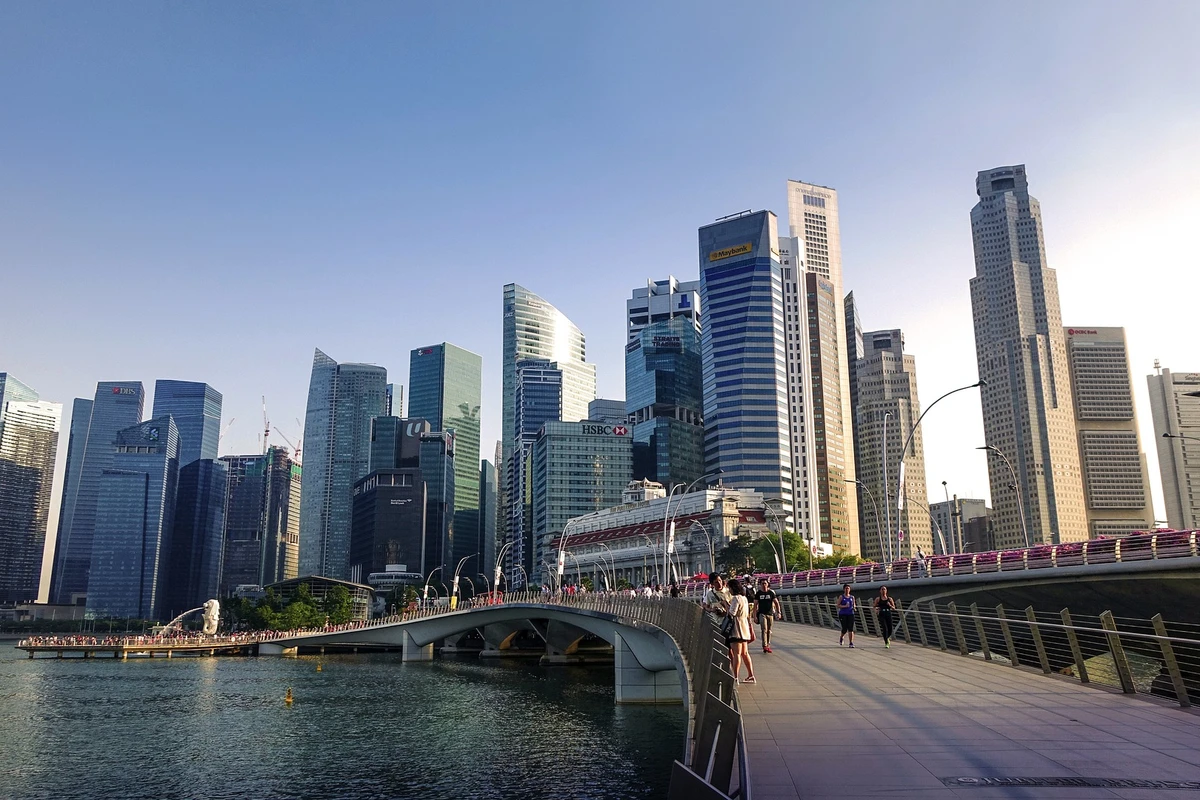
Many people don't know that Singapore, deeply influenced by Chinese traditional culture, makes ubiquitous use of feng shui. Let's take a stroll through Singapore's most bustling districts to see how Singaporeans cleverly use the mysteries of feng shui to attract wealth from all directions.
Singapore's most famous 'feng shui landmark' is Suntec City, an investment by Hong Kong tycoon Li Ka-shing. The five towers of Suntec City are arranged in a circle, with one low and four tall, resembling the five fingers of a left hand. And the fountain in the center of the 'palm' holds a hidden secret.
Ordinary fountains spray water from top to bottom and from inside out. But this fountain at Suntec City is supported by four 13.8-meter-high bronze columns holding up a ring, allowing water to flow from the inside of the ring downward and inward from the outside. It is said that this unique spray pattern is because 'water represents wealth,' and the inward-flowing fountain water symbolizes wealth converging from all directions toward Suntec City. Hence, this fountain is also called the 'Fountain of Wealth.'
According to unofficial folklore, because Suntec City's 'palm' faces directly toward Singapore's financial district, it would siphon away Singapore's 'wealth aura.' To counteract Suntec City's feng shui arrangement, the Singapore government deliberately built the Esplanade in the shape of a durian. This way, when the 'palm' tries to grab the financial district's fortune, it gets pricked by the durian's spikes, protecting Singapore's wealth.
Similarly, Marina Bay Sands also features a swirling waterfall that flows from outside inward, echoing the concept of Suntec City's 'Fountain of Wealth.'
The shape of the Marina Bay Sands hotel resembles three large mountains, and the infinity pool on the top floor symbolizes a lake at the mountain summit. Feng shui masters believe this allows the hotel to maintain harmony with its surroundings and generate endless wealth.
The ArtScience Museum in front of the Marina Bay Sands hotel is one of Singapore's popular photo spots. This building, shaped like a lotus flower, symbolizes inspiration, vitality, and auspiciousness, bringing good luck and blessings to Singapore at the heart of Marina Bay.
Nearby, the Singapore Flyer is another popular landmark. Tourists often enjoy Singapore's scenery from one of its 28 capsules. It is said that the number 28 was chosen because the numbers 2 and 8 are considered very auspicious in traditional Chinese culture. In particular, 8 sounds like the word for 'prosperity' in Chinese, adding an extra layer of good fortune.
Did you know? When the Singapore Flyer first opened, it rotated counterclockwise; later it changed to clockwise. According to folklore, this adjustment was made on the advice of feng shui masters, turning the Flyer into a 'feng shui wheel' that brings continuous good luck to Singapore.
By the Singapore River at Marina Bay stands Singapore's oldest bridge, Cavenagh Bridge. If you look at the bridge's location on a map, you'll notice that the route from Clarke Quay to the bridge resembles a carp. The only way for the carp to escape is to leap over Cavenagh Bridge, which happens to be positioned at the 'Dragon Gate.' Thus, the financial districts along both sides of the Singapore River benefit from the excellent feng shui blessing of 'The Carp Leaps Over the Dragon Gate.'
Chinese feng shui has long been ingrained in Singapore's DNA, adding many uniquely styled buildings and intriguing local anecdotes to this small island at the southern tip of Eurasia.
Perhaps the true essence of life is to experience the most splendid and diverse world amidst endless cycles of mutual generation and restraint.


![My Big World, Starting from Here — Singapore-Malaysia Trip [2011]](/img/e764f29a127779f0_s.webp?src=https%3A%2F%2Fdimg04.c-ctrip.com%2Fimages%2F01008120008edq3qiF8F5_W_320_0_Q80.jpg)