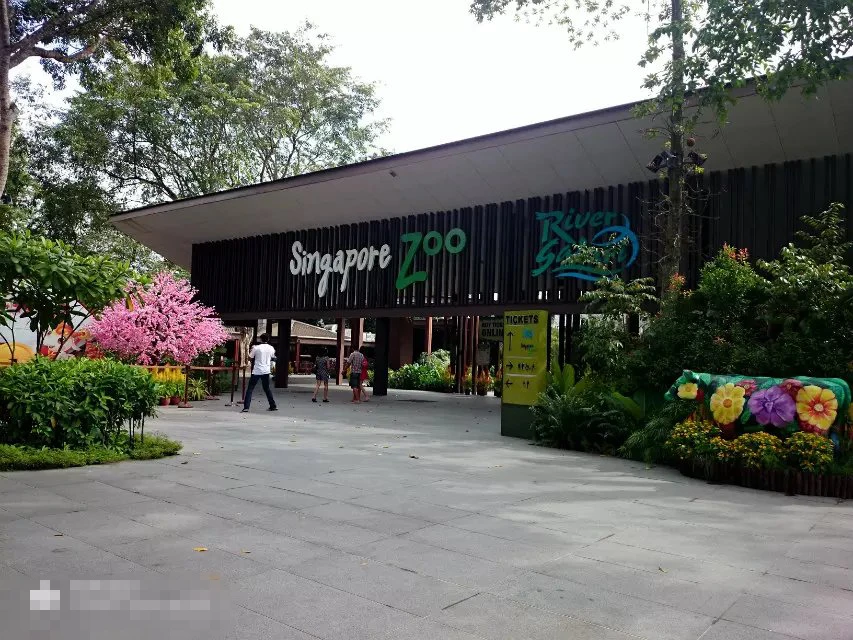
Singapore Zoo
Jurong Bird Park
After lunch, we prepared to head to Jurong Bird Park, which is said to be the largest bird park in the world. It's located in a relatively remote area in the west of Singapore. We needed to take the MRT first and then transfer to a bus. However, since the connections were well-integrated, the bus stop was right outside the MRT station, so it didn't feel too troublesome. The New Year was approaching, and the platform at the transit station was also decorated festively.
As soon as we entered the park, an orchid archway greeted us, with various orchids, some of which we couldn't name.
February in Singapore felt very hot. Seeing a penguin pavilion on the right, we quickly went in. The plump penguins were well-treated, with dim lighting and cool air conditioning. But comfortable as it was, we had to move on. Although the park was large, our tickets included a small train ride, which saved us a lot of effort. I think for a family outing with elders and children, this expense is unavoidable. We first went to the hornbill area, where many species were kept tightly enclosed. I still remember over a decade ago at Nanning Zoo, we could go inside and feed them oranges. Despite looking clumsy, they would fly over from a distance, accurately peck the orange from your hand, and then fly away to eat. I don't know if something dangerous happened later, but we never had that experience again. Now, looking at their beaks, I wouldn't dare to go in even if allowed. As we grow older, we become afraid of many things. Look at that one below—it looks so cartoonish, but unfortunately, it's all wire mesh, so we couldn't get a clear photo.
Passing through a small path, we arrived at an aviary we could enter. Along the roadside were many unfamiliar plants; the ecology here is really good.
Inside the walk-in aviary were some less aggressive small birds that were completely unafraid of humans.
Seeing us arrive, a peacock kindly spread its tail feathers for us to take photos.
Among the birds, the parrots were the most approachable. When they saw someone feeding, they flew over from distant branches. Some even jumped directly onto people, looking for food. Bird food was available for purchase, but I didn't dare feed them myself—what if the bird needed to relieve itself mid-meal?
At the entrance, there were also some beautiful parrots displayed specifically for photos, costing 10 SGD to take a picture with them.
The next stop on the little train was the African Waterfall Aviary, which had a large man-made waterfall for the birds. It was said that some precious birds were inside, but unfortunately, I didn't see them.
Various storks were by the poolside. They were completely outdoors but didn't fly away—strange?
This large bird, from the moment we arrived, was preening its feathers as if no one else was around, very focused.
Another was intently searching for food.
There were so many flamingos, a sea of red. Also called firebirds, they are a symbol of love, with very beautiful feathers.
The park had scheduled bird shows, featuring all kinds of birds. It was hard to imagine how much effort the staff had put into teaching them to dance to music.
After circling back to the entrance, we noticed that even the small trees in the park were decorated with small lanterns to celebrate the Spring Festival.
We saw another type of penguin that we had missed earlier—they didn't need to stay in an air-conditioned room and were swimming happily under an outdoor shelter.
The afternoon passed quickly. When we exited the park, we couldn't find the bus stop where we had arrived, so we had to go back and ask the staff for directions. Finally, we caught the bus back to the MRT station.
Singapore Zoo
Today's itinerary was Singapore's three major zoos, all located next to each other. Since the MRT didn't go directly and the bus ride was quite far, we hired a car. The driver was a foreigner who was very nice despite the language barrier—he even gave Yiyi a lollipop. After a ride of nearly forty minutes, we arrived at the park entrance cheerfully, only to realize we had forgotten the tickets as soon as the car left. What a disaster! I had to leave the group and take a taxi back to the hotel to get the tickets. How careless of me. Luckily, it was still early and there wasn't much traffic, but the round trip still took an hour and a half, costing over 30 SGD (about 200 RMB). While chatting with the taxi driver, he asked why Chinese tourists always buy tickets in advance. I told him it was much cheaper, but with this hassle, the savings were almost gone. I finally got the tickets back, and I'm really grateful for my family's understanding—they didn't scold me. As soon as I got out of the taxi, I saw a peacock leisurely strolling by; such sights were common on the roads.
The festive Spring Festival decorations were still in place.
Entering the three parks, the bull at the gate was also colorful.
Special park restrooms: plants were grown inside the toilets. On the other side were squat toilets. Actually, many foreigners find squat toilets dirty, so for the convenience of tourists, a few squat toilets were installed. For cleanliness, in addition to automatic flush switches, manual ones were added, and there was even a shower head for you to rinse the floor yourself.
First, we entered the daytime zoo. Due to the earlier mishap, it was already around 10 a.m. by the time we got inside. The vivid signage and maps left a deep impression on us.
Crocodiles. Looking at the information board, there were names in multiple languages, with English descriptions—unfortunately, my English isn't good, so I couldn't understand them. I need to study more.
The park's electric carts were painted with zebra and tiger patterns, blending into the park environment. There were many stops along the way for visitors to easily explore. We would soon take such a cart to tour the park.
The first thing we saw was the white tiger, the legendary treasure of the zoo. Its left eye looked a bit abnormal.
One big cat was lazily sleeping on a tree branch, while another was playing on the lawn. It looked very close, didn't it? The fences in the park were quite low, allowing visitors to see the animals up close, which was a bit frightening. But actually, there were deep moats behind the barriers, so there was no need to worry about the animals escaping.
Rhinoceros—we haven't seen one at Liuzhou Zoo for a long time. Are those the birds that supposedly clean the rhino's skin?
Big elephant—where did its tusks go?
The performance area had many shelters that provided both shade and rain cover, very thoughtful. Unfortunately, we didn't catch any of the shows, which was a pity. If time allowed, it would be nice to watch the performances properly.
Hippopotamus—always with its eyes closed. There were many fish friends accompanying it; would they be eaten?
Zebras and antelopes were kept together.
Various monkeys: an orangutan was sitting gloomily, while chimpanzees looked very intelligent.
Otters huddled together sleeping, round like little pigs.
The following are all friends from "The Lion King."
What were the kids looking at so intently?
Besides the caged animals, there were many harmless small creatures by the roadside.
It was the first time I saw bats eating so up close. I was a bit worried they might fly over—I always thought bats lived in dark caves.
By the roadside, we saw two affectionate little parrots.
Suddenly, a small creature darted out—scared me to death!
Ancient-looking species, kind of ugly. Is that one below the "Dr. Slump" turtle?
A lazy polar bear occupied a large private pool by itself. After bathing, it was lying in the sun. We bought lunch at the park's restaurant—I forgot the name, but it cost nearly 50 RMB. It came with coconut milk and curry; it was probably curry fried rice…
The restroom in the jungle behind the restaurant had a tropical feel but didn't feel very secure.
Finally, let's look at the various exotic plants and flowers in the park.
The tree we saw by the roadside earlier was full of fruit inside the park, still unknown what it was.
The branches of towering trees filled the sky.
River Safari
River Safari is different from typical aquariums; it mainly showcases creatures from several major river basins around the world (though I'm not sure why the giant panda is also placed here—maybe because it's more spacious here). See the map? There's a bridge spanning the river bay. A helicopter was circling in the sky. A little bird perched on the handrail, peering around. A large fish tank, very clean. Giant pandas munching on bamboo seriously. A monkey fishing—first time seeing a monkey using its tail to catch fish, so focused. Brave keepers feeding the animals; so many plump sea lions swarming around, a bit scary. Again, we saw beautiful plants.
Night Safari Singapore
At 5 p.m., it was our first time visiting a zoo at night. I felt a mix of excitement and slight fear. The Night Safari opens at 5 p.m. While waiting at the entrance, there was a stunt performance. Inside the park, we could choose to take a tram or walk. I must say I greatly admire those who choose to walk in the park at night—just thinking about the atmosphere scared me to death. To avoid disturbing the animals' lives, the zoo uses lighting to simulate natural environments, and flash photography is prohibited (though many people ignored this). Combined with the movement of the tram, it was hard to take good photos. Bear with the rough ones. At the last stop, there was an animal show after getting off the tram; the host and performers were very energetic. Apart from the Bird Park, which we visited during our free time on the first day, we spent one day exploring the three parks, which inevitably felt rushed. Forgive me for ending the travel notes somewhat anticlimactically. To summarize, if time is tight, you can skip River Safari and just visit the Zoo and Night Safari. The Night Safari is mysterious and a bit scary, offering us a unique experience.


![My Big World, Starting from Here — Singapore-Malaysia Trip [2011]](/img/e764f29a127779f0_s.webp?src=https%3A%2F%2Fdimg04.c-ctrip.com%2Fimages%2F01008120008edq3qiF8F5_W_320_0_Q80.jpg)