August 5-12 Singapore + Kuala Lumpur 8-Day Family Relaxed Free Travel (Departing from Beijing, Pure Dry Goods Sharing)
1. Visas
(1) Singapore Visa:
Choice: Singapore Personal Tourist Visa for Mainland Chinese Citizens, submitted in Beijing. Cost: 300 RMB/person
https://vacations.ctrip.com/visa/p16201s1.html
Complexity of visa materials: Medium; Visa processing time: 5 working days; Difficulty of visa application: Medium.
Main visa materials:
- Employed: Certificate of Employment in both Chinese and English (stamped with HR seal); Personal Information Form; Visa Application Form (templates are available on the page; just fill in personal details. Note: the visa application form can be filled online, and after Ctrip staff confirms, you can print it directly).
- Students: School registration card (we didn't have one, so we used a child's admission ticket, which had the child's ID number, school name, date, etc., and it was approved); Parents' asset proof (can use Alipay balance, generate online asset proof).
- Basic materials: Passport photo; Passport, ID card, household registration book, marriage certificate, child's birth certificate.
Prepare all materials according to the checklist and send them out. The next day, we received the original passport back from Ctrip. The electronic visa email arrived in 4 working days. Print the electronic visa (I prepared two copies just in case) and you're done.
(2) Malaysia Visa:
Choice: Malaysia Personal Tourist Visa, 3-month single entry Evisa. Cost: 268 RMB/person
https://vacations.ctrip.com/visa/visa/p5044s2.html#ctm_ref=www_hp_bs_lst
Complexity of visa materials: Easy; Visa processing time: 4 working days; Difficulty of visa application: Easy.
Main visa materials: Passport front page + photo + statement that you have not entered Malaysia within 3 months (handwritten on a piece of paper, take a photo, upload on the webpage).
After approval, it's an electronic visa; just print it out.
2. Route Selection (Decide based on time and places you want to visit)
Suggested play time for Singapore: 3-4 days; Suggested play time for Kuala Lumpur: 3-4 days. Since our vacation was about 9 days, we chose Singapore + Kuala Lumpur. If you have less time, you can choose just Singapore or just Kuala Lumpur; if you have more time, you can add an island in Malaysia.
Singapore and Malaysia have similar temperatures year-round, around 30°C, so it's suitable for travel all year. August 9th is Singapore's National Day, with fireworks and a National Day Parade. I didn't notice this time and missed it perfectly; if you have a chance, you can pay attention to this date.
Choose a Singapore free travel package, and book flights and hotels according to your schedule.
(1) For flights, consider Singapore Airlines. This time, we chose Singapore Airlines for both legs, just to experience a five-star airline. Overall, the service was okay, mainly punctuality; don't expect too much from the meals, especially on the outbound flight. We took off at 12:50 AM, and meals were served at 2 AM; not many could eat—they were all asleep.
(2) For hotel selection, I basically determined based on location, price, and ratings. Since 2012, I've been choosing free travel packages (flight + hotel) on Ctrip for over 10 years, and it's generally reliable.
Singapore's cost of living is high, especially hotels. For convenience to attractions, it's recommended to choose hotels in Marina Bay Sands, Orchard Road, or Sentosa.
This time in Singapore, we stayed 5 days and 4 nights, choosing two hotels, a triple room: Holiday Inn Express Orchard Road for 2 nights, and Shangri-La Sentosa for 2 nights. During the two days on Orchard Road, we mainly visited Orchard Road, Chinatown, Little India, the National Museum of Singapore, Merlion Park, etc. Then we went to Sentosa Island. The schedule was fairly relaxed.
Choose a free travel package, book flights, and choose hotels according to your preferences, and you're good.
Singapore uses the Singapore Dollar (exchange rate at the time: 5.3 RMB = 1 SGD), and Malaysia uses the Ringgit (exchange rate at the time: 1.7 RMB = 1 MYR).
Exchange SGD at Bank of China; Bank of China doesn't have MYR, so go to ICBC. Note: Nowadays, you generally need to make an appointment with the bank in advance to exchange foreign currency.
After arriving in Singapore and Malaysia, I found that Alipay and WeChat are used less, but Mastercard is accepted in most malls, supermarkets, convenience stores, and restaurants. So prepare a Mastercard (or VISA card) that can be used overseas before the trip; it basically serves the same purpose as Alipay and WeChat in China. On this trip, in both Singapore and Malaysia, only one or two small shops said Mastercard had a handling fee and asked me to pay cash; otherwise, I used Mastercard for everything. The currency I exchanged before the trip was hardly used. But to be safe, it's okay to exchange a little foreign currency beforehand. Get a Mastercard and set up bank SMS notifications; whenever you swipe, you immediately get a deduction SMS, convenient and safe.
The most important thing for free travel is mobile WiFi. Over the past 10 years, we've traveled independently to the Netherlands, Portugal, Spain, Turkey (group tours to France, Italy, Germany, Switzerland, Egypt, Japan), Hong Kong, Macau, and Taiwan. Being able to travel independently is entirely thanks to mobile WiFi + Google Maps. It can be said that with these two things, plus basic English communication, you can travel the world without fear.
Search for mobile WiFi on websites, select the destination country, and it will appear. Generally, pick up at the airport departure area and return at the arrival area, very convenient. Renting one mobile WiFi device can connect several phones. We had three phones, and for a day out navigating, searching for attractions, and sending WeChat messages, the data and battery were completely sufficient. About 30 RMB per day. With WeChat, you don't need to activate international calls, saving money and convenient. There are also multi-day phone data cards, but we haven't used them.
5. Useful Apps:
(1) Google Maps: Extremely useful.
(2) Grab: Extremely useful in Southeast Asia. Download Grab before the trip, link a Mastercard, and you can directly take taxis in Singapore and Malaysia. Select your pickup and drop-off locations; after a driver accepts, you can communicate briefly in the chat. Once you get in, a prepaid deduction occurs, and after arrival, depending on the actual fare, there may be a small additional charge; both are deducted directly from the card, and you get an SMS for each deduction.
In Singapore, most taxi drivers are Chinese, mostly speak English, some speak Chinese; the cars are clean and service is good. Fares are relatively high: from the airport to Orchard Road (30-minute drive) was 22 SGD (about 120 RMB), and from Shangri-La Sentosa to the airport was also 21 SGD.
In Malaysia, I encountered Chinese, Malay, and Indian drivers; car conditions and service vary. Chinese speak Chinese, while Malays and Indians can communicate in simple English. Taxis are relatively cheap: from the airport to the hotel (40-minute drive) was 65 MYR (about 110 RMB); within the city, a 20-minute drive costs about 15 to 25 MYR (about 25-40 RMB).
In Singapore, we wanted to eat the highly-ranked Song Fa Bak Kut Teh, so we spent an hour finding a shop, but there was a long queue, so we had to give up. The next day, at the Shangri-La Hotel, I used Grab to order delivery; there was a discount, and they delivered by car. The taste was quite good—what a pleasant surprise.
6. Antigen Policies, etc.
Both Singapore and Malaysia have canceled the requirement for antigen testing upon entry, and the antigen requirement for returning to China has also been canceled. We brought a few antigen tests but didn't use any. When returning to Beijing, we needed to fill in the places visited in the last 14 days. After landing, before going through customs, there was a QR code to scan and fill in. Very simple.
The subway map above has already marked Singapore's famous attractions and locations. You can choose according to your needs:
Day 1: Marina Bay
Marina Bay is a beautiful bay in the center of Singapore, somewhat like Shanghai's Bund. It also gathers many famous attractions, such as the famous Merlion Park, Marina Bay Sands, Helix Bridge, and Gardens by the Bay. The area has a wide view during the day and is brilliantly lit at night. You can spend a day walking around Marina Bay to see the scenery change from day to night.
1. Singapore Landmark—Merlion Park (Symbol and emblem of Singapore)
Take a tourist photo at Merlion Park; you can get creative and interact with the lion.
2. ArtScience Museum (The world's first museum combining art and science, with a unique shape—ten 'finger' structures like a blooming lotus on the water, known as 'Singapore's Welcoming Hand'. Visit inside. Pre-book tickets for the permanent exhibition 'Future World' online; use the electronic confirmation to enter directly. Opening hours: 10:00-19:00)
3. Marina Bay Sands (Singapore's new landmark, three 55-story towers support the 'Sands SkyPark' and infinity pool on top, with the base housing the hotel, a large shopping mall, and a casino)
The SkyPark Observation Deck at Marina Bay Sands is open to visitors. At nightfall, take the direct elevator to the 57th floor of the Sands SkyPark. Overlook the stunning night view of Marina Bay, the Central Business District, Gardens by the Bay, and other parts of Singapore.
4. Gardens by the Bay
Gardens by the Bay is a new landmark in Singapore. The garden has two conservatories: 'Flower Dome' and 'Cloud Forest' (Avatar experience). The conservatories cultivate over 200,000 plants. During the day, visit both conservatories to see a variety of flowers; at night, enjoy the spectacular light show and the garden's night view. Tickets for both 'Flower Dome' and 'Cloud Forest' can be booked on Ctrip (adult 195 RMB, child 155 RMB).
There are two free music light shows at night, starting at 7:45 PM and 8:45 PM, each about 15 minutes long. Recommended.
5. Esplanade – Theatres on the Bay
Singapore's premier performing arts venue. Its unique shape is called 'Durian'.
6. Singapore Flyer
Limited time; we didn't ride the Flyer.
Day 2: Singapore's Urban Districts and Museums
Orchard Road is to Singapore what Ginza is to Japan. Orchard Road is Singapore's famous shopping street, gathering many big brands and major malls. Our first two days' hotel was on Orchard Road, so shopping, dining, and transportation were very convenient.
2. Chinatown (Niu Che Shui)—Singapore's Chinatown
The name 'Chinatown' (Niu Che Shui) comes from the fact that, in the past, water was transported by ox carts in the Chinese quarter, so it was called Niu Che Shui (Ox Cart Water). Today, it is the area with the highest concentration of Chinese in Singapore. Chinatown also has famous religious buildings, including Chinese temples, Hindu temples, and mosques.
Buddha Tooth Relic Temple and Museum
Located in the heart of Chinatown, this Chinese temple is very popular. The temple houses the sacred relic of the Buddha—the tooth relic—in a 320 kg gold stupa donated by devotees. The temple features Tang Dynasty architectural style and elements, combined with Buddhist mandala design. Other attractions include the Buddhist Culture Museum, the Eminent Sangha Memorial Hall, the Tripitaka Hall, and exhibition halls that host related performances and lectures.
Little India: An Indian ethnic district where 90% of people are of Indian descent. It feels like you're not in Singapore.
4. National Museum of Singapore
At the National Museum of Singapore, you can learn about Singapore's history through exhibitions.
Days 3-4: Sentosa Island
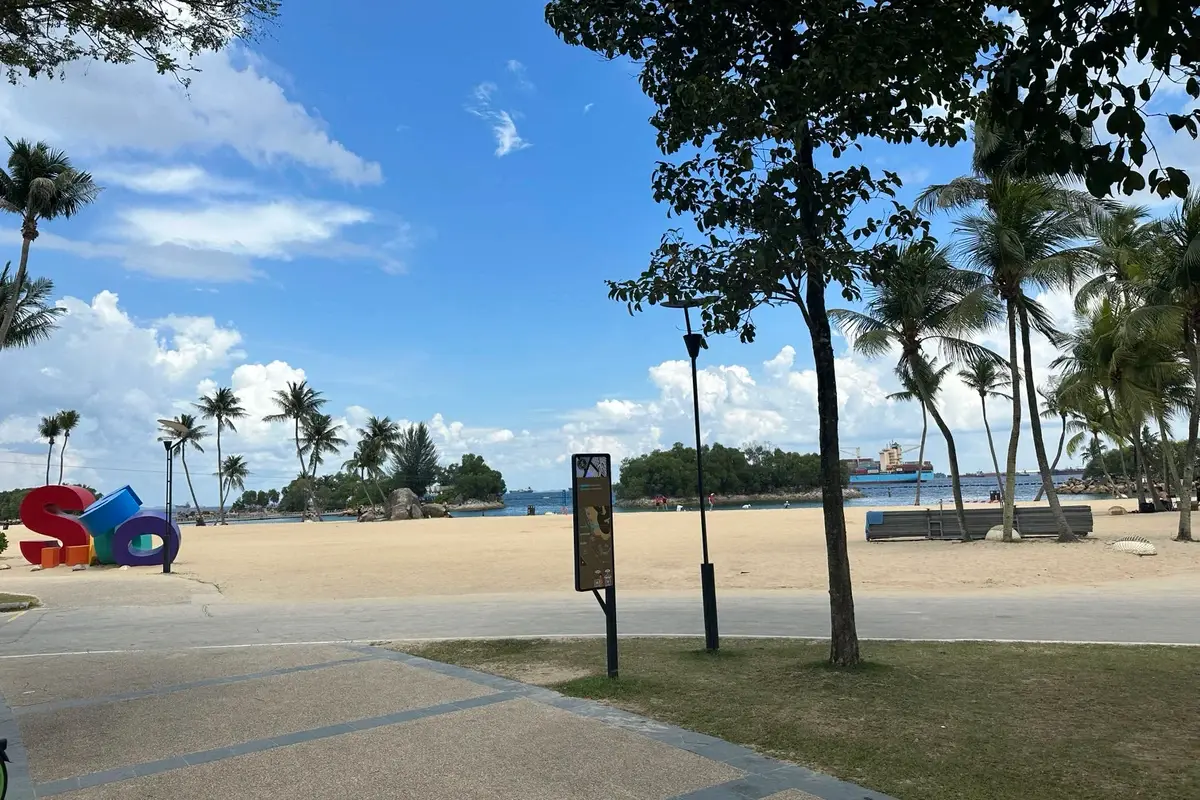
Sentosa Island is a famous resort in Singapore, comparable to Sanya. You can experience a variety of entertainment facilities on the island, making it a must-visit when in Singapore.
To enter Sentosa Island from the city, if you have booked a hotel on the island, you can show the hotel reservation email or order at the highway entrance to avoid the entry fee (about 2 SGD per person). After checking in, get a QR code from the hotel front desk, so you can enter Sentosa from the city without paying the entry fee.
Sentosa Island has free buses on two routes connecting major attractions and hotels. After checking in, check the bus stops near your hotel and choose accordingly.
There are also two cable car routes on the island. A full-day unlimited pass costs 45 SGD per person; choosing one route seems to be about 25 SGD per person. We chose the 45 SGD pass. Riding the cable car, you can not only enjoy a bird's-eye view of the scenery but also use it as transportation. The experience was pretty good.
We chose Shangri-La Rasa Sentosa this time, with a hill-view room. The hotel has a private beach and a children's pool. The buffet breakfast was very rich in variety.
Attractions on Sentosa Island:
1. Resorts World Sentosa
A complex integrating dining, entertainment, shopping, and accommodation.
2. Universal Studios Singapore
Smaller than Universal Beijing, but the rides are mostly similar.
3. Wings of Time
A multimedia extravaganza combining special effects, fountains, 3D visuals, fireworks, and live performances.
If interested, there are also the following attractions:
1. Singapore Changi Airport
An attraction that rivals city landmarks, winner of 'Skytrax World's Best Airport' for 7 years. Each terminal has theme parks, massage chairs, game rooms, children's slides, rooftop gardens, and beauty salons.
Jewel Changi Airport, opened on April 17, 2019, brings a waterfall and rainforest indoors, becoming an internet-famous attraction.
Please note: The waterfall rainforest is located in front of Terminal 1, not inside the terminal. When we arrived in Singapore, we were too tired and planned to leave time on the return trip to see the waterfall. However, when returning to Beijing, after going through customs and taking the Skytrain from Terminal 3 to Terminal 1, we couldn't exit Terminal 1. Exiting would require going through customs to see the waterfall, then going through customs again to board the flight, taking four to five hours. We simply didn't have time, so we could only sigh at the waterfall so close yet so far.
Friendly reminder: If you want to see the waterfall, make sure to set aside enough time; it's best to visit it first upon arriving at Singapore airport.
2. Night Safari
Highly rated, but we weren't interested, so we didn't go.
There are also other zoos and gardens, such as the Singapore Zoo and River Wonders. If you are interested in flora and fauna, you can choose them.
Singapore is known as the 'Garden City'; plants are everywhere along the city streets and on buildings wherever space allows, making it very pleasing to the eye.
These photos were taken casually by the roadside; Singapore's urban greening rate is really high, and the climate is particularly suitable for plant growth.
For transportation within Singapore, besides using Grab, the MRT and buses are also very convenient. During our few days in Singapore, besides going to and from the airport and taking a few taxis when too tired at night, we used the MRT and buses.
You can buy a card at the MRT station—10 SGD per card (including 5 SGD deposit). It can be used for both MRT and buses. A single trip on the MRT or bus is about 1 SGD. The deposit can be refunded at the airport, but we forgot to do so and kept it as a souvenir.
From Singapore to Kuala Lumpur, we took a flight just after 9 AM, and it took only 1 hour. There are many flights daily; you can arrange based on your schedule.
At Kuala Lumpur International Airport, we used Grab to take a taxi to the hotel.
Reminder: When using Grab in Kuala Lumpur, it's a ride-hailing service, not a regular taxi. After disembarking, make sure to follow the signs to the ride-hailing pickup area. If you don't want to use Grab, you can queue at the taxi stand. Considering that Grab provides a platform to hold drivers accountable in case of issues, we still used Grab for safety and transparent pricing. Otherwise, with KL taxi drivers of Chinese, Malay, or Indian backgrounds, and language barriers, it might be hard to protect your rights.
We arrived at the hotel around noon, had lunch, and started a city walk in the afternoon.
I must say, coming from high-priced Singapore to Kuala Lumpur felt incredibly comfortable! In Singapore, a bowl of noodles costs over 10 SGD, and a simple meal for three of us was easily over 300 RMB. Our first lunch in KL was at a shopping mall near the hotel, an area like Beijing's Zhongguancun, full of office buildings and near the University of Malaya. At noon, young office workers flocked out for lunch, and there were many restaurant choices—Chinese, Malay, Japanese, Western. For three of us, we had one bowl of seafood udon, two rice dishes with a variety of toppings (like good donburi), drinks, etc., all for under 100 RMB.
In Singapore, a drink like milk tea costs 7-8 SGD (about 50 RMB); in KL, a milk tea costs 3-5 MYR (5-10 RMB). That's the difference.
Someone online said KL's prices are like those of a second-tier Chinese city; I think they're cheaper than Beijing.
We stayed at VE Hotel & Residence, 4-star, about 600-700 RMB per night. When booking, the description said 'Two-bedroom Executive Apartment', and I didn't think much of it, but it was a pleasant surprise. It was a proper two-bedroom apartment with a living room (large floor-to-ceiling windows with a beautiful view), dining area, kitchen (fully equipped with pots and pans for cooking), and two large bedrooms. It had a fridge, and a combined washer-dryer. We stayed three nights, and before leaving, I washed and dried all our travel clothes—such a great feeling.
During our days in Kuala Lumpur, we mostly took taxis and didn't use the subway. A 20-minute ride cost about 20 RMB.
Overall, KL's prices are very friendly.
Must-visit attractions in Kuala Lumpur:
1. Petronas Twin Towers—KL's landmark
Day 6: Merdeka Square – Petaling Street – Durian – Thai Massage
We spent the whole day eating and wandering in KL. First, we went to Merdeka Square, where many famous KL buildings are gathered.
On August 31, 1957, the Malaysian flag was raised here, symbolizing independence from British rule. Now, a 100-foot flagpole marks this historic moment.
A short walk from Merdeka Square is Petaling Street (Chinatown), where you can eat.
Here are some random shots of KL streets:
Is it a regret to visit Malaysia without tasting durian? So in the afternoon, we chose a durian shop and took a taxi straight there.
After searching online, SS2 Street has many durian shops with high ratings. At the shop, we chose a Musang King durian at 68 MYR per kg. A 3 kg Musang King, paired with fresh coconut water, cost about 160 MYR (around 270 RMB).
How to describe it? My daughter and I used to not eat durian. Before the trip, my husband insisted on having durian in KL because Malaysian durian is called the king of fruits. My husband eats durian, but only occasionally. In Macau, he bought durian candy, and every time he ate it at home, my daughter and I would avoid him and open the windows—we really couldn't stand the smell.
But when we walked into the durian shop, where so many durians were neatly displayed for selection, my daughter and I exchanged glances and asked each other, 'Can you smell it?' Strangely, we couldn't smell the unpleasant odor. So we sat down, my husband picked a Musang King, and the shop assistant opened it for us. I took a small piece of flesh and slowly tried it. It felt like soft chocolate, melting and fragrant in the mouth, with no unpleasant smell anymore. Following the locals, we paired it with fresh coconut water—a few sweet bites, then a few cold, refreshing sips to cut the richness—absolutely perfect.
After eating over 3 kg of durian, we were too full for dinner. So my daughter and I had a fairly successful first durian experience.
In the evening, we returned to the hotel and lay by the infinity pool watching the traffic outside—very relaxing. Later, we discovered the hotel offered Thai massage and decided to try it. 98 MYR for an hour. The masseuse gave a full-body massage that relieved our fatigue greatly. Since leaving Beijing, we had been walking 20,000 steps a day in Singapore, and our feet and back felt like they weren't ours anymore. This massage really helped.
Day 7: Putrajaya + Malacca Day Trip by Chartered Car
After a day and a half of eating and wandering in KL, we had basically checked off the major attractions, so we looked around the outskirts. I searched for attractions near KL, and Malacca caught my eye. Then I looked into transportation: there's no direct bus from KL to Malacca; you'd have to transfer, taking several hours. A taxi one way costs about 300 RMB, round trip 600. Then I searched for a day trip on Ctrip: a chartered car for three people to Malacca for one day, total about 800 RMB. Since I was a bit concerned about safety given the recent news about scams in Southeast Asia, I contacted Ctrip customer service. They added me on WeChat, answered my questions in detail, and I placed the order.
Then the Malaysian driver added me on WeChat. I sent him the hotel location and confirmed the pickup time for the next day. Ctrip customer service also created a service group with the customer service, driver, and local dispatcher, which felt more reliable.
Here are the sights on the Putrajaya + Malacca day trip:
Putrajaya is Malaysia's new administrative capital, with the Pink Mosque, Prime Minister's Office, and Putrajaya Square.
After visiting Putrajaya, we drove on to Malacca. We arrived around noon and had lunch on Jonker Street. The driver went off to eat on his own. After lunch, we strolled around Jonker Street, walked along the Malacca River, and took a photo in front of the Dutch Square (The Stadthuys). Then we called the driver. He took us to the remaining sights: St. Paul's Church, the Strait of Malacca, and the Malacca Straits Mosque.
From the hill, we looked out over the Strait of Malacca—a famous name from history and geography textbooks, a vital chokepoint in world shipping routes.
Overall, having a chartered car saved energy and time; we covered all the famous spots, and the schedule was flexible—we could stay longer if we wanted. No extra charges. The experience was quite good.
We left Malacca around 5 PM, encountered some traffic, and it took over two hours to return to KL. My husband wanted durian again, since we were returning to Beijing the next day, so we wanted to seize the opportunity. We asked the driver to drop us off directly at Alor Street.
With yesterday's experience, we were now pros at eating durian. We chose Black Thorn durian (98 MYR/kg). Black Thorn is smaller than Musang King, around 2 kg.
The flesh was very plump. Compared to Musang King, it was more delicate, with a slight hint of alcohol, very soft and sweet.
Day 8: Return to Beijing
Woke up in the morning, boiled water, made coffee. Standing at the large floor-to-ceiling window in the hotel living room, looking at the view outside, I felt a bit reluctant to leave. The view from the high floor was excellent.
Let me add one more photo by the hotel pool, ending this wonderful 8-day Singapore + Malaysia trip in the most relaxing way!
Travelogue Directory
1. Pre-trip Preparation
2. Must-Visit Attractions in Singapore
3. From Singapore to Kuala Lumpur
4. Must-Visit Attractions in Kuala Lumpur
Travel Information
Hotel Index
Attraction Index
Flight Index
Website Navigation
Travel Index
Cruise Index
Corporate Travel Index
Franchise Cooperation
Distribution Alliance
Friendship Links
Enterprise Gift Card Procurement
Insurance Agency
Agency Cooperation
Hotel Franchise
Destination and Scenic Spot Cooperation
More Franchise Cooperation
About Ctrip
About Ctrip
Ctrip Hot Topics
Contact Us
Careers
User Agreement
Privacy Policy
Business License
Security Center
Ctrip Content Center
Intellectual Property
Trip.com Group Algorithm Disclosure


![My Big World, Starting from Here — Singapore-Malaysia Trip [2011]](/img/e764f29a127779f0_s.webp?src=https%3A%2F%2Fdimg04.c-ctrip.com%2Fimages%2F01008120008edq3qiF8F5_W_320_0_Q80.jpg)