November 2013 – Suzhou and Kunshan
Before we knew it, November was upon us and the autumn wind had turned chilly. With no long holiday, we used a weekend to explore somewhere nearby — 'heaven above, Suzhou and Hangzhou below.' Our target: Suzhou. I invited Miss Ling, and we hit it off right away. Renting a car for a short self-drive trip felt casual and relaxing.
We set off early. A minor hiccup refueling the rental car aside, everything went smoothly. Our first stop, chosen by Miss Ling, was breakfast at Kunshan Aozao Guan. The highway wasn't too congested; we queued briefly at the toll gate and reached Kunshan before the midday rush. Kunshan is familiar to most Shanghainese. Aozao Guan is beside Banshan Bridge at the south gate of Kunshan's Tinglin Park (Gu Yanwu's alias was Tinglin); it's the oldest traditional noodle shop in Kunshan. The story goes that the original owner had poor eyesight, and the noodles he served were a bit unkempt, so regulars jokingly called them 'aozao noodles' — 'ao zao' is Kunshan dialect for 'not too clean.' Surprisingly, the quirky name helped it spread. The noodles are Suzhou-style, with fresh clear broth and springy noodles. We ordered bowls with four toppings. The place was packed, but we ate happily — a small delight.
After eating, we drove several tens of kilometers straight to Suzhou, guided by GPS. Our first stop there was Tiger Hill. Both Miss Ling and the secretary had visited when they were little, but the memories had faded. For Shanghainese in the last century, Suzhou was the top choice for family outings with kids or for Qingming tomb-sweeping. This time, we wanted to see the Tiger Hill Pagoda and revisit the Sword-Testing Stone we vaguely remembered. Tiger Hill isn't large. Before entering, the roadside was already surrounded by wedding dress shops — it's a famous wedding dress street. Legend says King Helü of Wu was injured in the Battle of Zuili against Yue and died soon after; his son King Fuchai buried him here. Three days after the burial, a white tiger crouched on the tomb, hence 'Tiger Hill.' Passing through the 'Number One Scenic Spot in Wu' archway, the pagoda came into view. Crossing the small river, we entered the scenic area.
They say the hill is only 36 meters high. Inside, free tour guides were available — service in Jiangnan is really thoughtful. Walking along, childhood impressions floated back: the Simpleton Well, the Sword-Testing Stone. It felt cozy just looking and listening. The Sword Pool before the Thousand-Man Rock held an air of mystery; it's said there are three thousand swords at the bottom. We climbed to the Double-Well Bridge and peeked through the twin wells down at the pool — a bit dizzying for those afraid of heights. Crossing the bridge, we reached the core: the Tiger Hill Pagoda. Actually called Yunyan Temple Pagoda, it looked a bit dilapidated. An octagonal, seven-story brick pagoda imitating timber structure, it's the only surviving multi-story building in Jiangnan from the Five Dynasties period. The foundation lay half on sand and half on rock, so the pagoda's axis now leans northward and eastward; it's said it was already tilting northeast before completion. Having stood for a millennium, it's called China's Leaning Tower of Pisa. Standing beneath it, the slant felt dramatic. The ancient pagoda exudes a charm no modern structure can match.
Tiger Hill isn't large. We snapped some photos, admired the ancient pagoda, and ticked it off the list.
Leaving Tiger Hill, we drove straight to the Humble Administrator's Garden, the most glorious of Suzhou's gardens. Miss Ling had never been here, and now that it's a World Heritage site, she was determined to see it. The secretary had only visited once, back in primary school. Parking in the city center was a nightmare, but we managed smoothly and entered. The off-season ticket was 50 yuan, and free guided tours were available. Built in the fourth year of Zhengde in the Ming Dynasty, it's one of China's four great gardens. Originally the residence of Tang Dynasty poet Lu Guimeng, it later became Dahong Temple in the Yuan Dynasty. During the Jiajing reign of the Ming, imperial censor Wang Xianchen, frustrated with officialdom, retired to Suzhou and bought the property. He invited Wen Zhengming to help design it; construction took 16 years. Soon after completion, Wang died, and his son gambled away the entire garden overnight to the Xu family — who at that time also owned the Lingering Garden. Today, the Humble Administrator's Garden covers 70 mu and had evolved into three relatively independent sections by the late Qing: east, central, and west. We strolled along, listening to the guide's commentary, passing corridors and gardens, delicate and graceful. From the small lake, you could see the Beisi Pagoda. The city government protects the old town by banning buildings taller than three stories of the pagoda, giving Suzhou a very pleasing skyline. The original Ming-era design in the east felt most enchanting, while the Qing additions seemed slightly less striking. We walked the double corridor, viewed the rockeries and ponds — it's hard to put such a Jiangnan garden into words. To me, it's like taking a simple courtyard and complicating it: not a single straight path, no two window lattice patterns alike, everything rising and falling in layered charm, full of interest yet never cluttered. After the full loop, Miss Ling wondered why there was no residence area. The guide said, "This is just the garden part; the living quarters were separated long ago and now house the Suzhou Museum and the Taiping Heavenly Kingdom's Loyal King's Mansion." Likely the original appearance is gone, but the garden itself is the star — even emperors in the far north loved it, and imperial gardens in the capital abound with imitations of Jiangnan gardens.
Exiting the garden, it was just 200 meters to the Suzhou Museum. The exhibits weren't particularly remarkable, but the building itself is impressive — designed by I.M. Pei. Pei was apparently a Suzhou native from a prominent family, and he lived for a time at the Lion Grove Garden as a child. As one of the world's top architects, this was his way of giving back to his hometown. Naturally, to complement the garden designed by Wen Zhengming, only I.M. Pei could be up to the task.
The Suzhou Museum retains the white walls and black tiles of Suzhou, blending modern elements with classical garden style. Inside, the spatial flow and lighting were both logical and comfortable — though as a layman I could only admire the spectacle. Leaving the museum, we passed through the Loyal King's Mansion and completed our tour of the Humble Administrator's Garden area.
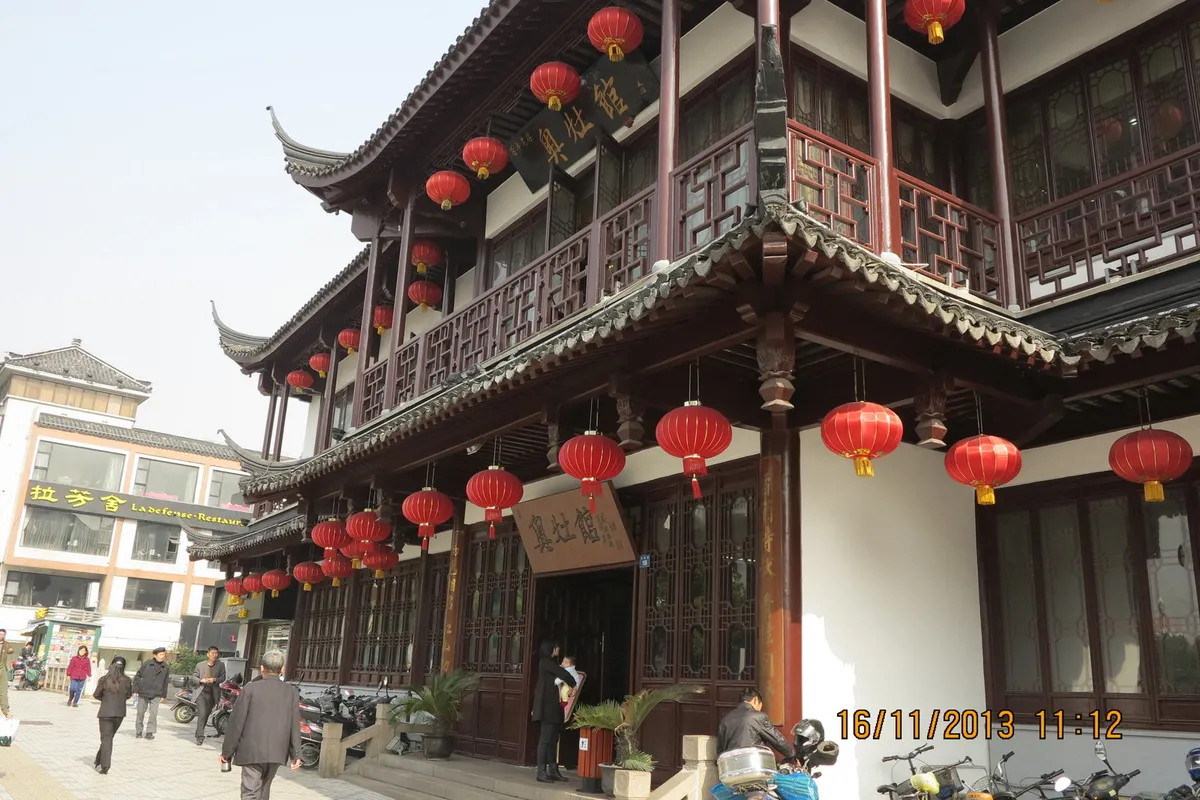
Driving across downtown Suzhou was excruciating. The old city is crisscrossed by canals, with few roads running straight through. Preservation rules mean there are hardly any wide streets. We could only follow the GPS, twisting and turning, until we slowly made our way to the hotel. We'd chosen the Nanyuan Hotel specifically because it's the only bookable garden hotel in Suzhou. Since it was getting dark, we decided to explore the hotel the next day. We parked and headed out to dine at Songhe Lou. To our surprise, a tycoon had booked the entire restaurant for a private event, so we looked across the street to Deyue Lou. Its small frontage belies its fame — a classic film "A Little Deyue Lou" from the last century catapulted it to stardom. We took a number and queued. Even with two wedding banquets and a birthday feast underway, they still took walk-ins. We didn't wait long. Inside, the place was huge, so big it could make you lose your way. Squirrel-shaped mandarin fish, sizzling eel strips, and jujube paste cake were all superb. We couldn't finish and packed up leftovers, even taking the fish head. That mandarin fish sauce — so delicious, slightly sour and sweet, not cloying at all.
The only regret was that the waitstaff were almost all from other places, and the diners too. We heard no soft Suzhou dialect — just Shanghainese and Mandarin everywhere. After the meal, strolling along Guanqian Street, we finally caught the Wu soft dialect from two city management officers talking.
A quiet night passed. The next morning, after breakfast at the hotel, we began our tour of Nanyuan Hotel. First, we saw the former residence of Chiang Wei-kuo, a three-story villa, elegant and still available for guests — there's only one room on the top floor, probably pricey. Right next to it were the ruins of Lin Biao's Project 571, smaller than Hangzhou's 704 Project but similar in layout. We walked around, passed through the underground tunnel, which connects directly to the swimming pool area.
Not far from the secret tunnel, we came to Mingxuan, known as the 'little Master of Nets Garden.' It's a tiny courtyard but complete with rockeries, a small pond, corridors, and pavilions — a typical Suzhou garden. A single banquet table fits in the lakeside pavilion; it's said many officials have dined there, and the feast is praised as 'the first banquet of Wu style.' Leaving Mingxuan, we wandered through the hotel's grounds. Nearby was Shanqing Temple, a small Zen courtyard we poked around in, wrapping up our hotel tour.
The hotel gave us two tickets to Hanshan Temple, so off we went. Traffic was moderate. Both Miss Ling and I had visited before. The temple's fame doesn't rest on its antiquity, but on Zhang Ji's poem "A Night-Mooring Near Maple Bridge" — an incredible advertisement! Plus, the Japanese reverence for the place turns New Year's Eve into a scene dominated by Japanese tourists, who book bell-ringing slots far in advance; locals can't get a chance. We stood on the stone bridge in front, soaking in the poetic mood of Zhang Ji's Maple Bridge. Passing the spirit screen wall, we entered the temple. Incense was thick. We paid five yuan to climb the bell tower and struck the bell three times, praying for peace.
Hanshan Temple isn't very large, and most of the buildings are modern reconstructions. With time on her hands, Miss Ling fed the fish and watched worshippers praying. We saw the Guanyin Peak Taihu rock, then exited through the back gate to the parking lot, got the car, and headed straight to the nearby Lingering Garden.
The Lingering Garden is smaller and less famous than the Humble Administrator's Garden, with far fewer visitors. We missed the half-hourly free guide, so we rented an electronic audio guide. This device was quite advanced — it even had image displays. The compact delicacy of Suzhou gardens meant the guide played nearly nonstop, very useful. Although not as renowned, the Lingering Garden is actually on par with the Humble Administrator's: a key national heritage site since 1961, one of China's four great gardens, and a World Heritage site. The only minor downside is that it's said to have imitated the Humble Administrator's Garden, but both have deep cultural roots. With few tourists and none of the noise, Miss Ling spent plenty of time among the pavilions and rockeries. It boasts the largest reception hall in Jiangnan, massive Taihu rocks, and various marble stones the owner loved. Everything is intricate and exquisite. Every pavilion position was chosen to enjoy different views in different seasons — absolute refined elegance.
We walked and savored the owner's aesthetic vision. As the last stop in Suzhou, the Lingering Garden was truly worth the visit. Perhaps because we explored it more thoroughly, Miss Ling ended up liking it even more than the Humble Administrator's. On the way out, the staff still seemed to suggest that the Humble Administrator's was superior; after all, this garden is only half its size.
Leaving Suzhou, we headed straight for the other highlight: Lotus Island on Yangcheng Lake. Shanghainese have a special love for hairy crabs. We used to go to Bacheng often, but it's become too commercial; here it's more authentic. This time, we wanted a close encounter with Yangcheng Lake. Because it was peak season, Miss Ling and I had to dine off-peak — we booked a 2 p.m. lunch. With the boss's directions and GPS, we easily found the pier to Lotus Island. There's a road to the island, but cars aren't allowed, not even for locals; you have to take a shuttle bus or a boat. Weekend buses were packed and irregular, so the boss sent a boat to pick us up, saving us the hassle of going to the north pier and waiting. It wasn't a meal time, so the speedboat was just for the two of us. The boatman zipped across Yangcheng Lake, past the surrounding nets — likely full of crabs inside. The lake shimmered; it was our first time touring Yangcheng Lake like this. The boatman told us that islanders used to be poor, growing watermelons and cabbages, until they started farming crabs and became well-off, living modestly prosperous lives. Soon we landed. Free-range eggs, white-water fish, fresh vegetables, and of course two large crabs per person — we ate blissfully; Miss Ling was utterly content. From the warm sun in the courtyard in the afternoon until sunset, when we moved the table indoors to dodge the wind, it was an afternoon of pure satisfaction, and total indulgence.
Beneath the setting Yangcheng Lake sun, we left Lotus Island, said goodbye to the boatman, and drove home. A little traffic jam on the highway didn't spoil things. We returned to the city in the evening light — that's exactly how a laid-back weekend getaway should be.


