Recording the Autumn of Suzhou and Wuxi in 2020
Recording the Autumn of Suzhou and Wuxi in 2020
In late October, autumn was in Wuxi. The four of us (Ping, Ting, Ying, and me) freeloaded on food, fun, and a big bed, enjoying the flowers, leaves, and autumn’s charm.
D1, Sunday, Oct. 25. Our plan: Shanghai – 136 km, 2.5 h – Dangkou – 30 km, 0.75 h – Wuxi Suning Hyatt Hotel. Sights: morning – Dangkou Ancient Town; check in at noon, rest; afternoon/evening – Xiaolou Lane, Chong’an Temple, Qingming Bridge Ancient Canal Scenic Area, Nanchang Street (Nantang), Yangchun Lane Bar Street.
The plan on paper came to life at 10:30 that morning, right in the parking lot of Dangkou Ancient Town.
At Dangkou Ancient Town, Ping and I, as niche visitors, enjoyed free admission. Ting and Ying, a bit miffed, paid full price to enter.
A Jiangnan water town, Dangkou seemed made of water. The clear Cang River, flowing east and west regardless, split the town north and south. Most bridges spanning the water were arched stone bridges, a few were plank bridges. Their names were a creative jumble—Gengdu, Yisheng, Zhongyou, Xiaoyi, Huayan, Yong’an, Yingfu, Yanxiang, Ruyi, Huitong, Xueshi, Chuanfang—big and small, too many to remember, forgotten once crossed. The only one I truly recall was our first encounter at the town’s west end: Wenchang Covered Bridge!
The covered bridge was about the highest point in Dangkou. Standing on it, you could almost take in the whole ancient town: medicinal cuisine, soup dumplings, royal tea, famous stoves, and also Guanyin Hall and a Christian church.
Ping’s foot hurt, so she rested on the beauty seat by the bridge. Over there, Ting was studying a patch of sky-blue on a gable wall. I walked down to the waterside steps and looked back to see Ying snapping photos of everything: the ancient tree, the moon gallery, lanterns under the eaves, red boats on the water.
Maybe we’d been too intense on the bridge—we all got hungry. At Dongwu Noodle House, a big bowl of noodles disappeared in no time, slurped down to the last drop. Full? Still felt a bit empty, so we bought roasted rice cakes and lotus root flour crisps from a street stall.
Masters like Qian Mu the sinologist, Qian Weichang the mechanics giant, educator Hua Hengfang, and cartoonist Hua Junwu are all known names from Dangkou, far beyond ordinary gentry. Yet they were just like common folk, once walking the short streets and lanes of this ancient town. We stumbled upon some of their former residences and missed others. But the former home of composer Wang Xin was one we absolutely wouldn’t miss. Approaching it, “Ode to the Motherland” rang in our ears: “We are hardworking, we are brave, we love peace, we love our homeland!”
Flowers bloom into trees, water flows into rivers—an unshakeable law of nature, echoing the course of history. That’s Dangkou Ancient Town.
At the old stage and the inspection office in Dangkou, we flew a drone, pushing our view higher and higher!
White walls and black tiles, a true water town—nothing more beautiful than Dangkou Ancient Town!
Leaving Dangkou behind, we next sought our lodgings: Wuxi Suning Hyatt Hotel. We’d booked online, and by 15:00 we checked in. Ting and Ying got room 5802; Ping and I had 5515. Not on the same floor, but the hotel did its best for us.
In the city center, the Wuxi Suning Hyatt boasts the highest lobby in Wuxi. We went up even higher, above the lobby, and gazed out. In the distance, the rolling hills were Huishan; below, the winding river was the Grand Canal. All these sights turned into a golden, silver-tinged sunset over Wuxi.
At 17:30, we hit the streets. The hotel sat in a prime spot, surrounded by malls and scenic spots. We skipped Xiaolou Lane on Renmin Road, Donglin Academy on Jiefang Road, the Catholic church on Zhongshan Road, and Qin Bangxian’s former residence on Chongning Road. Instead, we headed straight from Renmin Road to Zhongshan Road and on to Nanchan Temple by the canal.
En route, we noticed Sanfeng Restaurant and Sanfengqiao Meat Shop. The mixed wontons at Wangxingji tasted genuinely good, but we just had a bite, saving room for Wuxi xiaolongbao later at Xishengyuan.
Xishengyuan near Nanchan Temple was tucked away in a quiet corner, a bit hidden. Finding it took some doing, even with navigation. The place specializes in wontons and xiaolongbao. We ordered the buns—large, thin-skinned, stuffed with plenty of filling, sweet and delicate, fresh and smooth!
Too focused on the tasty treat, we nearly neglected Nanchan Temple Pedestrian Street, with its flashier colors and thicker crowds. Old relics—archways, temples, pagodas, ancient bridges—were outlined in light strips, making the serene old canal look completely different from daytime. Usually, scenic spots aim to restore things to look old. But Nanchan Temple went its own way; we felt it was like they started making it look old, then halfway through suddenly stopped!
We hopped on a boat for a canal cruise. Ping and I again went free; Ting and Ying again paid. After a short wait, at 19:30 the tour began from Nanchan Temple, passing Baota Bridge, Yangchun Bridge, the old and new Kuatang Bridges, Jintang Bridge, Dagong Bridge, and Qingming Bridge. At every brief stop, passengers got on or off—some diners from Water Lane, some players heading to Nanchang Street. Times have changed; we no longer saw village women washing clothes by the river.
Around 20:00, we docked at the one-way terminal: Wuxi Kiln Site Museum. I went ashore with the crowd to see the museum; Ping, Ting, and Ying stayed on the boat.
Quick knowledge tip: The Ming-Qing kiln ruins on Dayao Road have over 40 surviving brick kilns, about 20 well preserved, extremely precious. They’re a national key cultural relic protection site, now turned into a museum.
I was ashore only seven or eight minutes, then we headed back. The boat, nearly empty before, was now packed. The boatman skipped the commentary and busily checked tickets by row. A bratty kid behind us, full of mischief and endless energy, gave us pounding headaches more than once.
We wrapped up Qingming Bridge Ancient Canal Scenic Area and took a taxi back to the hotel. It was still early, not yet 21:00. Across the street, Xiaolou Lane blazed with dazzling lights, so eye-catching we couldn’t resist crossing the railing to check it out.
A giant light-shadow ad from a review platform spelled it out loud: Shangloulou, Danfei, Golden Banquet Four Seats, Xiaoxiangyouxi, Starbucks, Tan Yaxue, Qianchuan, Xiaomanyuan… one hyped-up spot after another.
Cobblestone and flagstone lanes led us from west to east, deep into Xiaolou Lane. Old residences had turned into eateries, shops into cultural-creative spaces. Men and women, hipsters and yuppies, each with their own agenda, flocked here. This place has history. Down the hidden alleys behind deep mansions, just in the Ming and Qing dynasties, it produced one zhuangyuan (top scholar), thirteen jinshi (presented scholars), fifteen juren (recommended men), and nearly eighty xiucai (licentiates)—a land of talent and bright stars.
This was Xiaomanyuan, with a breezy, casual vibe. Ting said she really liked it. And here was the Sun family’s old garden down a narrow lane—a deep, deep courtyard. “From now on, Master Sun is a stranger.” Ping said, “Ping likes it!”
Ying’s favorite was outside Dayuan Alley, while mine was that pot of mottled sake in Qianchuan.
CAT SPACE, a pet shop’s British Shorthairs and Siamese, won over all four of us unanimously. The pets had their own eye-catching tricks, whether in gentle play or snarling, claw-baring fights.
An unexpected twist: Ying got a headache, which dashed our hopes for Haidilao hot pot. The four of us hurried back.
We washed up and went to bed. Xiaolou Lane beneath the hotel still shone bright.
D2, Monday, Oct. 26, Wuxi. Sights: Morning – Xihui Park, Jichang Garden, Huishan Ancient Town; noon – hotel lunch and rest; afternoon/evening – Nianhua Bay. No matter what yesterday was like, today’s plan was still publicly posted.
Good news: Ying’s headache stayed in last night. Bad news: the sky was a bit overcast.
Breakfast at 8:00, hotel buffet, 64 floors up. Eating while enjoying the view—that smug little demeanor!
A short rest after the meal, then at 9:30 we set off for Xihui Park. The hotel got us a taxi. The driver, seeing there were four of us, dumped a woman he’d picked up along the way, leaving her fuming. At 10:00, we arrived at Qinyuan Gate of Huishan Ancient Town in Xihui Park. We got off; tickets cost 70 yuan. Ping and I were fully exempt; Ting and Ying paid.
Huishan Ancient Town: a quick visit, a photo at Huilu Bell to prove we were here.
We four walked the entire horizontal street (Qinyuan Street). For the vertical street (Xiuzhang Street), Ping, Ting, and Ying explored deeply; I only skimmed the surface.
On the horizontal street, from Qinyuan Gate onward, came Zhang Ming Memorial Temple, Xu Xianmo Memorial Temple, Yang Sibao Memorial Temple, Chastity & Filial Piety Temple, the Renjiediling Archway, Yu Xingeren Memorial Temple, Zhu Memorial Temple, and Chunshenjun Memorial Temple, until it connected with the vertical street at Xiuzhang Pavilion.
On the vertical street, Ping, Ting, and Ying went all the way to Dongyue Temple and beyond. I just lingered near Xiuzhang Pavilion, circled around the Xianxian Shizi Memorial Temple, and that was it.
Walking along, the sheer number of ancestral halls made an impression. Looking it up, there are actually 118, honoring over 180 figures from 80-plus surnames. Among them are Taibo, a sage of pre-Qin Wu; Lord Chunshen from the Warring States; Qian Liu, King Wuyue of the Ten Kingdoms period; and from Tang and Song onward, Li Shen, Lu Zhi, Zhang Xun, Wang Dan, Fan Zhongyan, Sima Guang, Zhou Dunyi, Zhang Zai, Zhu Xi, Ni Yunlin, Li Hongzhang, and more. A torch passed down, the lifeline of the nation. The ancestral hall culture pins down your roots and answers where you come from. As for where you end up—that’s entirely up to you.
At 10:30, we all regrouped. It was time to tick off the beauty of Xihui: Jichang Garden.
We entered slowly through the south foyer. Beyond it, a rockery of piled lake stones rose in uneven heights, twisting and turning. At the top stood a platform called “Nine Lions Terrace”; at the foot, a pond cleverly brought in the “Second Best Spring Under Heaven” from outside Huishan. This borrowed scenery and playful momentum eventually formed a pool named Jin Hui Yi. In Jiangnan gardens, mountains don’t need to be high, water doesn’t need to be deep. The creator knew this art well, deftly leaving empty where needed and adding weight elsewhere. Around the pond, fine trees were planted, waterside pavilions and towers built, winding bridges and covered walkways added.
We walked a short stretch along the corridor, then turned into the garden’s quietest “green-shaded nook,” separated by a moon gate. Within the small, one sensed the large; from minutiae, one grasped the whole. Here too were imperial stele pavilions from Kangxi and Qianlong’s time, and a lofty Lingxu Pavilion reaching for the sky. Between them, a lake-stone peak stood graceful, named Jieru Peak.
We found an open spot and flew the drone, but we were too casual—more than half the footage was just the lush greenery of Xishan and Huishan.
Turning back to the corridor, we hit peak visitor time, many crowding the prime spots at Yupan Pavilion and Zhiyu Jian. A few idlers secretly tossed fish food, drawing a frenzy of pond fish. A classic trick—we passed by without stopping.
We quickly crossed Seven Star Bridge, climbed to Plum Pavilion, and followed Eight-Tone Stream out of Jichang Garden. During that time, Ying even doubled back to walk the large rockery again.
Huishan Temple was just a midway sight. Our last main focus was the Second Best Spring Under Heaven, located near Huishan Temple, west of Clay Figure Ding, just up a short slope. That was it!
A bit hungry, we asked Ping about the eggs from the hotel; she’d already given them to the dogs in the field.
Hungry and tired, we four turned into a senior tour group. We hopped on a sightseeing car in the park and took a ride around Xihui Park, stringing together Yingshan Lake, Azalea Garden, Nine Dragon Wall, and Longguang Pagoda.
At 12:30, a taxi took us back. Without delay, we went straight up to the 64th floor. We were that determined for a steaming bowl of big noodle soup! Ping, Ying, and I followed the online reviews and ordered yellow croaker with snow vegetable noodles. Ting, however, went off the beaten path, insisting on meatball and two-mushroom noodles for something different.
After a noon nap, it was 15:00. We drove straight to Nianhua Bay town. When planning, we’d imagined staying low-key in Nianhua Bay, pretending just once we were in Kyoto or Nara.
The lakeshore twisted, the road curved, with a bit of mud along the way. Soon, Nianhua Bay opened up as a pristine stretch of clear water, clean land, and pure sky. At 16:00, we’d truly arrived. Kyoto? Nara? Ting and Ying sighed and continued paying; Ping and I kept enjoying free entry.
There are two ways into the town: a sightseeing car zips down Nianhua Avenue. We chose to stroll the small paths, from Nianhua Yixiao to Banshan Xianri.
A reed leaf set by the path, a stream trickling through a gully—seemingly casual, yet it became a scene. The sign read: Water Zen Sound Stream. Zen meets dry landscape here, stripped of borders, freed of ornament, very Japanese. For ordinary folks like us, it was hard to grasp. Even if we blended music, painting, poetry, tea ceremony, and gourmet food in five dimensions, how could we handle boundless Zen? So Nianhua Bay, timely as always, had a “One-Day Zen Joy” recommendation—instant enlightenment on the spot.
We reached Banshan Xianri, a square where you see water up close and mountains far away. This was just the opening part of a Nianhua Bay tour; the essentials came later. We crossed Yinxin Bridge. At the mountain gate “One Flower One World,” a crowd of uncles and aunties gathered. The knock-on-the-door question here must be Zen-minded. We were reverent, we worshipped, we passed through.
But nature called—Ping urgently needed a restroom and slipped away deep into Xiangyue Flower Street.
A place called Yi Chan Yi, a Zen tea house, and the first Japanese-style buildings along Xiangyue Flower Street exuded Tang-dynasty flair. Sky-blue roofs, beeswax-colored walls. The buildings weren’t tall, mostly framed in bamboo, wood, pottery, and stone. I thought, if I could sit a while and linger in this earthly autumn, what a blessing that would be.
Ting and Ying were nowhere in sight, scattered elsewhere. I walked a stretch of back street, savoring the refinement privately: a single flower, a stepping stone, low bamboo fences, serene yellow blossoms—light, tranquil, detached. This was my world of flora and flora.
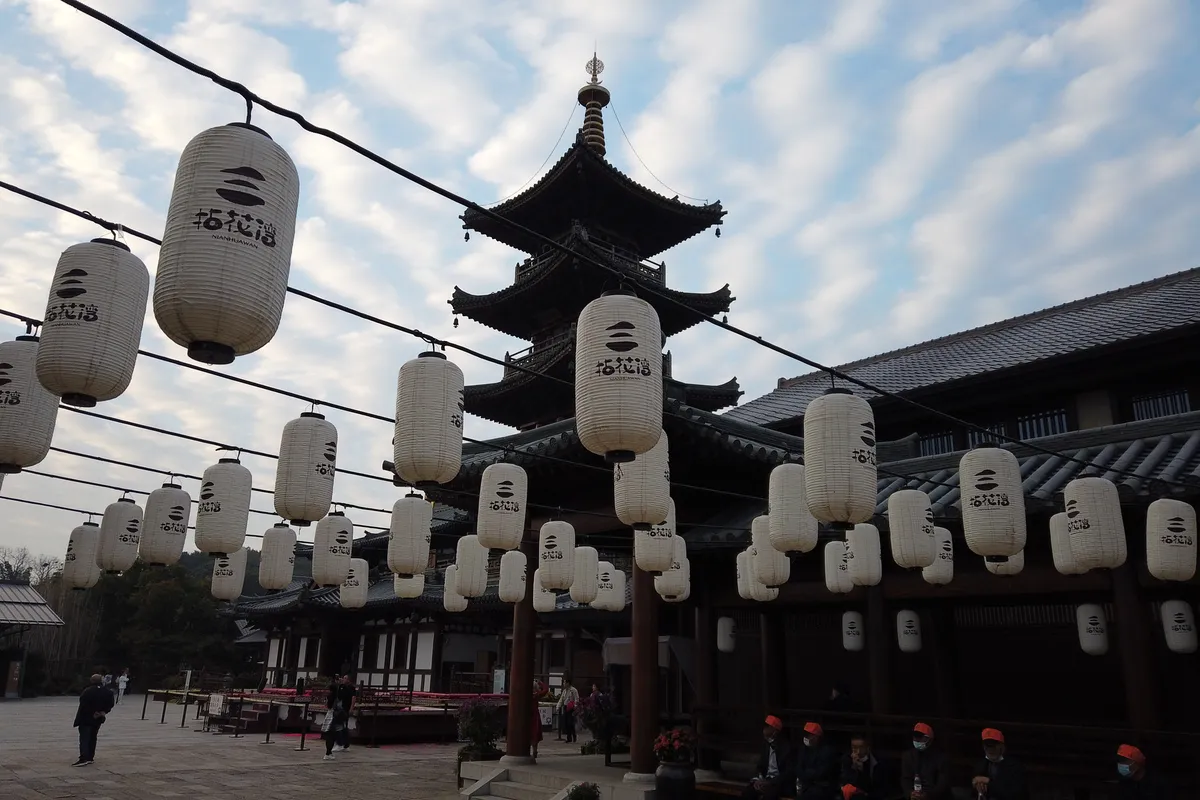
Zen Music Hall, Futian Pavilion, Jiaran, Wuyue Wine Workshop—scenes shifted behind me step by step. Ahead, in the square, stood the five-story Nianhua Pagoda, which gave my heart a warm jolt. The whole Daigoji Temple vibe: so Kyoto, so Nara.
Ping waved from afar, a relaxed look on her face. After we regrouped, we rested at Baichi Bridge, waiting for Ting and Ying.
We didn’t wait long for them but for a troop of Chinese aunties. We saw them form a circle in the open space before the bridge. The formation—no one else dared intrude. We suddenly realized this was the opening of a square dance. The lead auntie stepped into the circle, a close-up: “I’m Number One.” The next one showed herself: “I’m Number Two.” Then in order, Three, Four, all the way to the youngest, graceful figures, alluring charm. Ha ha, this was a Zen town, on Damo Road. No one has a bigger heart than these aunties!
Ting and Ying caught up and also witnessed the scene.
Nianhua Pagoda stood at the center of Nianhua Square, surrounded by Baihua Hall, Miaoyin Stage, and Nianhua Hall. We snapped photos for memories—capturing the pagoda and Miaoyin Stage!
The farthest we walked was Wudeng Lake Square, then turned to Yixiaotang’s Brahma Flower Sea.
The Brahma Flower Sea, enormous in size, held enough strollers to fill it. Admiring flowers and colors, we mingled among them like flower fiends, turning into flower monks and color nuns. We stayed in that flower sea for quite a while, until the distant setting sun plunged heavily into Taihu Lake beyond Nianhua Bay. During that time, we tried flying the drone but were promptly grounded by park staff.
Dinner was at the internet-famous Pinyuwei Lake Fresh Restaurant. At 18:00, peak dining time, the lakeside seats were all taken. We had to settle for the basement, sitting high on stools—no Japanese floor seating here.
The group meal deal was shrimp and fish, no need to fuss over preparation, just steam and roast. When the dishes arrived, the fish and shrimp that had battled knife and fire were no match for our sharp teeth and quick tongues!
Meat and drink passed through our bellies; Buddha stayed in our hearts. As the meal ended, our minds wandered to the colorful light shows. At 19:10, we rushed over. The Nianhua Pagoda light-up ceremony was already halfway through; the graceful dancers had quietly taken their curtain call, only the pagoda body still shifting colors.
At nearby Miaoyin Stage, some Zen music lovers were either listening to evening drum Zen sounds or writing sutras with brush—real gold and silver trading hands, a live lesson in Zen meditation.
We weren’t satisfied. North of Nianhua Pagoda, at Wudeng Lake Square, the “Flowers Blooming Five Leaves” show was nearly over, already missed.
We turned back. At Nianhua Square, another show rolled on nonstop, and this time we watched it in full.
The night of Nianhua Bay blazed bright as day, reaching a state of perfection, a scenery all its own. Enjoying it all the way, we lost track of time. At the mountain gate “One Flower One World,” we accidentally ran into a smiley face formed by drones in the sky. Well-wishing in our hearts, blessings to everyone—the language of love is the most beautiful!
Blessings to all, blessings to all living things!
Even as the lights dimmed, Banshan Xianri Square still had a spectacle. At 20:00, over the dark water, scattered fishing lights glimmered. Music rose, a figure crossed the river on a reed. Under a hint of starlight, I filmed the whole performance.
The light shows staged in Nianhua Bay town—the Nianhua Pagoda lighting, the Flowers Blooming Five Leaves at Wudeng Lake, the Smile in the night sky, and the Reed Crossing & Damo Zen Journey at Banshan Xianri—unfolded either like brilliant starry rivers, flowing with color, or like the sparse shadow of a breeze, a candlelit walk in the night. We could feel the town’s wholehearted effort. Among the myriad sentient beings, eighty-four thousand, we were but one in ten thousand. Yet the intriguing souls, the elevated taste—we could still sense it. Looking at each other without weariness—only Nianhua Bay. A little novice holding a lantern nearby, his state of mind arising from his heart, gains and losses going with fate, composed a haiku: “You leave, I stay—two autumns.”
Time to go home. By 21:15, we were back at Sanyang Baisheng Plaza near the hotel.
D3, Tuesday, Oct. 27. Today’s plan: Wuxi – 50 km, 1 h – Tianping Mountain – 130 km, 2.5 h – Shanghai. Sights: Morning – Yuantouzhu, lunch at Sanfeng Restaurant; afternoon – Tianping Mountain, then back to Shanghai.
Breakfast was again the hotel buffet. After eating, at 8:30, we drove toward our goal: Yuantouzhu. At 9:15, we were driving along the shore of Taihu Lake. At 9:30, we entered Yuantouzhu Park. As for tickets, the ones paying were still Ting and Ying, and the free ones still Ping and me.
“The finest spot of Taihu Lake is, after all, at Yuantouzhu.” That eye-catching, brainwashing slogan was first coined by literary giant Guo Moruo. We could feel Taihu’s partiality for Wuxi and for Yuantouzhu. Inside the park, the first scenic spot, Water Garden, borrowed from Taihu’s vastness. The water features weren’t just small-scale. We could gaze far: light boats, ring bridges, solitary isles, distant mountains. We could admire close-up: leisurely pond fish, lotus leaves in fresh clusters.
Following the waterside long path, we came to the depths of Lotus Flowers. The distant mountain pavilions in the background, not famous at first, we thought were just borrowed scenery from the seventy-two peaks of Taihu. Only when we moved to the next spot, Chongshan Yinxiu (Hidden Beauty of Chongshan), did the answer become clear.
Today wasn’t a sunny day, nor cherry blossom season. Even with occasional bursts of brilliant color, the feeling was like stumbling into a haze. But we still had distant views and the theme of Yuantouzhu ahead. I quickened my pace to dodge the dull scenery. Ping and Ting took their time, Ying brought up the rear. At the end of the waterfront boardwalk was Wangjing Platform, where we leaned on the railing, watching waters and mountains.
Chongshan Yinxiu: we just walked through, merely a trail over a small hill, up and down. The highest point on the trail was Yixiu Bridge, from which you could climb Ludi Peak and take in Taihu’s misty waves and the ages of Wu and Yue from Shutian Pavilion. The “hidden beauty” might be Swan Lake ahead or the Japanese iris garden by the path.
A bit tired, we rested at Friendship Pavilion beside a big lawn. In a nearby pond, a few waterbirds eyed live prey in the water. In another patch of woods, a group of aunties foraged for wild shepherd’s purse. The happiness index in life lies in going with fate, letting go of attachments, living in the now, not chasing the past.
Ping, Ting, and Ying stayed back feeding a gang of stray cats. The cats came in droves at the call, refusing to leave. The few eggs we’d sneaked from the hotel were nowhere near enough to fill their tiny bellies.
Cherry Blossom Valley: a bit of a pity. I’d forgotten the season. Autumn is not your best time. But I can leave the best of you for later, for spring. Forget it, forget it—too much talk only wears me out. Better left unsaid!
Ahead, the Mountain Glow & River Splendor Archway said it outright: Yuantouzhu is here. We’d finally entered the prime spot. Ting’s and Ying’s tickets included a boat tour of Taihu Lake, but at 10:30, there was no time to go to Taihu Fairy Islet. Sometimes a journey is about giving up—and Ting and Ying truly did!
At the finest spot of Taihu, I thought it was just a plain screen wall marking the way. Turning in here, the scenery suddenly came alive. Pavilions, towers, and terraces frequently entered the frame, no longer endless roads and boundless fallen leaves. Vast as Taihu, delicate as a pond—a long causeway separated the two, with traffic flowing under Changchun Bridge. From one side of the pond, I watched the leisurely strollers on Changchun Bridge opposite. A stretch of water, an arched bridge—even with no kingfishers chirping and no cherry blossoms, the beauty of people and scenery was still a perfect picture!
After Changchun Bridge came Yuantouzhu Spring Waves, the geographical Yuantouzhu. The floating turtle head raised itself from the lakeside land, boldly probing into Taihu’s spring waves and autumn tides. Standing on this three-side-by-lake terrain, you could take in Taihu’s vast blue expanse in all directions.
“Falling clouds and lone ducks fly together; autumn waters share the same hue as the vast sky”—a vision from early Tang poet Wang Bo’s prose. “I beg for a westerly wind to rise, to haul all the misty sails into Taihu”—a heartfelt cry from late Tang poet Pi Rixiu’s verses. Not slighting the modern, loving the ancients—between looking up and down, our impression was a horizontal scroll of splash-ink landscape. The small scroll embraced the world, a boat traveling ten thousand miles, all within Taihu!
On the high cliff of Yuantouzhu stood a navigation lighthouse. I took a photo.
Heading back, still at the finest spot of Taihu, right across from the grand Songfen Hall was another pond deep in lotus flowers—I’ll call it the Little Lotus Deep. Over the pond there was a tiny bridge, rainbow-shaped. After crossing, I noticed the trick: not high, but tricky to climb. Ping wobbled over, Ting took a running leap, Ying found it steep and managed by coping, while some simply walked around. All in good fun.
By 11:15, at the Mountain Glow & River Splendor sightseeing car station, we hopped on and followed Shili Fangjing back to the entrance at Chongshan Gate. With that, our Yuantouzhu tour came to a satisfying end.
Lunch was at Sanfeng Restaurant, as planned. For this, we’d earlier gotten special permission for a late hotel checkout. Sanfeng Restaurant on Zhongshan Road wasn’t far. By 12:15, we were seated. The server suggested a group meal featuring the “Three Whites of Taihu,” which we’d tried at Nianhua Bay. This time we ordered à la carte. From the top ten famous Wuxi dishes: Stuffed Gluten Balls, Wine-Pickled White Fish, Crystal Jelly, Crispy Silver Fish, Liangxi Crispy Eel, Fermented Tofu Pork, Wuxi Spare Ribs, Fish-Skin Wontons, Stuffed Raw Gluten, Mirror-Box Tofu—we chose Sanfengqiao Spare Ribs, Sizzling Oil Eel Paste, Stuffed Gluten Stewed with Bamboo Shoots, plus a seasonal vegetable in broth. From the top ten Wuxi snacks: Old-Style Stewed Noodles, Three-Fresh Wontons, Taihu Boat Pastries, Four-Color Glutinous Balls, Almond Flour Buns, Yulan Cakes, Osmanthus Taro, Tofu Pudding, Wuxi Xiaolongbao, Chicken Big Pancake—we ordered Crispy Yulan Cakes and Osmanthus Fermented Glutinous Rice Balls. Delicious dishes and snacks, we savored every bite.
At 13:30, we checked out. Before that, we snapped a few photos in the bookstore at Suning Plaza.
Tianping Mountain in Gusu (Suzhou) was on our way. At 14:00, we left Wuxi Suning Hyatt Hotel. By 15:15, we parked at Tianping Mountain parking lot.
We could already see some red maple leaves—not many, but we were hoping for a full bloom of red at Tianping Mountain!
We were hoping too much. At the foot of Tianping Mountain, the red leaves did not bloom for us.
Gusu, from my childhood impression, was very small. Though years of construction have expanded the city, Tianping Mountain is still outside Gusu’s city limits. I had an emotional knot with Tianping: I’d visited as a youth, memories blurred of the mountain full of red leaves and the ancient sages. What I never forgot was climbing Tianping, aiming to shout from the peak, only to be thwarted by a sudden storm of wind, rain, thunder, and lightning.
Ping and I, no tickets needed, entered Tianping Mountain Park first. Ting and Ying, however, spent a while tangled in the maze of ID verification and ticket purchase. The Gaoyi Garden Archway, the most eye-catching structure in the park, was a high-standard imperial gift, well deserved by Fan Zhongyan (also known as Fan Wenzheng). After Jiejia Pavilion came Shijing Pond. Around the pond stood many ancient maples, some with new branches from old trunks, tinged with a hint of wine-red. So vivid, so colorful—I got drunk on the autumn breeze without a drop of wine.
Wake up, wake up! Just this tiny speck and I was already carried away, imagining a red prairie fire. Such a thirst for color had me tipsy. Actually, I clutched that bit of red just to hold onto Tianping Mountain’s autumn!
At the winding bridge ahead, some foreign visitors couldn’t move their feet, guarding the view as if afraid they’d never see it again once they left the country. We understood. We gave way.
The winding bridge led to the shore. Many old buildings were related to Fan Zhongyan and his family: Baiyun Ancient Temple, Fan Wenzheng Memorial Temple, Three Grand Masters Temple, Fan Zhongyan Memorial Hall. Fan Zhongyan, a paragon of scholar-officials, known for dividing his porridge and cutting pickled vegetables, and for penning the “Record of Yueyang Tower”—high in the temple, far at the lake’s edge; in service or in exile, when poor he perfected himself, when successful he perfected the world: cultivate oneself, regulate the family, govern the state, bring peace to all under heaven. Worry before the world worries, rejoice after the world rejoices.
Behind the ancient buildings, a mountain trail led up Tianping. We didn’t climb. Instead, we sat resting by Baiyun Pond, but our eyes never left the ancient maples. Color clash: we spotted another group of foreigners laughing and snapping photos under a maple tree. Though the leaves hadn’t fully turned red, they were still having a blast.
Then we found our way out. We started our garden visit at 15:30, and by 16:30 we were out. Tianping Mountain—the red leaves didn’t bloom for us, but one leaf tells of autumn. The blank space left here, we were content.
The scenery outside the garden, naturally sculpted, was quite lovely. Ting and I saw the real view; Ping and Ying saw photographs.
At 16:40, we packed up, drove away from Tianping Mountain, and headed straight back to Shanghai. Nearby Mudu remained a dream water town in our hearts. At that moment, a Pingtan ballad, smooth as flowing clouds, plucked at our heartstrings—drunkenly sweet, the Wu dialect charming!
2020/11/28


