Starting from Shanghai: A 2014 One-Day Self-Drive in Suzhou (Luohan Yuan Twin Pagodas, Pingjiang Road, Couple’s Retreat Garden, Quanjin Guild Hall, Baodai Bridge)
June 2, 2014. I’ve been to Suzhou at least 30 times, and I’ve already visited major sights like Humble Administrator’s Garden, Lion Grove Garden, Lingering Garden, Master of the Nets Garden, Tiger Hill, Art Garden, Canglang Pavilion, Pan Gate, Hanshan Temple, and West Garden Temple. But Suzhou has so many attractions, there are still gaps to fill. On March 9, 2014, I also drove to Suzhou for a trip. Suzhou is only about 100 km from Shanghai. Without traffic jams, it’s just over an hour’s drive from my home in Pudong. This self-drive trip to Suzhou fell right on the Dragon Boat Festival. I covered 262 km in total and visited seven National Key Cultural Relics Protection Units and one China Historical and Cultural Street along the way. Suzhou’s tourism resources are incredibly rich. People from Shanghai can visit Suzhou many times without ever growing tired of it. Plus, the food is excellent. Just thinking about the noodles at Zhu Hongxing makes me want to find another chance to return to Suzhou.
June 2, 2014 (Suzhou weather: overcast with light rain, 19–25°C)
8:50 a.m. departed from my home in Pudong, Shanghai.
9:23 a.m. arrived at the Jiangqiao Toll Gate of the Shanghai–Nanjing Expressway. Total distance driven: 29 km.
9:35 a.m. arrived at the Anting Toll Gate of the Shanghai–Nanjing Expressway. Total distance: 48 km. Expressway toll: 15 yuan.
9:58 a.m. stopped at the Yangcheng Lake Service Area on the Shanghai–Nanjing Expressway for a rest. Total distance: 86 km.
10:12 a.m. arrived at the Suzhou Toll Gate of the Shanghai–Nanjing Expressway. Total distance: 99 km. Expressway toll: 25 yuan.
Compared to Hangzhou, the road from the expressway into downtown Suzhou is much smoother, and the distance is shorter as well.
This road is called Wangxingqiao Beiyi, in Suzhou’s old town. Parking on the roadside is free.
Guan Taiwei Bridge spans the small river between Wangxingqiao Beiyi and Guan Taiwei Bridge Road. It is a Suzhou Cultural Relics Protection Unit. The bridge’s name comes from a high-ranking official surnamed Guan who once lived here. The original bridge was built in the Song Dynasty; it was rebuilt in the 35th year of the Qing Kangxi reign (1696) and repaired again in the 4th year of the Guangxu reign (1878). The entire bridge is a single-span structure of stone slabs and beams.
The photo below was taken from Guan Taiwei Bridge Road.
About 100 meters south of Guan Taiwei Bridge is Dinghui Temple Lane. Twin Pagoda Garden and Dinghui Temple are on this little street.
Dinghui Temple is a Suzhou Cultural Relics Protection Unit. The temple was originally built in the 2nd year of the Xiantong era of the Tang Dynasty (861). In the 1950s it was occupied by the Suzhou No. 7 Plastics Factory. The factory was moved out in the 1990s, and the ancient temple was restored. It now serves as a branch of Xiyuan Jiechuanglu Temple and is open to the public for free.
The photo shows the entrance of Dinghui Temple Lane from Fenghuang Street. This lane is one-way; by car you need to turn in from Wangxingqiao Beiyi to the east.
Luohan Yuan Twin Pagodas and Main Hall ruins—listed as a National Key Cultural Relics Protection Unit on November 20, 1996, in the fourth batch, classified as ancient architecture from the Northern Song Dynasty. This is the place commonly called Twin Pagoda Garden. Admission is 8 yuan. The temple was first built in the 2nd year of the Xiantong era of the Tang Dynasty (861), originally named Prajna Temple. During the Wuyue period of the Five Dynasties, it was renamed Luohan Yuan. In the 7th year of the Taiping Xingguo era of the Northern Song Dynasty (982), a pair of brick pagodas was built and called the Twin Pagodas. In the 10th year of the Qing Xianfeng reign (1860), the temple was destroyed in warfare; only the twin pagodas and the main hall ruins remain.
When I went back to fetch the car, I photographed Yuan Xuelan’s Former Residence, also known as Twin Pagoda Reflection Garden, next to Guan Taiwei Bridge. The plaque on the gate says “Wudu Guild Hall.” It is now office space for a company. Yuan Xuelan was a quite influential poet in Suzhou’s literary circles in the late Qing Dynasty.
Both of the following pictures were taken on Ganjiang East Road.
I’d always thought parking at Guanqian Street was very difficult. In fact, if you drive from Ganjiang East Road into Gongxiang, there are both above-ground and underground parking lots on the south side of Bifengfang. Underground parking costs 5 yuan per hour. There are many lanes in this area, and many roads are one-way. Leaving the parking lot and heading west, you can see the signs of long-established brands like Zhu Hongxing and Luyang Wonton.
Zhu Hongxing’s main restaurant—a time-honored noodle house founded in the 1930s. Lu Wenfu’s novel “The Gourmet” mentions Zhu Hongxing’s noodles many times; the main character won’t eat noodles unless they’re from Zhu Hongxing. The noodles here are indeed good, though the prices at the main restaurant are a bit higher than at its branch outlets.
When the noodles are served in Suzhou, the toppings come in a separate little bowl. “The toppings must not be placed over the noodle bowl; they should be put on a separate plate and picked up with chopsticks when eating, as if crossing a stone arch bridge before reaching your mouth…” Lu Wenfu describes it this way in his novel.
Leaving Zhu Hongxing and walking north along Gongxiang for a short while, you reach Guanqian Street, right facing Xuanmiao Temple.
Sanqing Hall of Xuanmiao Temple—listed as a National Key Cultural Relics Protection Unit on February 23, 1982, in the second batch, classified as ancient architecture and historical memorial building from the Song Dynasty. Xuanmiao Temple was first built in the 2nd year of the Xianning era of the Western Jin Dynasty (276). It was called Kaiyuan Palace in the Tang Dynasty, Tianqing Temple in the Northern Song, and received its present name in the Yuan Dynasty. It has been destroyed and restored many times. Sanqing Hall is the main hall of Xuanmiao Temple, rebuilt in the 6th year of the Chunxi era of the Southern Song Dynasty (1179). It is the largest surviving wooden ancient structure south of the Yangtze River.
Parked on Cang Street; one-time charge of 8 yuan. Then walked to Couple’s Retreat Garden and Pingjiang Road Historical and Cultural Block.
The late-Tang poet Du Xunhe wrote in his poem “Seeing a Friend Off to Wu”: “When you arrive in Gusu, you will see houses all nestle by the riverside.”
Couple’s Retreat Garden—listed as a National Key Cultural Relics Protection Unit on June 25, 2004, in the fifth batch, classified as ancient architecture from the Qing Dynasty. Admission: 20 yuan. Originally named Sheyuan Garden, it was built by Lu Jin, Prefect of Baoning, during the Qing Shunzhi reign, taking its inspiration from Tao Yuanming’s “Return Home Ode”—“The garden grows pleasurable day by day.” Because there is a garden on each side of the residence—east and west—it is called Couple’s Retreat Garden (Ou Yuan).
Ticket: 20 yuan.
Walk along Daxinqiao Lane from the garden entrance, across Cang Street, and about 400 meters west is Pingjiang Road. Residents here can still use well water.
Daxinqiao Lane. The house in the picture below is Guo Shaoyu’s Former Residence. He was a famous linguist, literary scholar, and historian of literary criticism. After 1949, Guo Shaoyu served as dean of the Chinese Department at Fudan University, vice chairman of the Shanghai Literary Federation, vice chairman of the Shanghai Writers’ Association, vice president of the Shanghai Linguistics Society, deputy editor-in-chief of “Cihai,” former dean of the Literature School at Tongji University, and one of the first doctoral supervisors at Fudan University. His former residence is still a private home and not open to visitors.
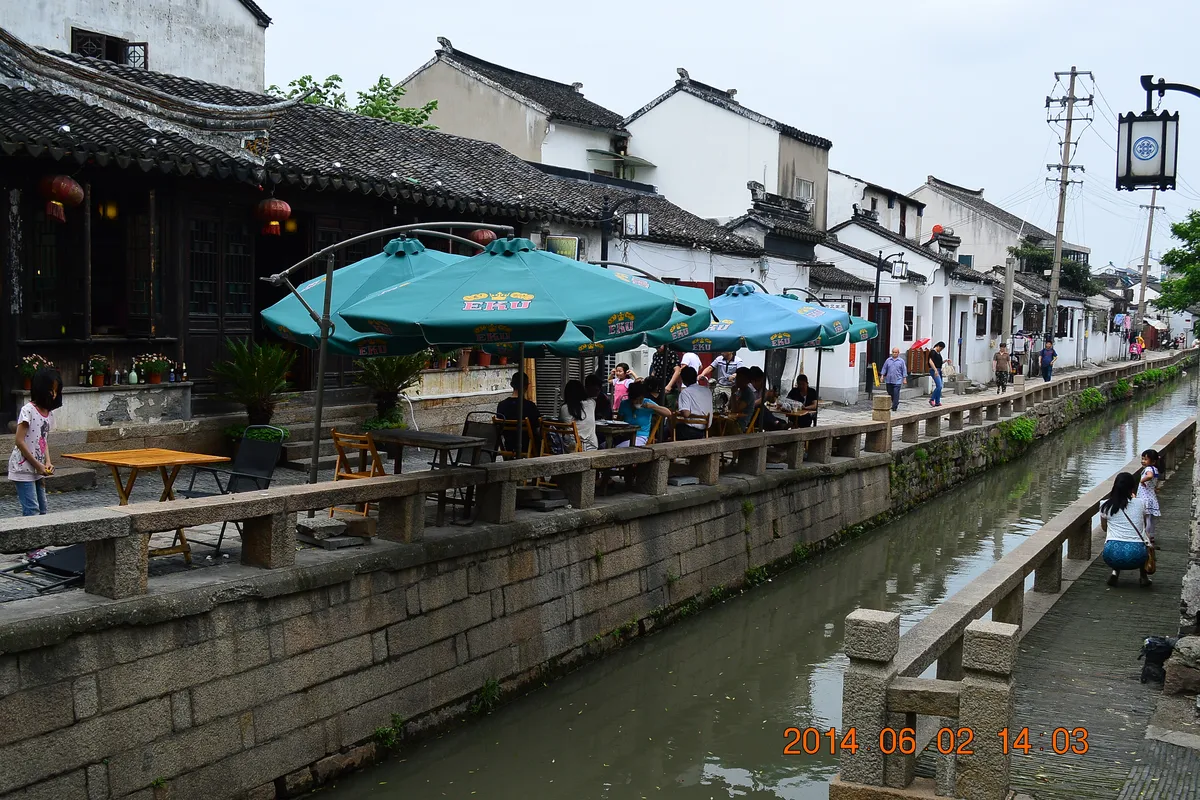
Pingjiang Road Historical and Cultural Block—one of the first China Historical and Cultural Streets to be honored. Pingjiang Road is a small road along a river. During the Song and Yuan dynasties, Suzhou was also called Pingjiang, hence the road’s name. It starts from Ganjiang East Road in the south, crosses Baita East Road in the north and connects to Dongbei Street, totaling about 1.6 km. The section I strolled this time runs from Baita East Road to Zhongzhangjia Lane, roughly one-third of the whole length.
Pan Residence at Weidaoguanqian—listed as a National Key Cultural Relics Protection Unit in April 2013, in the seventh batch, classified as ancient architecture from the Qing Dynasty. Weidaoguanqian is a small lane intersecting Pingjiang Road. Pan Residence is just over 50 meters from the Pingjiang Road entrance. It is also called Ligeng Hall, built in the 52nd year of the Qing Qianlong reign (1787) by the Huizhou merchant Pan Linzhao. Unfortunately, I didn’t come at the right time; it’s only open to visitors on weekday afternoons.
The China Suzhou Pingtan Museum on Zhongzhangjia Lane has three courtyards; the second-courtyard main hall is set up as a storytelling house in Qing Dynasty style. Outside of performance times, the museum is open to the public for visits. Again, my timing wasn’t right.
Quanjin Guild Hall—listed as a National Key Cultural Relics Protection Unit on May 25, 2006, in the sixth batch, classified as ancient architecture from the Qing Dynasty. It was built in the 30th year of the Qing Qianlong reign (1765) by Shanxi money-trade merchants. It was later destroyed and rebuilt by Shanxi silk and tea merchants. Now it houses the China Kunqu Museum and is open to the public for free. Quanjin Guild Hall is just about a hundred meters from Pingjiang Road. Very few tourists come here; the authentic relic itself receives little attention.
Kunqu opera originated in the 14th century in Kunshan, Suzhou. Later, through the improvements of Wei Liangfu and others, it spread across the country and is honored as the “ancestor of all operas.” The statue in the photo is Wei Liangfu. He held offices in the Ministry of Works, Ministry of Revenue, Ministry of Justice, and served as Surveillance Vice Commissioner of Guangxi and Administration Commissioner of Shandong. He was an outstanding opera musician and reformer during the Jiajing reign of the Ming Dynasty, and the founding father of Kunqu (southern opera). He made outstanding contributions to the artistic development of Kunshan qiang and was later honored as “the ancestor of Kunqu,” even known as the “Saint of Music” in operatic circles.
Jiachen Lane Brick Pagoda—listed as a National Key Cultural Relics Protection Unit in April 2013, in the seventh batch, classified as ancient architecture from the Song Dynasty. According to “Wumen Biaoyin,” there were once seven small brick pagodas in Suzhou, most built in the Song Dynasty. Two were lost long ago, two destroyed during the Qianlong reign of the Qing, the White Pagoda was pulled down in 1928 when Linton Road was widened, and the one on Lianxi Fang was also demolished when the street was widened in the 1950s. The sole survivor, recorded in “Wumen Biaoyin” as the second of the “Seven City Pagodas,” is this Jiachen Lane Brick Pagoda. Heading south from Cang Street across Ganjiang East Road, you reach Jiachen Lane. A hundred-odd meters into the lane, you will see the pagoda.
On the way from the old town to Baodai Bridge, I passed the Dongwu TV Tower, also known as Dongwu Pagoda. It stands 168 meters tall.
Baodai Bridge—listed as a National Key Cultural Relics Protection Unit on June 25, 2001, in the fifth batch, classified as ancient architecture from the Ming Dynasty. The bridge lies beside the Grand Canal to the west and spans the mouth of Tantai Lake. Along with Zhaozhou Bridge and Lugou Bridge, it is counted among China’s Ten Most Famous Bridges. Built entirely of Jinshan stone, the bridge is 316.8 meters long and has 53 arches. It is the longest multi-arch stone bridge among all surviving ancient bridges in China. Construction started between the 11th and 14th years of the Tang Yuanhe period (816–819 AD), and the present bridge was rebuilt during the Ming and Qing dynasties.
Baodai Bridge is quite well-known, but its surroundings today are messy and rather desolate. Visiting it, of course, requires no entrance ticket.


