A 3-Day Journey Through Suzhou’s Hidden Gems: Soaking Up Spring
Getting from Shanghai to Suzhou is so convenient. Just like Hangzhou, Suzhou is a great weekend escape for those living in Shanghai. The high-speed train can get you there in as little as 25 minutes. I recently spent a few days in Suzhou with a friend, and we chose some lesser-known sights and gardens, hoping to give you a bit of offbeat inspiration!
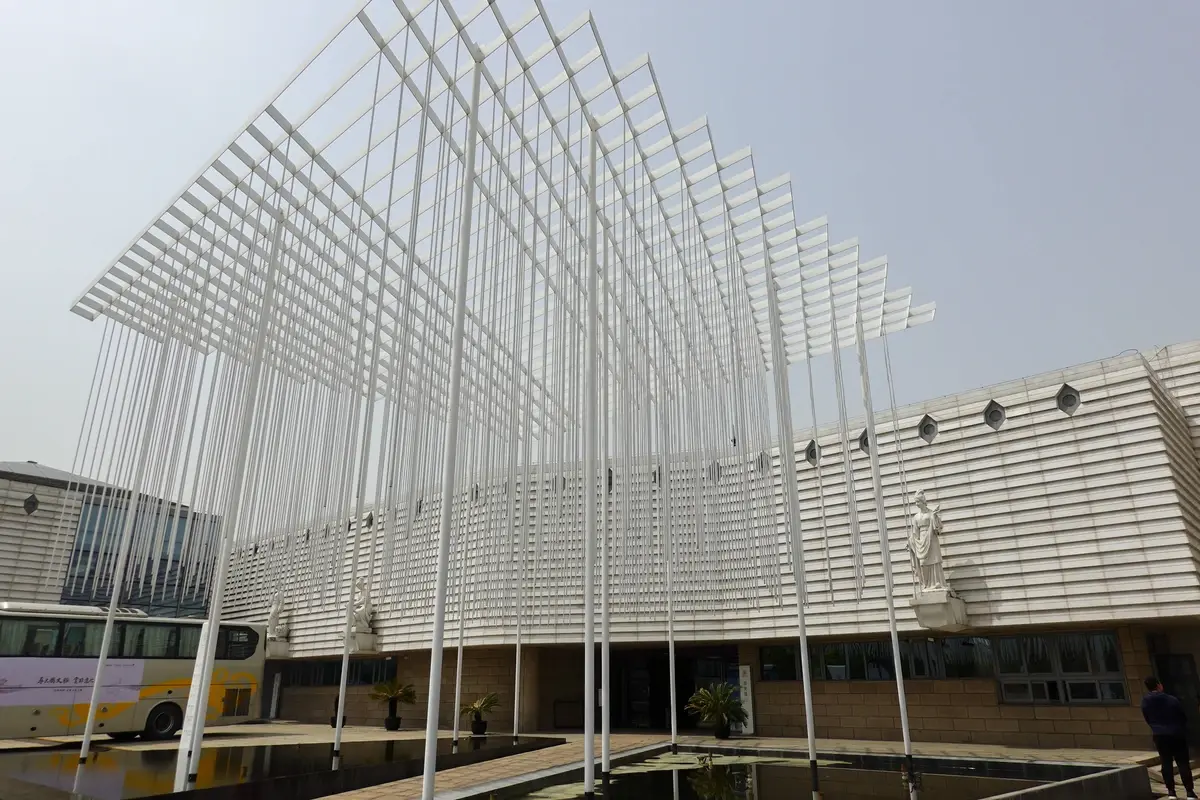
Our first stop was the Suzhou Silk Museum. Its white, bundle-like exterior gives the building a modern touch amid Suzhou’s traditional charm. Opened in 1991, it’s China’s first dedicated silk museum. Inside, there are six main areas: the History Hall, Modern Hall, Children’s Science Hall, Sangziyuan (Mulberry Garden), Silk Weaving Machinery Room, and the Qian Xiaoping Silk Culture and Art Hall. The History Hall includes the Ancient Hall, Silkworm & Mulberry Room, Weaving & Dyeing Workshop, Tribute Weaving Courtyard, Republic of China Street, and Intangible Cultural Heritage Hall. Admission is free. On weekends, kids serve as volunteers, and there are also guides to explain the exhibits. Besides the silk artifacts, after the History Hall you can see live demonstrations of mulberry cultivation and silkworm rearing, traditional loom operations, and modern applications of silk in daily life. The Ancient Hall traces the history of Chinese silk from pre-Qin times to the Qing Dynasty; the Weaving & Dyeing Workshop features traditional crafts like Song brocade and Zhangzhou velvet satin, along with loom models. The Intangible Cultural Heritage Hall showcases exquisite Suzhou embroidery, Song brocade, and more.
📍 2001 Renmin Road, Suzhou
🚴♀️ Metro Line 4 to Beisita Station, then walk
🕙 Tuesday – Sunday 9:00–17:00 (last entry 16:00), closed Mondays (except public holidays)
In the afternoon, we wandered around the Pingjiang Road Historic District and grabbed a bowl of noodles at Yang Yuxing Noodle House. Classic Suzhou-style thin noodles paired with a melt-in-the-mouth, fatty-and-lean slab of pork—this is a bowl of Fengzhen Pork Noodles for under 30 yuan. Some people order small dishes, but I’m all about Suzhou noodles.
Yang Yuxing (Lindun Road)
📍 5 Daru Alley
🕙 7:00–21:00
💰 About 47 yuan/person
Pingjiang Road is trending more than ever, and you can’t miss it when in Suzhou 😄. It’s all about that artsy, fresh vibe and the cute little shops. In the Song Dynasty, Suzhou was called “Pingjiang.” The city’s unique “double chessboard” layout—streets parallel to rivers and a dense water network—is best preserved right here in the historic district. Pingjiang River is one of the oldest active waterways in the city, stretching 3.5 km with 13 ancient bridges, many over 800 years old. Beyond eating and strolling, there’s a World Heritage site here—the Couple’s Retreat Garden (Ou Yuan)—and cultural gems like the Kunqu Opera Museum, Pingtan Museum, Suzhou Zhuangyuan Museum, and the Suzhou Fan Museum.
🚴♀️ Metro Line 1 to Xiangmen Station, then walk
💰 Hand-rowed boat: 40 yuan/person, 180 yuan/boat
Night scene around Pingjiang Road and Guanqian Street
On day two, we focused on niche gardens. Instead of the big-name ones, we sought a quieter vibe and visited the Garden of Cultivation (Yipu), Mountain Villa with Embracing Beauty (Huanxiu Shanzhuang), and the Pleasant Garden (Yi Yuan)—all within walking distance of each other. To our surprise, the weekend drew crowds of retired photography buffs! A huge patch of roses at the entrance had the shutterbugs snapping away, and I couldn’t resist lingering there myself 😁. Suzhou gardens are perfect for renting Hanfu and taking photos—lots of girls in flowing traditional dresses. But even a lesser-known spot like Yipu gets packed on weekends and holidays; come on a weekday if you can—it’s way better for Hanfu shots.
Yipu was built in the 20th year of the Ming Jiajing reign. It became a UNESCO World Heritage site in 2000 and a national key cultural relic in 2006. Covering 5.7 mu (0.94 acres), it’s split into a residence and a garden. The residence has five courtyards with winding paths and simple halls; the garden lies to the west, where buildings and rockeries hug a pond in a natural, lush setting. It’s classic Ming Dynasty style and once the home of scholar Wen Zhenmeng.
📍 5 Wenya Alley, Gusu District, Suzhou
🚴♀️ Walk from Chayuanchang Station (Line 4) or Shilu Station (Line 2)
💰 10 yuan/person (cash only at the door)
🕙 7:30–17:00 (Nov–Feb), 7:30–17:30 (Mar–Oct)
Huanxiu Shanzhuang is another off-the-radar garden, centered on rockeries. The Taihu Lake stone hill, created by Qing master Ge Yuliang, is hailed as the finest existing rockery in Chinese gardens. The site dates back to the Eastern Jin Dynasty and later hosted a temple, an academy, and various grand residences. UNESCO listed it in 1998. At 2,180 square meters with a 500-sq-m rockery, the garden’s buildings face the stone mountain from all angles, giving you “different views with every step.”
📍 272 Jingde Road, Suzhou
🚴♀️ Buses 262, 69, 522, 313, 933, 63
💰 15 yuan/person (cash only)
🕙 8:30–16:30 (last entry 16:00)
Lunch was, once again, noodles! On the walk from Huanxiu Shanzhuang to Yi Yuan, just a ten-minute stroll with Suzhou’s charm all around, I popped into a shop for a bowl of char siu noodles. I love Suzhou’s thin noodles and red broth, though the char siu was just okay.
📍 388 Yangyu Alley
🕙 5:30–14:00
💰 About 12 yuan/person
From 1874–1882 during the late Qing, Gu Wenbin, a governor from Zhejiang, spent nine years and 200,000 taels of silver building the garden on the site of a Ming minister’s old home. He named it “Yi Yuan” (Pleasant Garden) after a verse from The Analects about brotherly harmony. Divided east-west, it borrows features from many classic gardens—covered corridors, a mandarin duck hall, rockeries, a stone boat. It has “five highlights”: the Zen-like Wall-Facing Pavilion, the poetic Plum Path, a 640-year-old wisteria, a rock shaped like a bowing old man, and a 1919 “Plum Blossom Melody” played by a renowned monk.
📍 1265 Renmin Road, Gusu District, Suzhou
🚴♀️ Metro Line 1 to Leqiao Station, Exit 8, then walk
💰 15 yuan/person (cash only)
🕙 7:30–17:00 (tickets until 16:30)
Whenever I visit a city, I head to its museum. The new Suzhou Museum is the only museum in China designed by I.M. Pei himself—a must-see! 👏 Founded in 1960, the new building and renovated old wing total 26,500 sq m. It’s right next to the Humble Administrator’s Garden and Lion Grove Garden, so you can easily fill a whole day. Book ahead and scan your ID to enter. The museum has three sections: 1️⃣ Central: entrance, court, main hall, garden 2️⃣ West: main galleries 3️⃣ East: auxiliary exhibits and offices. White walls and dark tiles echo Suzhou gardens, while glass and steel flood the interiors with light.
📍 204 Dongbei Street, Suzhou
🚴♀️ Metro Line 4 to Beisita Station, Exit 4, walk east on Xibei Street 800 m
🎒 Leave bags at the visitor center opposite before entering
🕙 Tuesday–Sunday 9:00–17:00 (last entry 16:00), closed Mondays
The Shuangta Market is a revamped wet market from a TV makeover show. Once a gritty local bazaar, it’s now a hipster hangout. Some stalls still sell fresh produce, meat, and fish; the rest are snack kiosks and tiny eateries. I tried the famous Biluochun milk tea at Youth Youth—oaty, tea-scented, amazing. The braised chicken feet were fall-off-the-bone tender, 10 yuan for three—I got another 20 yuan’s worth to go. At the pancake stall, the owner gave me just two tiny lettuce leaves for my pork loin jianbing, haha, much skimpier than for the folks before me!
📍 1st floor, 2 Shijiang Alley
🚴♀️ Metro Line 1 to Xiangmen Station, Exit 1, then walk
On our last morning, we visited a temple. Xiyuan Temple is the common name for the Jiechuanglu Monastery and its West Garden pond. Dating to 1264–1294, the current structures are Qing Dynasty reconstructions. Its Five Hundred Arhats Hall is one of China’s four great arhat halls. Covering about 10 mu, it has the Hall of the Heavenly Kings, Grand Hall, Arhat Hall, Guanyin Hall, and a sutra library. Sunlight sifting through the trees felt soul-cleansing. The West Garden, with its greenery, winding streams, and pavilions, perfectly embodies the “temple within a garden, garden as temple” aesthetic.
📍 18 Xiyuan Lane, Huqiu Road
💰 5 yuan/person (incense included, mobile pay accepted)
🕙 7:30–17:30
Lunch was at Xinzhenyuan, a Suzhou-style snack shop on Shantang Street, for their famous prawn shengjian (pan-fried buns). I had a combo: pork and prawn shengjian, shrimp wonton soup, and two tiger-skin chicken feet—so filling!
📍 2 Shantang Street
🕙 7:00–22:00
💰 About 30 yuan/person
Shantang Street is the water-town scene I’d always pictured—shops and snack stalls line both sides of the short street. It doesn’t take long to walk, but grab a tea seat by the canal, sip, and watch the boats drift by for a perfectly lazy afternoon. The street runs about 3,600 m (7 li) west to Tiger Hill, hence the saying “Seven-Li Shantang to Tiger Hill.” Most buildings here are late Qing/early Republic.
📍 177 Shantang Street, Gusu District, Suzhou
💰 Boat ride: 50 yuan
Our final stop was the famous Lion Grove Garden. Unlike the smaller gardens, it had self-service ticket machines—easy even if you’re not tech-savvy, with helpful staff around. This garden is unique: the rockeries are shaped like lions, reflecting the founder’s Buddhist philosophy that in a chaotic world, you can “shatter illusions and quell desires with simplicity.” The Taihu Lake stone peaks are “porous, hollow, slender, and textured.” The eastern “dry hill” and western “water hill” make it China’s only surviving large-scale classical rockery complex. Inside are the Pointing to Cypress Hall, Facing Plum Pavilion, and Standing in Snow Hall.
📍 23 Yuanlin Road, Suzhou
🚴♀️ Metro Line 4 to Beisita Station, then walk
💰 40 yuan (peak), 30 yuan (off-peak)
🕙 Off-peak 7:30–16:30 (last entry 16:00); peak 7:30–17:30 (last entry 17:00)
Why do I adore Suzhou? Maybe it’s the soft dialect, or the laid-back air. Spending an afternoon over tea and Pingtan storytelling. Noodle shop owners are always so warm. And there are so many trendy spots worth a whole day of exploring. Since I’m based in Shanghai, I’ll keep coming back—next time for hairy crab season!


