Taking Our Grandson to the Water Towns
Just before National Day last year, we took our grandson on a spur-of-the-moment trip to the water towns.
Kuan Zai had just turned four. It was our first time taking him on a trip without his parents. We weren't sure if he would have fun and if everything would go smoothly during those days away from his mom and dad.
We set off from the West Lake Riverside area in Hangzhou at 9 a.m., heading east along the Ning-Hang Expressway (Hangzhou Bay Expressway). We arrived at our destination, Zhoushan, at 2:45 p.m., taking just over five hours (including a lunch stop at a service area). The roads were easy to drive.
In the car, his beloved Transformers toy kept him company most of the time.
Every evening of the trip, he never missed his cartoons—come rain or shine.
With his little wishes fulfilled, Kuan Zai was happy every day.
His every move was quite amusing.
The Zhoushan Islands are beautiful, with countless boats dotting the sea. It was the harvest season, with holds full of fish and shrimp.
We arrived at the Dongsha Resort Hotel in Zhoushan at around 3 p.m.
We hadn't booked accommodation in advance; as we drove, we looked around and picked this hotel, which offered great value for money on the island.
The hotel was nestled between mountain and sea, with unobstructed ocean views. We heard that just a few days later, during the Golden Week holiday, tourists would flood in and prices would rocket to several times what we paid (a standard room can cost 1,500–1,600 yuan in peak season). We were so grateful for Grandpa's plan to travel off-peak.
We dropped our luggage and hurried straight to the beach. Seeing Kuan Zai strutting along with his chest puffed out, you could tell his heart had already flown to the seaside. Before the trip, when we asked where he wanted to go, he replied, 'I want to go to the seaside.'
It wasn't a holiday, so the vast Dongsha Bay beach in Putuo, Zhoushan, had only a handful of visitors. Kuan Zai was fascinated by the tiny crabs hiding in sand holes. As he walked and played, his joy at being close to nature was plain to see.
Almost no one comes to Zhoushan without craving seafood. We planned to stay two nights, with three main meals and two breakfasts, trying different dishes and having seafood at every meal.
Dinner on the first night: plump sea crabs and stir-fried razor clams. Kuan Zai had grown up with his maternal grandparents in Tianjin, where his grandpa often took him to the seafood market, so he had a particular fondness for crab.
Lunch the next day: steamed hairtail and blanched prawns.
Dinner the next day: braised tiger grouper and seaweed with scallion oil.
He also ate the seaweed with scallion oil with great relish.
For breakfast both days we had seafood noodles—they were delicious. We also had small yellow croaker seafood noodles, but I forgot to take a photo.
The seafood noodle shop we chose was run by an elderly couple. At just 20 yuan a bowl, the noodles were tasty and great value.
The nearest restaurant street to the hotel was like a Beijing-style food court, quiet and tidy. In just one short week it would be bustling with life again; the pandemic had kept it eerily quiet for a long time, and the restaurant owners were eagerly looking forward to the arrival of the Golden Week holiday.
Hidden inside the Nansha scenic area of Zhoushan is a very unusual exhibition that describes itself as 'ephemeral art'.
The Zhoushan International Sand Sculpture Festival is a major exhibition, and it was one of Grandpa's main reasons for choosing Zhoushan.
A giant sand sculpture: The Little Mermaid.
The first Zhoushan International Sand Sculpture Festival was held at Nansha in 1999. The Zhujiajian International Sand Sculpture Art Square, covering an area of 421 mu (about 28 hectares), permanently showcases the magical charm of this ephemeral art form.
The sand sculptures are made by mixing local high-quality fine sand with special glue in a ratio, then piling and carving—an ingenious artistic creation. They don't deform or collapse under wind, sun, or rain.
Counting back, this sand sculpture art exhibition on Nansha Island has been going on for over 20 years now.
The sand sculptures were lifelike in every detail.
Art and childlike wonder blended perfectly—every sculpture was vivid and full of expression.
During the visit, Kuan Zai kept stopping to play with the fine sand on the spot, as if trying to recreate the shapes he saw in the scene. Seeing his curious and focused expression, we knew we'd brought him to the right place.
Ikkyu the Little Monk—this was also Kuan Zai's dad's favorite when he was little.
Each sand sculpture is a massive project, filled with the painstaking effort of the sand artists.
Sports-themed sand sculptures, full of dynamism.
When we arrived in the morning, it was overcast with occasional light rain. The little train among the sand sculptures wasn't running. The whole exhibition was just us, three generations, like a private viewing. When we finished the last sculpture, Grandpa and I were absorbed too, and the child wanted to stay even longer.
The vast group of sand sculptures was spectacular and truly stunning. We learned that the sand sculpture exhibition has a new design theme every year, created jointly by domestic and international sand artists, changing yearly without repeating. In that moment, I understood the meaning of 'ephemeral'.
Because of the pandemic, the current display was still the previous edition's works.
Full ticket for the sand sculpture exhibition: 70 yuan. Free for those over 70, half price for those over 60. Children under 7 free, those over 7 but under 1.2 meters half price. Grandpa and I got half-price tickets; Kuan Zai was free. (Friendly reminder: do, do, do bring your ID card.)
Leaving the sand sculpture exhibition, seeing Kuan Zai still bursting with creativity, we went back to the beach to satisfy his strong desire to create.
Ha ha, it was really just a few sand balls. The creations on the left and right were made by Grandma and Kuan Zai respectively.
Grandma said hers were mantou buns, while Kuan Zai said he liked red bean buns, so his were red bean buns.
He stood there admiring his own work, reluctant to leave.
When we left the beach in the afternoon, we happened to hear that there would be a bonfire party on the beach that evening.
It turned out it was a team-building event for young people from the Zhejiang Southeast Architectural Design Institute.
A blazing bonfire.
Dazzling searchlights beaming into the night sky.
As a special little guest from outside, Kuan Zai was exceptionally given a glow stick. While watching the performances, he fiddled with it curiously. When the party ended, he received six more glow sticks from the crowd and was overjoyed.
This was Kuan Zai's first time at a large gathering, and his first time experiencing the passionate, exuberant emotions of enthusiastic young people and a festive, joyful atmosphere. That night, there was a bonfire on the ground and fireworks in the sky, with spotlights sweeping back and forth. Everyone was excited as if it were a holiday. Looking at his dazed expression, I wonder if that hazy feeling will stay in his young memory.
After our Zhoushan trip, on the morning of the 24th, we headed to Tongli.
We passed the Hangzhou Bay Bridge, a sea-crossing bridge stretching 36 kilometers. Construction began on June 8, 2003, the bridge was connected on June 26, 2007, and it opened to traffic on May 1, 2008.
It starts from Cixi, Ningbo in the south
and reaches Haiyan, Jiaxing in the north.
This is one of the world's longest sea-crossing bridges, stretching magnificently across the sea, with the grandeur of 'a bridge soaring from south to north, turning a deep chasm into a thoroughfare.'
The sightseeing tower at 'Haitian Yizhou' (Sea and Sky Islet) stands tall on the east side of the observation platform. Also called the 'Pearl Tower,' it rises 145.6 meters with 16 indoor floors. Here you can enjoy views of the bridge and the surrounding scenery. It is located 1.7 kilometers south of the south shipping channel bridge of the Hangzhou Bay Bridge, about 18 kilometers from the southern shore.
When we reached the 19th-floor outdoor observation deck, Kuan Zai was thrilled.
If you drive across the Hangzhou Bay Bridge, make sure not to miss 'Haitian Yizhou,' especially with children, as it can help them learn more about this great feat of bridge building. Among the world's longest sea-crossing bridges, the first is the Lake Pontchartrain Causeway in the US, the second is China's Jiaozhou Bay Bridge in Qingdao, and the Hangzhou Bay Bridge we were on is third.
Ticket for 'Haitian Yizhou': full price 80 yuan. Seniors: free for those aged 70 and over with valid ID; discount price 65 yuan for those aged 60–69 with valid ID.
In front of the 'Pearl Tower,' there is a walkway that resembles a glass skywalk, which might be a little scary for those afraid of heights.
The outdoor observation deck is on the 19th floor. You first take an elevator to the 16th floor and then climb a spiral staircase to get there.
For Tongli Ancient Town, if you don't stay inside the town, you need a ticket. Full price: 100 yuan (valid for two days within the scenic area). Free for those over 70, half price for over 60. (ID required when buying tickets; online purchase available).
We booked online at the 'Jizhu Inn' in Tongli. To our surprise, it turned out to be the former residence of Ji Cheng, the master garden designer from the Ming Dynasty.
The small pavilion in front of the inn was built in 1991 on the suggestion of landscape scholar Chen Congzhou when he visited Tongli for research. It was named 'Ji Pavilion' to mark a lasting memorial.
In a panoramic view of Ji Cheng's former residence, the moss-covered outer walls and the 'Ji Pavilion' standing quietly under the shade seem to whisper stories of bygone days to later generations.
Tongli has produced many notable figures. From the Song Dynasty to the late Qing Dynasty, it produced one top scholar (zhuangyuan), 42 jinshi (imperial examination graduates), and 93 civil and military juren (selected scholars). There were poets, painters, calligraphers, educators, writers, economists... and Ji Cheng was among these renowned names.
It wasn't a holiday, so we could choose any room in the inn. Kuan Zai opted for the tatami room. The landlady was young and warm-hearted—she came to pick us up outside the ancient town and even brought us her homemade yogurt. The room was small but cozy, tidy, and convenient, with Bluetooth for easy music and internet access.
The tatami room, with no need to climb into a bed, was even more appealing to the child.
The quality of the toiletries was a sign of the owner's sincerity in hosting guests.
Tongli as night falls.
In the water town, the brighter the lights on the banks, the more dazzling their reflections in the water.
For dinner, the owner recommended the restaurant 'Jiutanzi Fantong' (Wine Jar Rice Bucket). It's quite famous, with walls covered in notes from patrons who came for its reputation and left satisfied. Every now and then, an elderly or middle-aged Jiangnan woman would sing a soft, melodious local tune a cappella, the sound lingering in the small restaurant of less than 30 square meters. A song request cost 10 yuan. The price was really not high; it's just that we weren't yet accustomed to having others provide such a special service while we enjoyed our meal.
This was Tongli's famous white fish, steamed and incredibly delicious. You'd think Zhoushan would have the bigger name for seafood, but at Tongli's 'Jiutanzi Fantong,' this white fish tasted even better than Zhoushan seafood. Four dishes (the vegetable medley that came later, I forgot to photograph) plus a plum wine, 136 yuan—delicious and affordable.
The restaurant gave us some rice wine. Kuan Zai said, 'This rice wine is really tasty, and so are these dishes.' Grandpa and I felt the same—the food in Tongli was excellent in color, aroma, and taste. The three of us, young and old, feasted here and went away well satisfied.
'Jiutanzi Fantong' is an alleyway restaurant with no flashy exterior decoration, yet it's well-known in Tongli and a must-visit food spot for visitors from out of town.
At 6 a.m., while Kuan Zai was still asleep and Grandpa stayed at the inn to watch him, I hurried into the streets of Tongli and immediately merged into the fresh, tranquil little town.
Traveling with a child so small, and in water towns where there are hardly any guardrails, I had to keep a close eye on him all day. Some historical sites or sights I could only glimpse in passing. So the early morning hours—ha ha—were Grandma's precious time to let loose and explore on my own.
The weather was fine; the morning glow was already reflected in the corridors along the water's edge.
This old rattan chair, repaired and tied up several times, felt like a weathered old person, advanced in years yet still sitting there steadily.
The wall painting was quite interesting, seemingly telling passersby: enjoy the good wine, but don't overindulge!
The hanging decoration was fashionable and practical, full of artistic flair. The clock showed 6:45 a.m.
In Tongli, apart from the natural scenery, there are many small man-made landscapes. Every household, every wall, every object, every ornament seems to tell an old story of the past.
Up close, an elderly person was washing gorgon seeds (qianshi). The small town was simple and elegant, filled with the strong atmosphere of a water town.
Homes are by the water, and every household can be reached by boat, earning it the praise of 'the Venice of the East.'
The famous Three Bridges of Tongli—Taiping Bridge, Jili Bridge, and Changqing Bridge. When taking photos, I couldn't find a good angle. In front was Changqing Bridge, to the left front was Taiping Bridge, and Jili Bridge was in the distance behind the trees between the two.
Built in the Qing Dynasty, these three bridges are the treasures of Tongli's bridges. Whenever there's a birthday for the elderly, a baby's full month, or weddings and other festive occasions in town, it's customary to walk across the three bridges for good luck.
The three bridges have been listed in the cultural protection registry.
A photo of the grandfather and grandson on the bridge.
Tongli has a total of 49 bridges, connected by water paths. It's hard to remember each one after walking past—there are arched and flat bridges, each with its own features.
At Jili Bridge, one of the three bridges, I met some young women who asked me to take their photo. For a moment, their reflections were mirrored in the water, creating a scene that echoed the poetic line: 'The spring's mouth cherishes the silent trickle, tree shadows on the water love the gentle clarity.'
A bridge where water and sky merge into one.
Having walked across countless bridges since early morning, I was drawn to this oddly shaped structure. It turned out to be another bridge, named 'Taile Bridge'.
'Taile Bridge' is unique—its roof is openwork. The owner told me that according to Tongli's elders, this location is in a wind channel. The previous roof was blown off, and when rebuilt, it blew off again, so they simply left it completely open. Since then, there have been no further problems. The name 'Taile' (also locally referred to as 'Tailai') plays on the saying 'pi ji tai lai' (when bad luck reaches its limit, good fortune comes), symbolizing auspicious luck and blessings.
Lize Girls' School—in the 32nd year of the Guangxu reign (1906), Ren Chuanxin, the second-generation owner of the Tuisi Garden, founded Lize Girls' School, pioneering women's education in Wujiang. The school was deep in the alley; it was too early, so I didn't go further.
'Heart-Piercing Alley' is a very narrow lane, winding and secluded. At its narrowest, only one person can pass. If two people meet by chance in the alley, it's said to be an instant 'heart-piercing' encounter, hence the playful name. This was also a filming location for director Gu Changwei's movie 'Love Returns to Tongli'.
The alley is over 300 meters long, paved with 345 blue stone slabs. When we walked through briskly, we could hear echoes. I think the hollowness beneath the slabs played a part, as did the tall walls on both sides and the narrow space, which created tiny echoes and resonance.
We came across an elderly person processing gorgon seeds. Every seed we eat is peeled by hand, one by one. The long years of labor had misshapen her hands.
Tongli's tourist boats (rowing boats) carry a maximum of six people, including infants. Fare: 120 yuan, for about half an hour on the water.
Kuan Zai was afraid of water from a young age and stubbornly refused to get on the boat, so we didn't press him.
A large bird standing on the boat would dive into the water to catch fish on the boat owner's command.
This large bird is called a cormorant, also known as a fishing hawk. The cormorant flew and landed on the boat, but I didn't manage to capture the moment it caught a fish.
Later I heard that you need to pay for the boatman to have the cormorant perform, so the kids waited in vain for quite a while.
At every place, Grandpa would explain things carefully.
Sometimes, Kuan Zai would make a little request: 'Grandpa, I'm so tired.' Then he'd add, 'I'm a little lazybones Kuan.' And whenever he did that, Grandpa would surely give the little lazybones a piggyback ride.
It was this same little lazybones who, when leaving Tongli, eagerly grabbed my luggage and pulled it along the bumpy cobblestone path, looking like it took real effort.
When he had dragged the suitcase onto a flatter stone road, he was hot and took off his hat, sweating.
Years ago, on our way to Antarctica, when we passed through Buenos Aires Airport in Argentina, we saw a young brother and sister carrying their own things and even helping adults push and pull luggage. We were deeply touched and felt that our only children at home were overly spoiled and pampered.
But now, seeing this old man and little boy, the young learning from the elder, it was such a heartwarming scene. That a child just turned four could understand independence and sharing was, no matter what, truly gratifying.
At home, with four grandparents and his parents doting on him, the child was the center of attention. I never expected that during these five days of travel, he would basically take care of his own things himself and occasionally even help adults—an unexpected bonus.
At 3 p.m. on the 25th, we checked in at the Giant Junlan Resort Hotel. We chose this hotel because when we first visited Nanxun seven years ago, we stayed nearby, and it's very close to the scenic area entrance—just a few minutes' walk. There was another reason: the ancient town doesn't charge admission before 8 a.m. and after 5 p.m., so by staying here we could enter and leave freely without tickets in the early morning and evening.
The hotel was originally a horse-iron factory in the 1950s, later converted into an elevator factory, and now transformed into a large resort hotel. The design is quite distinctive, blending a strong Republic-era style with modern industrial elements.
We chose an industrial-style room. This is the corridor leading to our room, full of industrial design flavor. You could still vaguely glimpse the tall factory building of the past.
Two beds pushed together to make one, feeling a bit like a big kang (heated brick bed). Kuan Zai was excited and gave it a thumbs-up. When we checked in, the hotel was offering a series of promotions. We chose a 588 yuan package that included dinner (Nanxun cuisine) and a buffet breakfast. It seemed a little pricey, but the room and meals were excellent value.
We entered Nanxun Ancient Town just after 5 p.m. At the famous Tongjin Bridge, the semicircular arch reflected in the water, creating a full circle of reality and illusion combined.
As dusk fell, there weren't many visitors in the small town, and it was filled with a sense of peace.
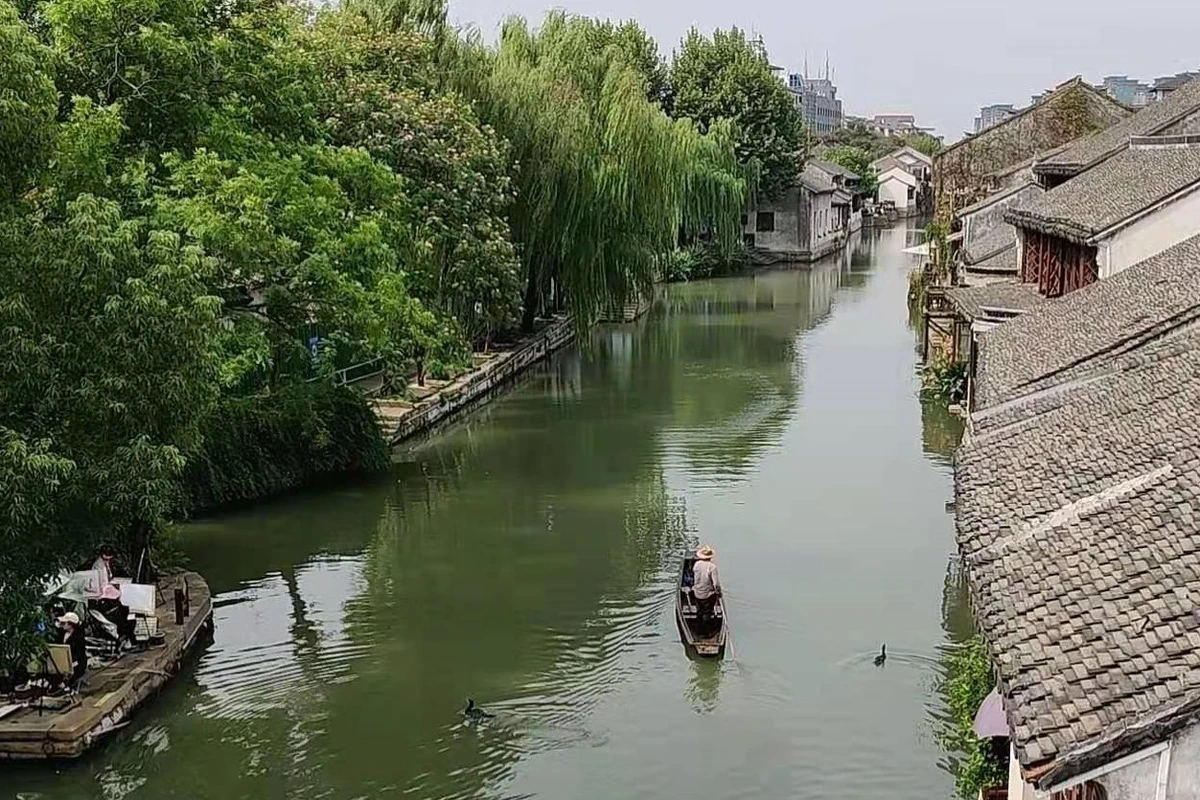
Painting en plein air—the Jiangnan water town is nature's most beautiful backdrop.
Art academy students immersed in their paintings showed no sign of stopping.
In June 2014, the Grand Canal of China was successfully inscribed on the World Heritage List. The Nanxun section of the Jiangnan Canal, known as the Ditang Ancient Waterway, runs right through the ancient town of Nanxun.
At nightfall, Tongjin Bridge saw people and boats coming and going above and below. During the day we hadn't seen many people, but they all seemed to come out at night.
During the day, the inn in the alley was unremarkable, but when night came, the lotus pond under moonlight had a special charm.
On weekends or holidays, there are water music performances at Tongjin Bridge. We happened to arrive on a weekend and were treated to a feast for the eyes.
The performance was vivid and emotionally powerful, with lifelike images that attracted many tourists and locals. The child loved it especially, and we stayed until the very end.
After a full day's touring (Tongli—Hangzhou Bay Bridge—Nanxun), a happy Kuan Zai was playing around with Grandpa.
At 6 a.m., once again I went out alone, heading to the new scenic area. This sign was for one of Huzhou's time-honored brands, 'Zhu Laoda,' famous for its zongzi (sticky rice dumplings). Their meat zongzi are delicious. I planned to buy some when the shop opened on my way back, but I ended up taking a different route.
Water caltrops are a Jiangnan specialty. I ate them as a child, but they're rarely seen in the north now.
I passed through the long, narrow residential morning market and streets, walking for over half an hour until I reached the newly built 'Four Elephants and Eight Oxen Square,' which is the north gate of the scenic area.
Nanxun Ancient Town originated, developed, and prospered because of the Grand Canal (Ditang). The advanced sericulture and agricultural economy in the Grand Canal area, supported by the canal's water conservancy and transportation functions, helped Nanxun grow from a small fishing village into a historically important economic hub. From the Wanli period of the Ming Dynasty to the mid-Qing Dynasty, Nanxun's economy reached unprecedented prosperity. Locals used animal sizes to rank the silk merchants' wealth, giving rise to the saying 'Four Elephants, Eight Oxen, and Seventy-Two Golden Dogs.' An elephant is bigger than an ox, and an ox bigger than a dog, so being called an elephant, an ox, or a dog immediately showed your wealth.
The ranking of the Four Elephants was: the Liu family (Liu Yong), the Zhang family (Zhang Songxian), the Pang family (Pang Yunzeng), and the Gu family (Gu Fuchang)—the four great families.
The new scenic area opened on May 1. Even the ticket checkpoint at the entrance was so grand.
Ticket price for Nanxun Ancient Town: from 8 a.m. to 5:30 p.m., full price 95 yuan. Free for over 70, half price for over 60. (ID required when buying tickets; online purchase available).
The new scenic area—the Mid-Lake Pavilion, was originally the private garden of the Pang family, known as Yiyuan Garden.
New residential complexes have risen along the shore.
Rows of townhouses.
The well-arranged horse-head walls and stone-framed gates seemed to echo the style of the Hundred-Room Building.
I had come out too early. Ha ha, on the way I finally saw some fellow travelers.
Zhang Jingjiang, from the Zhang family—one of the Four Elephants—donated huge funds to support anti-Qing revolutionary activities. Sun Yat-sen called him a 'remarkable man' and 'revolutionary sage,' and once wrote a dedication to him: 'A Loyal Heart and Chivalrous Bones.' Nanxun is a land of culture and a hometown of poetry; notable figures have emerged in every generation. There have been book collectors, educators, industrialists, writers... Even China's first-generation aircraft designer was from Nanxun.
Legend has it that a wealthy merchant in the Ming Dynasty built this for his maidservants—one hundred rooms facing each other along both banks of the river, hence the name Hundred-Room Building.
Through the generations, the Hundred-Room Building is now inhabited by ordinary folk. Walking past, you can feel that the people of Nanxun, living by the water, lead a peaceful and leisurely life.
White walls, grey tiles, horse-head gables.
Presenting the unique charm of the Jiangnan water town.
When coming to Nanxun, you must visit the old houses of the Hundred-Room Building. Though they look mottled and old, they bear the marks of history and are well worth visiting in Nanxun.
Houses standing along the river.
The many stone-framed gate corridors.
Together with the quietly flowing river, they have accompanied and sent off over seven hundred years of time.
I remember when we came to Nanxun in 2013 and visited the Hundred-Room Building, we overheard two visitors arguing. One said, 'It's not as beautiful as Wuzhen,' while the other insisted, 'Nanxun is more beautiful...'
Coming back to Nanxun again, here at the Hundred-Room Building, in this small space, the water glistened and boats swayed gently. The quiet was enchanting. In that moment, your whole being settles down, and that sense of peace and enjoyment is hard to find elsewhere.
Nanxun also has tourist boats, with black-awning boats shuttling across the water. Fares vary for full trips or segments. By day: 380 yuan, 280 yuan, and 160 yuan. By night, a segment costs 50 yuan.
At the Hundred-Room Building, we met an elderly gentleman surnamed Wang. Behind him was his home. Born in Suzhou, he had lived in the Hundred-Room Building for over 80 years.
Kuan Zai was thrilled when the old gentleman praised him.
The old man was very talkative and invited us into his home. When we saw a large 'longevity' character hanging on the wall, we realized he was already 91 years old.
He warmly offered candy to the child and water to us, and even brought out photos taken over the years with visitors and celebrities from home and abroad.
With his permission, I took his photo and sent him blessings! The old man laughed and said, 'I'm still young. In the Hundred-Room Building, there are two fellows aged 97, two at 95, and one at 93. Compared to them, I'm just a little brother.' Ha ha! What a humorous and cheerful old man.
Grandpa Wang of the Hundred-Room Building, a man about to complete a century, we wish him good health and long life!
The logo has great style—simple yet profound in meaning, with a strong sense of design.
The Xun Shufang (Book House) in the Hundred-Room Building, with an exterior quite different from other guesthouses, is said to have interiors of classic elegance and considerable comfort. I imagine the price must be steep.
A photo of grandfather and grandson at the Hundred-Room Building.
Zhuangyuan Lou (Top Scholar Pavilion) is actually a tiny noodle shop of less than 10 square meters. Seven years ago, a bowl of their 'double topping noodles' (with meat and smoked fish) left a lasting impression on us.
The little shop is clean and tidy, with noodles as the main food. They use various ingredients for toppings, with different prices.
A simple bowl of noodles, yet it felt like a ceremonial experience.
Seven years later, tasting it again, the flavor was a bit different from what we remembered. But Kuan Zai loved it beyond measure.
At noon on the 26th, we had to bid farewell to Nanxun and return to Hangzhou. Standing on Tongjin Bridge, we saw a fisherman below gently rowing his small boat, with two cormorants by his side, leaving faint ripples on the water.
The scene was like a painting, intoxicating. Even Kuan Zai kept saying, 'Grandma, I don't want to leave, I don't want to go home.'
In this green, tranquil world cut off from the hustle and bustle, it's no wonder even a child would feel so reluctant to leave.
Grandpa and I promised that we would often take him out in the future, to see the sea, the mountains, the grasslands, and to learn more about the outside world.
Travelogue Contents
1. Zhoushan Islands
2. Hangzhou Bay Bridge
3. Tongli Water Town
4. Nanxun Ancient Town
Travel Info
Hotel Index
Travel Guide Index
Flight Index
Website Navigation
Tourism Index
Cruise Index
Business Travel Index
Partnership & Cooperation
Distribution Alliance
Friendship Links
Corporate Gift Card Purchasing
Insurance Agency
Agency Cooperation
Hotel Franchising
Destination & Scenic Area Cooperation
More Partnership Options
About Ctrip
About Ctrip
Ctrip Hot Topics
Contact Us
Careers
User Agreement
Privacy Policy
Business License
Security Center
Ctrip Content Center
Intellectual Property
Trip.com Group
Algorithm Disclosure


