Qionglong's Verdant Peaks and Clear Waters, Mudu's Ancient Wu-Yue Splendor
In early summer of May, with the sunlight growing increasingly passionate, I, who had traveled across half the globe, started to search for domestic beauty due to the well-known circumstances. In 2021, I had traversed the vastness of Qinghai, the frozen landscapes of Tibet, and the tropical charm of Xishuangbanna, but unexpectedly, I fell in love with the Jiangnan charm of Suzhou—the poetic spirit of small bridges, flowing waters, and households.
Mudu Ancient Town was a resting place for Emperor Qianlong during his six southern tours. With its small bridges, flowing streams, and flagstone lanes, it inherently exudes a comfortable ease and an ethereal, graceful charm. This town, which has weathered the changes of time alongside Suzhou, boasts a history of over 2,500 years. Riding a wooden boat leisurely through an old bridge arch, you are instantly transported into a Jiangnan water village dappled with light and shadow. If you have been to Zhouzhuang or Tongli, those ancient towns enveloped in heavy commercial atmosphere, then Mudu’s unique tranquility will offer you a completely different feeling. Stray from the main street and delve into the crisscrossing alleys; admire the mottled walls, the leisurely flowing river—everywhere a scene of peaceful idyll.
In May, Mudu Ancient Town coincides with the Imperial Tour Festival. Throughout the festival, grand reenactments of Emperor Qianlong’s southern visit to Mudu are staged. You can immerse yourself in the lively scenes of the 'Qianlong Prosperous Era,' or slowly wander the town to trace the marks he left over 250 years ago: the 'folk palace' he stayed at, and the magnolia tree he planted with his own hands.
Mudu Ancient Town is a quintessential representative of China’s garden towns. During the Ming and Qing dynasties, it boasted over 30 private gardens, and more than 10 remain today. These include Yan’s Garden, Hongyin Mountain Villa, Ancient Pine Garden, and the Bangyan Mansion, which in those times served as the most prosperous commercial port west of Suzhou, connecting it to the outside world.
From an aerial view, the tour boats dot the river like stars, faintly reminiscent of the bustling port of yesteryear. There are various ways to explore Mudu: you can take a boat along the canals through ancient bridges, or stroll slowly on the bluestone paths, savoring history and culture, and discovering stories among the old buildings.
Stepping into the quaint Yan’s Garden, you immediately sense an ancient freshness. The exquisite craftsmanship and Suzhou garden-style elegance leap to the eye. This typical Jiangnan private garden evolved from the 'Zhuxiao Pavilion' of the celebrated scholar Shen Deqian in the Qianlong period and the 'Duan Garden' of Mudu poet Qian Duanxi, into the 'Xian Garden' of Yan Guoxin, the wealthiest man in Mudu during the Guangxu era, gradually gaining the common name Yan’s Garden. Within its confines, pavilions, terraces, towers, rockeries, ponds, greenery, and bamboo all harmonize in charming combination, with each season offering its own delights. The deep, winding corridors evoke the rise and fall of the Yan family, stirring deep emotions.
Yan’s Garden is a grand complex with many hidden gems. With its winding paths, it rewards a leisurely pace; take your time to fully appreciate the serene beauty of a Jiangnan garden. No matter which corner you gaze from—be it rockery, a small bridge, or flowing water—the view resembles an ancient painting rich in charm. Notably, the designer divided the garden into four distinct sections, each planted with seasonal flowers and trees, creating four scenic areas: spring, summer, autumn, and winter.
Since the 1920s, many film and TV dramas have shot scenes in Yan’s Garden, including 'Dream of the Red Chamber,' 'Paradise,' and 'Ruyi’s Royal Love in the Palace.' This has not only increased public understanding of Jiangnan gardens but also perfectly showcased their poetic, picturesque beauty on screen.
Hongyin Mountain Villa, 200 meters east of Yan’s Garden, is a famous garden on the outskirts of Suzhou from the Qianlong reign. Facing the Xiangxi Creek and backed by Lingyan Hill, its 'beauty of streams, hills, breezes, and moonlight, and the excellence of ponds, pavilions, flowers, and trees' surpasses other gardens. Thus, every time Emperor Qianlong toured the south and visited Mudu, he made a point of stopping here. He would stroll, watch operas, taste tea, and compose poetry, lingering until nightfall before reluctantly returning along the Shantang Imperial Road to his palace on Lingyan Hill. Consequently, locals also call it Emperor Qianlong’s 'Folk Palace.'
Its architectural style blends the delicate elegance of Jiangnan literati gardens with the majestic splendor of northern imperial gardens, truly embodying 'the beauty of streams, hills, breezes, and moonlight, and the excellence of ponds, pavilions, flowers, and trees.'
In the Mudu Imperial Edict Collection Hall, over a dozen imperial edicts from ten Qing emperors—Shunzhi, Kangxi, Yongzheng, Qianlong, Jiaqing, Daoguang, Xianfeng, Tongzhi, Guangxu, and Xuantong—are on display.
The exhibition at Hongyin Mountain Villa features four major collections: 1. The Qing Dynasty Imperial Edict Hall, displaying genuine edicts of ten Qing emperors. 2. The Imperial Examination System Hall, showcasing detailed materials on the exams, including test questions, answer sheets, and corrected papers for the xiucai and juren levels; palace examination papers for jinshi and zhuangyuan; and even cheating aids like silk scrolls and miniature 'Four Books and Five Classics' used by examinees. 3. The Palace Artifacts Hall, presenting hundreds of items such as Ming and Qing dragon robes, court costumes, and folk articles. 4. The Qing Dynasty Plaque Hall, exhibiting nearly a hundred calligraphic plaques by jinshi and zhuangyuan, along with finely carved imperial edict plaques.
The Ancient Pine Garden was built by Cai Shaoyu, a wealthy man from Mudu in the late Qing dynasty. Originally from Dongting West Hill, Cai made his fortune in Shanghai trading foreign goods and returned home to construct houses and purchase vast tracts of land. He was one of Mudu’s 'Four Great Tycoons,' alongside Yan Guoxin (grandfather of Yan Jiagan), Zheng Lingjiu, and Xu Fenglou. The garden’s layout follows the typical Qing-era residential style, with living quarters in front and a garden at the back. The architecture is primitive yet elegant, with exquisitely fine carvings, holding artistic and cultural value, and is a protected cultural site in Suzhou. In the rear garden stands a Ming-dynasty Podocarpus tree, verdant and gnarled with graceful posture—hence the garden’s name.
Today, the Ancient Pine Garden is not only about appreciating the architectural style; it also houses the Wang Lipeng Art Gallery and Calligraphy Museum, as well as Yao Jianping’s Embroidery Art Museum—all well worth visiting.
During my days in Suzhou, I had black rice (wu mi fan) at almost every meal. Without exaggeration, I wholeheartedly recommend it. At Wuzhentang in Mudu Ancient Town, the black rice I tasted was, in terms of texture and flavor, the best of all the meals I've had. It even appeared in the documentary 'A Bite of China.' The main ingredient is glutinous rice, which, after being soaked overnight in the juice of the Nanzhu leaves, turns from white to a glossy, jet black. The dark purple-black rice glistens on the surface; its fragrance is unique, and the grains are soft, glutinous, and smooth, clinging to the palate and stimulating salivation—truly a distinctive flavor. Sprinkle with sugar and mix well; that light, sweet stickiness is irresistible once you start.
At night, Mudu Ancient Town glimmers with enchanting lights, exuding myriad charms. But within the deep courtyards of Yan’s Garden, a splendid performance unfolds. 'The Tale of Mudu,' the first immersive site-specific drama, presents a story set in the century-old mansion, appealing to both refined and popular tastes. As visitors move through the garden with the actors, they experience the unique wedding customs at the Shangxian Hall, partake in a family banquet with opera performances at the Huan Shan Cottage, sit quietly in the Mingshi Pavilion to enjoy pingtan (storytelling and ballad singing), and listen to a farewell scene in the rear garden pavilion... Immersing yourself in it all is well worth the ticket price.
This is a wonderfully unique way to experience Yan’s Garden at night. Actors perform live within the ancient architecture, interspersed with pingtan and Kunqu opera excerpts, telling the rise and fall of the Yan family, once the richest clan in Mudu. Their superb acting, so close-up, gives a magical sense of being part of the story; the whole experience is deeply moving.
The drama unfolds in nine episodes across nine scenes, portraying a century-old mansion story. Against a backdrop of national turmoil and change, it tells of the patriarch, a representative of the Dongting merchant guild, who donated his ancestral home and all his wealth out of faith and righteousness, and who gave his own son to the country—a patriotic spirit of 'sacrificing one’s family for the greater good.'
With winding corridors and pavilions, stone bridges shimmering in the moonlight, and crowds moving through Yan’s Garden, this visual feast comes highly recommended.
'Qiong' means exhaustiveness, vastness, depth, and height, thus extended to mean 'heaven,' as in the saying 'The dome of heaven, its color is azure.' The character 'qiong' is further interpreted as 'rising high.' Hence 'Qionglong' describes 'a shape that bulges in the middle and slopes down all around'—perfectly fitting the mountain’s form and giving it its name. Qionglong Mountain lies in the western suburbs of Suzhou, with its main peak Ruo’mao Peak standing 341.7 meters tall, the highest among the hills east of Lake Tai and Suzhou’s tallest summit. The Dongwu National Forest Park was established here in 1993, and the Qionglong Mountain Scenic Management Area in 2006. Today, it is an integral part of the national 5A-level Wuzhong-Taihu Lake Tourism Zone.
The south gate of Qionglong Mountain is also the entrance to the Sun Wu Cultural Park, themed around the life and deeds of the ancient Chinese military strategist Sun Wu. The park covers his biography, military culture, the development of Wu-Yue culture, and the prosperous state of the country after the war. Using modern high-tech methods, it simulates ancient military strategic deployments, battle scenarios, and features a distinctive cultural experience zone. This flexible combination of ancient military culture and cutting-edge technology immerses visitors in the military wisdom and combat acumen of the era.
The early summer sun is already scorching, but step into the woods and you’ll feel the mountain’s unique coolness. A gentle breeze caresses as you watch tender buds gently sprout.
Despite being a mountain scenic area, it is dotted with many buildings in the Suzhou garden style.
Sun Wu’s Study has been transformed into a small, secluded tea house tucked away in a quiet valley corner. Here, you can invite a few close friends to sip tea and chat in utter contentment.
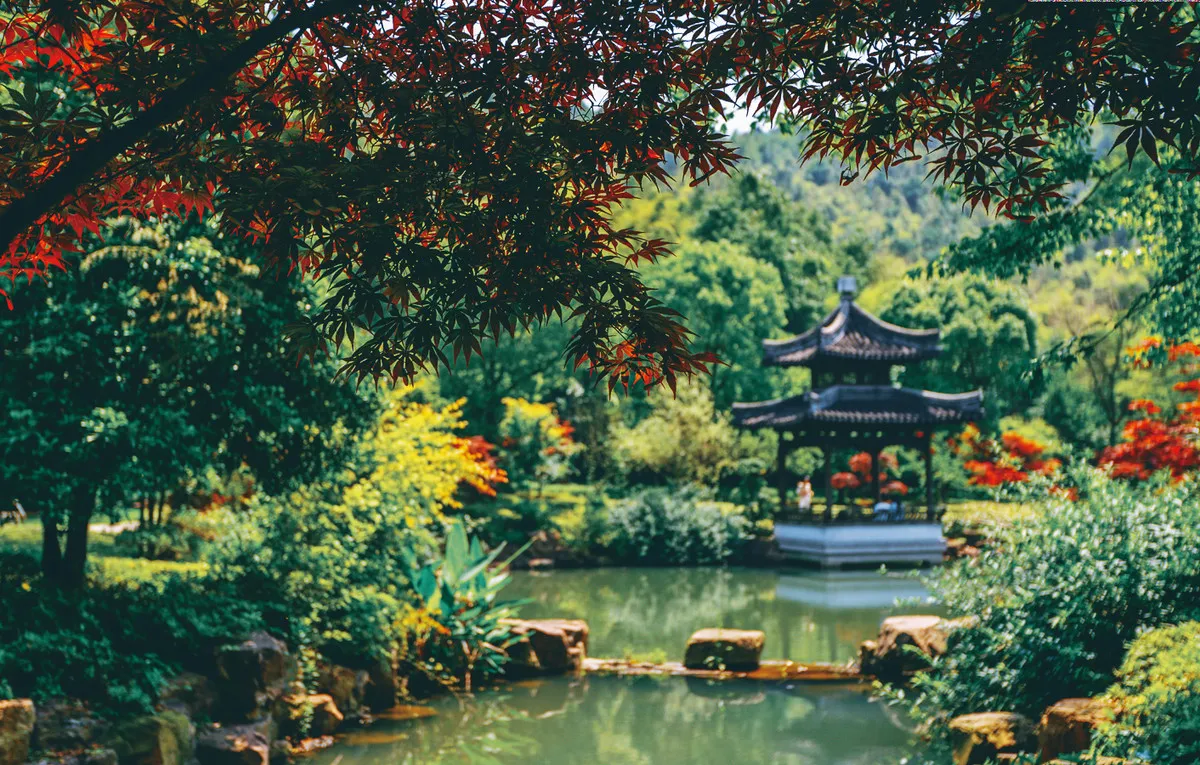
The garden architecture on the mountain holds a unique charm in the early Jiangnan summer—green shade, red leaves, ponds—a perfect picture of tranquil summer beauty.
In the Herb Hall within the scenic area, dozens of traditional Chinese medicines are displayed with introductions. Outside, more than ten common medicinal herbs are planted for visitors to see.
You can also make your own sachet following a classic ancient recipe from the Wu School of Medicine. It uses ten carefully selected herbs: atractylodes, cinnamon, mugwort, frankincense, clove, sweet wormwood, turmeric, indigo naturalis, borneol, and saposhnikovia. Wearing the sachet not only helps clear the mind and sharpen the senses but also boosts immunity—both healthy and beautiful, a win-win.
'Heaven rewards the diligent'—an eternal truth. If you rise early and climb the forest trail on Qionglong Mountain before sunrise, you’ll see a red sun slowly emerge from the horizon, gradually illuminating the city in a breathtaking panorama. As an outsider, I think Suzhou residents are truly blessed with Qionglong as a massive natural oxygen bar. Ancient celebrities like Sun Wu left their footprints here, and many attractions on the mountain revolve around these famous figures. Suzhou’s highest peak is rich in history, culture, and sentiment. Besides its qualities of wonder, elegance, spirituality, and seclusion, it also offers a refreshing coolness amid the hot summer sun.
Ningbang Temple, located on the northern slope of Qionglong Mountain, was first built during the Liang Dynasty. It is surrounded by dense forests, towering ancient trees, and lush bamboo groves. The temple still houses two Ming-dynasty stone inscriptions: one recording its founding, written by Wen Zhenmeng and carved by Zhao Huanguang, and another calligraphy stone by Xu Fang, titled 'Mountain Radiance, River Charm.' Near the temple is the Moon Viewing Platform, with the Hundred-Zhang Spring below, which never dries up and remains crystal clear year-round—truly an ancient temple deep in the mountains, with a bright moon and flowing spring, an ideal moon-gazing spot. Legend has it that the Southern Song general Han Shizhong often stayed here in his later years, visiting his beloved subordinates, ascending the platform to admire the moon, and gazing upon it with patriotic concern.
At sunrise, Ningbang Temple is solemn and majestic; the morning glow slowly turns red, tinting the ancient temple with a layer of pink.
Continuing upward from Ningbang Temple to the summit of Sanmao Peak, you arrive at Shangzhen Temple, a key site on Qionglong Mountain and an important bearer of its Taoist culture. Throughout history, whether officials, wealthy men, or literati, all would pay homage at Shangzhen Temple upon visiting the mountain.
The site of Shangzhen Temple is distinctive: facing the old city of Suzhou, with the famous Buddhist Lingyan Hill to the east, and connected to Xiangshan Peach Blossom Ridge and other scenic spots to the south, the rolling peaks resemble a coiling dragon, imposing and majestic. The temple complex is built along the mountain slope, grand and harmonious with nature. Its main buildings are arranged along a central axis from east to west and from low to high. Above the main gate hang the horizontal plaque 'Qionglong Mountain' and a vertical plaque 'Shangzhen Temple,' both written by Emperor Qianlong himself. Proceeding upward from the gate, you’ll see a massive nine-dragon screen wall, exuding the awe-inspiring aura of a former royal Taoist temple.
Having weathered two millennia of wind and rain, Shangzhen Temple on Qionglong Mountain has witnessed the vicissitudes of time. Imbued with profound religious and historical culture, it will continue to shine brilliantly before the world!
Sun Wu’s Retreat is a five-bay thatched cottage built into the hillside. A clear spring is piped down from the mountain via bamboo tubes in front. The interior recreates his reclusive life with an antique bed, stools, a straw rain cape, and a hoe. One side outside has a vegetable patch, the other a bamboo pavilion. Sun Wu was from Le’an in the Qi State during the Spring and Autumn period—present-day Huimin County, Shandong, where his former residence still stands. He was a Qi aristocrat who fled internal strife and came to Wu, so most of his life and achievements were in Wu. As a child, he studied military strategy under his uncle Rang Ju, the Grand Marshal of Qi and an early renowned strategist. His military theories were inseparable from his uncle’s influence. After seeking refuge in Wu, Sun Wu lived in seclusion in Maopengwu on Qionglong Mountain, where he wrote the world-famous 'The Art of War' in 13 chapters. Later, through Wu Zixu, a famous minister of Wu, he was recommended to King Helü and eventually helped him achieve hegemony.
At the entrance, a plaque inscribed with 'Sun Wu’s Retreat' by General Zhang Aiping hangs. Inside, a clear mountain spring flows in front of the cottage, with a vegetable plot on one side and a bamboo pavilion on the other, faithfully recreating Sun Wu’s living and working environment. The garden features a black marble stele engraved with 'Know yourself and know your enemy, and you will always win,' as well as a statue of Sun Wu. The 'Art of War Inscription Corridor' is built in a '回' shape, with 13 chapters of the entire text carved on 19.3-meter-long, 4.8-meter-high black marble.
The Sage of War Hall is built into the mountainside in a ceremonial architectural style imitating the Spring and Autumn period, based on fragmentary ancient designs. Inside, a large screen composed of 72 pieces of redwood is inscribed with the full text of 'The Art of War' in bronze script, while the base is engraved with a 'Land and Naval Battle Scene' depicting over 500 figures. The inner walls feature 14 line-carved stone tablets chronicling Sun Wu’s glorious life. The hall also displays simple daily items and precious historical materials related to Sun Wu.
Qionglong Mountain is not only a summer retreat with green hills, clear waters, and pavilion reflections in ponds; the Ten Thousand Birds Garden, nestled among the lush greenery, is also a superb stop. It’s a veritable ocean of birds, gathering over 150 species from around the world and more than 10,000 individuals, including over 20 rare international species and over 30 nationally protected ones. It is one of China’s most comprehensive bird parks in terms of species, numbers, and bird performance shows.
Personally, I think it’s the best place for Suzhou friends to spend a weekend with their kids.
Based on bird species and characteristics, combined with the terrain and functions, the garden is divided into eight zones: entrance service area, single-net aviary area, small bird viewing area, high-net raptor area, waterfowl free-range area, bird disinfection and quarantine area, bird show area, and Ten Thousand Birds Culture Street. The single-net area houses peacocks, flamingos, ostriches, and other featured birds. In the small bird area, you can see world-endangered and rare turtledoves, red-whiskered bulbuls, and more. The waterfowl area features red-crowned cranes, white swans, black swans, crested ibises, great bustards, as well as mandarin ducks, bar-headed geese, and others—including nationally protected red-crowned cranes, mute swans, white swans, and various colored pelicans from Africa, Australia, and the Americas.
Seeing a peacock spread its tail requires a fair amount of luck. Rare birds, melodious chirping, harmonious coexistence between humans and nature—joy with birds, natural pleasures, all in this realm of bird songs and fragrant blossoms.
Legend has it that Suzhou cuisine originated in 514 BC. Suzhou-style cooking emphasizes superior ingredients, fresh and sweet flavors, precise heat control, and rich, dark soy-based sauces, belonging to the 'southern sweet' tradition. It is meticulous in ingredient selection, fine in preparation, and adapts to seasonal produce. Its cooking techniques are renowned for stewing, braising, and simmering, with a focus on broths and preserving original tastes. Signature dishes include Gusu braised duck, crab meat tofu, yan du xian (bamboo shoot and pork belly soup), braised pork with bean curd knots, and ginkgo with vegetable heart. Having traveled far to Suzhou, naturally one should seek an authentic local restaurant. Laofengting, inside the Pattaya Leisure Plaza at No. 55 Lingtian Road in Mudu, is a good choice. After visiting Mudu Ancient Town, it’s just a few minutes’ walk away. It serves Jiangzhe cuisine and is a must-try, with a pleasant ambience. Entering the hall, you immediately feel the elegance and beauty of a Suzhou-style courtyard: pavilions, terraces, bridges over flowing water, whitewashed walls with dark tiles, maples, bamboos, plum blossoms, and poetic delicacies—every glance is a picture.
According to my local Suzhou companions, the flavors are quite authentic. The steamed white fish is fresh, the white-cut chicken and fermented glutinous rice balls bring back childhood tastes for them, and the sizzling eel paste is my personal favorite.
Since I planned to photograph the sunrise over Qionglong Mountain, staying as close as possible was ideal. The Suzhou Sun Wu Academy Louvre Hotel, at No. 2 Jinji Mountain Road in the Qionglong Mountain Scenic Area, sits right at the foot of this national 5A-level mountain, adjacent to the beautiful Qionglong National Forest Park. The environment is peaceful and natural, with stunning scenery. The architecture cleverly blends ancient elegance with modern chic: pavilions and towers, white walls and dark tiles—a Jiangnan garden refinement that also exudes the luxury and grandeur of a modern hotel.
The rooms are standard but clean, and most importantly, quiet and natural.
If you’re too lazy to go out for food, the hotel restaurant also offers authentic Suzhou dishes. It has a banquet hall and various private rooms, accommodating around 300 diners at once.
In just three short days, I admired the timeless charm of Mudu Ancient Town, walked through the ancient, dense forests of Qionglong Mountain, and sought out historical sites that have weathered the centuries. The natural scenery, where mountains and waters embrace, is stunning at every turn. This is definitely a place I will return to again....


