The Gentle Suzhou, with a Hint of Boldness
The Gentle Suzhou, with a Hint of Boldness
Because of COVID, recent out-of-province trips, from last October to this April, have all been broken down into shorter escapes. We chose spots near Shanghai — or Wuxi, or Shaoxing, or Hangzhou — all Jiangnan, and also pulled in a few ancient towns, including Dangkou, Anchang, and Xitang. Truly, as Yu Dafu said, the scenery of Jiangnan is lovely everywhere. But we kept feeling something wasn't right, like something was missing. A perceptive friend pointed out, 'Heaven above, Suzhou and Hangzhou below.' Without Suzhou, could Jiangnan still be Jiangnan?
To make up for the missing piece, we prepared for three months. On June 20, 21, and 22, we spent three days, ate three bowls of noodles (at Yuxing Ji, Yumian Tang, and Songhe Noodle House), strolled three streets (Xietang Old Street, Shantang Street, Pingjiang Road), visited three gardens (Humble Administrator's Garden, Lingering Garden, Canglang Pavilion), and checked in at three trendy spots (the G2 Yangcheng Lake Service Area on the expressway, Eslite Bookstore, and Suzhou Museum) — to fill the Suzhou void.
Day 1, June 20, Sunday. We set off early in the morning. Ping and I drove 45 minutes to pick up Ting and Zhang on Yindu Road. By 7:45, the four of us were already at the G2 Yangcheng Lake Service Area, a must-visit social-media spot.
There were little bridges over flowing waters, whitewashed walls with grey tiles. Time and space seemed to slip: in this tiny service area, on one side blazed the bright lights of a commercial mall, on the other lay the quiet solitude of old brick-and-wood lanes. Looking around, we captured photos of waterfront pavilion eaves and fire-seal gable tops.
There really weren't many tourists; we took a leisurely walk but didn't buy anything.
It's called the G2 Yangcheng Lake Service Area, but actually it's already in Suzhou, right next to Suzhou Industrial Park. The Jinji Lake Hotel we'd be staying at today sits beside Dushu Lake inside the park.
Back in the car, we felt a little thirsty. Zhang timely handed out American ginseng hot drinks; steeped in boiling water, it still carried a cooling, thirst-quenching freshness on the tongue. Then we drove along the Changtai Expressway, then Dushu Lake Avenue, and after a series of big and small turns, around 9:20 we reached Xietang Old Street. We parked near the west gate, by the roadside next to Costa.
Xietang is Suzhou's gateway. The Xietang River runs from west to east through it; downstream is the mother river of Shanghai, Wusong River (Suzhou Creek). Once, Shanghai was just a fishing village by the East China Sea, and it was the constant trickle of Xietang that gradually civilized the earthy Shanghai, turning it into the renowned 'Little Suzhou.' Of course, Shanghai also worked hard enough itself — opening its port, enduring the Taiping Heavenly Kingdom war, ultimately transforming magnificently into the modern demon capital, Greater Shanghai, a hub of wealth.
Today's Xietang has plenty of old-style architecture housing dining and cultural creative shops. We checked the landmark map and circled our favorites: Zuowang Study — this could be good; Yujian Pond — this too; and Yuxing Ji — this absolutely!
Zuowang Study, a refurbished old house, not tall, just two storeys. At first glance I thought it was a village school for kids to study Chinese classics and liberal arts. Outside, a few seats scattered; the wooden door had lattice windows. Once inside, it turned out to be a bookstore — fresh, elegant, with cultural creative displays that truly calm the mind. Here you could meet friends over papers or entertain guests with tea. I, though, didn't fancy the large red lanterns hung high around the courtyard white walls, so I retreated and went next door to Yujian Pond.
By then Ping, Ting, and Zhang were already deep in the garden. I followed. Yujian Pond is small, but it has all the basic elements of a Suzhou-style garden — none missing: red leaves, white lotus, rockeries and cascading water, pavilions and terraces, covered walkways and footpaths, with many local scenes and subtle delights. We each pursued our own pleasures as we wished.
Yuxing Ji was near the old street's west gate, so we headed west along the way. After a hundred steps, there it was. We went inside, sat around a table. The waitress recommended the Three Shrimp Noodle (shrimp meat, shrimp roe, shrimp brain), but we had our own minds. Two red broths and two white: I recall Ping had red-broth Lohan Vegetarian Noodle, Ting also red-broth with twin mushrooms and bamboo shoots, Zhang had white-broth with shredded pork and shrimps, and I had Fengzhen Big Meat Noodle, white broth.
It's often said that soup noodles are Suzhou people's favorite, so we did as the locals do. Suzhou-style soup noodles place great emphasis on the soup; the noodles are fine and soft yet chewy, the soup is delicate and fresh. My Fengzhen big meat was as fresh as it gets, perfectly salted. The big meat topping wasn't served separately over a 'bridge'; it lay on the spine of the fine noodles in the white broth. I slurped the noodles down, the meat melted in my mouth. Noodles gone, meat finished, even the white broth was nearly empty. This soup — excellent! This meat — excellent! This noodles — excellent!
We didn't just eat noodles; we also ordered soup dumplings, full of broth and a touch sweet. Ting said, compared to the franchised Yuxing Ji in Shanghai, here the taste was better and more value for money!
After the satisfying meal, we had more room to walk. From the west gate's Starbucks, chatting over coffee, we crossed the Xietang River. On the opposite bank we saw another Zuowang Study. We forgot to sit, didn't stop, walked east a stretch, crossed a covered bridge under renovation, and only turned back at the Tangka Art Gallery to head to the parking spot.
At 10:30 we left Xietang Old Street, heading for our next target, our accommodation, Jinji Lake Hotel. Very close, less than half an hour's drive, but checking in took quite a while. While waiting, we strolled the garden grounds, snapped a few photos. Good news — the Gusu self-driving permit was all sorted out online.
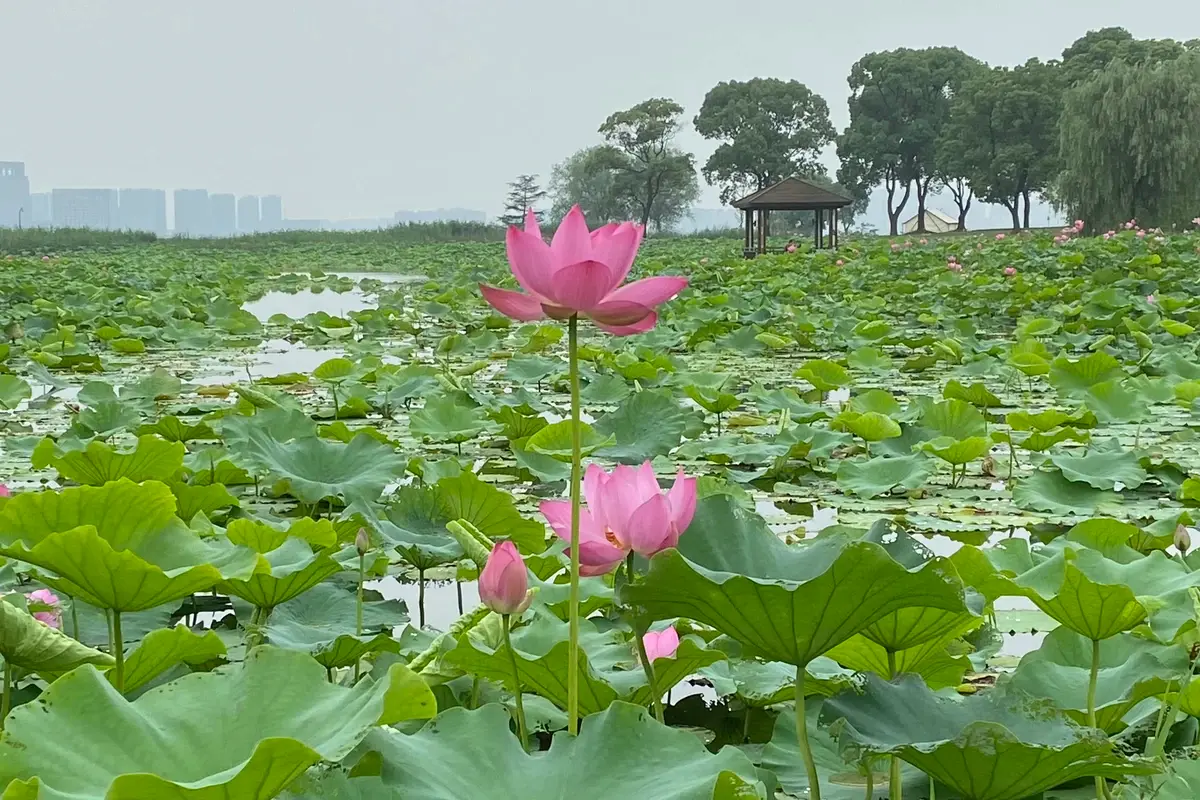
The hotel is rather big, with its own lotus lake. The most beautiful scene was the lotus unfurling and folding, childlike innocence and spontaneity — the green leaves and red buds.
At 12:10 we officially checked in, drank a cup of Pu'er tea, rested, and browsed online for lunch spots. Too many to choose from; the ones that caught our eye were Deyue Lou on Ligong Causeway and Jiangnan Yachu.
Speaking of Ligong Causeway, it's a long embankment in the southern part of Jinji Lake, 1,400 meters in total, built by Yuanhe County Magistrate Li Chaoqiong during the Guangxu period. Originally a convenient shortcut for travelers from Gusu to Xietang and on to Shanghai, linking Suzhou and Shanghai. Because it matched Suzhou's gardening ideal of one lake, one causeway, merchants flocked to it, capital converged, and it became the icing on the cake, forming a leisure and commercial district blending sightseeing, dining, and entertainment.
We arrived at 13:20, parked in the South Beauty parking lot, and walked a short stretch along Hamani Road and Hamani Bridge. Beyond the bridge, the distant view was the Gate of the East (nicknamed 'the Big Pants'); below the bridge nearby was the top-rated restaurant Jiangnan Yachu, an independent villa by Jinji Lake.
We still had to take a number and wait. The waiter's slip showed four tables ahead. Ping, Ting, and Zhang waited in the lobby while I moved the car to park right at Jiangnan Yachu.
By the time I returned to the restaurant, the three of them were sitting calmly, sipping tea. Seeing their attitude, we just accepted it — still had to wait.
Finally our number was called; it was already 13:45. The host led us up to the second floor, a large lake-view private room — that was our table.
For ordering, no matter how fancy the menu, it couldn't dazzle us. We picked squirrel-shaped mandarin fish, stir-fried three shrimps, braised handmade dried tofu, porcini mushroom with clover, garden square cakes, plus a jug of Suzhou old-style soda.
The garden square cakes came first. Maybe the staff sensed we were hungry and rushed them over. No matter, the little cakes — we bit into them and found jujube paste, pine nuts, walnuts.
The signature squirrel-shaped mandarin fish, sour-sweet and crispy. As long as the ingredients are fresh, it wouldn't be too outrageous, though plating had to be considered. Five grapes seemed a bit much for the obviously undersized fish. When we ate, the crispness was only in the moment the dish arrived; later it just turned ordinary. As for the side ingredients, there were only a few shrimps; too much water bamboo dice played the extras, so naturally pine nuts had no role. All things considered, this was the squirrel-shaped mandarin fish we had at Jiangnan Yachu.
The stir-fried three shrimps surfaced just in time, slightly making up for the fish's shortcomings. Seasonal shrimp meat, shrimp roe, and shrimp brain, white with a blush of pink, laid flat on a wide-open lotus leaf — immediately conjured a vivid scene of Jiangnan's water-town landscape. The taste? Tender, fresh, with a touch of vinegar, a mouthfeel intoxicating. Ping said, 'Eat up quickly while it's hot; the flavor is best hot.'
At 15:00, we set down glasses and chopsticks. It was time to pay. I, who had declared I wouldn't fight as a retired person, ended up being paid for by the retired Zhang. One might guess this newly joined young guy must have a mine at home!
We took a photo of Jinji Lake, with the Gate of the East in the distance:
We planned our next route: Ligong Causeway – Gate of the East – Eslite Bookstore – Moonlight Wharf. All scenic spots, all ringing Jinji Lake.
Set off. First stop by car: Deyue Lou on Ligong Causeway at Jinji Lake. In a moment we were there. This plum rain season, yet the sky was clearing; such fine scenery would lift anyone's spirits. Ting and Zhang wandered to the lake-center pavilion on Ligong Causeway that juts into Jinji Lake; Ping and I launched the drone.
Jinji Lake has enough depth to let us gaze freely, even lending us the drone's perspective to look west at the Big Pants, south at Ligong Causeway. Even the Jinji Lake tunnel project under construction in the lake, we could see Suzhou's golden-silver future.
At 15:45 we drove to the second stop, the Gate of the East. Parking wasn't difficult; we chose Lakeside New World on Chui Liu Lane. The city square by the lake was the perfect spot to look up at the Gate of the East. Too bad some sights are best viewed from afar, not up close. The Gate of the East, as a landmark, merely annotates and demarcates between Suzhou's old town and the industrial park. From our eastern side, our limited height already couldn't see the old Gusu city to the west.
The sun turned too hot, so we hurriedly snapped a photo of the Big Pants and ducked into a nearby Starbucks to escape the heat. Ping had a latte, Ting an Americano, I a coffee frappuccino; only Zhang, a coffee outlier, brought his own mineral water.
The café was a mixed crowd, noisy. As we drank coffee and admired our photos, an old man with a loud musical instrument entered. Fearing the high decibels, we left Starbucks. It was about 17:15. Neither rashly young, greasily middle-aged, nor roguishly old, we stuck to our plan and headed to Eslite Bookstore to further our self-cultivation.
A scenic moment along the way: Moonlight Wharf Old North Gate Restaurant, a sight meant to be glanced at in passing. But the dashcam was sharp-eyed and swift, following my photo cue — it captured it instantly with a click.
We parked in Eslite Bookstore's underground garage, took the elevator up to B1, and that's where our Eslite experience began.
An extraordinary place draws extraordinary people. A very bizarre spot, with very bizarre young ladies. Is this still a bookstore? But this is indeed a bookstore — the old binary paradox unites here at this Eslite singularity.
Eslite Life Collection: playful dolls full of childish whimsy, Planet Bear's taiyaki panda. For those speculating, you could try blind boxes, lucky bags, or precise targeting.
The atrium was huge. Here, setting up booths were Suzhou Art & Design Technology Institute, Shen Delong Embroidery, Suzhou Museum, Taohuawu woodblock New Year prints, even POP MART and Maokong set up shop-in-shop. It was dazzling, mind-blowing; we felt like entering a bazaar — Kyoto-quality goods, fan art and Suzhou embroidery, cultural creative items everywhere, too many to take in.
If you needed a break, Pin Tai, Zhu Hongxing Snacks, new-style Chaozhou cuisine, Lu Yang — a whole range of restaurants could serve you any time.
Eslite Bookstore has four floors. B1 is the trendy lifestyle zone; the first floor is style and aesthetics. From the first floor upward, there's a long stepped book path, 72 steps, straight to the second and third floors. Books build the ladder of human progress. In this huge activity space with diverse book categories, thinkers and trend-players each have their own readable and playful corners. Readers immerse in a sea of books, in spaces at most 4A-paper-sized, yet it's a home for the soul of introspection and watchfulness. Wanderers like me follow the crowd like migrating fish, moving between books and non-books, up to the children's section, then to the humanities view area, the vast library of literature, history, and philosophy.
I once strayed from the mainstream with Ping, Ting, and Zhang, seeking a different kind of joy, a moment's lightness, but only for a distracted instant.
We saw vinyl records, gift packaging, art albums, travel picture books. In the literature, history, and philosophy bestseller section, I spotted a timely book, _Authentic Local Flavors: Suzhou_. I opened it, spent a few moments reading, and a thought boldly popped into my head, completely overturning my ingrained impression of Suzhou as gentle. Gentle Suzhou is originally a land of fierce struggle and courage: Wu-Yue springs and autumns, Wu-Chu hegemony, a Ganjiang sword, a scene of Yu Ji's farewell. Men of Jiangdong either contended for the Central Plains or returned wrapped in horsehide. Even by the Sui-Tang eras, local gazetteers recorded, 'Wu people favor swords, make light of death.' As a hard-to-change genetic imprint, martial spirit has always been in Suzhou people's blood. It was only in the Song dynasty, when scholar-officials governed, that Fan Wenzheng set up the Suzhou Prefecture School here. From then on, Wu region flourished in culture and education, talents emerging generation after generation. The book _Authentic Local Flavors: Suzhou_ — delightful words, pages full of fragrance! The pleasure of reading was the moment I swiped my card to buy. Ting swiftly searched JD Shop — RMB 35.4, guaranteed authentic. Did I buy a book? I bought sentiment!
A friend asked: Why a bookstore again? Buying books again? A scholar's heart knows no bounds; this is a fixation, a so-called scholar's complex. It's easy to break bandits in the mountains, hard to break bandits in the heart. At that moment, damn it, a hundred mud horses galloped through my heart — really, exactly that!
On Eslite's open third-floor rooftop plaza, surrounded by towering buildings, we felt absolutely not inferior. We roamed a sea of books. It is books, it is Eslite Bookstore that delivers the ultimate high-end experience. We passionately modified what Eslite old friend Wu Qingyou said: We may not have much money, but we can have Eslite's warm spaces.
Ping basked in the splendid evening light and didn't want to leave. Neither did I, but I remembered Ting and Zhang were still browsing elsewhere. Fine, let's regroup first, unify our pace.
We left Eslite around 18:45, taking the stepped book path straight down to the northeast door on the first floor. Overhead hung large banners recording major events of certain periods and famous quotes. We remembered 'in silence,' but now it was 'listening to thunder,' now 'deep water flows.' We were puzzled; Zhang was even more baffled, so much so that he overlooked the art sculpture 'Rabbit Nini' nearby. The photo was taken only later, at 21:15 after dinner at Moonlight Wharf, on our return visit to Eslite.
Heading southwest along the lake, there was the Moonlight Wharf pedestrian street by Jinji Lake. Midway, a sculpture called 'Return' — a world unto itself — was clearly today's Suzhou, a vivid portrayal of self-contained, time-traveling iterations.
At that moment Jinji Lake's waterline overflowed the embankment, and the Big Pants across the lake was anxiously waiting for the sky to darken, for the moment to change colors. The sky was still bright, night not yet fallen; we strolled along Moonlight Wharf.
Clearly, the bricks and tiles here had been Europeanized. The cobblestone-paved streets adjusted our stride into a pleasant little mincing step. Browsing took a little time; on both sides were not only fountains and sculptures but also some connected or standalone two- or three-story Western-style buildings, standing by Jinji Lake, pleasing to the eye and fitting the scene. A water channel meandered in, bringing a moment's cool. Bridges crossed, wind blew past. In front of camphor trees, neon lights already glowed; a conical tower was boldly emblazoned with the luminous Moonlight Wharf sign.
We turned toward the lake. The Big Pants was now hitting its stride, going all out with a full set of cosmetic, disguise, and transformation techniques. We, a bunch of country bumpkins watching a novelty show, had our own response too — we didn't lose out, deploying our all-powerful photo-editing skills.
At 19:30, the Big Pants still performing, while we were discussing where to have dinner. We were sightseers, but even more we were meal-getters. The Wuyue Rongji up ahead? A trendy Suzhou-style restaurant — could work!
The owner led us inside. The center of the dining room was arranged in a Jiangnan waterside style: right bank by the water, left bank by the window. We just wanted a comfortable seat, so we chose an empty table by the window.
White water fish, steamed; yellow-braised old goose, clay pot; crab roe tofu, deep waters; celery with lily bulbs, water spinach, homestyle stir-fries; hollow big sesame ball, as round as the fifteenth moon had grown to the twentieth.
Enough — meal-getters, fish had fish, goose had goose, plus veggies, plus dim sum, and finally a bowl of plain rice specially requested by Zhang.
Delicious and flavorsome: old goose plus fish. But there was an accident: I, far fiercer than the white water fish, was stabbed by a fish bone, had a bad coughing fit, and had to force down half a bowl of rice to swallow it dry!
By the book: celery with lily bulbs and water spinach. Actually, by-the-book equals the mean; the mean is mediocre.
The big sesame ball steals the show. Even Lan back home flat in Shanghai got deeply shot — 'Suzhou's moon is round in Shanghai,' they say. You see, this was something we fought hard for; in the end, the boss had no choice but to get it transferred from the second branch. Finger to lips before speaking: Shh, don't let outsiders know!
Crab roe tofu, all show and no substance — thumbs down. A bowl of vast ocean with no real thickening is sheer rogue. The water — too deep! The landmines — too many!
This meal we ate very laboriously, filling pits as we met them, digging up mines as we hit them, constantly guarding against possible sneak attacks. By 21:00 when we finished, there were still plenty of leftovers on the table.
Time to go. Then we retraced our steps to Eslite, picked up the car, quickly drove back to Jinji Lake Hotel, settled in, and rested.
2021.7.24


