Walking a Map in Sydney
June is known as the coldest season in Australia, but Sydneysiders still dress lightly, at most wrapping a colorful scarf around their necks. To be honest, this is a truly blessed country, with no scorching summers and no freezing winters.
Before going, I read many travel notes from friends trying to plan my itinerary and figure out how to cover Sydney's main attractions without detours. After actually visiting, I found that Sydney's downtown is surprisingly tiny—this is a conclusion I reached by measuring with my own feet. In fact, as long as you grasp the general directions described below, you can roam freely on foot.
Let's start by pinpointing the origin of this map: the Queen Victoria Building (absolute city center, equivalent to Beijing's Wangfujing Department Store). The main street running vertically (north-south) is George Street, and the one running horizontally (east-west) is Market Street. The following introductions to the attractions will basically use this cross as a reference. The attractions are introduced counterclockwise.
[Go Up - Circular Quay]
Starting from the origin, walking north along the vertical axis, it takes about 15 minutes to reach the core attraction, Circular Quay. It is bustling with bars and restaurants, with boats coming and going.
Standing at the quay, facing the harbor, walk to the left for 3 minutes to reach the [Museum of Contemporary Art]. Personally, I feel it's a place filled with 'trash' and 'delusions'. Many exhibits, including graffiti (I hesitate to call it painting), sculptures, and audio-visual works, are incomprehensible, with at most a hint of sexual innuendo. I feel quite embarrassed by my own crudeness. The good thing is that the museum is free. Further ahead, along a road with shops like LV and GUCCI, after 10 minutes you can reach the so-called [The Rocks], which is a street market. Price-wise, roughly the same small items that cost in yuan in China cost in Australian dollars here. I think it's worth a look for the atmosphere, but note that the market closes at 5 PM. Looking up from The Rocks area, you'll see the most famous [Sydney Harbour Bridge], commonly known as the 'coat hanger bridge.'
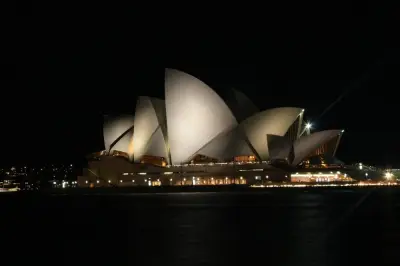
Still standing at the quay, facing the harbor, look to the right and you'll naturally see the world-famous symbol of Sydney—the Sydney Opera House. It takes about 10 minutes to stroll over. Aside from positioning your camera at every angle to capture this charming building, another good activity is to enjoy performances over a few evenings. All performance details can be arranged online, paying by credit card, which is very convenient. More importantly, compared to domestic performances, ticket prices are not expensive, usually ranging from 50 to 100 Australian dollars.
Still at the quay, if you want to go to Manly Beach, just buy a ferry ticket. A round trip costs about 12 Australian dollars, and the one-way trip is half an hour. Once the boat sets off, you can look back at the skyline of Sydney Harbor with its tall buildings.
[Go Left - Darling Harbor]
Starting from the origin, walking left (west) along the horizontal axis, you'll see Darling Harbor in about 10 minutes. There is a pedestrian bridge across the harbor. At the end of the bridge before crossing are the [Sydney Wildlife World] and [Sydney Aquarium]. These are mini versions for those who don't have time to go to Taronga Zoo (by ferry from Circular Quay) or Manly's underwater world. After crossing the bridge, you'll find the free [Australian National Maritime Museum], which tells the history of maritime exploration or promotes the experience of some 'boring' Australian who rowed around the world. It's worth a look.
After crossing the bridge and walking another 10 minutes, you'll reach the [Fish Market], highly praised by Chinese tourists. It offers a full range of fresh seafood, with on-site processing. Half a lobster with cream sauce costs less than 20 Australian dollars, and a dozen oysters costs around 20-plus dollars—quite a bargain. Two people can enjoy a very satisfying meal for 60-80 Australian dollars.
In fact, the night view of Darling Harbor is very beautiful. The surrounding high-rises seem to have their lights on all night, shining brightly. Having a small drink by the water is quite bourgeois.
[Go Down - Chinatown and Blue Mountain]
Starting from the origin, walking down (south) along the vertical axis, the more you walk, the more Chinese people you see. After about 10 minutes, you'll see a cluster of Chinese restaurants. [Chinatown] is similar all over the world; Sydney's is okay, not particularly dirty or messy. In Chinatown, you mainly eat Chinese food and go to duty-free shops to buy Australian specialties known to all Chinese. Lanolin cream ranges from 1 to over 10 Australian dollars; I didn't ask about the more expensive ones. Fish oil has many varieties with big price differences, but I didn't pay much attention, thinking it's all about tricking rich but naive Chinese people. UGG seems to be popular among Chinese girls; in Australia, it's sold in almost any tourist souvenir shop, and in Chinatown it's usually around 100 Australian dollars.
Continuing down the vertical axis for another 10 minutes, you'll see the city's transport hub—Central Station. From here, you can take a train to [Blue Mountain]. Many netizens say the scenery of Blue Mountain is mediocre and not worth visiting. To be honest, if you've been to Zhangjiajie, this place is truly like 'a firefly compared to the bright moon,' as Xu Shu said when recommending Zhuge Liang. But if you have plenty of time in Sydney, consider it a countryside hike. There's a little tip about buying train tickets: when you inquire about Blue Mountain tours at the Central Station information desk, they'll give you a round-trip timetable from Central to Katoomba (roughly one train per hour), which includes a price for the Blue Mountain Explorer Link, 46.8 Australian dollars for adults. Don't buy that; it includes the bus transportation within Blue Mountain. Go directly to the ticket counter and buy a round-trip ticket for only 10.8 dollars. The one-way train ride takes exactly 2 hours, and you can slowly enjoy the Australian countryside scenery until you arrive at Katoomba. The station is very small. When you exit, you'll see the Explorer company's hop-on-hop-off bus for over 20 Australian dollars. It's completely unnecessary; you also have to wait for the schedule. Since you've already sat for two hours on the train, it's nice to take a walk. Follow the road directly opposite the train station, walk about 10 minutes to leave town (unless you browse small shops), then continue walking for another 20 minutes (with a couple of slight turns, and signs along the way) to reach Echo Point, the viewing platform for the Three Sisters. This attraction is free to enter; you can look as much as you like. Grab a map at Echo Point, then take a 15-minute mountain trail to reach the Skyway boarding station near the Three Sisters. Take the Skyway across a valley; along the way, you can see a trickling waterfall, and you'll arrive at another attraction, Scenic World. Take the Railway down to the valley floor, stroll through the chilly forest, then take the Cableway (regular cable car) back up. That's pretty much the Blue Mountain experience. A combo ticket for the three 'ways' costs 25 Australian dollars. Notably, the Railway is an old mining cart track with a vertical slope of over 45 degrees, quite thrilling, but luckily the speed is slow. This project should really be visited by the managers of Zhangjiajie. I remember when hiking in Zhangjiajie, I saw many so-called 'tiankengs' (sinkholes), and the guide told many legends. Developing a 'descend into the tiankeng' attraction should be a good business. Tourism operators in Australia (and many other countries) must envy their Chinese counterparts. I boarded each 'way' immediately upon arrival, and each was operated by a single staff member (meaning one runs while the other stops). Last month at Mount Emei, while taking the cable car in the rain, there were thousands of people waiting in line. After finishing at Scenic World, remember to allow half an hour to catch the return train. There's no need to walk back for half an hour; just wait by the attraction entrance, ask a bus, and soon you'll find one that goes to the station in 10 minutes for only 2 Australian dollars. :)
[Go Right - Bondi Beach and Oxford Street]
This time you'll need to take some transportation; relying solely on your legs is difficult. And we want to save our energy for the most worthwhile beachside walk. Again starting from the origin, from the south exit of the Queen Victoria Building, walk 3 minutes to the Town Hall station. From there, check the direction and take the train to Bondi Junction, 4.4 Australian dollars for a round-trip ticket. After getting off at Bondi Junction, take bus 380 or 381 for 2 Australian dollars and 15 minutes. Bus stops in Australia are very short; you can get off as soon as you see the beautiful beach approaching. [Bondi Beach] is where the beauty of Australia fully reveals itself. A crescent-shaped golden beach over a kilometer long, black rocky cliffs, surging blue waves from the South Pacific, and scattered resort hotels... At Bondi, even doing nothing but staring at the waves for half a day is not a bad idea.
The 5-kilometer coastal walk from Bondi Beach to Coogee Beach is highly recommended—it's stunning. The route passes Tamarama Beach, Bronte Beach, Waverley Cemetery, Clovelly Beach, Gordon Bay, and finally Coogee Beach. The leisurely walk takes about 3 hours. Every step brings a new view, with almost every scene featuring crashing waves, turquoise water, and golden sand. The biggest regret is not coming in summer; otherwise, when passing Bronte Beach, I would definitely swim in that free public pool. Imagine every giant wave crashing into the pool—how amazing! Clovelly Beach is even better, extending hundreds of meters inland, essentially a wave pool itself. The cemetery is indeed a bit eerie, but it has a strong sense of history. Any worn-out tombstone might belong to someone from a century ago. Such a prime ocean-view plot, still quietly listening to the wind and watching the sea—if it were in China, it would have been demolished long ago.
At Coogee Beach, you can take bus 372 back to Bondi Junction, then transfer to another bus to nearby Oxford Street. Oxford Street is very long and, if you keep walking back, you can return to my designated origin. Oxford Street is famous for Sydney's gay culture. Every February, it becomes the center of the Mardi Gras parade, considered the liveliest festival in Australia. On ordinary days, browsing the myriad of small shops is also enjoyable—that's another major feature of Oxford Street.
[Go Upper Right - Royal Botanic Garden, Art Gallery of New South Wales, Government House]
Again starting from the origin, walking northeast along the horizontal axis, after 5 minutes you'll see a large lawn, the so-called [Hyde Park] (of course, it can't compare to London's Hyde Park). At one corner of the park is [St. James' Cathedral]. Past the church, there is even larger green space, the city's green lung (The Domain and [Royal Botanic Garden]), actually just a place for daily leisure activities. Whether on weekends or weekdays, you'll see plenty of fit runners.
Follow the path through the center of the green lung, walk about 10 minutes, and you'll see the [Art Gallery of New South Wales], which is free to enter. Its collection is quite rich, from European classical to contemporary art, from Chinese porcelain to Australian Aboriginal culture—worth careful appreciation.
Exit the gallery and continue along the botanic garden path for about 15 minutes until you reach the seaside, the famous [Mrs Macquaries Point]. This is an excellent spot to take in both the Opera House and the Sydney Harbour Bridge.
From Mrs Macquaries Point, walk back along the sea by Farm Cove, heading toward the Opera House. About 15 minutes later (if you don't stop for the birds or plants in the botanic garden), you'll arrive at the [Old Government House] (free admission). This building dates from 1845 (around the time of the Opium War in China) and was decommissioned in the 1990s, becoming a state ceremonial venue open to the public. As photos prove, when President Hu Jintao attended the APEC meeting, the grand dinner was held here. To be honest, Australia is isolated overseas, and this Government House is not much larger than some mansion in Shanghai.
Having traveled to many cities, I find Sydney exceptionally suitable for walking. Backpackers, why not pick up this map and measure and touch this beautiful land?
(Bondi Beach)
(Bondi Beach)
(Seaside Pool)
(Manly Beach)