Melbourne-Cairns-Sydney, from Beautiful Coastline to Bustling City, a Detailed Budget Travel Guide for 12 Days and 3 Cities
Day 1 Depart from Shanghai
Day 2 Arrive in Melbourne, check into the homestay, rest in the morning to recharge, explore Melbourne city center in the afternoon
It was summer in Melbourne, and the sun hadn't set even at 8 PM. Although we had a long nap during the day, we still had plenty of time to explore the city center. Melbourne's city center is not large, and you can get around easily on foot (though it still requires some energy). There is a free vintage tram loop, City Circle Tram Route 35, which takes you around the city's attractions—free and convenient.
In the heart of Melbourne, we visited the historic and architecturally unique Flinders Street Station, the majestic St. Paul's Cathedral, and the artistic Hosier Lane. We strolled along the Yarra River path, feeling the river breeze, and saw the floating bars along the riverbank packed with people.
St. Paul's Cathedral is diagonally opposite the station.
Hosier Lane is on the street from the station to the cathedral.
The Yarra River is right next to the station, behind it.
Day 3 Humble Rays + Melbourne City Center + Puffing Billy Railway + Chocolate Factory + Penguin Parade
Today's main itinerary was the Puffing Billy Railway and Phillip Island Penguin Parade. Since the penguin parade is after 8 PM, we booked a day tour online that departed from Melbourne city center at noon. That gave us another morning to explore the city. We woke up naturally, walked to the trendy brunch spot Humble Rays for a late breakfast. It’s said that there’s always a long queue, but we were lucky—only two or three people were waiting outside, so we didn’t wait long. We ordered Benny Egg, Crab Meat Scramble, and the dessert French Toast Forever. True to its reputation, it was delicious and beautifully presented. Highly recommended.
The soft-shell crab scramble (Crab Meat Scramble) was great, and the croissant was tasty.
The dessert French Toast Forever was too sweet for us. The first two dishes were enough for two people, so we didn’t finish it.
After eating, we passed an eye-catching building—a public restroom.
We walked along the street and saw the diverse architecture of RMIT University, then quickly glanced at the State Library Victoria.
After our morning stroll, we headed to the meeting point near the State Library. The city center is far from the railway and Phillip Island, so self-driving isn’t cost-effective. I recommend searching on all-powerful Taobao. We booked a day tour online and joined a group organized by our fellow countrymen overseas. We headed toward the Puffing Billy Railway. The train is open-air; previously, you could sit on the windowsill with your legs dangling out. Unfortunately, that action has been deemed unsafe and is no longer allowed. Still, the train ride was a great experience—the station and train have a long history and a vintage feel, making you feel like you're inside a toy.
The train wound along the tracks through the jungle, and pedestrians would stop and wave to the passengers. A little kid even got off the train and waved to everyone on board—very amusing.
The next stop was Charlie's Chocolate Factory, full of various chocolate creations—an eye-opener. You could also play games to win chocolate beans. After the chocolate factory, we had dinner, then went to Phillip Island to wait for the penguins to return. We chose the preferred viewing platform; the general one was indeed too far. By the time we arrived, people from all over had already taken most of the seats, so we had to find a corner to sit. But later, we realized that the spot wasn’t the most important thing. The penguins came out of the sea very far from the viewing platform, so you must bring binoculars to see the cute little penguins hopping on the rocks in groups or pairs. Later, the penguins came very close along the path, and we could see them up close. Words can’t describe how adorable they were. No photography is allowed on site, so I can’t share photos. I strongly recommend seeing it in person—it’s incredibly cute.
There was also a large chocolate waterfall.
After watching the penguins, we returned to our accommodation at midnight. So be mentally prepared—it’s very physically demanding.
Day 4 Morning: Pick up a rental car in Melbourne city center. Begin the Great Ocean Road self-drive trip.
Route: Melbourne – Geelong (see the bollards) – Split Point Lighthouse – Memorial Arch of Great Ocean Road – Lorne – Apollo Bay – Accommodation
As we drove on the winding road, we suddenly turned a corner and were greeted by a stunning view of the deep blue ocean—very impressive. This section of the Great Ocean Road is blue, with the sea on the left and mountains on the right, winding along the foothills—a beautiful scenery.
PS: In Australia, you drive on the right side of the car (left side of the road). The Great Ocean Road is twisty, and speed limits are not low. So either you’re a skilled driver or you go slow. The driver basically can’t enjoy the scenery along the way—you need to focus on driving.
First stop: Geelong’s painted bollards
Second stop: Split Point Lighthouse
Third stop: Great Ocean Road Memorial Arch
Fourth stop: Lorne Town. We didn’t do enough research—there’s a lookout in Lorne with a beautiful panoramic view of the Great Ocean Road, which we missed.
Arrived at our homestay on the outskirts of Apollo Bay in the evening. The village had all kinds of houses, delicate and lovely.
Day 5 Great Ocean Road Day 2 Route
A perfect day, starting with sunrise and ending with sunset
Apollo Bay – watch sunrise – Cape Otway Lighthouse area – Gibson Steps – Twelve Apostles – Loch Ard Gorge – Port Campbell homestay – The Arch – London Arch – The Grotto – watch sunset.
Our village was right at the foot of Marriners Lookout. Before sunrise, we drove up to the lookout—the highest point in town. When we arrived, some people had already set up professional photography gear to capture the sunrise over the sea.
The sun slowly rose from the horizon, spreading golden light layer by layer over the town, until all the roofs and lawns were bathed in gold. I regretted not being a good photographer—I couldn’t capture the beauty of the sunrise.
From above, you could see the entire Apollo Bay, with its two arms reaching into the sea—it felt like standing on a map.
After watching the sunrise, we went back for a nap, then packed up and went to the town of Apollo Bay for breakfast. We specially visited Dooley’s Ice Cream, an award-winning ice cream shop that is the only one of its kind in the world—well-deserved reputation.
We continued our Great Ocean Road self-drive. Next was the green section, with tall trees on both sides, making us feel like we were driving through a dense forest.
The next attraction was Great Otway National Park, but we were short on time and skipped it. Our original plan was to visit Cape Otway Lightstation. Driving along the road, we occasionally saw koalas in the trees on both sides—free koala viewing. Koalas are small and easy to miss if you don’t look carefully. But there’s a trick: if you see cars parked on the roadside and people pointing cameras at a tree, stop and you’ll find koalas. When we got to the lighthouse entrance, we found out it was a paid lighthouse, unlike Split Point Lighthouse. The entrance was far from the lighthouse, so we couldn’t even see it. From photos, we knew it was a short, squat lighthouse compared to the tall, slender Split Point—no need to pay for a repeat.
Zoomed in with the camera to capture a koala high up in a tree.
Continuing on, we entered the yellow section of the Great Ocean Road.
We emerged from the dense forest onto open grasslands. Rolling hills with neatly trimmed lawns.
Some had stacks of hay bales, others had herds of cattle grazing.
The road wound up and down the hills, and the scenery kept my camera busy.
After passing through large grasslands, we reached the final and most famous section of the Great Ocean Road—the rock formations led by the Twelve Apostles. Combining nature’s craftsmanship and human imagination, each rock has its own shape and story. Over time, the rocks have been shaped by waves and erosion, giving rise to tales like the gradually disappearing Twelve Apostles and the London Bridge that broke and stranded people. Truly a sight to see before it’s too late.
The Twelve Apostles were breathtakingly beautiful—even more stunning in person than in photos.
The viewing platform is between the apostles; the ones on the other side didn’t photograph as well due to lighting.
Next stop after the Twelve Apostles was Loch Ard Gorge.
The earlier rocks were close together. After Loch Ard Gorge, we drove to our homestay in Port Campbell. After resting, we went before sunset to see The Arch, London Arch, and The Grotto. Australian summer is great for travel—long daylight gives you plenty of time to explore.
London Arch was gradually formed by wave erosion.
In 1990, the arch connecting to the mainland suddenly collapsed, trapping a couple from London on the remaining section. They were rescued by helicopter. Their story is now part of the attraction.
Now only a lonely arch stands in the sea, disconnected from the land.
Next, we went to The Grotto. The opening framed the sea and sky perfectly—a great photo spot. Unfortunately, we arrived too late, and the sea and sky were gray.
At The Grotto, the sun was setting, and we watched the sunset over the sea with beautiful evening colors.
Day 6 Transfer day. Morning: Depart from Port Campbell, drive directly to Melbourne Airport. Afternoon: Fly to Cairns. Evening: Arrive at our homestay in Cairns.
Day 7 Sunlover Reef Cruises – Moore Reef One-Day Tour
Again, we booked tickets in advance on all-powerful Taobao. We chose the package with boat round-trip + 10-minute helicopter ride and prepared seasickness medication beforehand. If you don’t get seasick, this package is cost-effective—you can enjoy the sea views on the way out, nap on the way back, and the 10-minute helicopter gives you a good view of the Great Barrier Reef. If you get seasick, you can go to the open deck on the second level, where crew members are on standby with vomit bags—and indeed, many people were vomiting.
On the way, we passed Green Island. Some passengers who had planned to go there disembarked, while the rest continued deeper into the sea. We arrived at the Moore Reef pontoon around noon.
The pontoon offers various activities: semi-submersible, glass-bottom boat, marine life touch pool—all with scheduled times. There’s a large snorkeling area where you can rent equipment and swim. Unfortunately, we don’t know how to swim and didn’t even bring swimsuits, so we missed the chance to get close to the deep sea.
On the glass-bottom boat, we saw colorful coral, swimming fish, and waddling sea turtles through the transparent bottom.
The best part was the helicopter ride overlooking the reef. From above, the Great Barrier Reef appeared as patches of deep and light blue on the sea—breathtakingly beautiful.
It is said that the reef is gradually dying due to ecological changes—another sight to see before it’s too late. Make time to experience the visual impact of this beautiful reef.
The helicopter circled over the reef and the pontoon before landing back on the helipad.
The seawater was crystal clear. From the pontoon or the underwater observatory, we could see deep-sea fish swimming by—vibrantly colored and varied in shape.
The deep-sea fish were so beautifully unreal, like stepping into an underwater world documentary.
Day 8 Cairns Botanic Gardens Day Trip
Besides the Great Barrier Reef, Cairns is also famous for the tropical rainforest. Unfortunately, the day tour to the rainforest arranged by travel agencies couldn’t fit our afternoon flight to Sydney, so we gave up. On a whim, we visited the Cairns Botanic Gardens—a relatively relaxing day.
At noon, we went to Waterbar Grill by the sea to enjoy the ocean view and a big meal. In the afternoon, we departed for Sydney.
The T-bone steak at Waterbar Grill was quite good.
Day 9 Another day of sleeping in. At noon, we met up with an old classmate and visited the University of Sydney, then enjoyed a rare Chinese lunch. In the afternoon, we wandered around the city center and shopped.
Sydney's city center has the historic Hyde Park.
Next to Hyde Park is St. Mary’s Cathedral.
Behind Hyde Park is the Sydney Tower.
The shopping district has the Queen Victoria Building (QVB), which is over a hundred years old.
The interior of the QVB is magnificent and luxurious.
Day 10 Taronga Zoo + Sydney Opera House Day Trip
In the morning, we took a bus to Circular Quay, then a ferry to Taronga Zoo. On both sides of Circular Quay are the Sydney Opera House and the Harbour Bridge. The ferry offers great views of both landmarks. The zoo has all kinds of animals, of course, the Australian specialties—koalas and kangaroos—which you can see up close. We also watched a seal show, a bird show, and the zoo’s highlight—a recently acquired tiger from Asia.
In the kangaroo area, visitors can go in and get close to the kangaroos.
From one corner of the zoo, you can see the Opera House and Harbour Bridge—a perfect spot for photos with both landmarks.
On the ferry to and from the zoo, you can enjoy various angles of the Opera House and Harbour Bridge. After the zoo, we returned to Circular Quay and transferred to a ferry to Manly Beach. When we arrived at the Manly Wharf, we thought the small beach next to the wharf was Manly Beach—we wondered how such a small beach could be famous. After playing for a while, we realized Manly Beach is actually a bit further away. By then, we were exhausted from the zoo, but we forced ourselves to walk to the beach and found out why it’s famous.
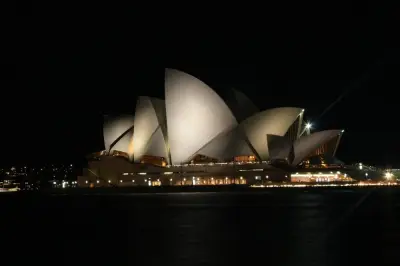
Returning to Circular Quay, we went to the Sydney Opera House to see this iconic building up close. Despite being tired, the beautiful architecture and sea breeze revived us.
In the evening, we visited a trendy restaurant, Pancakes on the Rocks. It has locations in The Rocks and Darling Harbour. Their specialty is waffles. We ordered a plate, but I found the waffles average—not recommended.
We also ordered a plate of pork ribs, which were delicious—typical Chinese palate…
Day 11 Harbour Bridge + The Rocks + Darling Harbour Fireworks
We took a bus to the base of the Harbour Bridge, then an elevator up to the bridge deck to feel its grandeur. Cars were flowing on the bridge, and we could feel the vibration. There’s a bridge climb activity, and we saw a group climbing with their instructor—very brave.
It was Saturday, and we encountered the weekly markets in The Rocks, with all kinds of trinkets.
As Sydney’s oldest neighborhood, The Rocks has historic and unique architecture—a popular spot for Instagram-worthy photos.
We had dinner at Nick’s Seafood in Darling Harbour, waiting for the weekly fireworks display.
Nick’s Seafood specializes in seafood, including the famous Australian lobster. The price was indeed high, but the baby lobster was somewhat affordable. It was really delicious—the texture was excellent. In Australia, you definitely have to eat lobster.
We also ordered a seafood platter, which was not huge but tasted good.
Even though the fireworks are weekly, the bridge was still packed with people, so we had to secure a spot early.
The big Ferris wheel in Darling Harbour looks beautiful when lit up at night.
Day 12 Sydney to Shanghai
This is a budget guide for two people, 3 cities, 12 days, with a total cost of 30,000 RMB.
Eating out at restaurants can be very expensive—often 10 to 20 AUD per item. Once in Apollo Bay, we had a simple breakfast (wontons + noodles) that cost about 100 RMB, just to give you an idea. Besides the trendy spots we visited, using good strategies can save a lot.
For breakfast, we usually ate whole wheat bread, which is super cheap in Australia—about 10 RMB for 30 slices, enough for several breakfasts. So breakfast cost was negligible.
Instant noodles are allowed to be brought into Australia. We hadn’t done enough research before the trip and brought a lot of food. We had only two packs of instant noodles; other food couldn’t pass customs and was confiscated. Fortunately, the noodles were allowed, and they sustained us for one meal. We regretted not bringing more.
Fast food: In China, burgers are relatively expensive, but abroad they are the cheapest Western food. We went to Hungry Jack’s, and a meal for two cost about 70 RMB—very affordable.
After seeing hotel prices, we gave up on hotels and stayed in homestays throughout.
Booking method: Airbnb app.
Booking time: For popular places, book at least one month in advance.
Discounts: New users get a 100 RMB coupon upon registration.
Tips: Set filters (recommend selecting Superhost), use the map to locate, and read reviews.
We monitored flight prices a month in advance and booked only budget airlines. Even though it was peak tourist season in Australia, we still found cheap tickets.
International flights – Xiamen Airlines: Free checked baggage (23 kg/person), carry-on 5 kg/person (usually not strictly enforced), free headphones, free blanket (red-eye flights).
Domestic flights in Australia – Jetstar: Budget airline; need to purchase baggage allowance. Jetstar allows 7 kg free carry-on per person. Excess baggage can be purchased online: 180 RMB/15 kg, 200 RMB/20 kg.
Melbourne Airport to city: Take Skybus; buy tickets in advance in China.
Cairns city: Take the bus; pay in cash.
Sydney: Buy an Opal card in advance in China; can be used on buses and trains.
PS: Download Google Maps in advance; it can tell you exactly when the next bus will arrive.
Car rental: Free international driving permit translation (just pay shipping); book in advance, pick up locally.
Purchase insurance from the rental platform before departure; no need to buy locally. If an accident occurs, you pay up to 6,000 AUD upfront, then claim reimbursement from the platform after returning to China.
1. Right-hand drive (drive on the left); remind yourself “Keep Left.”
2. Right-of-way awareness: On empty roads, make sure the main road is clear for 100 meters before entering.
3. Honking: Almost never honk unless necessary.
4. Parking fees: Most places have free parking.
5. Some roads may have tolls, but we didn’t know about them or how to pay. One month after returning, we received a credit card bill of about 200 RMB for tolls and late fees.
Choose to shop in the last city to avoid carrying luggage everywhere.
Chocolate: 4 AUD, Papaw ointment: 4 AUD (at Woolworths)
Goat soap: 2.5 AUD, Lanolin cream: 4 AUD (at Chemist Warehouse)
Note: Spending over 300 AUD at the same store allows a 9% tax refund at the airport.
(1) Download the TRS refund app in advance.
(2) Spend over 300 AUD at the same store.
(3) Get the receipt stamped at the airport (TRS counter in the arrivals hall).
(4) After clearing customs, find the TRS refund point at Sydney Airport.
(5) Provide your bank card and show the app QR code for the refund.
(6) Refund arrives within one month.
SIM card: Purchase a Telstra prepaid data SIM online.
Cost: 66 RMB/person, unlimited data + unlimited calls to China and Australia.
Note: Activate only upon arrival in Australia.
1. Payment methods abroad: Cash, credit card, Alipay (very rare).
2. Special note: For non-USD transactions, VISA charges an additional currency conversion fee (about 1.5%). Cash exchange: buy at 4.88%, sell at 4.63%. Credit card charges in USD require the bank to purchase USD first, plus a conversion fee.
Bank of China’s card discount only applies to UnionPay POS machines abroad; VISA does not qualify. UnionPay overseas is mainly available in Hong Kong, Macau, and Taiwan.
Credit card types: Distinguish between VISA and multi-currency cards.
Visa application: e-visa, apply through an online agency.
Cost: 855 RMB/person.
Processing time: Within one month.
Required documents: All in electronic format, including company business license, employment letter (with specific travel dates), one-inch photo, bank statements (all accounts with at least 30,000 RMB balance per person).
Before entering Australia, the airline will distribute customs declaration forms as needed, or you can fill one out at the airport upon landing. Note: Do not bring eggs, meat, fruits, vegetables, etc. Personal medications do not need to be declared.
Travel Diary Contents: 1. Melbourne 2. Cairns 3. Sydney 4. Budget Tips – Food, Accommodation, Transport 5. Car Rental/Self-Drive 6. Shopping Guide 7. SIM & Internet 8. Currency Exchange & Credit Card Usage 9. Visa and Customs Declaration
Tourism Info Hotel Index Strategy Index Flight Index Website Navigation Tourism Index Cruise Index Corporate Travel Index Franchise Cooperation Distribution Alliance Friendship Links Enterprise Gift Card Purchase Insurance Agency Cooperation Hotel Booking Destination and Scenic Spot Cooperation More Cooperation About Ctrip About Ctrip Ctrip Hotspots Contact Us Careers User Agreement Privacy Policy Business License Security Center Ctrip Content Center Intellectual Property Trip.com Group Algorithm Disclosure