Hiking Sydney Olympic Park, checking out the 'Floating Forest', and admiring the beautiful coastal saltmarsh
Inside the Olympic Park in the Rhodes area of Sydney, there is a large coastal saltmarsh dominated by mangrove plant communities — so beautiful! There is also a ship dismantling relic, with a rusty hull overgrown with lush mangroves, which people call the "Floating Forest", attracting photography enthusiasts from all over the world.
On May 23, 1966, the Maritime Services Board approved the use of land at Homebush Bay as a shipbreaking yard for Sydney Harbour. Since 1970, some private companies have leased the shipbreaking yard for dismantling scrap ships. Records were kept until 1992, when the site appeared to have been used for other purposes. Today, this land is part of the Sydney Olympic Park, and some shipwrecks remain in the bay because of their historical significance and are protected by the Commonwealth Historic Shipwrecks Act of 1976.
There are remote telescopes on the shore platform, through which you can view the wrecks of Homebush Bay.
The wreck at this location is closest to the shore.
In Homebush Bay within Sydney's Rhodes Olympic Park, many ship remains are moored. Among them, one ship with a rusty hull overgrown with lush mangroves is called the "Floating Forest" by people. Its beautiful sight adds a touch of vitality and elegance to the residential area. This ship is named "The SS Ayrfield".
The SS Ayrfield (originally called SS Corrimal) was a coal-carrying ship built in Britain in 1911. During World War II, the Commonwealth Government used it to transport supplies for US soldiers in the Pacific. In 1950, it was sold as a coal carrier, transporting coal along the 60-mile route between Newcastle and Sydney. In 1972, the ship was decommissioned and sent to its final resting place, Homebush Bay.
(The sign shows: Historic wrecks of Homebush Bay, and the ship's early appearance)
Before the 2000 Olympics, this place was just a scrap ship dismantling site, with dozens of scrapped ships moored here telling the story of historical changes. People say The SS Ayrfield is a microcosm of the Homebush Bay ship cemetery, but its unique appearance makes locals prefer to call it the "Floating Forest". The rusty metal hull has grown dense mangroves from below the waterline, full of vitality and distinctive, attracting photography enthusiasts from around the world. Due to our poor shooting angle, we couldn't capture the "Floating Forest" feel of the wreck.
Outside the bird observation hut in Sydney Olympic Park, there is a saltmarsh. Looking from afar, it appears as a large area of red. Getting closer, we found it is a plant called bead glasswort (Sarcocornia quinqueflora), covering large patches in red. Also, there is a special grass: saltwort (Salicornia), which also turns red in autumn. Each saltwort plant looks like red coral. The saltmarsh formed by these plants is very beautiful. Under the blue sky and white clouds, the saltmarsh is covered with lush vegetation, indescribably beautiful.
Here is a coastal saltmarsh mainly composed of mangrove plant communities.
Coastal Saltmarsh refers to the transitional zone between terrestrial and marine ecosystems.
Under the blue sky and white clouds, the saltmarsh is covered with lush mangrove plants, indescribably beautiful.
The spiraling observation deck offers panoramic views of the water, park greenery, and city skyline.
The residential buildings along the waterfront on the opposite side of the river in Rhodes.
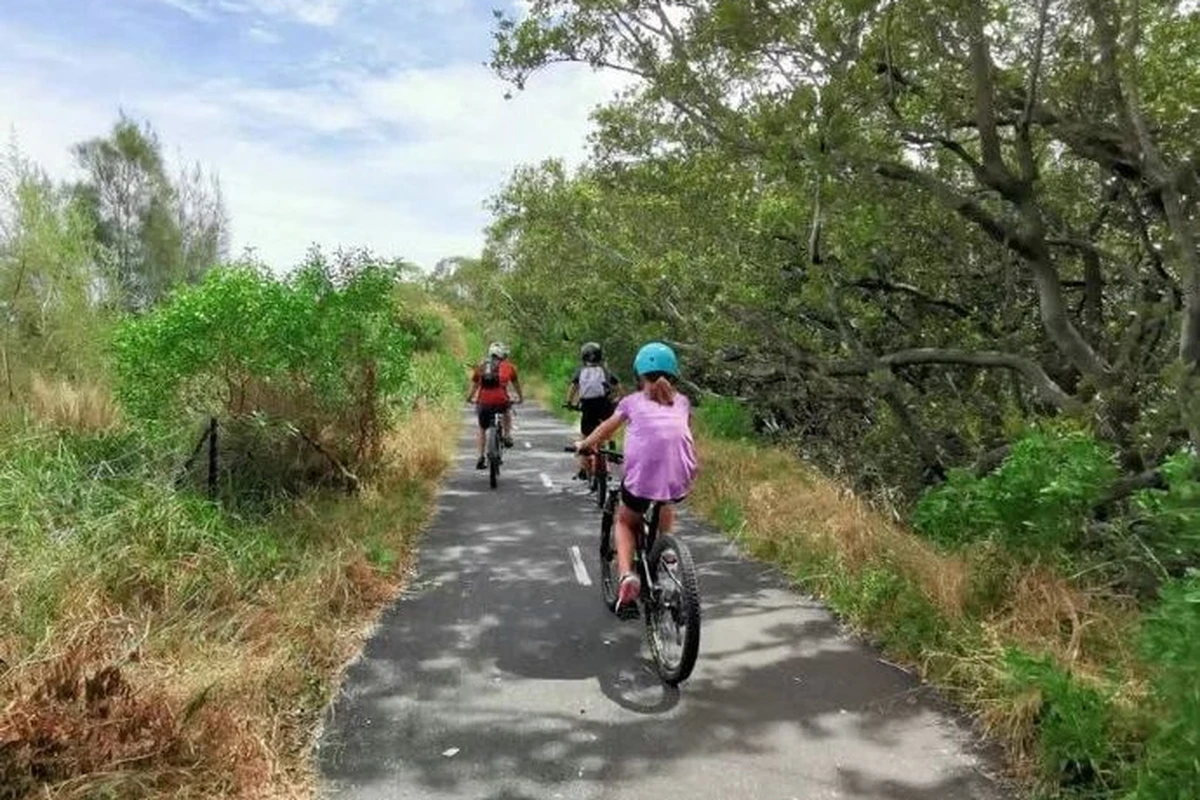
The entire route hugs Homebush Bay closely, with forests and various bridges. The beautiful scenery along the way made us feel relaxed and carefree, reluctant to leave.
For hikers and cyclists who want a combination of ease, safety, comfort, and beautiful scenery, the Olympic Park here is their top choice.
Cycling along the park's trails, enjoying the roadside views.