【18-Day RV Self-Drive Tour in Southeastern Australia】
A family of 7 (6 adults and 1 child), 18-day RV self-drive tour in southeastern Australia, covering over 3,000 kilometers.
Total cost approximately 140,000 yuan, with per-person cost under 20,000 yuan. Main expenses as follows:
Flights: 57,000 yuan
Visa fees: 1,065 × 7 = 7,455 yuan
Transport (rental car, fuel): 32,000 yuan
Food (supermarket groceries): 8,000 yuan
Accommodation (campgrounds, city hotels): 20,000 yuan
Other (tickets, helicopter): 10,000 yuan
Independent travel requires preparation. For a self-guided trip with limited vacation time, pre-trip preparation is especially important! The degree of preparation is directly proportional to how enjoyable the trip is! Moreover, traveling with a large family makes spontaneous trips unreliable. To have a good time, thorough advance preparation and detailed itinerary planning are essential.
First, I thoroughly read various travelogues and guides to understand how others planned their itineraries, what factors they considered, and what precautions they took. This gave me some feel for the unfamiliar destination, so I could start designing my own itinerary and delve into the specific attractions, hotels, campgrounds, routes, etc., gradually refining my plan.
Before departure, it's best to create a rough itinerary sheet including important information such as flight numbers/departure times, hotel names and addresses, campground addresses and phone numbers, for easy reference and navigation on the road.
Google Maps is a great tool. You can mark routes and attractions on the map for a clear overview. It can be adjusted anytime and shared with your family.
Tips for Traveling in Australia
After comparing prices, I finally chose Ctrip: Malaysian Airlines via Kuala Lumpur. Round-trip tickets for adults were about 8,500 yuan.
There is plenty of information online about how to prepare visa materials, so I won't elaborate. But the Australian embassy expects you to prepare materials as detailed as a public disclosure of assets. Per-person cost was 1,065 yuan.
I booked the RV directly through the Britz website. RVs for 2 to 6 people are available. Britz's RVs were relatively older, and the interior facilities were not particularly good—for example, the drains were not very smooth, and the refrigerator door didn't close tightly. I recommend considering the slightly more expensive Maui RVs.
Since our group exceeded 6 people and we couldn't rent just one 6-person RV, and also for safety and comfort, we decided to rent one fully equipped 4-person RV plus one small car.
In Australia, due to fewer cars, most highways have only one lane in each direction, and overtaking by crossing the center line is prohibited. Every few kilometers or dozen kilometers, there is an overtaking lane. If you want to overtake, stay in the right lane; if you want to let others pass, move to the left lane.
Australia is vast and sparsely populated, with few gas stations along highways, even for A-class roads. It's best to fill up near towns where stations are clustered. Missing a gas station can cause major trouble. I recommend forming the good habit of refilling when the tank is half full—when it's around half, go to the nearest town to top up.
Except for staying in a hotel in Sydney for convenience, we stayed exclusively in campgrounds. For comfort, we chose one Cabin (a small house with kitchen, shower, and toilet, accommodating 2–4 people) plus one Powered Site (for parking the RV, which can sleep 2–4 people).
Note: In Australia, hotels and campgrounds require checkout by 10 AM, not 12 PM as in China.
Since we had a fully equipped RV and cabins with kitchens at night, we prepared all three meals ourselves, eating familiar food without unsettling our stomachs. For that, we stopped at large supermarkets daily to stock up on ingredients for breakfast, lunch, and dinner.
The most famous local supermarkets are Coles and Woolworths. Keep all shopping receipts, as many gas stations offer discounts on fuel when you show them. Alcohol is not sold in supermarkets but in adjacent specialty stores.
Breakfast typically consisted of milk, cereal, bread, avocado, eggs, and bacon.
For lunch, we stopped at a rest area and cooked a quick but hearty meal in the RV using ingredients prepared the day before.
Dinner was the most important meal of the day and the most elaborate—usually local steak or lamb, which tasted fantastic.
Since we are all Chinese at heart and love rice, but RVs and campgrounds don't have rice cookers, we decided to bring our old rice cooker from home. That turned out to be the most brilliant decision of the trip—everyone enjoyed hot, fluffy rice daily. It was pure bliss.
It's hard to find Chinese vegetables in Australian supermarkets, and they are extremely expensive. Leafy greens are sold per head; three heads tied together cost 2 or 3 Australian dollars. To stir-fry a plate, you'd need four bundles, which is over 50 RMB.
Australia welcomes family travel. Many paid attractions offer family ticket discounts. A "family" usually means a couple plus two children under 16.
[Suggested Items to Bring] Power strip, power bank, charging cables, car charger, rice cooker, chopsticks, plastic wrap, garbage bags, laundry detergent, nail clippers, high-SPF sunscreen, walkie-talkies, binoculars, flashlight.
[Power Sockets] Australian sockets are rarely two-pin; most are three-pin, the same type as in China, and voltage is 220V. Since most phone/camera chargers have two-pin plugs, you must bring a power strip with multiple two-pin outlets, or you'll go crazy.
[Phone SIM Card] After clearing customs at the airport, go directly to the Optus counter and buy a SIM card, similar to China's Shenzhouxing card. A 15-day card costs 30 AUD, a 30-day card costs 60 AUD. They deduct 2 AUD per day, with unlimited domestic calls within Australia—enough to chat with your Australian friends.
[2014/1/25 Beijing via Kuala Lumpur (MH361) to Melbourne (MH129)]
On 1/24 at 10 PM, we used Didi Dache to book a taxi to the airport. The flight was delayed by nearly an hour, but we had enough transfer time. After about 6 hours of flying, we arrived in Kuala Lumpur, with over an hour to transfer to Melbourne. Then another 8 hours of flying, arriving in Melbourne around 9 PM local time.
Since we arrived late and would pick up the rental car the next day, we didn't book a hotel in Melbourne city center but instead chose Best Western near the airport. After arriving, we called the hotel, and a few minutes later, they sent a car to pick us up. The hotel owner was Chinese, and they hired some international students on summer internships, so the airport shuttle and front desk staff were all Chinese-speaking students.
[2014/1/26 Pick up cars, see little penguins]
Of the entire 18-day round trip, January 26 had the most stories—twists and turns that gave us a scare, as if foreshadowing an unlucky journey. Fortunately, everything turned out fine, and the remaining 16 days went smoothly.
Since January 27 was an Australian public holiday and all rental companies were closed, we had to pick up the cars on January 26. The next day, we hailed a large taxi that could accommodate 7 people and 4 suitcases. We dropped the non-drivers (5 people) at Queen Victoria Market, and the two drivers continued to the rental company.
The RV was booked directly through Britz. They have RVs for 2 to 6 people. Since we arrived early at Britz, we had to wait half an hour to pick up the vehicle. The staff gave us free chairs and a tent. Britz's RVs were relatively older, and the interior facilities were not great—e.g., drains were slow, and the refrigerator door didn't close tightly. Recommendation: consider the slightly more expensive Maui RVs.
Driving a large RV on the right-hand side of the road, keeping left, was challenging. The RV almost filled the entire lane, and you constantly felt like you would collide with oncoming cars. The car instinctively drifted left, so you had to consciously steer right to avoid encroaching on the left lane. Fortunately, both drivers had over a decade of experience and quickly adapted. Extra caution was needed when turning and every morning when first hitting the road.
For the car, we also booked through Britz for convenience. That was a mistake. Britz itself does not have small cars; they only act as a booking intermediary, and the car would actually be from Europcar. Although I had prepaid the car fee to Britz online, Europcar required a $1 hold on my credit card for security. Unfortunately, Europcar did not accept UnionPay credit cards, and I only had a Visa card with a UnionPay logo. After multiple communications with Britz and Europcar, no solution was found, so we had to cancel and switch to another rental company. Unfortunately, it was a long weekend (Jan 26 was Sunday, and Jan 27 was an Australian public holiday), and all nearby rental companies had no cars available. Finally, we went to Avis. The first female receptionist said there were no cars, but then a male receptionist said he had a car but demanded over 1,400 AUD, when normally it should be under 1,000 AUD. We had no choice but to accept the humiliating terms. Recommendation: If you want to rent a car, book directly with international brands like Avis, Hertz, or Budget. Avoid local rental companies that might not accept UnionPay co-branded credit cards.
For campgrounds, we heard there are many in Australia and you can just call to book anytime. After picking up the RV and car, it was already after 4 PM, so we called to book. Result: all campgrounds near our destination were fully booked—again because of the cursed long weekend. Regardless, we drove to Phillip Island as planned to see the world's smallest penguins' parade (Penguin Parade). After watching, we used Google Maps to find the nearest campground and drove there hoping for luck. We were lucky—there was one last powered site for $90. After that ordeal, we never encountered a lack of campgrounds again. Every day after lunch, we called to book that night's site.
Recommendation: If traveling on holidays/long weekends, be sure to prepare everything in advance—cars, hotels, campgrounds, supermarkets. Unlike China, overseas, the more weekends/holidays, the earlier attractions/shops/rental companies close.
[2014/1/27 Koalas @ Phillip Island]
From Phillip Island, we drove via Melbourne to the Great Ocean Road, enjoying the undulations of Bell Blvd, the beautiful beaches of Bell Beach and Angelasea Beach, and arrived at Bimbi Park Camping Under Koalas (90 Manna Gum Dr, Cape Otway VIC 3233).
This campground was specifically recommended by friends, mainly because koalas can be seen everywhere on the eucalyptus trees around the camp. And indeed, in 16 days in Australia, this was the best place to see wild koalas. Aside from the koalas, this campground had nothing to recommend: the grass was almost bare, all services charged extra, and prices were high—e.g., 1 AUD for 3 minutes of shower.
[2014/1/28 Great Ocean Road: Twelve Apostles]
Leaving Bimbi, we continued along the Great Ocean Road, passing the famous Twelve Apostles and the lovely town of Port Campbell. We stayed at Port Fairy Caravan Parks (111 Griffith St, Port Fairy VIC 3284).
Highly recommend this campground. Surroundings: 5 (2 minutes from the beach); Facilities: 4 (good public facilities, free shower); Price/Service: 3 (a bit pricey).
The helicopter ride at the Twelve Apostles, though expensive (145 AUD per person), is recommended for a completely different perspective of the Twelve Apostles.
[2014/1/29 Mt. Gambier]
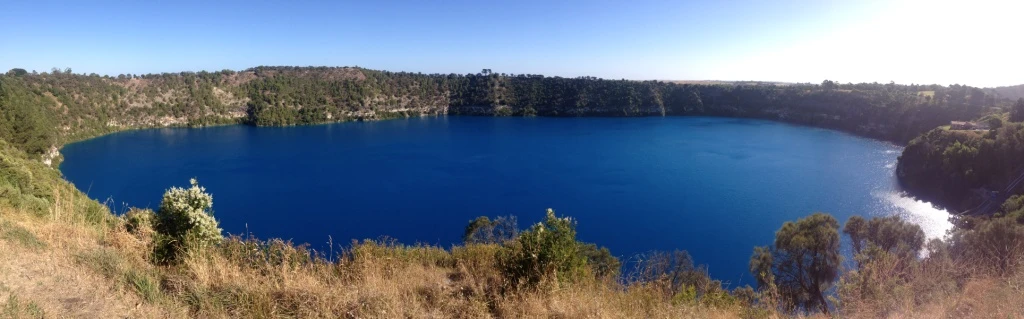
Leaving Port Fairy, we continued along the Great Ocean Road, passing the famous Nelson Lighthouse, and arrived at the first Big4 campground near the beautiful town of Mt. Gambier: Big 4 Blue Lake Holiday Park (Bay Road, Mount Gambier, 5290).
Highly recommend this campground. Surroundings: 5 (right next to the dreamlike Blue Lake); Facilities: 4 (beautiful campground, well-equipped public facilities, free shower); Price/Service: 4 (reasonable price: Cabin with kitchen, shower, toilet: $123 + Powered site: $40).
[2014/1/30 New Year's Eve Dinner @ Robe]
Leaving the dreamlike Blue Lake, we passed through the lobster-producing beach port, and stayed at BIG4 Robe Long Beach Holiday Park (70-80 Esplanade, Robe SA 5276, Australia).
Highly recommend this campground. Surroundings: 4 (next to the beach); Facilities: 4 (beautiful campground, well-equipped public facilities, free shower); Price/Service: 3 (Cabin with kitchen, shower, toilet: $149 + Powered site: $40).
The whole family prepared New Year's Eve dinner.
[2014/1/31 Adelaide]
Leaving Robe, we headed toward Adelaide. We took a break in a small town called Meningie to feed seagulls. Before entering Adelaide, we passed a salt flat area, presenting a completely different landscape, beginning several days of driving through salt flats. We checked into Big4 Adelaide Shores Holiday Parks (1 Military Road, West Beach SA 5024).
This was the only campground we stayed at for 3 nights. It was huge—over 400 powered sites and over 100 cabins—yet still fully booked. Since we couldn't get a cabin, we used the RV plus a tent. Fortunately, the temperature was around 40°C those days.
Recommend this campground. Surroundings: 4 (next to the beach, close to Adelaide); Facilities: 4 (beautiful campground, well-equipped public facilities, free shower); Price/Service: 4 (Powered site $85).
[2014/2/1 Adelaide Big4]
The local temperature reached 40°C, so we stayed in the camp and watched the Spring Festival Gala on iPad.
[2014/2/2 Kangaroo Island]
Although the temperature was still 41°C, we had to go to Kangaroo Island despite the heat.
Originally, we planned to join a one-day tour of Kangaroo Island with pickup and drop-off, but after seeing the price, we gave up and drove ourselves. We drove over 100 km to the ferry terminal. Lucky to arrive 5 minutes early, we caught the 10 AM ferry, taking both car and people to Kangaroo Island.
From the ferry terminal, we drove to Remarkable Rocks, Admirals Arch, Cape du Couedic Lighthouse, and other attractions. One way took over 2 hours. Since we hadn't seen any kangaroos yet, everyone hoped to see one on Kangaroo Island. Unfortunately, we looked in vain—no live kangaroos in sight. On both sides of the road, we saw one dead kangaroo after another hit by cars. We joked, "It seems there are no live kangaroos in Australia, only dead ones." History tells us that miracles often happen when you're about to give up. On the way back to the ferry, we first spotted a lone kangaroo by the roadside. We stopped and took photos like crazy, as if seeing a lover. History also tells us that miracles often come one after another. Just as we were immersed in the joy of finally seeing a live kangaroo, we saw a group of kangaroos in the grass a little further away. We stopped again, screamed, and took photos.
Later, we gradually realized that due to the heat, kangaroos only come out from sunset until the next morning.
[2014/2/3 Yorke Peninsula]
Leaving Adelaide with the joy of seeing kangaroos, we headed to Pt Victoria, a port town on the Yorke Peninsula. Along the way, we saw completely different scenery: endless golden grasslands on both sides of the road, occasionally dotted with cattle and sheep.
Originally, we planned to stay at a campground on the Yorke Peninsula, but to reduce the driving distance for the following days, we decided to drive a bit more and chose Blanchetown Riverside Holiday Park (Sanders Street, Blanchetown SA 5357), 200 km away. After checking in, we found that we were the only guests—we had the entire campground to ourselves. We were given a separate kitchen room and two separate shower/toilet facilities.
If you get a chance, try this campground. It's quiet, right by the Murray River. There are flocks of parrots in the trees and pelicans in the river. You'll definitely be woken up by bird calls in the morning. Surroundings: 4 (by the Murray River, like a bird park); Facilities: 4 (small campground, well-equipped public facilities, free shower); Price/Service: 4 (inland, so cheap: Powered site only $32, cabin discounted to $85).
[2014/2/3~6 Crossing the Southeastern Australian Interior]
Over 3 days, we drove 1,500 km crossing the interior of southeastern Australia (Yorke Peninsula > Blanchetown > Renmark (winery) > Mildura > Hay > Wagga Wagga > Canberra > Jervis Bay (beach, abalone digging) > Kiama). Originally, we didn't plan to go to Canberra, but during the drive, my son expressed a strong desire to see the "tiny" Australian capital, so we changed the route to detour through Canberra.
What we thought would be a monotonous 3-day long drive turned out to be full of surprises.
Surprise 1: The scenery changed constantly. There were salt flat landscapes, desolate as a no-man's land; endless golden grasslands similar to the Yorke Peninsula, like autumn; and often, large vineyards popping up between the salt flats and grasslands, like oases; from Canberra to Sydney, lush green trees, like summer.
Surprise 2: We saw various animals along the way. Besides the usual cattle and sheep, we unexpectedly saw many ostriches in the salt flat area; at the Canberra campground, we saw kangaroos entering the camp at night, and in the morning, groups of kangaroos grazing beside the camp.
Surprise 3: Abalone-covered eastern coast. After leaving Canberra and arriving at the eastern coast of Australia, we found the rocks on the beach covered with abalone.
Day 1 stayed at Hay Big4 (4 Nailor Street, Hay NSW 2711, 02 6993 1875, haybig4.com.au?).
Day 2 stayed at Canberra Carotel Motel & Caravan Park (150 Aspinall Street, Watson ACT 2602). Recommendation index: 4. Reason: kangaroos appear. Price was high due to proximity to Canberra.
Day 3 stayed at BIG4 Easts Beach Holiday Park (Ocean Street, Kiama NSW 2533, Australia). Recommendation index: 4. Reason: right by the beach, very large campground, well-equipped.
[2014/2/7~9 Heading to Sydney]
We finally headed toward our final destination, Sydney, passing through Wollongong (waves) > Coledale Beach (beach, waves, abalone digging) > Sydney.
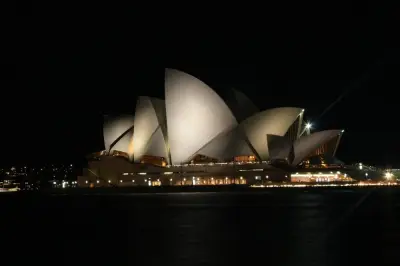
We checked into Medina Serviced Apartments Martin Place (1 Hosking Place, Sydney NSW 2000). If you come to Sydney and want to be close to major attractions while being able to cook your own meals, this hotel is for you. Located in the city center, it's within a 5–15 minute walk to all attractions (Sydney Opera House, Harbour Bridge, Royal Botanic Gardens, Government House, Hyde Park, museums). After dinner, you can stroll to admire the stunning Sydney Opera House and Harbour Bridge night views.
Day 1 walking route:
From hotel > Circular Quay > Sydney Opera House > Royal Botanic Gardens > Government House > Hyde Park > Back to hotel.
Day 2 walking route:
From hotel > Hyde Park > Australian Museum > St Mary's Cathedral > Art Gallery of New South Wales > Circular Quay > Manly Island (ferry) > Darling Harbour (ferry) > Sydney Tower Eye > Queen Victoria Building > Back to hotel.
If you have a child, don't miss Sydney's Sunday transport special: with one child, the whole family (regardless of number or identity—aunts, uncles, etc.) can buy an all-day transport pass for just $2.50 per person, unlimited travel on all ferries, buses, trains, etc. We happened to be there on a Sunday and used these tickets to take ferries to Manly Island and Darling Harbour.
[2014/2/10 Return to Beijing]
Returned to Beijing via Kuala Lumpur from Sydney.
Re-shared in May 2024 for more people to learn from.