Netherlands Travel: From Zundert to Rotterdam (Photos)
Our "World Puzzle: Spring Blossom Tour of Europe: Holland, Belgium, Luxembourg" trip, after successfully concluding our sightseeing in Belgium, began our return to the Netherlands to continue our new journey.
Antwerp Street View (Photo by Feng Ganyong)
On May 3, 2025, at 13:00, after having our last Chinese lunch in Belgium at the Anshi Guo Restaurant in downtown Antwerp, our driver Thanasis drove for nearly an hour from Belgium to the Van Gogh House in the small town of Zundert, located in the province of North Brabant, Netherlands.
Arriving in Zundert (Photo by Feng Ganyong)
Walking into the small town of Zundert where Van Gogh was born and grew up, it was quiet and ancient, as if time itself had slowed down. On both sides of the street were houses arranged in a pleasing disorder, most of them retaining the old Dutch architectural style—white walls paired with red sloping roofs, windowsills full of colorful flowers gently swaying in the breeze, as if telling the leisurely time of the town.
Group Photo at Van Gogh House (Photo by Cai Qi)
Strolling along the street, we soon found the Van Gogh House, a small red-and-white attached building full of historical charm. Entering the house, half of the first floor had been converted into a restaurant, with the aroma of delicious food filling the air.
Entering the Van Gogh House (Photo by Feng Ganyong)
Going up to the second floor of the Van Gogh House, there were exhibits introducing the Van Gogh family, as well as works created by later artists based on Van Gogh's life and art.
A Corner of the Exhibition Hall (Photo by Feng Ganyong)
Although there were no original works by Van Gogh here, the restored scenes and old furniture made it seem as if we could see pictures of Van Gogh's childhood life, hear his childhood laughter and dreams.
Town Hall (Photo by Feng Ganyong)
Leaving the Van Gogh House, looking straight ahead, a white building facing us was the Zundert Town Hall. Built in 1830, it has a strong neoclassical style, with a regular and symmetrical exterior, featuring classic elements such as column structures and triangular pediments.
Group Photo at Town Hall (Photo by Ma Manman)
The Town Hall is an important local administrative venue where local affairs are handled and public services are provided. Because this is also the birthplace of the painter Van Gogh, it has a certain cultural commemorative significance, and its surrounding environment carries rich local history and life memories.
Sculpture of the Van Gogh Brothers (Photo by Feng Ganyong)
Turning right out of the house and walking a short distance, we arrived at Van Gogh Square. Here stands a sculpture of Van Gogh and his brother Theo, standing side by side with their hands intertwined, their deep brotherly affection moving.
Church of Van Gogh's Father (Photo by Wang Jue)
Not far away was the church where Van Gogh's father once preached, a scene that appears repeatedly in Van Gogh's early paintings. The interior of the church was simple, with the words "Built in 1805" engraved above the pulpit.
Group Photo in Front of Van Gogh Statue (Photo by Cai Qi)
In the churchyard, there was the tombstone of Van Gogh's stillborn brother. After all these years, someone still brings flowers, as if telling a story that spans time and space.
Street Sculpture in Town (Photo by Wang Jue)
Strolling along the field paths Van Gogh walked as a child, golden wheat fields undulated in the breeze, windmills slowly turned in the distance—wasn't this exactly the world in Van Gogh's paintings? People wandered here as if transported back to his time, feeling the beauty of nature and the power of life alongside him.
Zundert Street View (Photo by Feng Ganyong)
The trip to Zundert gave us a deeper understanding of Van Gogh's childhood and growth, and made me realize that his artistic inspiration came from this land, this small town, and his experiences. Everything here became the eternal themes of his paintings, and also allowed everyone who came here to resonate deeply with the great artist.
Arriving at Kinderdijk (Photo by Feng Ganyong)
At 14:35 that day, the Europe: Holland, Belgium, Luxembourg team drove from the Van Gogh House in Zundert to the second stop of the day: Kinderdijk, known as the "hometown of Dutch windmills," for exploration and sightseeing. As soon as we entered the windmill village scenic area, we saw the "Kinderdijk" statue lying quietly in the water.
Overlooking a Corner of Kinderdijk (Photo by Wang Jue)
Following the sightseeing boardwalk over the water into the small village of Kinderdijk, a gentle breeze brushed by, carrying traces of moisture and the fragrance of earth, as if telling ancient stories.
Group Photo at Windmill Village (Photo by Feng Ganyong)
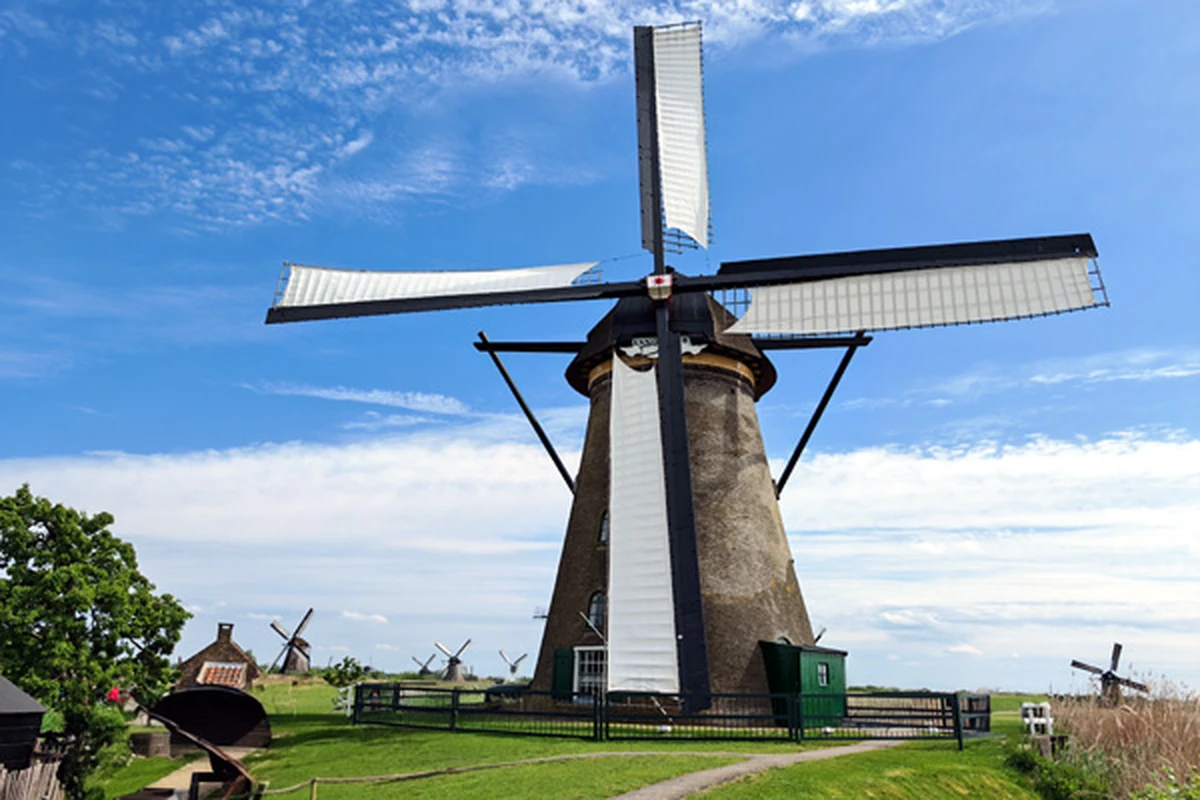
Looking into the distance, on the vast plain, windmills stood in scattered order, their white blades appearing particularly pure and elegant against the blue sky and white clouds.
Windmill Village Landscape (Photo by Feng Ganyong)
They were like giants stepping out of a fairy tale, quiet and dignified, each rotation seeming to pluck the strings of time, playing touching pastoral melodies.
Inside a Large Windmill (Photo by Feng Ganyong)
Entering a large windmill that was turning, I couldn't help but marvel at its exquisite structure. Huge blades connected complex gear mechanisms, still well-preserved despite the years. Inside there was also the windmill keeper's living quarters; the interior space was quite large.
Close-up of a Large Windmill (Photo by Feng Ganyong)
Ma Manman explained that these windmills were not only used for drainage, keeping the land from being flooded by the sea, but also for grinding grain and pressing oil, serving as capable helpers for the Dutch in their life and work. Nowadays, although most of them no longer bear heavy labor, they have become symbols of Dutch culture, attracting visitors from around the world to explore their secrets.
Boat Tour of Windmill Village (Photo by Feng Ganyong)
We strolled along country paths, with a yellow-and-green pastoral landscape on both sides. It is said that if you come at the right season, you can see colorful tulip fields: red like fire, pink like sunset clouds, white like snow. They complemented the windmills in the distance, forming a beautiful pastoral picture.
Windmill Amid Reeds (Photo by Feng Ganyong)
Roaming here, it felt like being in a Monet painting, intoxicated by the endless beauty of flower fields and windmills intertwined, unable to tear ourselves away. Occasionally, a few butterflies danced among the flowers, adding a touch of liveliness and vitality to this peaceful land.
A Corner of Village Architecture (Photo by Feng Ganyong)
Besides windmills and flower fields, the rural architecture of Kinderdijk was also unique. Traditional Dutch cottages with pointed roofs, colorful walls, and delicate flowerpots on the windowsills filled with blooming flowers.
Capturing Beautiful Moments (Photo by Feng Ganyong)
In front of and behind the houses, there were either cattle and sheep leisurely grazing or old bicycles parked, every place exuding a strong sense of life. Here, time seemed to slow down, making one involuntarily forget the hustle and bustle of the city and immerse in this peace and tranquility.
Looking Back Again and Again (Photo by Feng Ganyong)
The trip to Kinderdijk truly made me feel the unique charm of the windmill homeland. Every blade of grass, every brick and tile here carried the history and culture of the Netherlands, making it hard to leave. As I left, I looked back frequently, silently making a wish in my heart that someday I could set foot on this magical land again and continue my unbreakable bond with the windmills.
A Corner of Rotterdam Streets (Photo by Feng Ganyong)
At 17:00 that day, the Europe: Holland, Belgium, Luxembourg team left Kinderdijk Windmill Village and, after about an hour's drive, finally arrived at the day's destination: the SAVOY Hotel in Rotterdam, Netherlands. Since it was still early, everyone put down their luggage and, led by Ma Manman, started sightseeing in Rotterdam. It can be said that Rotterdam is a Dutch pearl where tradition and modernity intertwine. We visited unique attractions such as the Cube Houses and the Markthal.
Cube Houses (Photo by Feng Ganyong)
One of the most iconic buildings in Rotterdam is the Cube Houses. Designed by the famous Dutch architect Piet Blom, these houses look like giant Rubik's cubes carefully placed, standing at a unique 45-degree angle on hexagonal pillars.
Group Photo at Cube Houses (Photo by Cai Qi)
Construction began in 1982 and was completed in 1984; they are a perfect combination of architectural art and imagination. Entering one of the Cube Houses open to the public, the interior space was ingeniously arranged, and the unique perspective offered a new way of looking at the world around us. Standing by the window, looking down at the bustling traffic below, it felt as if we were in a strange three-dimensional world.
A Corner of the Old Port (Photo by Feng Ganyong)
Leaving the Cube Houses, we strolled to the Old Port. This place was full of historical charm, with all kinds of boats moored along the shore. In the distance, the red bridge spanned both sides, complementing the surrounding buildings and forming a beautiful picture. Walking along the river, we saw the red Swan Bridge, the Erasmus Bridge.
View of the Erasmus Bridge (Photo by Feng Ganyong)
This bridge has an elegant shape, like a graceful swan about to take flight, or like a huge harp lying quietly on the River Meuse, connecting the north and south banks of Rotterdam. It is not only a transportation hub but also an outstanding work of art. Nearby there was also the unique Pencil Building.
Pencil Building (Photo by Feng Ganyong)
The cuisine of Rotterdam undoubtedly left a deep impression. In the beautiful Markthal with its colorful roof, a variety of authentic Dutch delicacies were gathered. Just in the evening, we also enjoyed a delicious grilled herring dinner at the APARTT Western Restaurant in Rotterdam.
Entering the Markthal (Photo by Feng Ganyong)
Inside the Markthal, it was bustling with activity. Stalls were filled with fresh ingredients, local snacks, and delicate pastries. Visitors could try traditional Dutch raw herring, served with onions and pickles, its unique taste lingering; also the sweet Dutch pancakes with various fruits and syrups, each bite full of sweet flavor.
Tempting Food (Photo by Feng Ganyong)
Rotterdam has both the visual impact of modern architecture and profound historical and cultural heritage; it has both beautiful natural scenery and a rich variety of food. Rotterdam is like a treasure full of surprises, captivating everyone. (Text & Photos: Feng Ganyong)