Shaanxi Travelogue: A Red Journey and a Food Lover's City
At just past 7 a.m., the city of Yan'an was still quiet. The guide told us that work usually starts at 8 or 9 here!!
The Yan'an Revolutionary Memorial Hall is located on the east bank of the Yanhe River in the northwest of Baota District, 1 km from the city. It was first built in January 1950 at the former Nanguan Reception Office, making it one of the earliest revolutionary memorial halls established after the founding of the People's Republic of China. In 1954, it was relocated to the former site of the Central Committee of the Communist Party of China in Yangjialing and named 'Yan'an Museum.' In 1955, it moved to the revolutionary site at the foot of Fenghuang Mountain in the city and was renamed 'Yan'an Revolutionary Memorial Hall.' In June 1973, it moved to its current location in Wangjiaping. Above the main entrance hangs a red plaque inscribed with the hall's name by Guo Moruo during his visit to Yan'an in 1971.
After visiting the memorial hall, we went to Zaoyuan (Date Garden)!
Zaoyuan, also known as 'Yanyuan,' was originally the estate of the northern Shaanxi warlord Gao Shuangcheng. During the Land Revolution, it was taken over by the people. After the Central Committee of the Communist Party came to Yan'an, construction began in 1941 and was completed in 1943. More than twenty cave dwellings, over eighty tiled one-story houses, and an auditorium were built. In 1943, Mao Zedong, Zhang Wentian, Liu Shaoqi and others moved to Zaoyuan, and it became the seat of the Secretariat of the CPC Central Committee.
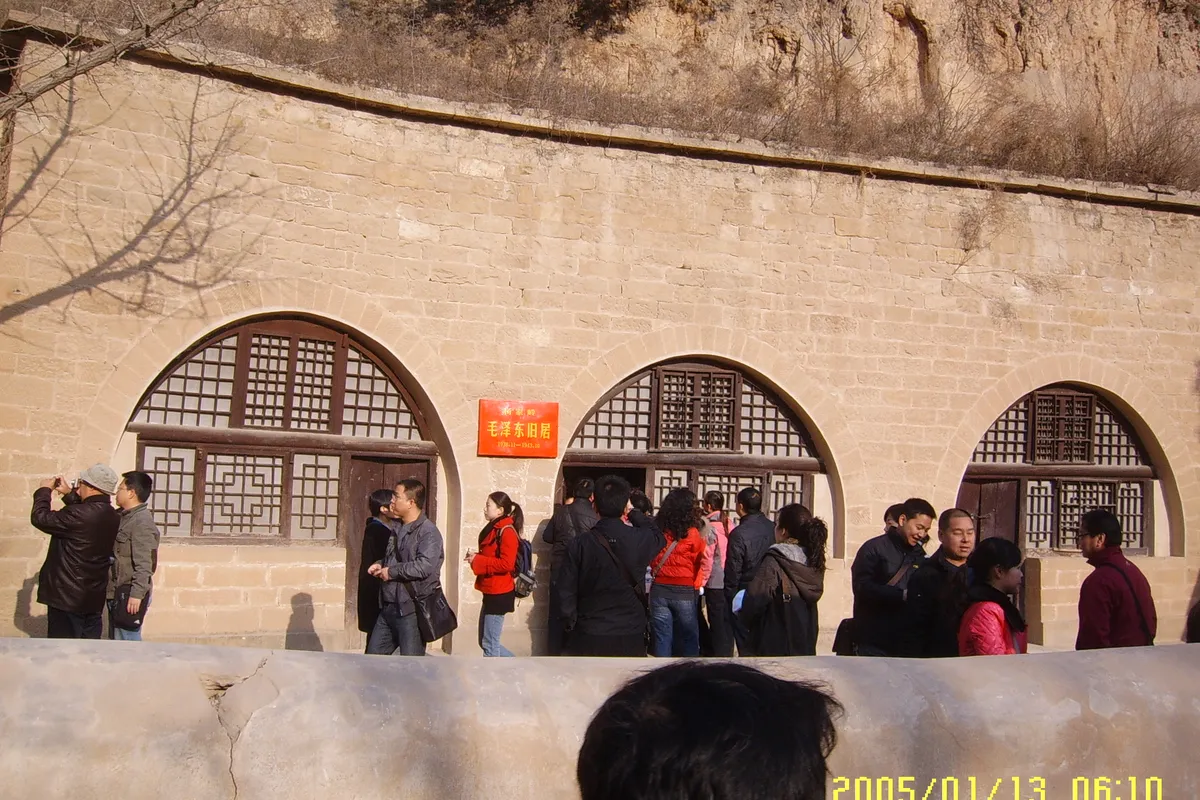
The Yangjialing Revolutionary Site is the former headquarters of the CPC Central Committee, located 2 km northwest of Yan'an. From November 1938 to March 1947, Mao Zedong and other central leaders, along with the CPC Central Committee organs, lived here. During this period, the Central Committee continued to direct the war of resistance against Japan behind enemy lines, led the War of Liberation, launched the Great Production Campaign and the Rectification Movement, and convened the 7th Party Congress and the Yan'an Forum on Literature and Art. The Central Auditorium was built here in 1942, and from April 23 to June 21, 1945, the 7th National Congress of the Communist Party was solemnly held in it.
That afternoon, after visiting the Yangjialing Revolutionary Site, we drove to Hukou Waterfall and spent the night at a hotel by the waterfall. Originally we were supposed to stay at the Hukou Waterfall Hotel, but due to ice floods in February, ice chunks from the Yellow River swept onto the second floor, smashing the windows—it was still under repair!
The next morning, we visited Hukou Waterfall, then drove to Xi'an, stopping at the Mausoleum of the Yellow Emperor along the way!!
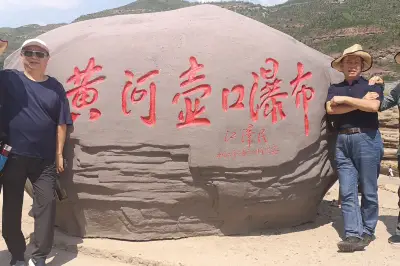
Hukou Waterfall is a famous waterfall on China's Yellow River, and its surging momentum symbolizes the spirit of the Chinese nation. It lies in the Yellow River bed in the Jin-Shaanxi Gorge, 35 km east of Yichuan County and 45 km west of Ji County. It is now the world's largest yellow waterfall and widely celebrated for its overwhelming power. It faces Hukou Town in Ji County, Linfen City, Shanxi Province to the east, and Hukou Township in Yichuan County, Yan'an City, Shaanxi Province to the west.
The Mausoleum of the Yellow Emperor is the tomb of the legendary ancestor of the Chinese nation, Xuanyuan Huangdi, and is known as China's No.1 Mausoleum. It lies atop Qiao Mountain, 1 km north of Huangling County seat, and is a key national cultural protection site and a popular pilgrimage destination. The Yellow Emperor was a great tribal chief at the end of China's primitive society. His surname was Gongsun, but because he grew up beside the Ji River, he also went by the surname Ji. He once lived on Xuanyuan Hill (now Xinzheng County, Henan Province), hence the name Xuanyuan. His ancestral clan was the Youxiong tribe, so he was also called Youxiong. As he venerated the virtue of earth, and earth is yellow, he became known as the Yellow Emperor. He was born in Shouqiu, Shandong, passed away in Jingshan, Henan, and was buried on Qiao Mountain, Shaanxi. The Yellow Emperor is remembered in history for first unifying the Chinese nation. He cultivated grains and plants, promoted production, created writing, invented clothing, built boats and carts, developed the south-pointing chariot, established mathematics, composed music, and founded medicine, making him the forefather who initiated the ancient civilization of the Chinese nation.
After visiting the Mausoleum, we continued driving to Xi'an, passing by Nanniwan on the way—the very place where the 359th Brigade reclaimed wasteland during the Great Production Campaign!! That night we stayed in Xi'an!
Huaqing Pool, also known as Huaqing Palace, is famous worldwide for its 3,000-year history as a royal garden and 6,000 years of hot spring use. Located at the northern foot of Lishan Mountain in Lintong District, Xi'an, 30 km east of the city proper, it faces the Wei River to the north and leans against Lishan to the south. This ancient Chinese detached palace is renowned for its hot spring baths. Rulers of the Zhou, Qin, Han, Sui, and Tang dynasties all regarded this auspicious site as a pleasure resort, and it is especially celebrated for the love story of Emperor Xuanzong of Tang and his consort Yang Guifei.
It was a bit cloudy and hazy. Huaqing Pool is where Yang Guifei and Emperor Xuanzong of Tang took their baths. There's also a statue of Yang Guifei—her figure was quite plump!
After visiting Huaqing Pool, we headed straight for the Terracotta Warriors of Qin Shi Huang!
Located in Lintong District, Xi'an, about 35 km from the city center, they form part of the mausoleum of Qin Shi Huang (Ying Zheng). In 1987, it was inscribed on the World Cultural Heritage list. The mausoleum complex took 37 years from the emperor's accession to his death, and 38 years in total to complete. The tomb is on a grand scale and majestic, with inner and outer city walls, the southern part being the core. The inner city is square, with a perimeter of 2,525.4 meters; the outer city is rectangular, with a perimeter of 6,294 meters. The burial mound today is a square pyramid, with a base 515 meters north-south and 485 meters east-west, and a height of 55 meters. The entire necropolis covers 2.18 million square meters and includes large-scale palace-style structures.
After visiting the Terracotta Warriors, we set off for Mount Hua!! That night we stayed at the Jianghu Inn at the foot of the mountain!!
Early morning brought a drizzly rain, making our climb uncertain. For safety, we took the cable car up and down, only venturing to the North Peak—the very spot where 'Sword Contest on Mount Hua' took place!!
Mount Hua, one of China's famous Five Great Mountains, rises 2,154.9 meters above sea level. It lies within Huayin City, 120 km east of Xi'an in Shaanxi Province. To its north stretches the vast Weihe Plain and the roaring Yellow River, while to the south it leans against the Qinling Mountains. It is a granite mountain on the northern side of a branch ridge of the Qinling. Dressed in nature's ever-changing mists and clouds, Mount Hua's myriad forms are vividly painted, creating a national 5A-level tourist attraction.
We spent two hours going up and down Mount Hua without lingering, grabbed a meal, and then headed back to Xi'an city proper!!
The Giant Wild Goose Pagoda is a famous scenic spot in Xi'an. Built in the third year of Yonghui (652 AD) of the Tang Dynasty by Xuanzang to store Buddhist scriptures, it is a seven-storey structure 64.5 meters tall. It is regarded as a symbol of the ancient capital. On January 17, 2011, the Giant Wild Goose Pagoda–Tang Paradise scenic area was officially recognized as a national 5A-level tourist attraction.
In the afternoon, after strolling around the Giant Wild Goose Pagoda Square, we didn't even visit the Daci'en Temple and went straight back to the hotel!
The Xi'an Circumvallation (city wall) is located in the center of Xi'an. Rectangular in shape, it stands 12 meters high, 18 meters wide at the base and 15 meters at the top, with a total perimeter of 13.74 km. There are four main city gates: Changle Gate in the east, Anding Gate in the west, Yongning Gate in the south, and Anyuan Gate in the north. As of 2004, Xi'an's city wall had 18 gates. Listed clockwise from the north: Shangwu Gate, Anyuan Gate, Shangde Gate, Jiefang Gate, Shangjian Gate, Shangqin Gate, Chaoyang Gate, Zhongshan Gate, Changle Gate, Jianguo Gate, Heping Gate, Wenchang Gate, Yongning Gate, Zhuque Gate, Wumu Gate, Hanguang Gate, Anding Gate, and Yuxiang Gate.
The city wall is very well preserved, and you can tour it or cycle on top.
With the revolutionary tour basically completed, it was time to dive into a world of food! In Xi'an, that meant the famous Drum Tower Snack Street. We had the whole morning to wander and indulge.
After half a day exploring the snack street, it was time to head home. We flew back from Xianyang Airport. From the moment the guide said we'd entered the airport grounds until the bus reached the terminal, it took nearly half an hour—that's how vast the place is!!