Xi'an: A Millennia-Old City That Keeps Going Viral
Across the 800-li Qinchuan Plain, dust swirls; thirty million Shaanxi locals belt out Qinqiang opera. Ever since the Qin Dynasty established its capital at Fengjing and Haojing, Xi'an has always been a red-hot internet sensation city. The rich historical and cultural heritage of an ancient capital for 13 dynasties makes Xi'an a must-visit ancient city for countless people.
In 2014, I passed through Xi'an and stopped for just one day. Six years later, Xi'an, with its bowl-smashing wine and the tumbler lady, has gone viral online once again. Chang'an was the cherished dream of Tang Dynasty people; Xi'an is the Chang'an dream of modern people!
Here lies the over 6,000-year-old Yangshao culture at Banpo.
Here stand the breathtaking Terracotta Warriors of the Qin Dynasty.
Here is the profound Han Dynasty cultural heritage.
Here is the prosperity of the flourishing Tang Dynasty.
Here is the grand magnificence of the Ming Dynasty city wall.
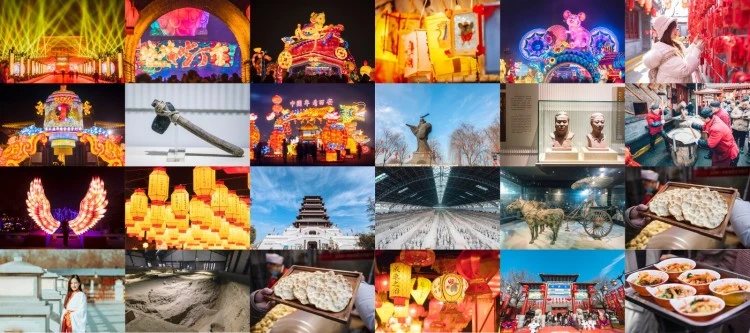
Here, nestled by mountains and rivers, the ancient city hosts dazzling lantern festivals.
Here is the brilliantly lit Grand Tang Dynasty Ever-Bright City.
Here are three days' worth of endless Shaanxi cuisine.
Here are the must-try bowl-smashing wine and the popular tumbler lady.
You can reach Xi'an by high-speed train or plane. Railway stations: Xi'an has three railway stations: Xi'an Station, Xi'an South Station, and Xi'an North Station. Xi'an Station is the main station; all trains originating from or passing through Xi'an (from Wuhan: Wuhan/Wuchang/Hankou) currently stop at Xi'an Station. Xi'an North Station serves Zhengzhou-Xi'an high-speed trains. Xi'an South Station is for some Xi'an-Kangming railway trains. Airport: Xi'an Xianyang International Airport is quite far from the city center, about 30 km from the Bell Tower. From the airport, you can take the airport bus or the intercity metro.
Day 1: Suzhou to Xi'an, evening Xi'an City Wall Spring Festival Lantern Show. Day 2: Morning: Banpo Museum; afternoon: Terracotta Warriors Museum; evening: Huaqing Palace Tang Palace Lantern Show. Day 3: Morning: Hancheng Lake Park; noon: Yongxingfang; afternoon: Bell and Drum Towers; evening: Tang Paradise and Grand Tang Dynasty Ever-Bright City.
I arrived at my hotel in Xi'an from Suzhou around 2 o'clock. After a short rest, I headed to the Xi'an City Wall scenic area to enjoy the Spring Festival Lantern Show as the lights were just beginning to glow.
Compared with the Ming city wall in Nanjing, Xi'an's wall is smaller in scale but retains its complete structure, with well-preserved gate towers and arrow towers. The Xi'an Ming city wall is the largest and best-preserved ancient city wall in existence.
Walking around the wall takes about 3-4 hours; you can also rent a bike or fly kites on top. The wall has many watchtowers and arrow towers, most of which are fairly complete.
Xi'an's city wall retains all four of its barbicans, grand in scale and exquisite in architecture. The West Gate, East Gate, and South Gate towers are all surviving Ming Dynasty wooden structures, and the arrow towers at the east, west, and north gates are well preserved. The Anding Gate tower and arrow tower are particularly outstanding, with Ming Dynasty painted carvings still clearly visible on the wooden beams.
[ South Gate – Yongning Gate ] It is recommended to ascend from the South Gate, as it is a short walk from the Bell Tower. The southern wall offers many sights: the Forest of Steles, Shuyuanmen, and Xiamaling are all near Duanlümen on the south wall, and there is a museum inside the Hanguangmen section.
At the South Gate (Yongning Gate), there are three performances: 'Dream of Chang'an – Grand Tang Welcome Ceremony,' warriors on patrol, and a warrior changing-of-the-guard ceremony. The South Gate and city wall host lantern festivals during Spring Festival and the Lantern Festival.
[ North Gate – Dingyuan Gate ] The North Gate of Xi'an's city wall is Anyuan Gate, built during the Ming Dynasty. Located on the north-south central axis, it is the most iconic gate on the northern wall. Dating back to the Tang Dynasty, it was the main gate for welcoming guests, known as the 'First Gate of the Ancient City.'
[ East Gate – Changle Gate ] Changle Gate, the main eastern gate, is slightly south of the center of the eastern wall. It was built between the 7th and 11th years of the Hongwu reign (1374-1378) during the expansion of Xi'an's city. It has survived through the Qing Dynasty and the Republic of China era. Today, it retains its barbican, arrow tower, main tower, and dual gate arches.
[ West Gate – Anding Gate ] The site of Anding Gate was originally Shunyi Gate, the central western gate of the Sui-Tang imperial city. It was retained when Han Jian rebuilt the city at the end of the Tang Dynasty. During the expansion of Xi'an's city from 1374 to 1378, it was kept as the West Gate and renamed Anding Gate. Today, it has its barbican, arrow tower, main tower, and dual gate arches.
On both sides of the gate, three archways have been opened for vehicle and pedestrian traffic. At Wenchang Gate, there is a Kuixing Tower on the wall. Inside Wenchang Gate is the Forest of Steles, and inside Zhongshan Gate (Little East Gate) is Yongxingfang, home to the internet-famous bowl-smashing wine. The street inside Zhongshan Gate is called Dongxin Street, also a food street!
As depicted in 'The Longest Day in Chang'an,' the liveliest time in the Tang Dynasty capital was the Lantern Festival. Moonlight and lanterns filled the imperial city, with fragrant carriages crowding the streets. According to 'New Accounts of the Tang Dynasty,' during the Lantern Festival, the city would display countless lanterns, and the night curfew was lifted for three days, making the entire city as bright as day, with everyone celebrating together and the streets packed with people.
With fiery trees and silver flowers, the star bridges unlock their gates. Dust follows the horses, the bright moon chases the people. The singing girls are as lovely as plums, and their songs are filled with falling plum blossoms. The imperial guards do not enforce the curfew, so let the jade clock not hurry the night. Xi'an's lantern show is the most magnificent I have ever seen: vast in number, extensive in area, diverse in style, rich in culture, and innovative in technology. It seems to draw the efforts of the whole city, skillfully blending the sceneries of the city wall, Mount Li, Qujiang Pond, and market streets to recreate the brilliant Tang Dynasty at its peak, making it a modern-day Chang'an that never sleeps.
The oldest Spring Festival Lantern Show in Xi'an is probably the one on the city wall. It has been held for over thirty years, becoming a childhood memory for one or two generations of Xi'an people.
This year's 33rd Spring Festival Lantern Show, in the Year of the Rat, still centers on Yongning Gate, the South Gate of the city wall. Yongning Gate is the only remaining gate with a portcullis tower, and the lantern square in front of the gate sparkles with starlight and brilliant pillars.
Five themed zones—Prosperous Chang'an, Joyful Wishes, Splendid China, Dreamy Childhood, and Glowing Past and Present—illuminate the entire South Wall area with dazzling lanterns.
Passing through the portcullis tower and into the Moon City, the radiant 'Flying Apsaras and Music' lantern ensemble merges with the majestic gate tower. Several apsaras-like figures, as if having traveled from Dunhuang, have flowing robes, and colorful lotus flowers bloom in layers, reviving the splendor of the Silk Road.
Climbing onto the wall, on both sides of the enceinte are two 'Wishing Lantern Corridors' hung with palace lanterns, where visitors stop to take photos.
Walking eastward along the wall, the lanterns vividly display the fantasies of the 'City Wall Baby' about Chang'an: galloping horses charge forward, luxurious silk ribbons seem to flutter in the wind, and people play polo surrounded by thousands of lights, presenting a magnificent scene of prosperous Chang'an.
A giant 'Prosperity Ding'—made from 150,000 colorful small glass bottles—is grand and splendid, bursting with a vibrant scene of myriad colors and glimmering gold.
Lotus patterns express good wishes, peony blooms are so beautiful they could captivate a kingdom. The brilliant lights add vitality to the ancient city, with spring in the air bursting into prosperity. Look at the colorful clouds, listen to the sound of flowers blooming—symbolizing the accumulated radiance of the ancient city, blossoming splendidly across the Chinese land.
Walking west of the enceinte, you enter a fairy-tale land where butterflies and bees dance. Based on mushroom, little warrior, and animal shapes, cheerful cartoon figures in various poses exude charming appeal.
Cute Shuke and Beita instantly bring back childhood memories.
The 'Myriad Lights of Home' theme features lanterns and riddles for the Year of the Rat.
The lantern feast atop the wall has a unique charm: rows of lanterns light up the city's edges, the brilliant lights complement the majestic gate and arrow towers, and the blue bricks and curved tiles tell ancient tales in the night.
Ramada Plaza Xi'an Qujiang
Accommodation in Xi'an is relatively affordable. You can stay in guesthouses near the Bell and Drum Towers—cheap but don't expect too much in terms of conditions. This time we chose the Ramada Hotel near the most developed southern suburb of Xi'an.
As a star-rated hotel under the Accor group, it ensured a good stay.
The room was spacious, and the central air conditioning was powerful.
Ramada Plaza Xi'an Qujiang
Ramada Plaza Xi'an Qujiang
The desk by the window is suitable for business travelers.
Ramada Plaza Xi'an Qujiang
The unique bathroom design adds depth and spaciousness to the room.
Ramada Plaza Xi'an Qujiang
Ramada Plaza Xi'an Qujiang
Ramada Plaza Xi'an Qujiang
Ramada Plaza Xi'an Qujiang
Ramada Plaza Xi'an Qujiang
Ramada Plaza Xi'an Qujiang
The buffet on the first floor was excellent, with elegant decor and clever space division that added privacy.
Ramada Plaza Xi'an Qujiang
Ramada Plaza Xi'an Qujiang
Ramada Plaza Xi'an Qujiang
Ramada Plaza Xi'an Qujiang
Ramada Plaza Xi'an Qujiang
It offers breakfast, lunch, and dinner with a rich variety of cuisines—Chinese, Western, Japanese, and local Xi'an dishes—all tasty and fresh.
Ramada Plaza Xi'an Qujiang
Ramada Plaza Xi'an Qujiang
Ramada Plaza Xi'an Qujiang
Ramada Plaza Xi'an Qujiang
Ramada Plaza Xi'an Qujiang
Ramada Plaza Xi'an Qujiang
Ramada Plaza Xi'an Qujiang
Ramada Plaza Xi'an Qujiang
Ramada Plaza Xi'an Qujiang
Day 2: Banpo Museum
As an ancient capital of 13 dynasties, Xi'an has over 200 museums. Besides the Shaanxi History Museum, some niche ones are also worth seeing. Shaanxi Province has nine national first-class museums, six of which are in Xi'an: the Shaanxi History Museum, the Emperor Qinshihuang's Mausoleum Site Museum, the Xi'an Beilin Museum, the Xi'an Museum, the Xi'an Banpo Museum, and the Xi'an Datang Xishi Museum.
Banpo Museum is one of them, based on the Banpo site. Located north of Banpo Village in a city suburb, it is a relatively complete relic of the Yellow River Basin. The existing area is about 50,000 square meters, divided into residential, pottery-making, and burial areas. You can get a feel for primitive life.
6,000 years ago, it was a matrilineal clan village. Men worked in their own clans during the day and went to the women's homes at night, leaving after children were born. People knew only their mother, not their father. Women led society, and the dead were buried with members of the same sex.
[ Hall – Unearthed Relics Exhibition ] The exhibition comprises two rooms displaying production tools and daily items excavated from the site.
It mainly showcases tools, utensils, and artworks used by primitive people from the Banpo and Jiangzhai sites, including stone, bone, and pottery artifacts.
Between the two exhibition halls is a large semi-circular area recreating scenes of Banpo primitive life.
The treasure of the Banpo Museum is the Human-Face and Fish Design Basin. It is 16.5 cm high with a diameter of 39.5 cm. On its inner wall are painted two symmetrical human faces and two fish patterns. It was found in the residential area of the Banpo site. The meaning of the design and the purpose of the basin remain unknown. Its unique mystery makes it the most artistically valuable painted pottery design.
The small-mouthed, pointed-bottom bottle is the most typical artifact of the Banpo culture, found in large numbers at the site. Opinions about its use also vary.
Many colorful pottery pieces from the Banpo site feature simple, ancient painted designs, including zoomorphic and geometric patterns, often symmetrical, reflecting their aesthetic in painted pottery culture.
Nail-impressed red pottery pot & bird-and-fish painted pottery gourd-shaped vase.
[ Hall – Banpo Site Hall ] Exiting the display hall, you enter the Site Hall. The four characters 'Ban Po Yi Zhi' were inscribed by Guo Moruo back then, but no one knows why he used the character for 'toe' instead of the usual one for 'site.'
Early houses were semi-subterranean, half underground, with pit walls serving as walls and a roof over the exposed half. Such houses were low and damp.
The site also contains a large ditch over 300 meters long, about 5 meters deep, and 6 meters wide—a defensive fortification to protect the village from invasions by other tribes and surprise attacks by wild animals.
In the late Neolithic period, they built walls on the ground and used wooden pillars to support the roofs. This upright wall and sloping roof formed the basic pattern of traditional Chinese architecture later on—a remarkable achievement at the time.
A communal cemetery is also visible. Some graves had burial jars, covered by pottery basins with a small hole in the middle. The dead were placed inside the jars, and the hole was believed to allow the soul to come and go.
[ Garden – Study Experience ] Behind the site hall, there is a garden with many peonies and an educational experience area where instructors guide visitors in primitive ways of life, such as making fire by drilling wood and drilling holes in stone tools.
Banpo Museum
True Love Li Mountain—Da Qin Xiao Yan
After visiting Banpo Museum, we drove to Lintong District to explore Qin culture. At noon, we checked out 'Da Qin Xiao Yan' near the Terracotta Warriors, a restaurant specializing in a Qin-themed banquet. Legend says that the father-and-son generals Wang Jian helped the King of Qin defeat the six states, were honored, and often invited to share imperial feasts. Grateful, they named the delicacies 'Da Qin Xiao Yan' (Grand Qin Little Banquet).
Dressed in Qin costumes, with drum and zither music, we tasted pre-Qin specialties in a classical banquet hall.
True Love Li Mountain—Da Qin Xiao Yan
The themed banquet can be served individually, just as in the Qin style, with everyone facing each other. The tableware is Qin-style. The pre-meal rice wine is especially good, and you can enjoy Lintong's famous pomegranates and stone bread.
Wang Jian's grilled fish, Lian Po's meatballs, Haojing mixed soup, Qin palace date cake, Penglai golden melon... Every dish in the themed banquet has a story. Before each dish is served, a waiter in Qin attire explains the tale behind it.
True Love Li Mountain—Da Qin Xiao Yan
Roujiamo (meat in bread), Chencang Qiaoqiao, and mashu (cat-ear noodles)... authentic local snacks are, of course, also included.
After the meal, you can stamp the menu with the imperial seal reading 'Mandate of Heaven, Longevity and Prosperity' to take home as a souvenir—a ritual-filled touch.
True Love Li Mountain—Da Qin Xiao Yan
Terracotta Warriors Museum
In the 13-dynasty ancient capital Xi'an, if you want to trace Qin culture, the Terracotta Warriors are a must-see. They are in Lintong District, the farthest scenic spot from downtown Xi'an, reachable by direct bus from the Xi'an railway station.
During the Warring States period, after unifying the six states, King Ying Zheng of Qin made Xianyang the capital and chose the green Lishan Mountain in Lintong for his mausoleum. He employed 720,000 laborers and took nearly 39 years to complete the 56-square-kilometer site. With mountains behind and rivers ahead, and with Lantian jade on one side and Tongguan gold on the other, it is said to be a feng shui treasure: 'head resting on a mountain, feet on a river, generation after generation of high officials; one hand grasping gold, the other jade, a perfect golden and jade match.' The First Emperor was entombed here for its auspicious name. The Terracotta Warriors Museum includes two sections: the museum and the Mausoleum of the First Qin Emperor, 1.5 km apart. One ticket covers both and the shuttle bus in between.
Because of the huge crowds, a new entrance was built later. After check-in, you can walk or take a battery car to the original gate.
Passing through a landscaped park, you reach the original main gate, a perfect photo spot. There's a folk saying about the museum: 'Turn your life around don't forget the Party, get rich all thanks to Qin Shihuang,' with a horizontal scroll: 'Thanks to Old Yang.' This is because the warriors were discovered by a farmer surnamed Yang while digging a well.
Currently, the museum has excavated four pits and a bronze chariot exhibition hall. The fourth pit had no warriors and was backfilled. Some say it was a workshop for making warriors; others say it was left unfinished.
In 1978, Paris Mayor Jacques Chirac exclaimed after seeing Pit 1, 'The eighth wonder of the world!' By incomplete count, millions of foreign visitors come each year; if they held hands, they'd circle the Great Wall. Rumor has it a German exchange student once cosplayed as a warrior and jumped into the pit without being spotted by staff.
Pit 1 is the earliest and largest excavated pit. Upon entering the hall, the view opens up to towering, stern-faced terracotta warriors. The entrance is the best viewing spot, but now visitors are not allowed into the pit, so unfortunately you can't get close to these lifelike figures.
The formation in Pit 1 consists of vanguard, main body, flanks, and rear guard. Full excavation could yield over 6,000 warriors and horses, each life-sized. The warriors wear armor or battle robes and look majestic, while the horses seem to be neighing and ready to charge.
Terracotta Warriors Museum
Renowned for their unique craftsmanship and imposing array, the Terracotta Warriors are called the eighth wonder of the world. Over 8,000 have been unearthed, each with a different face; they average 1.8 meters tall and were handmade using the coil method. In the Qin Dynasty, the system of 'inscribing the maker's name on objects' was in place.
Every warrior originally had painted colors. It's said that among the pigments is a mysterious one called 'Han purple,' one of the earliest synthetic colors known (the other being Egyptian blue from the same era).
Terracotta Warriors Museum
The rear of the pit is a restoration area. The museum restores while exhibiting, and on workdays you can still see staff excavating and restoring.
Terracotta Warriors Museum
Here you can observe newly restored warriors up close.
Terracotta Warriors Museum
Rows of broken pottery figures and horses quietly await staff to restore their former glory.
Terracotta Warriors Museum
Hall 2 displays the Emperor's special force—the cavalry formation. Neatly arrayed, four horses per row, with cavalrymen standing to the left front, tall and imposing. The formation is more complex and complete, the most spectacular of the three pits.
The museum's 'crown jewel' is this kneeling archer, with clear garment folds and hair strands. It is the most intact and the only one un-restored. Its good condition is attributed to its low posture, which helped it survive the collapse.
Pit 3 is the smallest, consisting of side chambers and a chariot room containing a four-horse chariot and four warriors. In total, 68 figures can be excavated here.
Its layout indicates it was the command center for Pits 1 and 2. It is the only pit not burned by a great fire, so the figures retained more colorful painting. A bronze sword belonging to a high-ranking officer was also found here, still razor-sharp.
Terracotta Warriors Museum
Terracotta Warriors Museum
Terracotta Warriors Museum
Terracotta Warriors Museum
[ Emperor Qinshihuang's Mausoleum Relics Exhibition Hall ] The most famous exhibits are the bronze chariots and horses, dubbed the 'crown of bronze' and arguably the most valuable 'cars' in the world.
There are two chariots, one small and one large: the small one is a pilot carriage, the large one the passenger carriage, also called a 'wenliang' cart. Chariot No.1 is authentic, while No.2 is a replica based on historical materials.
Each chariot has four horses: the middle two are 'fu ma,' the outer two 'can ma.' The right can ma has a tassel on its head, a decoration for the emperor's carriage symbolizing status and power.
The chariots were modeled after the 'Five Time Deputy Carriages' in the Emperor's fleet, representing part of his entourage. At half life-size, the figures, horses, and vehicles are all bronze with many gold and silver fittings.
Outside the museum, there's a 'Terracotta Warriors Qin Academy' where you can try making a warrior yourself, using simplified modern techniques. First, staff give a thorough explanation to deepen your understanding.
Terracotta Warriors Museum
The steps—pounding, taking, kneading, pressing, demolding, refining, and finishing the clay—are a favorite activity for kids!
Terracotta Warriors Museum
The finished warriors don't need firing; after air-drying for a few minutes, they're ready to take home as souvenirs.
Terracotta Warriors Museum
Terracotta Warriors Museum
Terracotta Warriors Museum
At the Qin Emperor Grand Theater, you can watch the large-scale musical 'Love of the Terracotta Warriors,' offering a vivid, direct experience of their story.
The upgraded 'Love of the Terracotta Warriors' follows a revived warrior through time, re-experiencing those poignant historical tales and emotions.
The Huaqing Palace Tang Dynasty Lantern Show in Lintong has a charm different from the city wall show. It seems to converse with the stars and dance with Mount Li. The show, tailored to the locale, highlights Tang court culture and the love story. At night, climbing Mount Li, 31 large dynamic lantern sets are arranged, overwhelming the eyes.
The perfect blend of technology and traditional lanterns adds many highlights, like dreamlike light shows and drone light shows, recreating the prosperity of the Tang Dynasty from all angles.
Entering Wangjing Gate, the waterside 'Prosperous Tang Palace' greets you, with a large dynamic main lantern set 'Auspicious Elephant and Good Fortune,' featuring auspicious elephants, roaming dragons, and imperial figures, making visitors dream back to the Tang heyday and feel the wishes for good luck.
Xi'an Huaqing Palace Scenic Area
Xi'an Huaqing Palace Scenic Area
Lantern sets like 'Tang Elegance,' 'Love at First Sight,' 'My Heart Belongs,' 'Fated at the Magpie Bridge,' and 'Imperial Consort's Bath' create a majestic Tang palace atmosphere, showcasing the prosperity of the golden age.
Xi'an Huaqing Palace Scenic Area
Xi'an Huaqing Palace Scenic Area
Large sets like 'Moonlit Lotus Pond,' 'Polo on Horseback,' 'Blessing and Vows,' 'Flying Wing to Wing,' 'Lotus in Bloom,' 'Mirrored Splendor of Li Palace,' 'Imperial Tour,' and 'The Drunken Concubine' depict the eternal love between Emperor Xuanzong and Lady Yang, as well as the economic prosperity, national strength, and confidence of the Tang.
The theme of 'Pear Garden' opera culture is shown through dynamic lanterns like 'Pear Garden Fairy Banquet,' 'Auspicious Rat Greets the Year,' 'Spring Celebration at the Pear Garden,' and 'Music and Acrobatics,' demonstrating Chinese opera's charm.
The Imperial Lantern Corridor displays various lanterns showcasing highlights of reigns like the Wen-Jing and Zhenguan eras.
Visiting the lantern fair and solving riddles is a top New Year tradition. Interesting riddles let you personally experience the charm of traditional culture, with brilliant lanterns illuminating hearts as you laugh and celebrate.
Xi'an Huaqing Palace Scenic Area
Xi'an Huaqing Palace Scenic Area
Naturally, the lantern fair includes a cartoon wonderland for children: lifelike animated dinosaurs, human-shaped elephants, etc., creating a colorful childlike world that will surely attract kids.
Xi'an Huaqing Palace Scenic Area
On the city tower stage, Qinqiang opera resounds powerfully.
Xi'an Huaqing Palace Scenic Area
The Xi'an Incident cultural zone holds red revolutionary educational significance, allowing families to learn through play. With light projection shows, light sculptures, and lantern sets themed on the Xi'an Incident, it pays tribute to the heroes and patriots.
The 'Dragon Soaring over Mount Li' is China's tallest and largest mountain-based dragon lantern, like an auspicious dragon riding the wind.
The drone light show features formations like starry skies, lovebirds, and Huaqing Palace, creating a splendid aerial display of light and shadow with themes of love, Tang palace banquets, and New Year revelry, dancing with the stars above Mount Li.
Xi'an Huaqing Palace Scenic Area
Xi'an Huaqing Palace Scenic Area
Day 3: Hancheng Lake Scenic Area
Xi'an was anciently called Chang'an, the capital of 13 dynasties including Western Zhou, Qin, Han, and Tang. When people say 'Chang'an' in Xi'an, they usually mean Tang Chang'an; the Han capital is specifically called Han Chang'an. As the saying goes: 'Chang'an in the East, Rome in the West.' Han Chang'an was the starting point of the ancient Silk Road, the world's first city with a population over a million, and the earliest international metropolis.
Today, the grandeur of Han Chang'an's high platforms and towers is gone, but the Han Chang'an City ruins are still the largest, best-preserved, most richly layered, and culturally significant capital site in China, a core treasure of Chinese civilization.
To protect this cultural heritage, northern Xi'an has seen little commercial development, making it a great place to enjoy rural scenery. In spring, when flowers bloom, Hancheng Lake Park is a top spot for outings, flower viewing, and kite flying.
From Anmen to Qingmingmen was originally the Tuanjie Reservoir, part of the moat along the south and east walls of Han Chang'an. It was later transformed into the scenic Hancheng Lake Park, like a slice of Jiangnan on the Guanzhong Plain.
The park is centered on the Han Chang'an ruins and divided into seven themed areas—Fengshan Tianxia, Bacheng Yicai, Hanqiao Shuizhen, Jiaolou Diecui, Yujing Fu'ang, Liuguang Banwan, and Anmen Shengshi—to showcase the profound Han culture.
There are seven entrances. Entering from near Qingmingmen, you find the Fengshan Tianxia area. A striking quadruple Han watchtower with 'Hancheng Lake' inscribed greets you; beyond it is a wide avenue often hosting lantern fairs and temple festivals.
Emperor Gaozu Liu Bang hailed from Pei County, Xuzhou—my hometown as well, where there are also Han-style parks and streets in the same architectural style. Visiting the place where my fellow townsman Liu Bang once started his enterprise added a sense of familiarity. In the distance, the statue of Emperor Wu of Han stands atop a high platform, with morning mist shrouding Hancheng Lake.
The statue faces south, one hand holding a sword to pacify the borders, the other caring for the people, showcasing Emperor Wu's ambition to unify the land and his magnanimity.
The statue is 21.5 meters high, symbolizing the 215 years of Western Han rule; its 7-meter base signifies that Liu Che was the 7th emperor. It is the largest imperial statue in China.
In the lake are two 'Fengshan' watchtowers, 10.9 meters high, in front of which a musical fountain performs nightly at 8:30 PM. Through three chapters—'Might of Emperor Wu,' 'Melodies of Green Lake,' and 'Scenes of a Flourishing Era'—it vividly presents the grandeur of the Han Empire and the emperor's heroic spirit.
Hancheng Lake is water-focused; you can boat on the lake, weaving among green trees and willows, experiencing the charm of Jiangnan-style scenery.
In the Morality Lecture Hall, you can experience wearing Hanfu and learning Han etiquette—an important activity for family study tours.
Led by a teacher, dressed in Han-style clothing, you relive Han Dynasty rituals and culture.
After the etiquette activity, you can continue your park tour in Hanfu, taking photos along the way. From Fengshan Tianxia southward, three ways to explore: by boat, on foot, or by sightseeing car.
Passing through Bacheng Yicai and Hanqiao Shuizhen, you arrive at Dafeng Pavilion. Named after Liu Bang's 'Song of the Great Wind,' it is the highest point in the park. Climbing up, you get a panoramic view of the Han Chang'an ruins and northern Xi'an.
Dafeng Pavilion, the iconic structure of Hancheng Lake, covers 9,442 sq m and is 64 m tall, with two underground floors and seven above ground. It's open 9:00–17:30, ticket 50 yuan.
Inside is a multimedia show 'Grand Han Sky City.' The 5th, 6th, and 7th floors exhibit images and artifacts of Han clothing, military, emperors, and stories. On the first floor, there's a Han-era interior for photos, where you can also return the Hanfu.
At the foot of Dafeng Pavilion is the southeast corner site of Han Chang'an. A 'corner tower' is an auxiliary structure at the corner of defensive walls. This remnant is about 20 m north-south and 23.5 m east-west, made of rammed earth, connecting to the south and east walls.
West from Dafeng Pavilion are many relief sculptures, passing through areas like Yujing Fu'ang, Liuguang Banwan, and Anmen Shengshi.
Tang Chang'an was divided into the Palace City, Imperial City, and Outer City. The Outer City had 108 wards (fang) and two markets. Yongxingfang was one of these, at the foot of the imperial city's east wall, originally the residence of Wei Zheng, a famed chancellor during the Zhenguan reign, known as the 'mirror of the emperor.'
At the entrance of Yongxingfang is Mirror Plaza, commemorating Emperor Taizong's words: 'With bronze as a mirror, one can straighten one's attire; with history as a mirror, one can see the rise and fall; with a person as a mirror, one can know gains and losses.'
Today, Yongxingfang features reconstructed ancient-style shop and residence buildings, arranged to recreate the old ward layout, showing the street life, historical flavor, and traditional folk customs of ancient Chang'an.
Yongxingfang is filled with folk traditions, intangible cultural heritage foods, and performances, with a strong New Year atmosphere and lively scenes everywhere.
At the entrance is a Baixi performance area; you can sit in open-air teahouses and enjoy Shaanxi folk shows.
In front of the 108 Square in Guanzhong Alley, there is a stage with various performances.
South of the stage is an underground food museum displaying snacks from all over Shaanxi, where you can also watch shadow puppetry.
Xi'an has two food streets: Muslim Quarter in the west, and Yongxingfang in the east. Unlike the former's halal snacks and commercialization, Yongxingfang has become a must-visit new food block. I've never seen a food street like this: no grilled squid, no stinky tofu, no Taiwanese sausages. Each stall offers something different, gathering authentic specialties from 107 counties and districts of Shaanxi, many of which are famous intangible heritage foods.
Geographically, Shaanxi is divided into three regions: Southern Shaanxi south of the Qinling Mountains, and Northern Shaanxi north of them, which is further split by the Ziwu Ridge into the Guanzhong Plain and the northern plateau. Their food cultures differ greatly.
Yongxingfang is clearly divided into Shannan Street, Shanbei Lane, and Guanzhong Alley, making it easy to choose based on taste. With so much food, you need to be strategic; maps, queue guides, and old shop signs help foodies navigate.
Southern Shaanxi, in the mountains, loves sour, meat, and alcohol, with a diet similar to Sichuan, Hubei, and Chongqing, based on rice. Representative dishes include Ziyang steamed pot, Hanyin hot stone soup, Zhashui potato mash, Zhenba fried potatoes, Hanyin baked buns, Ankang steamed noodles, Hanzhong hot rice noodles, vegetable tofu, spicy konjac, etc.
The hot stone soup is a typical stone-cooking method: a stone pot contains pork, mushrooms, bok choy, tofu, with egg white, starch, fungus, ginger, scallions, goji berries, and red dates, covered with gauze.
Stock is poured in, then a 300°C white-hot stone is added. In five minutes, the soup is colorful, delicious, and fresh-tasting.
The bowl-smashing wine spot still draws crowds, with ever-increasing lines. It's 5 yuan per bowl of slightly sweet, low-alcohol rice wine. The wine isn't the point; it's the interactive ritual everyone enjoys.
At the queue entrance is a guide: Step 1, receive the wine; Step 2, face east, raise the bowl above your head, close your eyes, and make a wish; Step 3, drink it all; Step 4, smash the bowl and shout, 'After drinking the smashing wine, my home has everything!'
After the wine, write a wish card and hang it on the wall.
Ningqiang Thousand-Hammer Crisp, made from top-quality peanuts, sesame, walnuts, sunflower seeds, rock sugar, osmanthus powder, and honey, is slowly cooked into a thick paste, then placed on a board, dusted with flour, and hammered over a thousand times before being cut and packaged.
Three hammers fly without clashing—amazing! The rhythmic shouts of the old masters have a unique flavor of Shaanxi.
Potato mash is made by pounding cooked potatoes in a stone mortar until mushy; it's fragrant, sweet, and delicious, and can be shaped into balls or cakes.
[ Shanbei Lane ]
The thick loess, simple folkways, high-pitched Qinqiang, and distant Xintianyou songs characterize Northern Shaanxi. Representative foods: Zichang pancakes, Zizhou guoxian, potato shreds, and youmian noodles.
Men smoking long pipes and wearing white headscarves, sitting on heated kang beds eating Zichang pancakes, instantly transport you to the north.
Zichang pancakes, made of buckwheat, are as thin as paper and white as silver, rolled with pig head, braised pork, crispy meat, chicken, stir-fries, salads, hot tofu, dried tofu, etc., served with vinegar, garlic soup, chive flowers, chili oil, tomato sauce, and sesame.
Suide yellow buns, featured on CCTV's 'A Bite of China,' are made from soft and hard millet. In my hometown we make similar ones with cornmeal and red bean filling.
The owner, He Dong, has appeared on TV shows like 'Open the Door,' 'Golden 100 Seconds,' 'Towards Happiness,' and 'Avenue of Stars'; many famous hosts and stars have eaten his Dingbian liangpi.
The liangpi is thin, glossy, and chewy, topped with red chili oil, fragrant scallions and cilantro, and a layer of shredded sheep liver—spicy, numbing, and appetizing.
The Guanzhong Plain, the 800-li Qinchuan, is noodle-centric. Representative foods: biangbiang noodles, Xunyi imperial noodles, Jingyang stone bread, Qianxian tofu pudding, fermented rice, Qinzhen rice noodles, Xingping Qin pepper shop, buckwheat heluo noodles, thousand-layer oil pancake, calabash chicken, Chengxian water basin lamb with bread, Qishan hand-pulled noodles, Qishan saozi noodles, Tongguan roujiamo, vermicelli soup with sheep blood, crispy fried pork, beef pancakes, zeng cake, fried jelly, and Dali pork elbow.
Stone bread, also called pebble bread, is a relic of 'stone cooking' from the Stone Age. The Qing Dynasty gourmet Yuan Mei praised it as 'natural cake' in his 'Recipes from the Sui Garden.'
Binxian imperial noodles differ from liangpi; they are jade-like, hence called 'jade noodles,' and were once a tribute to the court, hence 'imperial noodles.'
Qianzhou's three treasures: guokui (flatbread), dried noodles, and tofu pudding. Actually, Qianzhou also produces crispy fried dough twists, which are tastier.
Each area has a main building; Guanzhonglou is the main building of Guanzhong Alley. Since Yongxingfang was originally Wei Zheng's residence, the 'Wei Zheng Family Banquet' is a special dining experience, available in Guanzhonglou.
The banquet menu includes many local snacks, served in small portions so you can sample a wide variety.
One dish is said to be a work meal for ancient officials rushing to court: mini wowotou (corn buns) with pickled vegetables, fried radish balls, and braised pork.
Steamed fruit platters taste different from fresh, a unique flavor.
The finale is biangbiang noodles: in a huge bowl weighing several jin, a single noodle over a meter long makes you want to squat down and eat like a local.
The Bell Tower stands at the intersection of the four main avenues, a landmark of Xi'an. Reach it via Metro Line 2 Bell Tower Station. A combo ticket with the Drum Tower is 50 yuan. Visit in the afternoon, as the night view is lovely. From the Starbucks at Century Ginwa Plaza, you can gaze at the Bell Tower.
Climbing the Bell Tower offers a panoramic view of the city. The tower is 36 m high, and all buildings inside the city are capped at that height.
The Bell Tower is mainly brick and wood, built on a square base of grey bricks. Each of its wooden doors has 8 relief carvings, each telling an ancient story.
At the northwest corner, there's a morning bell performance: 15 minutes at 8:30 AM, with 13 costumed warriors striking a replica of the Tang Jingyun Bell 24 times.
Walking from the Bell Tower along the street with Starbucks leads to the Drum Tower; the Muslim Quarter is right there.
The first floor of the Drum Tower houses a drum exhibition; on the stage, a replica Qin dynasty bell performance is quite impressive.
For dinner, we ate at Zui Chang'an, a newly popular Shaanxi cuisine restaurant.
The interior is decorated in an antique style.