Xi'an: Strolling with Children Through Ancient Time
At dusk we entered the city. The kids ran through the city gate and chased each other across the square. It felt like a time warp—just 11 hours earlier we had left the Southern Hemisphere's winter and arrived in the height of a Northern Hemisphere summer.
Xi'an's city wall was built in the early Ming Dynasty on the foundations of the Tang Dynasty's imperial city. It's 12 meters high and 12 meters wide, broad enough to match a modern four-lane highway. A moat encircles the wall, and it's considered one of the most famous fortifications of the late medieval period.
Originally, there were four gates: East/Changle Gate, West/Anding Gate, South/Yongning Gate, and North/Anyuan Gate. Every 100-plus meters along the wall there's a watchtower, once used to defend against attackers.
Cycling along the ancient city wall is a special experience. Unfortunately, there were no bikes for small children, so poor Daniel had to chase us on foot. On that summer evening, with a gentle breeze, it felt like we were riding deep into a thousand years of history. Yangyang and I pedaled from dusk-lit Anyuan Gate all the way to nightfall-tinged Yongning Gate, taking in the views inside and outside the wall.
Bike rental on the wall: single bike 45 yuan, tandem 90 yuan, deposit 200 yuan.
Note that only adult bikes are available; no children's bikes.
Traditionally, following feng shui principles, you should enter through the South Gate (Yongning) and exit through the North Gate (Anyuan). However, the North Gate is often very crowded. If you don't mind breaking tradition, try the South Gate; in the quiet dusk, you'll feel the millennia-old grandeur of the wall even more.
When traveling with kids, museums are an absolute must. Every museum in the world holds a fragment of history. By delving into the stories behind each treasure, we can travel back in time to a distant past.
The star exhibit: the Gold-inlaid Beast-Head Agate Cup.
The Shaanxi History Museum sits northwest of the Big Wild Goose Pagoda and is China's first large-scale national museum. Here, kids can see artifacts from prehistoric Lantian, the Western Zhou, Qin, Han, and Tang dynasties. You must book real-name tickets in advance via the museum's WeChat public account; admission to the permanent exhibition is free. Since we hadn't booked ahead and it was the peak summer holiday season, we had to pay 300 yuan for a special exhibition ticket. Later, Yangyang and I agreed that this special exhibition actually turned out to be the best experience of our trip.
While you can read written descriptions and use audio guides, a live guide can tell you much more fascinating stories behind the treasures. Ever since I first used a guided tour in Tokyo last year, I've realized how much a good guide can transform the experience. With a private guide—just Yangyang and me—we could ask questions about anything that caught our interest. Not only did the kids learn a lot, but I also gained so much interesting knowledge, far more than I ever did in any history class.
The best experience was the 'Tang Dynasty Mural Treasures' special exhibition, where no photography was allowed. Few visitors, elegant displays. For the first time we learned about the techniques of mural-making and the classification of tombs. In the Tang Dynasty, only the tombs of the highest-ranking nobles and royals were adorned with murals, and among them, the most eminent was Crown Prince Li Xian. Li Xian was exceptionally gifted as a child and deeply favored, but after offending Wu Zetian, he was demoted to commoner status by his own mother and forced to hang himself at just 29. It was only over 20 years after his death that his younger brother Emperor Zhongzong posthumously restored his crown prince title.
From the exquisite detail of the flourishing Tang to the simpler strokes of its decline, the craftsmen who painted these murals by lantern light in gloomy tombs a thousand years ago could never have imagined that their work would one day be so carefully displayed for the world to admire.
Tickets can be reserved via the WeChat public account 'Shaanxi History Museum Ticketing System' using either a Chinese ID or passport. The permanent exhibition is free.
Make sure to bring your ID (both Chinese ID and passport are accepted) on the day of your visit.
Chinese and English guided tours are available: 100 yuan for the permanent exhibition, 50 yuan for the special exhibition.
The Terracotta Warriors are at the Emperor Qinshihuang's Mausoleum Site Museum, located 1.5 kilometers east of the mausoleum in Lintong District, Xi'an. Discovered in 1974 by farmers from Xiyang Village near Mount Li, they have since been hailed as the eighth wonder of the world. Although I had braced myself for crowds, I still couldn't help feeling deflated when we reached the entrance and were greeted by the scorching summer heat and dense throngs of people.
We were lucky—according to the guide, today's crowd was actually 'small,' and we could squeeze in to see the bronze chariots. On busier days, you’d need to bring a cloth to wipe the glass, which is smeared with warm breath and fingerprints, just to get a clear view.
For comparison, here's a photo of a bronze horse I took with my phone three months ago at the Museum of New Zealand Te Papa Tongarewa in Wellington. That was the first time the kids and I had ever seen a terracotta warrior in person, and we were completely awed by the might of the Qin army and the craftsmanship of Warring States-era artisans. That visit was what inspired this trip to Xi'an.
Te Papa National Museum of New Zealand: here's a bonus set of photos from that visit. The wall displays a quote in Chinese and English: 'If ghosts had done it, it would exhaust their spirits; if people did it, it would bring suffering to the people.' This comes from Sima Qian’s 'Records of the Grand Historian.'
Back to the warriors themselves. Pit 1 is the largest formation display area, showcasing the main force of chariots and infantry, with around 6,000 life-sized, uniquely detailed figures. After shamelessly pushing through layers of people, the moment the vast army of Qin came into view, my heart was truly shaken. This scene can only be felt at the site itself; no other museum can replicate the awe-inspiring spectacle of this military formation. Those few seconds of world-shaking wonder made the whole trip worthwhile.
Originally, they were excavated as fragments like these. The warriors we see today have all been painstakingly pieced back together.
When I was little, I always thought the warriors were cast from real people, and along with the legend that Qin Shi Huang created an underground moat of mercury, it added an air of mystery to this history.
The museum has Pits 1, 2, and 3, one exhibition hall, and an introductory hall.
Adult ticket: 120 yuan (half price for students).
There's a lot of walking, and many steps, so pushing a stroller might be inconvenient.
After ticking off all the must-see Xi'an spots on our wish list, we spent the rest of the time strolling around at leisure. I checked online and though the Tang Paradise also has nighttime light shows, the Great Tang All Day Mall at the foot of the Big Wild Goose Pagoda seemed to have a much more lively, local vibe. This experiential commercial street is themed on the culture of the Tang Dynasty’s golden age, aiming to recreate the splendor of a millennium ago.
In Chang’an at all hours, dreaming back to the Tang with no wish to return.
Every few steps, you’ll see various song and dance performances, and people in Han or Tang costumes weave through the crowd from time to time.
In the middle of the street, we came across a local band playing the morin khuur (horsehead fiddle) and singing Pu Shu's 'The Ordinary Road.'
Near our hotel were two malls, making dining and shopping super convenient, plus a food street where we stuffed ourselves every day. Chatting with our driver, Mr. Liu, on the way from the airport, I got him to spill the beans on many popular local eats. That very evening, we strolled to the Yuanjiacun restaurant in the nearby Lotus Center. Yuanjiacun is hailed as the 'Number One Folk Village of Guanzhong,' and someone later created this food city that gathers all sorts of Shaanxi snacks under one roof—like a Shaanxi-style food court.
Yuanjiacun is large, filled with individual food stalls: cold noodles, potstickers, tofu pudding, beef patties, clear stewed lamb, vegetable dumplings, donkey-hoof noodles, Guanzhong steamed bowls, pan-fried oil bread, braised pig trotters, sheep blood vermicelli soup, fermented rice wine, honey rice dumplings, lamb meat, spicy noodles... and the kids' favorite: old-style yogurt ice cream. So many things, it's impossible to try them all.
Driver Liu, with his northern Shaanxi accent, recommended the Old Mi Family's paomo near our hotel, saying that the famous 'Old Sun Family' makes it in large batches and the flavor isn't as good as these smaller shops. With kids in tow, I didn't leisurely break the bread myself; I ordered a machine-chopped premium lamb paomo instead.
And now, drumroll, I officially recommend the two most delicious things we ate on this trip—right here at: Jin Bai Wan Roast Duck!
Xi'an friends, don't criticize. When Mr. Liu recommended it, I was skeptical and asked, 'Isn't Beijing the place for roast duck?' He pursed his lips and said, 'I've had Beijing's roast duck too, but our Shaanxi one roasted with fruit wood is just different. Ah, I can't explain—you'll know when you taste it.'
One day, not wanting to venture downtown, we grabbed a casual meal at the duck restaurant near the hotel—and were completely won over by Jin Bai Wan's roast duck. Later, I checked online reviews: five stars, flavor rating 9.0. The restaurant also had a promotion at the time, something like spend 200 get 200, so we ended up eating there again and again—probably four times in total. The two dishes below were must-orders every single time.
When traveling with kids, accommodation is my top priority, and I often spend days researching before choosing. I usually go for relatively new star-rated hotels, then consider facilities, design, price, and location. My budget this time was around 600 RMB, with a pool. After comparing many, I picked BoFF L Hotel Xi'an, an Australian brand with nice interiors and a pool (later I found out hotel guests can use the fitness club downstairs, which is very well-equipped and even offers yoga and fitness classes). Nearby there's a Lotus mall, and on the third floor a huge indoor kids' playground. The hotel is in Weiyang District; the main downside is it's far from downtown, about 20-plus kilometers. But since we had to take a car to all the sights anyway, the extra travel time wasn't a big deal.
The hotel offers airport transfer, and what's really worth mentioning is the thoughtful butler service. Before we even arrived in Xi'an, we had arranged with Ms. Li for an extra bed for the kids. Not only did they bring us fresh fruit every day, but they also prepared a children's toiletry set for each of our little ones. Absolutely fantastic service—highly recommended.
The lobby and rooms are beautiful. The bathroom faucet is designed like a water droplet, and the bathtub has the currently trendy open layout—just slide open the door and you can soak while watching TV. Exhausted from dealing with two-year-old Baby Ding on the plane, I didn’t have the energy to take proper photos. I just handed toys to the kids and flopped onto the sofa like a lazy bum.
Way back, one summer during high school, I took a green train to Chengdu for a competition and caught my first distant glimpse of the city wall as we passed through Xi'an train station. The second time was right after university, when I stopped over in Xi'an for two days on my way to Pingyao. This is my third visit, and I finally saw the Terracotta Warriors. With planes, the distance between us has shrunk. I'm already looking forward to the next journey.
Shanghai—Xi'an (MU4791)
Taking the midday flight means the kids don't have to wake up at dawn. After a little over two hours, we arrived at the hotel with plenty of time to rest before heading out to enjoy some delicious food.
Dinner: Yuanjiacun
Yuanjiacun Guanzhong Impression Experience (Fengcheng 8th Road branch) is a concentrated collection of Shaanxi cuisines, averaging 23 yuan per person, with an online flavor rating of 9.1.
Shaanxi History Museum
China's first large-scale national museum, where kids can see artifacts from prehistoric Lantian and the Western Zhou, Qin, Han, and Tang dynasties.
Shuyuanmen Pedestrian Street
A street from the Stele Forest to the gate of Guanzhong Academy, where you can buy all kinds of traditional writing supplies.
Dinner: Zui Chang'an
A Shaanxi restaurant with a long wait. The gourd chicken and 'Miaobi Shenghua' (a writing-brush-shaped pastry) are famous, but we found the flavors just average.
Cycling on the ancient city wall is a special experience—we rode from dusk-lit Anyuan Gate all the way to nightfall-tinged Yongning Gate.
Terracotta Warriors
Hailed as the eighth wonder of the world, it's truly worth seeing—though it's also insanely crowded; there probably isn't ever an off-season.
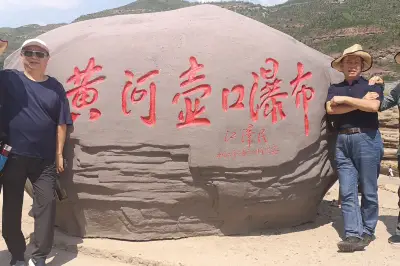
The bathing site of Yang Guifei, whose 'single glance back bewitched the emperor.' Those interested in historical details can check out the structure of the ancient bathhouse.
Dinner: Jin Bai Wan Roast Duck
A tiring day of travel, so we dined near the hotel and had an unexpected gastronomic delight.
With all our must-sees visited, today was laid-back: just wandering around nearby, and in the evening going to the Great Tang All Day Mall near the Big Wild Goose Pagoda.
Xi'an—Shanghai (MU2165)
We booked an evening return flight, so we had a whole day to leisurely stroll and snack around Xi'an.
Welcome to follow my WeChat public account 'Yaya San Xiaoding' for more travelogues.
Author: ZAYAH
A learning experience designer living in the Southern Hemisphere
Mother of three
Pisces, born in the '80s, passionate about art and travel. Here to share the journeys of growing up and traveling with kids.
We travel not to escape life, but for life not to escape us.
All photos and graphics in this article were taken/designed by the author. Please credit the source or contact the author for reprints.