Hidden Gem: Lantian Wangshun Mountain - Yushan Lanhe Scenic Area
Lantian County in Xi'an is one of the birthplaces of human ancestors and one of the earliest cradles of Chinese civilization. “The finest jade is known as lan”—Lantian was named after the Lantian jade. The eastern part of Lantian County is the gully area at the southern foot of Lishan Mountain, the southern part extends from the northern foot of the Qinling Mountains, the central and western parts are interspersed with plains and rivers, the Ba and Chan rivers run through the entire area, and diverse landforms such as terraces, tablelands, hills, and mountains create a beautiful multi-layered landscape, making it known as the backyard of Xi'an.
A glance at the Lantian tourist map shows that attractions are scattered throughout the county. To explore it in depth, you’d need plenty of vacation time. With just one day, we could only pick two attractions along the central route: Wangshun Mountain Forest Park and Yushan Lanhe Scenic Area.
Xi'an – Wangshun Mountain Forest Park – Yushan Lanhe Scenic Area – Xi'an, 156 km round trip
“Among all famous mountains, this one is uniquely wonderful; the scenery in sight is like a painting and a poem.” This is how Ming Dynasty poet Liu Ji described Wangshun Mountain. Lantian Wangshun Mountain, anciently called Yushan, is located in Lanqiao Township, 20 kilometers from Lantian County. It leans against the Qinling Mountains to the south, borders the Ba River to the north, and is surrounded by blue waters. It was named after Wang Shun, one of the Twenty-Four Filial Exemplars of ancient China, who carried earth to bury his mother here.
Wangshun Mountain is an important part of the Qinling Zhongnanshan World Geopark and a national AAAA-level tourist attraction. It has six main scenic areas and 150 sights, with its peak being Yuhuangding (Jade Emperor Peak) at an altitude of 2,239 meters. It is said that from Yuhuangding, you can see Mount Hua to the east, the Wei River to the north, the mountains to the south, and the ancient capital Chang'an to the west. It combines the steepness of Mount Hua and the elegance of Mount Huangshan, earning it the nickname “Little Huangshan of Shaanxi.”
While waiting in line to park, we were already immersed in the atmosphere of Chinese filial piety culture.
The Wangshun Mountain parking lot is large, with several parking areas. It is quite a distance from the parking lot to the mountain entrance gate, estimated to be several kilometers. There are shuttle buses (one-way 10 yuan per person), and some people choose to walk.
The hiking path is a well-maintained stone stairway. Those with good stamina can climb all the way to the highest peak, or you can climb to “Yincui Pavilion” (Drinking Emerald Pavilion), take a cable car to the “Observation Deck,” and then continue to the summit.
Along the way, we enjoyed the natural oxygen bar while soaking in the strong atmosphere of filial piety.
We finally reached the ticket office of the Yincui Pavilion Cable Car, bought round-trip tickets (80 yuan per person), and took the cable car up to the Observation Deck.
From the cable car, we looked down on the hiking trail and the brave souls climbing step by step.
Mountain views captured at different altitudes during the ascent
The hiking trail itself became a unique scenic line. The climbers surely didn't realize that they were an indispensable ornament to the beautiful scenery, their presence adding a sense of liveliness to the views.
Sitting in the cable car, it felt as if we could almost touch the rocks, and the clusters of small white flowers seemed within reach.
Two of the photos we took could easily make you think we were at Mount Huangshan.
This is probably the highest peak near the Observation Deck!
At the end of the cable car ride, the towering peaks now seemed shorter.
Standing on the Observation Deck and looking around 360 degrees, every glance offered a new view.
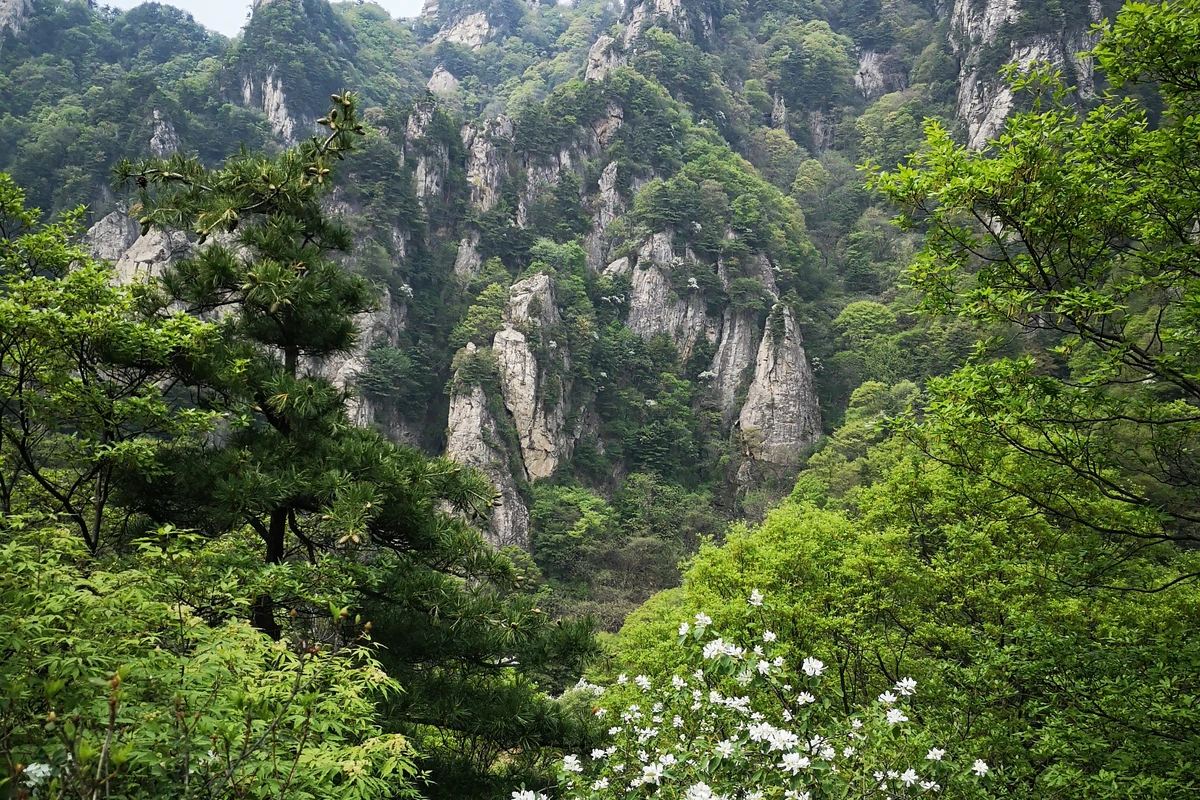
From afar, the granite rocks were clustered together, and the cone-shaped peak clusters formed a natural bonsai landscape.
Up close, the distance between the stone pillars and pinnacles seemed to fit the definition of a “peak forest” rather than “peak cluster.”
Lush vegetation on the ridges
At our feet stretched the rolling Qinling Mountains, giving the feeling of “all other mountains are dwarfed beneath us.”
As we looked back from the descending cable car, we realized we were surrounded by mountains.
Leaving Wangshun Mountain, we stopped by the Yushan Lanhe Scenic Area on the way back. It is located in Lanqiaohe Village, Lanqiao Town, and belongs to the same mountain range as Wangshun Mountain, just with a different hiking route—the ultimate summit is also Yuhuangding. This trail features towering bizarre peaks, jagged rocks, deep ravines, and serene beauty. Unlike Wangshun Mountain, the pristine natural scenery here hides cultural landscapes left by poets who visited Yushan over the centuries. The area includes the Hui-style pastoral Wang Wei Garden, the elegant and grand Bai Juyi Tower, and the leisurely and calming Du Fu Tower, exuding a strong humanistic atmosphere.
At 6 p.m. we started our return journey. Before dark, we could still make up for the scenery we missed on the way there due to our rush.
Such unique landforms attracted many returning visitors to stop and take photos.
In one day, we visited two scenic areas and climbed two mountains (though we didn't reach the top of either). Not only did we enjoy the pristine natural scenery, but we also immersed ourselves in filial piety culture and the humanistic atmosphere of the Tang and Song dynasties. It cleansed our minds and lungs—“COVID-19” and “smog” were long forgotten.