72 Hours in Chang'an
The first stop of my 2020 solo trip: Xi'an!
Just me, a book, a backpack, and an unshakable determination to go. No hesitation, no dawdling. From the moment Xi'an, this historic city, flashed into my mind, to booking flights and locking down the itinerary, it all happened within a day. I had planned this short trip to trace the shadows of the past and soak up the rich historical atmosphere of the ancient capital.
Dates: May 22–24, 2020 — three days in total.
Transport: round-trip flights. Xi'an has always been a super popular tourist city, so airfares usually stay sky-high. But this time, due to the pandemic, my round-trip ticket cost less than what a one-way used to be. Before departure, I found a local travel planner named Tingting through online guides. She helped plan my three-day route, and the cost was very reasonable.
Day 1: Lishan – Terracotta Warriors – Huaqing Palace – Yongxingfang – Datang Everbright City – Bell and Drum Towers
Day 2: Chinese First Ancestor Hall – Yan'an – Hukou Waterfall
Day 3: Mount Hua
Because of limited vacation time, I tailored the above route to my own interests, and Tingting helped arrange everything. Shaanxi is rich in tourism resources; you'd need at least ten days to two weeks to cover it all. For someone like me who snatches a few days off work to hit the highlights, itinerary planning is crucial.
Total cost: 2600 yuan for three days.
Let me kick off my 72 hours in Chang'an with a photo of that internet-famous girl...
1. The First 12 Hours in Chang'an
At 6:30 a.m., I boarded an Okay Airways flight at Changsha Huanghua Airport. An hour and a half later, we landed at Xi'an Xianyang Airport, where the driver arranged by Tingting was already waiting. We headed downtown, and he dropped me off at the Super 8 Hotel on Northwest Third Road, close to the Bell Tower and Muslim Quarter. After checking in, I couldn't wait to rest; I immediately found a restaurant and ordered a roujiamo and millet porridge, officially beginning my free-and-easy journey.
My first impression of Xi'an: grand, tidy, and excellent urban greenery. After breakfast, I hopped on bus 102, meandering along, slowly savoring the relaxed yet vibrant rhythm of daytime Xi'an. When the bus reached the train station, the ancient city wall on the square came into view.
Xi'an City Wall Scenic Area lies in the city center. It has four gates: Changle Gate (east), Anding Gate (west), Yongning Gate (south), and Anyuan Gate (north). The wall was built on the foundations of the Tang imperial city, entirely centered on a defensive strategy. The wall is thicker than it is tall, solid as a mountain, and broad enough on top for vehicles and military drills. The existing wall was built between the seventh and eleventh years of the Hongwu period of the Ming Dynasty (1374–1378), over 600 years ago. It's one of the most famous city fortifications from the late medieval period in Chinese history and the most intact ancient city wall still standing in China.
Due to the pandemic, the wall was temporarily closed to visitors, so I couldn't climb up and feel like an ancient hero overlooking a prosperous world and strategizing. That will have to wait until next time.
I originally planned to take a tourist bus from the train station to see the Terracotta Warriors. But just like at any train station, I was immediately accosted by private hire drivers. I ignored several of them, but in the end, pressed for time, I agreed with a tall driver on 40 yuan to go to Lishan in Lintong. The driver, named Dalong, was very warm-hearted. As soon as I got in, he started telling me about Xi'an's history and local customs, acting as both guide and commentator. After two hours of chatting, I decided to hire his car for the whole day to take me around Lishan.
The usual route is to visit the Terracotta Warriors and Huaqing Palace first, then wander around the foot of Lishan. But with the transport sorted, we reversed the route and drove up the winding mountain road to enjoy the scenery from the top of Lishan.
Lishan is located south of Lintong District, Xi'an, Shaanxi Province. It's a branch of the Qinling Mountains, rising 1,302 meters above sea level and composed of eastern and western Xiuling peaks. Formed by the uplift of the Qinling in the late period, it's an isolated horst block mountain standing abruptly in the Weihe fault basin. The mountain ranges rise and fall, lush with trees, and from afar it resembles a dark green steed—hence its name. Lishan is also known as "Xiuling" (Embroidered Ridge) because of its emerald beauty.
The uphill road twisted through serene, wooded paths. This off-the-beaten-track route was free from crowds, offering a delightful tranquility.
We chanced upon a wheat field. Dalong said southerners rarely see wheat, so I had to take a photo here. From then on, he also became my photographer.
On Dalong's recommendation, I saw a cherry orchard on Lishan for the first time, and for the first time, I climbed a tree to pick cherries.
Loaded with fruit! Locally, cherries sell for 30–40 yuan per jin, but here the local price was as low as 8 yuan; in the picking garden, it was only 15 yuan per jin!
We stopped briefly at an elderly woman's house halfway up the mountain and got a chance to see Shaanxi rural dwellings.
The couple was so simple and genuine. As soon as we entered, they served tea, cut melons, and warmly invited us to rest, while chatting with Dalong about daily life. I couldn't understand their dialect, but I could feel their kindness and hospitality. When we left, Dalong bought 8 yuan's worth of chives, paid 10 and told them to keep the change. The man insisted on giving us a bag of cherries in return. Such lovely people!
As the car climbed higher, Dalong stopped at every best viewing spot for me to take photos, explaining the scenery, landforms, history, and culture.
Since the Zhou, Qin, Han, and Tang dynasties, Lishan has been a royal garden, dotted with imperial villas. In ancient times, Nüwa mended the sky here; at the end of the Western Zhou, King You teased his vassals with beacon fires here; Qin Shi Huang built his mausoleum at the foot of Lishan, leaving the world-famous Terracotta Warriors; in the glorious Tang Dynasty, Emperor Xuanzong and Lady Yang played out a poignant love story here; and in modern history, the famous "Xi'an Incident" also took place on Lishan.
Descending from Lishan, we arrived at Huaqing Palace, formerly known as Huaqing Pool. It's a royal garden built on the ruins of the Tang Dynasty Huaqing Palace, renowned for the love story between Emperor Xuanzong and Lady Yang. Historically, the famous "imperial concubine's bath" was here.
If you have no evening plans, you could watch "The Song of Everlasting Sorrow," China's first large-scale landscape historical dance drama. It cost a fortune to produce, with a huge cast and spectacular scenes, telling the poignant love story of Emperor Xuanzong and Yang Yuhuan. Bai Juyi's poem "The Song of Everlasting Sorrow" vividly recounts that history, and its classic lines are still passed down:
"In the sky we'd wish to fly like two birds with the same wings; on earth we'd wish to grow like two trees with branches twined. Heaven and earth last forever, yet someday they shall end; This endless sorrow will go on without ever ceasing."
Since I had arranged to see Xi'an's night scenery that evening, I'll save "The Song of Everlasting Sorrow" for next time.
"In the chill of spring, she bathed in Huaqing Pool; the warm spring water glided over her creamy skin."
Recalling how the imperial concubine "glanced back with a smile that cast a hundred charms, leaving all the powdered ladies of the six palaces without color," history passes, and everyone is but a grain of dust, leaving only Huaqing Pool for later generations to muse upon.
A ten-minute drive from Huaqing Palace brought us to the Mausoleum of the First Qin Emperor Museum—the UNESCO World Heritage-listed "Terracotta Warriors," known as the Eighth Wonder of the World and Xi'an's calling card to the globe.
The Terracotta Warriors burial pits face east. There are three pits. Pit 1, the largest and first discovered, is rectangular and contains over 8,000 figures. The warriors are mainly divided into soldiers and officers. Pit 1 has the most warriors, each with different attire and expressions. Their hairstyles, gestures, and facial expressions vary vividly; the ancient sculpting skills are simply breathtaking!
Officer figure –
Bronze chariot –
Cavalryman figure –
Kneeling archer figure –
It was dusk by the time we finished seeing the terracotta warriors. The ancient city of Xi'an was already adorned with brilliant lights. Without delay, Dalong drove me to Yongxingfang downtown, lifting the curtain on Xi'an's nightlife.
Yongxingfang occupies the original site of the Tang Dynasty official Wei Zheng's residence. The government reconstructed ancient-style "fang" (neighborhoods) and "si" (shops), archways, added leisure squares, inner streets, well houses, and antique decorations on buildings, combining Guanzhong archways and traditional folk architecture to form an old neighborhood layout that displays the street-market form of ancient Chang'an, historical life, and traditional folk customs.
When it comes to Shaanxi cuisine, it's famed throughout China! The array of noodle dishes alone is endless: guotie (potstickers), guantang baozi (soup dumplings), niu yang rou paomo (crumbled flatbread in beef/lamb soup), niu yang rou xiao chao paomo (stir-fried crumbled flatbread with beef/lamb), hulu tou paomo (crumbled flatbread with pig intestines), la niu rou jiamo (cured beef sandwich), la zhi rou jiamo (cured pork sandwich), Qishan saozi noodles, pulled noodles, biangbiang noodles... As for the character "biang" in biangbiang noodles, I'm in awe that Shaanxi people could create what's said to be the Chinese character with the most strokes—so complex it can't be typed by any input method!
There are two local legends about the origin of biang. Whether the scholar was unrecognized or had just passed the imperial exam, the character biang has become famous throughout Guanzhong: A dot flies to the sky, the Yellow River bends on both sides, the character for eight opens its mouth wide, the word for words goes inside; twist left, twist right, a long one in the west, a long one in the east; in the middle add a king of horses, a heart at the bottom, a moon on the side, a hook to hang sesame candy, pushing a cart to travel to Xianyang.
Don't think only Hunan and Sichuan people love spicy food. In Shaanxi, meals are also incomplete without heat.
The bowl-smashing wine at Yongxingfang has been an internet-hit spot in recent years. Legend says after drinking the rice wine, you smash the ceramic bowl for "good luck and safety." It's 5 yuan per bowl, minimum three bowls to smash. I tried it. Honestly, the rice wine had no alcohol, just sugar water, but the smashing was vigorous.
If daytime Xi'an is an 80-year-old man, etched with age and gravitas, then nighttime Xi'an is an 18-year-old maiden, radiating vitality and allure. After ticking Yongxingfang off my list, we rushed to Datang Everbright City to catch the 9:30 p.m. fountain show. Even during this unusual period, tourists still flocked to Xi'an, and Datang Everbright City was packed with people. Dalong drove me around the outer streets, and I could already feel the enchanting charm of Xi'an by night. Unfortunately, there were so many people and cars that we drove around for half an hour before finding a parking spot. By the time we entered, the fountain show was over, but I happened to catch the Datang tumbler performance.
Aerial photos show Datang Everbright City ablaze with light and color! (Photo from the internet)
Datang Everbright City lies at the foot of the world-famous Big Wild Goose Pagoda in Qujiang New District. It's 1,500 meters long north to south and 480 meters wide east to west, occupying a total area of 967 mu with a built-up area of 650,000 square meters. It takes the culture of the great Tang as its backdrop, Tang-style elements as the main thread, and experiential consumption as its feature, weaving through three themed squares: Xuanzang Square, Zhenguan Culture Square, and Kaiyuan Celebration Square. Through lights, sculptures, landscapes, cultural relief pillars, steles, water features, three-dimensional transport... it organically combines historical figures and heroic tales with modern culture, perfectly interpreting the grandeur of Datang Everbright City, showcasing the nation's splendor, and creating a joyful atmosphere of peaceful prosperity in the Tang Dynasty.
Beneath the Big Wild Goose Pagoda, enduring peace forever.
Fire trees and silver flowers, singing and dancing in a flourishing land.
I walked until my legs nearly gave out, measuring this magnificent and brilliant Datang Everbright City by foot. Even with pandemic restrictions, the crowd could have rolled ten thousand human balls; I can't imagine the shoulder-to-shoulder hustle during normal times! Chang'an over 1,400 years ago must have looked just like this. Feeling the peak of splendor, I sighed inwardly at the nation's huge investment to create such a night-bright city. How many kilowatt-hours must the government use daily to keep these 650,000 square meters dazzling and the 10,000 square kilometers of Xi'an's streets lit? My driver seemed even more adorable than me. Though his calves ached, his professional dedication made him drive me late into the night to visit the old city wall, Muslim Quarter, Bell Tower, and Drum Tower one by one. Half of Xi'an's nightscape unfolded before my eyes as his wheels turned.
Xi'an Bell Tower –
Muslim Quarter is also a food culture street. We arrived close to midnight, yet some shops were still open. Unlike Yongxingfang, locals consider the Muslim Quarter the authentic snack street.
Xi'an Drum Tower –
2. The Next 36 Hours in Chang'an
After a fulfilling day with Dalong's company, I woke early the next morning, freshened up, and took a taxi to Shaanxi Province Gymnasium. Following Tingting's plan, I shared a ride to the revolutionary holy land—Yan'an.
My solo breakfast seemed a bit much? Well, it was a 700-kilometer round trip to Yan'an, so I bought extra to stave off hunger on the long ride.
My lone luggage—backpack, sun hat.
The luxury VIP bus arranged by Tingting was clean, comfortable, with charging ports throughout and a starry-sky ceiling!
In elementary school, our textbooks described the Loess Plateau as yellow earth everywhere, barren hills with hardly a tree, and when it rained, torrents of mud rushing into the Yellow River. But passing through cities like Tongchuan, Huangling, and Luochuan, I saw hills now covered in trees, leafy and green.
It's hard to imagine such a beautiful river in northern Shaanxi. She has a simple name—Hulu River—the mother river of Fuxian County!
The Huangdi Mausoleum on Qiao Mountain north of Huangling County is the tomb of Xuanyuan Huangdi, the ancestor of the Chinese nation. During the trip, we visited the hometown of our Chinese ancestor—the Chinese First Ancestor Hall in Huangling County.
When in Yan'an, you must see the traditional local dwellings—yaodong (cave houses). Yan'an's yaodong are of three types: earth, brick, and stone. In the old days, the furnishings were very simple, just the essentials. Today, most yaodong have kept up with the times and are well furnished.
The people on the Loess Plateau, who work from sunrise to rest at sunset, have not only cultivated honest, hardworking, and generous characters but also created this vigorous, passionate, and bold folk song—Xintianyou. It's powerful and majestic, tender and soulful. It has echoed over the plateau for a thousand years, its open, unrestrained melodies passing from generation to generation among the tawny hills.
Hukou Doudrum is a unique form of traditional Shaanxi folk drum dance. I hadn't seen the majestic force of Ansai Waist Drum, but today I was blown away by Hukou Doudrum's rousing, rough, and untamed rhythm!
Tanned skin, resounding voices, brilliant smiles—the Yan'an folks are so warm!
The group meal in Yan'an wasn't bad!
Bidding farewell to the villagers, we drove down the mountain road, the ranges stretching endlessly under a vast sky. At the foot of the mountains, the Yellow River curled eastward day and night.
"The Yellow River with nine bends and ten thousand li of sand, waves swept by wind from the edge of the sky!"
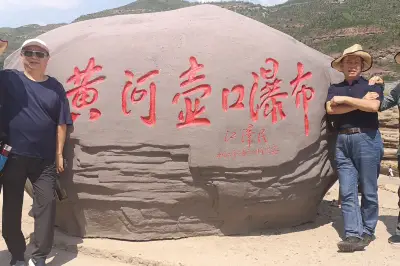
History is replete with poems describing the Yellow River, and Hukou Waterfall, as a unique natural spectacle along the Yellow River, perfectly embodies the river's power to swallow mountains and rivers, its raging waves, and its headlong rush!
Hukou Waterfall lies in the southern section of the Qin-Jin Grand Canyon. One bank is Shaanxi, the other Shanxi. Because the river surface abruptly pours from a 400-meter-wide floodplain into a narrow groove only 30–50 meters wide, it forms the world's largest yellow waterfall.
Over the years, the central government has worked hard to control desertification along the Yellow River, creating a beautiful home of clear waters and green mountains. With improved environment and clear weather, and no heavy rain upstream in Gansu, the Hukou Waterfall today didn't match my impression of gold and sand swirling in muddy torrents; instead, the water was clear enough to see the stones. The surging Yellow River crashed passionately against the rocky banks, sending mist meters high into the breeze. A brilliant rainbow hung there—truly spectacular!
Amid the misty spray of Hukou Waterfall, in the coolness of summer by the roaring water, if you have no idle worries, then it's the best season of life. This scene, this feeling—couldn't be better!
When we set out at dawn, ancient Xi'an slept in the morning light; when we returned at dusk, the city was already adorned with lights, radiating charm!
It was still early. After a quick wash at the hotel, I took a taxi to South Street and wandered around. The driver was very enthusiastic and chatted with me about Xi'an trivia all the way. Then I found a place to eat. It wasn't easy ordering for one—I negotiated the lamb skewers from an original order of 20 down to 5. In the end, I still wasted more than half of the fried bread. The owner was from Gansu and immediately asked what liquor I'd like. Maybe he thought every solo traveler has a story to tell. If there's a story, there must be wine. "Brave the Journey" suited me just fine!
Let me post a few night shots of South Street to wrap up this long day on the road.
3. The Final 72 Hours in Chang'an
Good morning, Xi'an!
I woke up naturally and went to a lane opposite the hotel for breakfast. Xi'an locals have a rich breakfast—all kinds of baozi, flatbreads, congee, soy milk, eggs, hulatang (spicy soup)... Last year in Xinjiang I tried hulatang, and I really couldn't get used to the flavor, but the baozi and flatbreads here were delicious and cheap. After eating my fill, I set off to conquer Mount Hua!
After a two-hour bus ride, we arrived in Huayin City, Shaanxi Province. Mount Hua, anciently called "Western Sacred Mountain" and elegantly named "Taihua Mountain," is one of the Five Great Mountains. I'd heard many friends shiver on the cable car up the West Peak, let alone look down into the abyss—proof of its precipitousness. Today there weren't many tourists; I had a cable car all to myself, exactly what I needed to take in a 360-degree panorama of Mount Hua's countless sheer peaks and protruding rocks.
I alighted from the cable car at 11 a.m. and started hiking. By noon I reached the West Peak; 1 p.m., South Peak; 1:30 p.m., East Peak; 2 p.m., Center Peak; 3 p.m., North Peak. In four hours, I had conquered all five peaks!
If you don't want your kneecaps smashed from fatigue, going up the West and down the North is the easiest route. The North route is extremely steep; every pause on the way down made my calves twitch. Locals usually climb Mount Hua the night before, reach the East Peak's Sunrise Platform by dawn to watch the sunrise, then tour the other four peaks, and finally rush to the West Peak's Lotus Flower Peak at sunset to see the sunset.
Let me introduce the five peaks in the order I visited them.
1. West Peak. At 2,082.6 meters, it's one of Mount Hua's main peaks, named because it lies to the west. The summit has a huge rock shaped like lotus petals, and Li Bai wrote "rock forms lotus, clouds form pedestal," so it's also called Lotus Peak or Furong Peak. The West Peak is full of scenic spots: Cuiyun Palace, Lotus Cave, Giant Footprint, Axe-Split Rock, Sacrifice Cliff, and many beautiful legends, the most famous being Chenxiang splitting the mountain to rescue his mother. You can watch a full sunset from the West Peak, but with limited time today, I could only admire the beautiful landscape.
2. South Peak. At 2,154.9 meters, it's Mount Hua's highest peak and the tallest of the Five Great Mountains. The ancients revered it as the "Head of Mount Hua." Standing on South Peak, you see endless rolling mountains and sheer cliffs. At the summit, you feel you could pluck the stars.
3. East Peak. Also called Facing-the-Sun Peak, it offers a broad view and is a famous sunrise spot. From here, the steep ridges seem like screens, the vast plain like silk brocade, the Yellow River winding through, and the view stretches to the horizon.
4. Center Peak. Also known as Jade Maiden Peak, it's lush with trees and tranquil. It's the easiest to reach of the five. After ascending from the West Peak, you visit South, then East, and from East you backtrack a short way to Center. Compared to the others' steepness, Center is gentler, making it a good resting point on the five-peak route.
5. North Peak. In the north of Mount Hua stands a cliff-hung peak, crowned by auspicious clouds overhead and linked to earth veins below, towering in solitary splendor like a cloudy platform—hence the name Cloud Terrace Peak. Tang poet Li Bai wrote: "The three peaks lean as if about to fall, emerald cliffs and scarlet valleys..." North Peak has many rock-climbing chains and the trail is exceptionally steep—a perfect test of courage and perseverance.
At 3:30 p.m., I took the cable car down from North Peak to the bus transit station. Looking up, Mount Hua revealed another majestic face, confirming the verse: "Mount Hua juts abruptly into the blue sky, sitting between heaven and earth with a thousand peaks." I regretted not seeing waterfalls and streams on Mount Hua this season, but then midway up, a clear spring gushed from a crevice—"Nine-story cliffs carve the blue sky, three-tiered springwater sprays the evening rain!"
Many friends ask: If you want to climb Mount Hua by night like the locals, how long does it take? Currently, due to the pandemic, the scenic area doesn't allow entry after 3 p.m. To experience the joy of a night climb, you'll have to wait for the local tourism bureau's notice. Hiking all the way to the top takes 8–9 hours.
We left Mount Hua and arrived back in Xi'an at 7:30 p.m. I had a bowl of biangbiang noodles in an alley, rushed to the airport, and ended my three-day trip on a cheerful note!
Nowadays, traveling to Xi'an is quite safe. Local authorities have stringent prevention measures. Before entering any scenic spot, you must register for a local health code on your phone and scan to pass. You can check Xi'an's weather on your phone and prepare clothes accordingly. On sunny days, sun protection is a must. Masks are essential. Other than that, there's not much to note—just bring a good mood to feel the warmth and charm of a capital of thirteen dynasties, eat well, and have fun!
Postscript
Three days, 72 hours, following the historical thread of ancient Chang'an. From the Banpo ruins of the Neolithic Age to the Three Sovereigns and Five Emperors, from the Warring States to the Three Kingdoms, from the cultural flourishing of the Qin and Han to the everlasting peace of the Kaiyuan era. The emerald pines of Lishan accompany twilight clouds as seasons change; the morning bell of the imperial city’s Big Wild Goose Pagoda bids farewell to beacon fires and ushers in prosperous years. Every dynastic transition heralds a new era. The emperors, generals, beauties, and talents have long vanished into the river of history, leaving only the enduring landscape—and a gentle sigh from later generations.
Today's Xi'an, with the Big Wild Goose Pagoda still standing and city walls intact, imperial tombs and Qin bricks and Han tiles all proclaim past glory. Skyscrapers cluster together, eateries and shops thrive everywhere. Xi'an, with over 5,000 years of civilization, blends the chimes of bells, Tang poetry, and Song verse seamlessly with modern culture, sparking a dazzling new guise!
72 hours, though hasty, let me glimpse the grace of this ancient capital of thirteen dynasties—like the prologue of a story, awaiting my return to continue its unwritten splendor!
--------The end!