Famous for the Mogao Caves, Yearning for the Crescent Moon Spring: A 7-Day Trip to Dunhuang & Xi'an (June 20-26, 2020)
In the blink of an eye, 2020 is nearly half over. The sudden pandemic had me drafting several travel backup plans over the past six months, yet none were put into action. Watching the epidemic finally easing, but with the domestic rainy season and typhoon season bringing unstable weather ahead, I was torn between waiting longer or just going. After much hesitation, I still hoped to make a trip happen.
While keeping an eye on the epidemic every day, I also monitored the weather. For someone who likes to have everything prepared in advance, I had never found myself still undecided about a destination until just two days before departure. In the end, because of forecasted heavy rains in the south, I changed my plan from Guizhou to the dry northwest region at the very last moment.
Typically, a trip to the northwest involves flying to Xining and doing the great northwest loop by self-driving or hiring a car. But with limited time, I chose just one stop on the loop: Dunhuang. Apart from wanting to see the celestial murals with my own eyes, I was mainly drawn by a photo of a crescent-shaped oasis in the desert—an image of a place I'd never been that instantly captivated me. Dunhuang had long been in my travel wish list.
Since there are no direct flights from Shanghai to Dunhuang, we had to transit via Lanzhou or Xi'an. At 10 a.m., we embarked on this not-so-short journey.
Tips: Because of the special period, here are some important reminders:
① Before departure, be sure to check with your hotel about local pandemic policies to ensure you can check in smoothly and enter scenic areas when crossing provinces (for instance, most scenic spots in Xinjiang currently do not accept tourists from outside the region).
② Always wear a mask when entering or exiting airports, scenic areas, hotels, or any public places (carry extra masks in case you lose one—without a mask, you won't be allowed in anywhere).
③ Most importantly! Every person traveling must have a mobile phone number! Why is this so crucial? Because wherever you go, you'll need to scan a QR code to show a green health pass. Each province has its own mini-program, and while operations are largely similar, there are key differences. For example, in Shanghai and Gansu, a health code can be generated with just an ID number—even one phone can generate codes for multiple people, though it's a bit troublesome. But in Xi'an, the health code requires a phone number to register, and one number can only register one person. Additionally, when checking into hotels in Gansu, besides showing the health code, you also need to scan a code that shows where your phone number has been. So it's vital that every traveler has their own phone number.
With these three points in mind, as long as you're not coming from or intentionally heading to medium- or high-risk areas, avoid crowds, follow local policies, and fill in information truthfully, it's still possible to get out for a breath of fresh air and a change of mood even during these extraordinary times.
As the earth's color gradually turned yellow and barren, we finally arrived at Dunhuang Airport at 4 p.m. After getting off the plane, we had our temperatures taken, scanned codes to fill in information, and verified our health codes and ID cards. We officially set foot on Dunhuang soil. Although I had been quite worried about the pandemic before departure—especially when it seemed under control but then suddenly flared up again in the capital, which made me a bit anxious—I felt much more at ease after seeing how strict the prevention measures were throughout the journey.
We chose the Bohui Wenhua Hotel, located in downtown Dunhuang, right next to Shazhou Market. At the intersection stands the statue of the Rebounding Pipa, and we had no worries about food and drink from morning to night. The hotel was roughly equidistant from the airport, Mogao Caves, and Mingsha Mountain, about a 20-minute drive to each. There's a bus stop across from the hotel for Mingsha Mountain, but we opted to take taxis to these places.
Tips: Regarding taxis in Dunhuang, some say they negotiate a price without using the meter, but in reality, they do use the meter, which is located near the gear shift. There's no ride-hailing app like Didi here; drivers still wait for hails on the street or line up at scenic area entrances. Our taxi driver gave us his card before we got out, hoping we'd call him for future rides—better than waiting aimlessly. The main sites in the city aren't far, and he could usually reach our pickup point in about ten minutes. If the driver seems honest, sticking with a regular taxi is a good option. (Our taxi fares: Shazhou Market to Mogao Caves 22 yuan; Mogao Caves to Mingsha Mountain 35 yuan; Mingsha Mountain to Shazhou Market 15 yuan; Shazhou Night Market to airport 30 yuan.)
Due to the pandemic, hotel prices throughout the trip were not expensive, and we even got a room upgrade. After dropping off our luggage and resting a bit, I thought 5-6 p.m. was already late, but I soon realized there's at least a two-hour time difference here. Plus, this time of year has the longest daylight; sunset starts around 9 p.m., and it doesn't get fully dark until after 10. The driver told us that because of the scorching heat, locals work in the morning, rest in the afternoon, and go back to work around 5-6 p.m. So going out at 5-6 p.m. was not late at all—most market stalls were just setting up. A quick walk around didn't reveal anything particularly eye-catching; almost uniformly, stalls sold dried fruits. Above each stall hung a price sign, showing a conscious effort to manage pricing, which was nice.
After a brief stroll, we set out for our first meal in Dunhuang. As non-locals, we relied on reviews to avoid pitfalls—not necessarily the most authentic local flavors, but at least ones widely approved.
This restaurant, Jingyuan Ga Liu Delicious Lamb, located downtown, was bustling at mealtime. When we arrived, it was nearly full, and by the time we finished, there was a line. The staff were very polite and made us feel comfortable. Photos on the wall showed quite a few celebrities had dined there. We ordered hand-grabbed lamb chops—the meat had little gamey taste, with a light salty-umami flavor when eaten plain, and even more fragrant dipped in chili powder. Their chili powder here is excellent: not overly spicy but incredibly aromatic. The stir-fried lamb heart and liver was very tender, though a bit too spicy for us. Sha Cong (a local wild onion) is unique to the area, with a texture like a mix of scallion, chive, and yellow chive; its taste was good and worth trying. Apricot drink is somewhat like sour plum juice—perfect for quenching thirst and cutting through grease in the hot weather.
Back at the hotel, I snapped a photo out the window. The distant shape must be Mingsha Mountain; it was already 9 p.m.
In the morning, we first went to Xia's Hezhi nearby for breakfast. It tasted somewhat like vermicelli soup and was quite nice as a breakfast.
Our main plan for the day was the Mogao Caves. Although tickets might not be as hard to get now, to be safe, it's best to buy them early on the official website. Entry is by timed slots, with a daily limit of 3,000 tickets. We chose the 9:15 slot, which required arriving at the Mogao Caves Digital Exhibition Center half an hour early to pick up tickets. First, we went through ticket checking with health code verification, then security; luggage could be stored if needed.
After entering, we watched two introductory films to get a general understanding of the caves.
Then we took the scenic shuttle bus to the Mogao Caves. There's actually quite a distance from the Digital Center. The wind was strong that day, whipping up sand that got in our eyes and quickly covered our phones in a layer of dust—a true taste of the Northwest. But thanks to the strong wind and lack of sun, we didn't feel the heat; it was pleasantly cool.
Mogao tickets are divided into Category A and B, with separate queues; the difference lies in how many caves you can see. Visitors are grouped, each group assigned a guide who leads and explains throughout. The paintings and statues inside are extremely precious and fragile, sensitive to light and humidity, so photography is strictly prohibited. If you want photos of the cave interiors, there are QR codes at the entrance where you can view introductions and pictures. Inside, it's very dark; the guide's flashlight illuminates each spot as they explain. Stepping in was awe-inspiring—looking at the mottled, oxidized, fading murals covering the walls, at the countless caves, I couldn't find words to express my wonder. Though we are doing our utmost to protect them, the erosion of time is irreversible, and we will eventually see less and less. I'm glad I came now, yet I also wondered if I shouldn't be disturbing this place. The Mogao Caves now offer an AR online tour; those interested can check it out.
After the cave tour, we were free to roam—taking photos with the caves' exteriors or visiting the nearby exhibition halls for artifact introductions. Finally, we took the bus back to the Digital Center. (P.S. In the evening, there are large-scale performances near the Digital Center; tickets aren't cheap, but worth seeing if interested.)
We didn't get to explore all the exhibition halls because the wind and sand grew very strong, even mixed with a bit of rain. At this point, I really wished I had brought dust-proof goggles instead of sunglasses, and a hat with a string so it wouldn't be blown away.
Back at the Digital Center, we took a taxi to Luye Yousha Inn near Mingsha Mountain. Since Mingsha Mountain tickets are valid for three days, staying near the scenic area made it convenient to re-enter the next day, whether to catch a sunrise or sunset.
The road where the inn is located runs between Mingsha Mountain and Crescent Moon Spring Town, and the entire street is lined with inns. Our inn was relatively new and stylishly decorated, but unless you come by car, if I had to choose now, I'd pick an inn closer to the intersection—this one was too far in, and after a tiring day, it suddenly felt very distant on the way back.
When we entered the inn at noon, the ground was covered with sand and fallen leaves. The young lady at the inn said, "We're not usually this dirty—there's a sandstorm today." We told her we had just come from Mogao and had already experienced it. We were also informed that Mingsha Mountain was closed, so we decided to do as the locals do: rest inside during the midday heat, and around 4 p.m., head out to Crescent Moon Spring Town for a walk.
The town felt quite artificial—clearly built in imitation local style for tourists. It wasn't big, and you could walk through it in under half an hour. Aside from a row of eateries and a few inns, the open-air stalls were all empty, giving the whole town a desolate feel.
But we were drawn by the aroma from an old man's chili powder shop. We bought some chili powder to make chili oil at home—it was incredibly fragrant and not overly spicy.
We had dinner at the nearby Lao Tong Guan Rou Jia Mo (Crescent Moon Spring Town branch). Although I'm not a big fan of wheat-based foods, this roujiamo was so much better than any I'd had in Shanghai that I didn't even plan to eat another in Xi'an—I felt this level was already delicious enough to represent the dish. Judging by the name, it seems to be a chain.
After dinner, worried we'd go to Mingsha Mountain for nothing, we called to check if it was open. By 6 p.m., the wind had died down, the sun came out, and off we went to Mingsha Mountain!
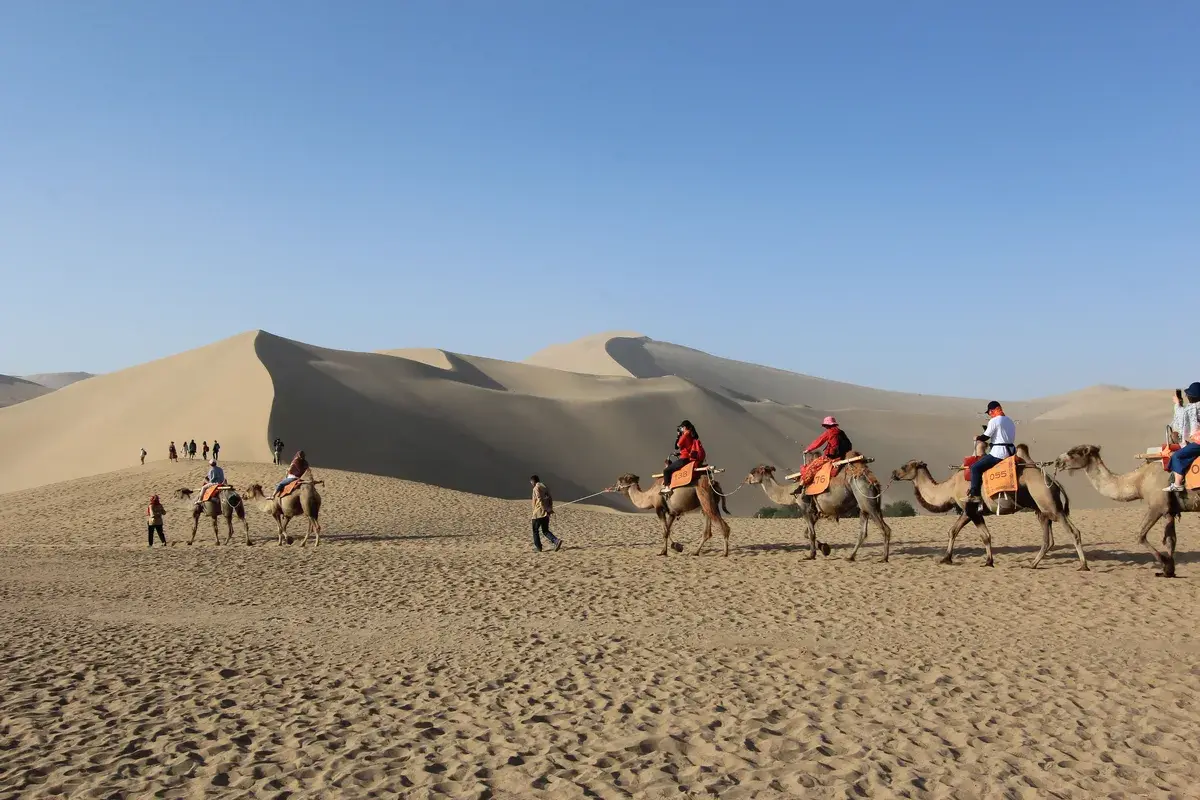
When we first entered the scenic area, I was a bit disoriented—sand everywhere, with no clear path. I initially thought the mountain you reach by camel ride was the one overlooking Crescent Moon Spring. But no: camel rides go to the left, towards the Eastern Mountain. Crescent Moon Spring is on the right side of the area, and the sand dune directly facing it is the one you need to climb to get a bird's-eye view. In the center of the area, there's a low sand slope that's especially great for photos with the S-shaped dunes.
Climbing the sand mountain truly demands some stamina and courage. There's only a rope ladder, and near the top, even that disappears—it felt like taking three steps forward and sliding one step back. As a first-time sand climber, I had a certain fear of the sand, feeling it wasn't solid ground, afraid I'd slip and fall face-first.
After reaching the top, on the other side of the mountain, it was all sand dunes as far as the eye could see.
The dune was packed with people sitting and waiting for sunset. But sunset here is really late. Since my dad and I had climbed up, we were worried my mom waiting below might get anxious, so once the sun had mostly set but it wasn't fully dark yet, we started our descent.
Going down, besides the fear of tumbling down, was much easier than climbing up.
Tip: Before leaving the scenic area, if you plan to re-enter the next day, remember to have your face scanned at the machine near the exit for record.
Originally, we planned to enter the area at 5 a.m. to watch the sunrise. But after waiting for the sunset the night before and returning to the inn late, getting up that early was impossible—plus the thought of climbing the sand dune again in the pitch dark was a no-go. So we took it easy: once it was light, we went to ride camels and take photos.
Unfortunately, we didn't end up riding. After buying tickets, we were split into different groups to fill vacancies. Our protests were in vain, so we refunded the tickets. Camel rides cost 100 yuan per person and last about 40 minutes. At the top, scenic area photographers take your picture, which you can buy near the entrance/exit. I'm not sure if taking your own digital photos is allowed.
Since we didn't ride, we had time to take plenty of photos while there were few tourists in the morning.
Mingsha Mountain was truly a place I especially loved on this trip.
Leaving Mingsha Mountain, we took a taxi back to Shazhou Market.
We went to another saved restaurant, Yige Hu Yang Men Bing, for lunch. I don't get why it's called "braised bread" when it's clearly wide belt noodles. But it was incredibly delicious—lots of meat, chewy noodles, and a rich, hearty flavor. With other dishes too, we accidentally stuffed ourselves. As a result, when we wanted to have barbecue in the evening, we weren't hungry at all, so we ended up skipping it.
Did it feel like we did nothing yesterday? That's because we were conserving energy for today. The Western Route trip would start at 8 a.m. and not end until midnight, when we'd return to the hotel.
Tip: For transportation on the Western Route, since there are many attractions and long distances, the only options are chartering a car, renting a car and self-driving, or joining a group tour/carpool. Originally, I planned to drive myself. But considering ease, completeness, and cost, we ended up booking a local day tour online. It cost 76 yuan per person, with lunch and scenic area tickets at our own expense.
Why did we, who prefer independent travel, choose a group tour? Because here, things are a bit different. Covering over 160 kilometers round-trip in a single day by car would be exhausting; with my stamina, I'd surely skip some attractions to ensure I get back before dark. But with a group tour, all sites are covered, and if you don't want to enter one (ticket at your own cost), you can just wait on the bus. The freedom and rushed sightseeing I usually worry about weren't big concerns here. Many of the stops along this route are small, or if you're not deeply into history, they're just quick visits anyway. For the major sites, you take a scenic shuttle bus inside, so the timing is still fixed—not much different from a group tour.
First stop: Dunhuang Film and Television Ancient City. It's a small film set where many dramas and variety shows have been shot, but the construction is rather rough. If you're short on time while self-driving, I'd say you can skip it.
Second stop: Western Thousand Buddha Caves. Probably because most had already been to Mogao, the majority skipped this stop. Only our family and one other couple went to see it. During the pandemic, only three caves were open. The tour format was basically the same as Mogao: no photos inside, guided by a docent. The cave preservation here isn't as good as Mogao.
Third stop: Yangguan Pass. I recommend buying the electric cart ticket; otherwise, walking in the heat wastes both time and energy. Since these are historical sites, just looking without context doesn't reveal much. After a short wait at the entrance, a guide led a group of tourists, explaining along the way, and escorted us to the cart boarding point.
I picked up some tiny sand dates from the ground—gritty, sour-sweet in taste. Encountering them for the first time, it was just amusing; I didn't really know how they're normally eaten.
After Yangguan, the driver took us to a nearby farmhouse restaurant where we ordered our own dishes. The same "men bing" dish tasted much worse than yesterday's, and the prices were high. If you're a foodie, better bring your own snacks—eating here is just to fill your stomach.
Fourth stop: Yumen Pass. It's on the only road to Yardang Ghost City; the ticket check is right on the highway, so whether you want to visit or not, you have to pay the "toll." It consists of three sub-stops: Yumen Pass, Han Dynasty Great Wall, and Hecang Fortress. After buying the scenic bus ticket, you visit each in turn.
Fifth stop: Yardang Ghost City—the part I was most looking forward to all day. The advantage of a group tour is that the driver times it to arrive at the scenic area around 7 p.m., so you take the 7:40 shuttle bus, tour the stops, and arrive at the last one right in time to wait for sunset.
The "West Sea Fleet" spot is where the shuttle bus ends and everyone gathers to wait for sunset. Here, I really regretted not bringing a drone. Drones aren't allowed at Mogao or Mingsha Mountain, and I'd heard they're also banned at Yardang. But without aerial footage, this West Sea Fleet landscape just can't convey its true awe.
We left the scenic area at 10 p.m. and drove 2.5 hours back to our respective hotels. The weather was exceptionally good that day. Along the way, the driver stopped in a no-man's-land area so we could get out and gaze at the star-filled sky. It was even more vivid and plentiful than what I'd seen at Lugu Lake. For the first time, I clearly picked out the Big Dipper.
We got back to the hotel close to 12:30 a.m. Finding that the hotel had left us some apricot drink as a gift was a very warm touch.
To return to Shanghai, today we first went from Dunhuang to Xi'an. Although we could have slept in to catch up on rest, we didn't wake up particularly late.
We ended up browsing a nearby supermarket and had lunch at Cheng Bian Bian BBQ, which we had skipped earlier because we were too full. The taste was indeed good, but since they probably focus on dinner and late-night business, at lunchtime they didn't have everything we wanted.
On the way to Xi'an, at some point during the flight, I looked out and saw mountain ranges still covered in snow.
Arriving at Xi'an Xianyang Airport (Why is Xi'an's airport in Xianyang? Curious minds can Baidu it), on the taxi ride downtown, you immediately feel you're back in a city—with the urban ailment: traffic jams.
We highly recommend the Ibis Styles Hotel. Step outside: Bell Tower to the left, Drum Tower to the right—the location couldn't be better. The hotel environment was also great.
For dinner, we walked to Jiang Cheng Xiao Guan Shaan Nan Mama Cai · Han Tang Ji Shi. A group-buy meal was so generous we couldn't finish it. I checked and found that the special dishes at several popular restaurants are similar. The "calabash chicken" is basically fried chicken—not particularly amazing to me, but the chili powder here was so fragrant that dipping made it tasty. The osmanthus cold cake was quite good, and the pickled cabbage fish was also nice.
The Bell Tower sits at the center of a roundabout and is currently under renovation, completely wrapped up so its real appearance is hidden.
Today's day tour to the Terracotta Warriors and Huaqing Palace: Since taking public transport felt very inconvenient, we signed up for a local group day-trip bus. Again, tickets were on our own, but it included round-trip transport, lunch, and a guided explanation at Huaqing Palace. The tour product was well designed, though I have to complain about the guide—too young, paying no attention to the group's walking pace, just darting off, then at the destination checking who got left behind. This made the elderly especially anxious.
For this itinerary, if you can solve your own transportation, independent travel would be more comfortable. At Huaqing Palace, we only briefly saw a few pools, plus paid extra for a performance. There were many group tourists around, and no time to stop for photos. Now, all I remember is rushing along; I can't recall anything clearly, not even the layout of Huaqing Palace. That's the usual routine with group tours: rushing through highlights, cutting corners on sights, and adding non-shopping extra charges.
The guide joked at the start, which was actually a heads-up: "In the morning, see five small pits (the five pools at Huaqing Palace), in the afternoon, see three big pits (the three pits of the Terracotta Warriors), and go home thinking the Xi'an guide was really a "pit" (rip-off)." Xi'an is a city full of stories—70% listening, 30% seeing. So just looking doesn't reveal much; there's no grand natural scenery here, so it leans heavily on cultural experiences. There are many performances, and in the end, you almost have to pick one to watch.
Not that the performances are bad—the Xi'an Incident show we saw was quite good. But Xi'an's attraction tickets aren't cheap, and adding extra shows isn't either. In summary, touring Xi'an isn't a budget-friendly affair.
Lunch was included in the tour fee, meant mainly to fill the stomach.
In the afternoon, before entering the Terracotta Warriors, we paid out of pocket for a 3D documentary. Currently, guides aren't allowed inside the Terracotta Warriors site, so it's purely self-guided viewing—which basically reveals little to the untrained eye. As they say, insiders see the intricacies, outsiders just see the spectacle.
Pit 1 is the most spectacular; Pits 2 and 3 are almost empty. Watching the documentary had its benefits—at least I learned that the warriors were not originally this earthen color; the colorful coatings have faded over time. Archaeologists once unearthed colored terracotta figures, but due to limited preservation techniques, the colors peeled off soon after excavation. So until we have the ability to protect such relics, the Mausoleum of the First Qin Emperor will not be further excavated.
The road back was seriously congested.
For dinner, we ate at Zui Chang'an, and it was also bustling. The flagged special dishes at several popular restaurants are pretty similar, but I felt last night's meal tasted better.
After dinner, near the hotel, the Drum Tower was beautifully lit. A driver told us that the Giant Wild Goose Pagoda and Tang Paradise are best visited at night with the lights.
Stepping into the Muslim Quarter behind the Drum Tower—wow, the crowds! You'd never guess we're still in a pandemic.
We hadn't had a proper noodle meal in Xi'an yet, so we had to arrange one before leaving. We found Lao Li's Biangbiang Noodles in a nearby alley—a tiny shop that seemed to cater mainly to tourists. Perhaps expectations were too high: it wasn't that impressive, and I still preferred the "men bing" I had in Dunhuang.
Since we had to fly back to Shanghai in the evening, we just strolled around the area. For the first time in our seven-day trip, we encountered drizzle and overcast skies.
I'd known from a previous trip to Nanjing that the Xi'an City Wall is the largest and best-preserved ancient city wall in China. But walking onto it didn't give me the same historical feel as Nanjing's wall. Looking at the bricks on the sides and ground, they were all modern restorations, most marked with 1984. Maybe because the bricks are modern anyway, the wall has a unique activity: bicycle riding, and there are also sightseeing trams.
There's also a performance on the wall, and the square is taken over by stage setups. Honestly, I'm not a big fan of this—it feels like history is being commercialized.
Before heading to the airport, we made a point to have an early dinner, hitting the last bookmarked spot nearby: Hu Tu Ji.
Seven days flew by in a blink. Before departure, my mom was really worried, fearing we'd get quarantined and unable to return. In truth, her fears were unnecessary. Sitting at home watching the news can make you increasingly scared, but once you actually venture out, you realize how excellent our country has been in handling this pandemic. May the epidemic end soon!
Travelogue Contents
1. Foreword
2. Day 1: Shanghai–Dunhuang
3. Day 2: Mogao Caves & Mingsha Mountain
4. Day 3: Mingsha Mountain
5. Day 4: Dunhuang Western Route (Dunhuang Film Ancient City & Western Thousand Buddha Caves & Yangguan & Yumen Pass & Yardang Ghost City)
6. Day 5: Dunhuang–Xi'an
7. Day 6: Huaqing Palace & Terracotta Warriors
8. Day 7: Xi'an–Shanghai
Travel Information
Hotel Index
Guide Index
Air Ticket Index
Website Navigation
Travel Index
Cruise Index
Corporate Travel Index
Affiliate Cooperation
Distribution Alliance
Friendship Links
Corporate Gift Card Purchases
Insurance Agency
Agency Cooperation
Hotel Affiliation
Destination and Scenic Area Cooperation
More Affiliate Cooperation
About Ctrip
About Ctrip
Ctrip Hot Topics
Contact Us
Careers
User Agreement
Privacy Policy
Business License
Security Center
Ctrip Content Center
Intellectual Property
Trip.com Group Algorithm Disclosure