Xi'an: A Living History
The trip to Xi'an had been planned for a long time, but busy work and daily life kept pushing it back. Originally, it was scheduled for the National Day holiday, but considering the crowds during that time—and indeed, I heard Xi'an was not only jammed with traffic but also with people—we postponed it by a month to the end of October. In hindsight, this was a very wise decision. By avoiding the peak travel season, Xi'an still had its fair share of visitors but not enough to detract from enjoying the sights.
Xi'an overall gives off a grand and weighty feeling, perhaps in keeping with its historical character. The city wall is especially magnificent; cycling along it is like taking a tour around the whole downtown area—more on that later! Here are a few places I personally think are absolutely worth visiting: the City Wall, the Bell and Drum Towers, the Terracotta Warriors, Big Wild Goose Pagoda, and Mount Hua. As for whether other spots are worth it, you'll have to read on!
[Historical Introduction]
Although all this information can be easily Googled, I feel it's worth laying out—both as a trip down memory lane for myself and as a primer for friends planning a visit to Xi'an.
Xi'an, known in ancient times as Chang'an, boasts over 3,100 years of urban history and served as the capital for more than 1,100 years. Thirteen dynasties made their capital here, including the Western Zhou, Qin, Western Han, Eastern Han, Xin, Western Jin (under Emperor Min), Former Zhao, Former Qin, Later Qin, Western Wei, Northern Zhou, Sui, and Tang. It also served as the seat of peasant rebel regimes such as the Chimei, Lulin, Great Qi (Huang Chao), and Great Shun (Li Zicheng). Xi'an was the starting point of the Silk Road, which stretched westward to ancient Rome. It is a world-renowned historical city, ranking alongside Rome, Athens, and Cairo, and among China's six ancient capitals, it enjoys the longest history as a capital. The culture of Chang'an represents the backbone of Chinese culture.
One thing to note: for sites like the Terracotta Warriors, we hired a guide. In historically rich places, having a guide really helps you learn more. Here's a breakdown of our expenses—per person it came to just under 2,700 yuan, and since we flew round trip, that's actually quite low!
(3) Regarding Muslim Street: in my opinion, it's all hype. The food is heavy-flavored and pricey—a bowl of pita bread soaked in lamb soup (yangrou paomo) runs about 40 yuan, and a roujiamo (Chinese hamburger) goes for around 20 yuan. Later, we met some Xi'an locals during the trip who told us that to get authentic Xi'an street food you shouldn't go to Muslim Street. So if you know someone from Xi'an, be sure to ask them for recommendations. We had asked quite a few locals before we went, but the results were still less than satisfying.
(4) For the route to Huaqing Pool and the Terracotta Warriors, if you're not chartering a car or driving, you must take a bus from the train station. Be absolutely sure to board an official public bus (Route 306 / Route 914). Speaking of which, I have quite the sob story. We had read plenty of articles warning us to only take designated buses, so we headed straight for the bus dispatch office. But right outside the office, there were several people in uniform with armbands marked 'ticket seller' and the like. Naively, we assumed they were legitimate ticket vendors. We asked the fare—it was 15 yuan round trip (7 yuan outbound, 8 yuan return). We paid directly, and they assigned someone to take us to a coach bus. That's when we knew we'd been duped. Later we learned that on a real public bus, they wouldn't collect the whole fare at once; the ticket price depends on your destination. On the bus, a 'guide' kept talking, ultimately trying to get us to buy tickets through them. When we realized the scam, we said we had already bought tickets online, and overheard the guide muttering something like, 'You've already bought tickets, so what are we supposed to earn?' After arriving at Huaqing Pool, we cut ties with them and chalked it up to a loss of about ten-plus yuan.
Receipt from the scam bus
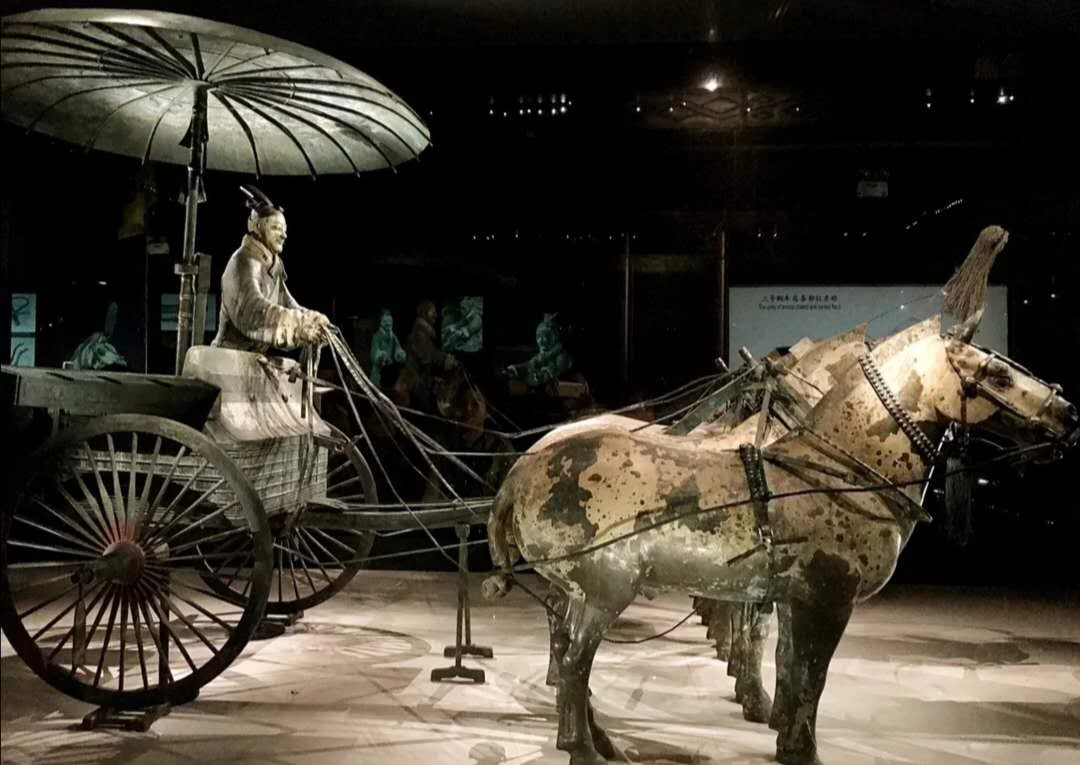
The best-preserved Terracotta Warrior unearthed to date, with only a single crack on the sole of its foot.
(5) About the musical fountain: it's right in front of Big Wild Goose Pagoda, with shows at 12:00 noon and 8:30 pm. I think it's more beautiful at night. The Great Tang All Day Mall is right next to the pagoda and also has lovely evening views.
(6) Shaanxi History Museum offers free tickets each morning with an ID card (for three exhibition halls; special halls require extra tickets). Officially, they say 2,000 tickets are available, but I feel there are actually far more than that.
(7) As for Tang Paradise, it's supposedly built on the site of an imperial garden, but it no longer carries the same aura. This season is a bit late to visit; it would probably be quite lovely in spring when flowers are blooming. We had gone specifically for the water screen movie at 8 pm, but were told it was canceled and replaced with a musical fountain. Since we had just seen one the day before, it felt like a total waste of the 120-yuan entrance fee. So, I suggest asking clearly when buying tickets. They also have a performance called 'Dream Back to the Tang Dynasty' inside, but the stage is rather small.
Don't take my comments on Tang Paradise as overly negative—I'm just being realistic. It's purely a profit-driven place.
b. Preparation: comfortable shoes, gloves (simple white work gloves will do; you can buy them at Mount Hua, and it's a good idea to get a pair), long sleeves plus a jacket (the jacket can be thicker, but don't overdress underneath), water, and dry food.
c. The temperature at the foot of Mount Hua is about 5°C lower on average than in Xi'an. By late October, temperatures up on the mountain are certainly below freezing, and with a bit of luck, it may already be snowing. While climbing, you'll sweat and feel warm, but as soon as you stop to rest, you'll get cold. If it snows, the trails become extremely difficult to navigate—even more slippery due to the steep slopes.
If you plan to climb up, you'll need to go via the North Peak. To come down, there are cable cars at both the North and West Peaks; you can decide based on your stamina, or you can climb back down. If you're fit, a route could be: ascend North Peak – South Peak – East Peak – descend West Peak.
If you want to take the cable car up, you'll go up from the West Peak.
e. About the Plank Walk in the Sky: it's located on the South Peak of Mount Hua. That day, because of snow and slippery trails, it took us five to six hours just to reach the junction between the West and South Peaks. Since we had to catch a high-speed train, we had to skip it due to time—a real pity, since that was the main reason we went. But we hadn't anticipated Mount Hua being this hard to climb; there were many sections where we literally crawled on all fours (hence the need for gloves).
g. In total, we spent 7.5 hours climbing Mount Hua, excluding the South and East Peaks. Many people climb at night, which has its pros and cons. You get to see the sunrise, but you miss the scenery along the way, and some of the more dangerous sections are closed at night—you'll only take relatively safe routes. After the climb, I highly recommend a foot massage; it makes the next day much more bearable!
We departed from Shanghai Pudong at 8:30 am and exited Xianyang Airport around 11:30 am. Taxis in Xi'an are actually quite easy to hail, and drivers rarely refuse passengers. It took us about an hour and a half to reach downtown Xi'an, where we stayed. Right downstairs was the famous 'Wei's Liangpi' shop, so we rushed down and ordered a serving. The texture was fantastic—chewy and satisfying—though as newcomers, we found the spiciness a bit hard to handle. But as my buddy put it, 'it hurts so good, hahahaha!'
On the way into the city, we caught a distant glimpse of the ancient city wall (photo below).
Wei's Liangpi – the taste is really great!
After filling our bellies, our first stop was the ancient city wall. A full-price ticket is 54 yuan, with half-price for students. You can enter through any gate, but according to our taxi driver, the South Gate is the main entrance to the Xi'an City Wall and is naturally more imposing than the others.
Xi'an City Wall, also known as the Xi'an Ming City Wall, is located in the city center. The wall is 12 meters high, with a top width of 12–14 meters and a base width of 15–18 meters. It forms a closed rectangular loop totaling 13.74 kilometers. The wall encloses the old city district. There are four main gates: Changle Gate (East Gate), Yongning Gate (South Gate), Anding Gate (West Gate), and Anyuan Gate (North Gate).
Once inside, we felt like wild horses set free and started snapping photos like crazy.
Once we actually got onto the wall, we immediately rented a bike. The prices were: tandem bike 90 yuan / 2 hours, single bike 45 yuan / 2 hours. I thought it was a fair deal. If you choose to walk, I'd recommend starting in the morning—even at a leisurely pace, it would take five or six hours. We pedaled like mad for an afternoon (I felt we went a bit fast, stopping occasionally to admire the view) and finished the loop in just under 2.5 hours. You can rent and return bikes at any bike station along the wall. We completed the entire circuit. Many sections of the wall were under repair, but you could still see the original appearance at the main gates.
After cycling the full loop, we strolled leisurely on the wall, marveling at the ingenuity and toil of ancient people. We tried taking a panoramic shot on the wall—unfortunately, I nearly ran myself ragged to get this result, but the skill has been acquired, so next time we'll do better!