Shaanxi, Gansu, Ningxia, Shanxi: A Journey Across Four Provinces in Northwest China (Shaanxi & Shanxi Chapters)
Arriving in Xi'an, the ancient capital of thirteen dynasties, at nine in the morning, we immediately called the car rental company to pick us up. For the first two days we rented a Borgward BX7, and on the last day we switched to a BX5—both nearly new, less than six months old. The BX5 was smaller with a 1.4T engine, but much nicer to drive.
The forecast called for light rain, but it only got heavier and more relentless as the day went on. The drive from the airport to the Museum of the Terracotta Warriors and Horses of Qin Shi Huang was over 60 kilometers, and by the time we arrived, it was almost noon, so we decided to grab lunch first. There were plenty of places to eat outside the museum, but they were just to fill the stomach—if you're after quality, head to the city center.
After satisfying our hunger, the rain showed no sign of letting up, so we had to tour the imperial tomb in the rain. In the square before the entrance stood a towering statue of Qin Shi Huang, but the downpour made taking photos impossible. Xi'an's two most popular attractions—the Terracotta Warriors and the Shaanxi History Museum—have no off-season; they're always packed with crowds.
After entering, take an electric cart (only one way) on the left to the museum, where you can learn all about the history and origins of the terracotta warriors. There's a saying: 'Above ground, look to Shanxi; below ground, look to Shaanxi'—especially in Xi'an, capital of thirteen dynasties. While most above-ground relics were destroyed by war, the underground treasures are so abundant that a casual shovel might unearth something valuable.
The Mausoleum of the First Qin Emperor is quite far from the Terracotta Warriors, and with the rain getting heavier, we decided to skip it at the last minute—a bit of a regret.
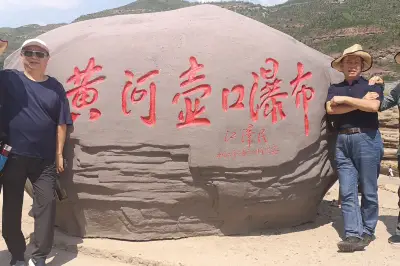
Next stop was Hukou Waterfall, famously known as 'the place where the Yellow River is gathered into one pot.' The drive was close to 300 kilometers, and after exiting the highway onto a section of national road, we joined the Yellow River Highway. Dubbed China's 'Route 1,' this road runs along the west bank of the Yellow River, from Yulin in the north to Huashan in the south, stretching over 800 kilometers and linking more than 50 scenic spots and historical sites. Along the way, the Yellow River scenery was endlessly charming and varied—truly a feast for the eyes. At intervals, lookouts by the roadside allowed travelers to pause and gaze out or down. The most beautiful scenery is always on the road.
At dusk, crossing the Qilangwo Yellow River Bridge, we entered Ji County in Shanxi Province. There are two options for viewing Hukou Waterfall: on the west side in Yichuan, Shaanxi, where the famous 'Yellow River Cantata' stage is located; or on the east side, which offers a broader view and allows you to see the full panorama of the waterfall cascading down.
We chose the Ji County side and had pre-booked 'Zaliang Yuzhuang,' a locally run agritainment that opened last year. On the ground floor is the restaurant, and on the second floor are accommodations, all very clean. The owner and his wife were incredibly warm; they drove us up the mountain road to the highest point, where we could overlook Hukou Waterfall from above—a privilege you'd never get on a group tour. That made us especially glad we'd made the right choice. In the evening, the owner cooked us a special Yellow River carp dish, which was so delicious we devoured it in no time.
Early the next morning, we drove to Hukou Waterfall. The early bird catches the worm, and we saved 100 yuan on the sightseeing shuttle. The gate was locked tight, and we didn't encounter the rumored 'forgotten unlocked gate' — haha, so no saving on the admission ticket.
Once the staff were on duty, we were among the first to enter, and the sight before us was awe-inspiring. It was like ten thousand galloping horses, the earth shaking—the Yellow River rushes here, the channel abruptly narrows, and the raging water pours down, swallowing mountains and rivers. Now, in the season of abundant flow, the river, laden with silt, funnels into the mouth, roaring down and throwing up towering waves and mist like clouds of smoke—enough to startle heaven and move the gods.
Below the viewing platform there is a 'Dragon Cave' which, during the dry season, allows you to enter and gaze up at the waterfall from below—a drop of over fifty meters. Now, because the water is too powerful, it's temporarily closed. Across the river is the stage for the 'Yellow River Cantata.' Eighty years ago, with lyrics by Guang Weiran and music by Xian Xinghai, this cantata became the strongest voice in the fight against Japanese aggression and for national salvation, inspiring countless Chinese to sacrifice themselves for their country. You could say the Yellow River is the very soul of our nation.
Like all tourist sites in China, some commercialization is unavoidable. Local people, wearing white headscarves and lamb-skin vests, lead donkeys for tourists to pose with in local costumes, snapping a photo with the waterfall—except, donkeys seem a bit petty; you'd want a tall horse instead.
After Hukou Waterfall, we drove over 160 kilometers to the Mausoleum of the Yellow Emperor. This is the burial place of the Chinese nation's ancestor—Xuanyuan Huangdi—a sacred site for the descendants to pay respects and seek their roots, located in Huangling County, Yan'an. The scenic area is divided into two parts: Xuanyuan Temple and the Yellow Emperor's Mausoleum Garden.
A two-hundred-meter walk from the parking lot brings you to the entrance of Xuanyuan Temple. Inside, the first thing that catches your eye is a towering, emerald-green cypress so tall it seems to pierce the clouds. A stone tablet beneath it says the tree was planted by the Yellow Emperor himself over five thousand years ago—a truly breathtaking sight. In front of the main hall stands another cypress, scarred with age, known as the 'Armor-Hanging Cypress,' where Emperor Wu of Han (Liu Che) is said to have hung his armor after returning from an inspection tour of the northern frontier. In the stele pavilion, there are more than fifty stone tablets from ancient to modern times, with inscriptions left by Sun Yat-sen and Mao Zedong as memorials. At the rear of Xuanyuan Temple is the majestic public memorial hall, where many dignitaries have paid homage to ancestor Huangdi.
Continuing onward, you soon come across a high platform—the 'Hanwu Immortal Terrace.' Throughout history, people's most persistent wish has been for immortality and a place among the immortals, and Emperor Wu was no exception. Legend has it that each time you climb this platform, you extend your life by a year. Further on is the tomb of the 'Cultural Progenitor'—the Yellow Emperor. Incense smoke curls thickly here, a sign that worshippers come often. Ancient trees tower above, and the solemn atmosphere lets you feel the profound cultural heritage.
In the morning, I went alone to Xianyang Airport to swap the car for a BX5, then headed straight to Mao Mausoleum. 'The lord of Mao Mausoleum, a traveler in the autumn wind; he hears horses neigh at night, but by dawn leaves no trace.' Mao Mausoleum is the tomb of Emperor Wu of Han, Liu Che. It is the largest and most richly furnished of all Western Han imperial tombs. Historically, it was looted many times—so it's a pity that such a heroic emperor was desecrated by petty thieves after his death.
Mao Mausoleum is about 30 kilometers from the airport. There are many imperial tombs in Xianyang, such as the Chang Mausoleum of Han Gaozu, the Yang Mausoleum of Emperor Jing, the Zhao Mausoleum of Tang Taizong, and the Qian Mausoleum—the only joint tomb of an emperor and empress, for Tang Gaozong and Wu Zetian. I chose only Mao Mausoleum out of sheer admiration for Emperor Wu's cultural and military achievements.
The area is divided into a museum and the mausoleum garden, about a kilometer apart. I visited the museum first; the vast site had only me as a visitor. The centerpiece here is the 'Tomb of Huo Qubing.' Huo Qubing was Emperor Wu's most beloved general. Though he died at just 24, his achievements were earth-shattering. Ban Gu's 'Book of Han' praised him: 'The champion of the swift cavalry, a whirlwind of valor. He rode far and attacked six times, like thunder and lightning. He watered his horses at the vast desert, performed the Feng sacrifice at Langjuxu Mountain. He brought the Hexi Corridor under control and established commanderies in Qilian.' Before his tomb, incense burned steadily, and fourteen stone carvings were displayed, most notably 'Horse Trampling a Xiongnu Warrior,' symbolizing the brief but brilliant life of the 'Marquis of Champion.' He was truly a genius born once in a century; had he not died so young, who knows how far he would have driven the Xiongnu.
I had heard that Wei Qing's tomb was also here, but I searched high and low without finding it. Asking a staff member, I learned it was just behind a wall in a wild field. Wei Qing, of humble origin, was once a slave to Princess Pingyang. Later, his sister Wei Zifu caught Emperor Wu's eye and won his favor, allowing Wei Qing to rise through his sister's status. He achieved great feats in the northern campaigns against the Xiongnu. Yet, both were great generals, and Huo Qubing was even Wei Qing's nephew—so why the stark difference in their posthumous treatment? It wasn't because Emperor Wu was ungrateful; rather, the Wei family crossed the emperor's ultimate red line by getting involved in the succession struggle for the crown prince. As for Wei Qing's death, officially from illness, many historians believe he died from anxiety caused by the emperor's suspicion. One tomb is bustling with incense and visitors, while the other is overgrown with weeds and neglected—a tragic contrast, truly epitomizing the saying, 'Being close to the emperor is like being close to a tiger.'
A kilometer away is Mao Mausoleum Garden. It was once encircled by walls, but these were destroyed long ago by tomb robbers over the centuries. Now only two stone tablets remain, hinting at its owner's illustrious identity. Emperor Wu's cultural and military achievements need no elaboration, but his later years were a mix of praise and blame. The countless burial treasures naturally attracted covetous eyes, especially that of Dong Zhuo at the end of the Han dynasty, who not only looted the tomb but even exposed the emperor's corpse to the elements—truly detestable.
By the time we returned to Xi'an, it was noon. We had lunch with family at 'Hutu Ji' next to 'Guanzhong Inn'—a well-known local restaurant specializing in Shaanxi cuisine. Dishes like Gourd Chicken, Gaoling Oil Pancakes, Guanzhong Four Treasures, and Ziyang Steamed Pot were authentic and highly recommended.
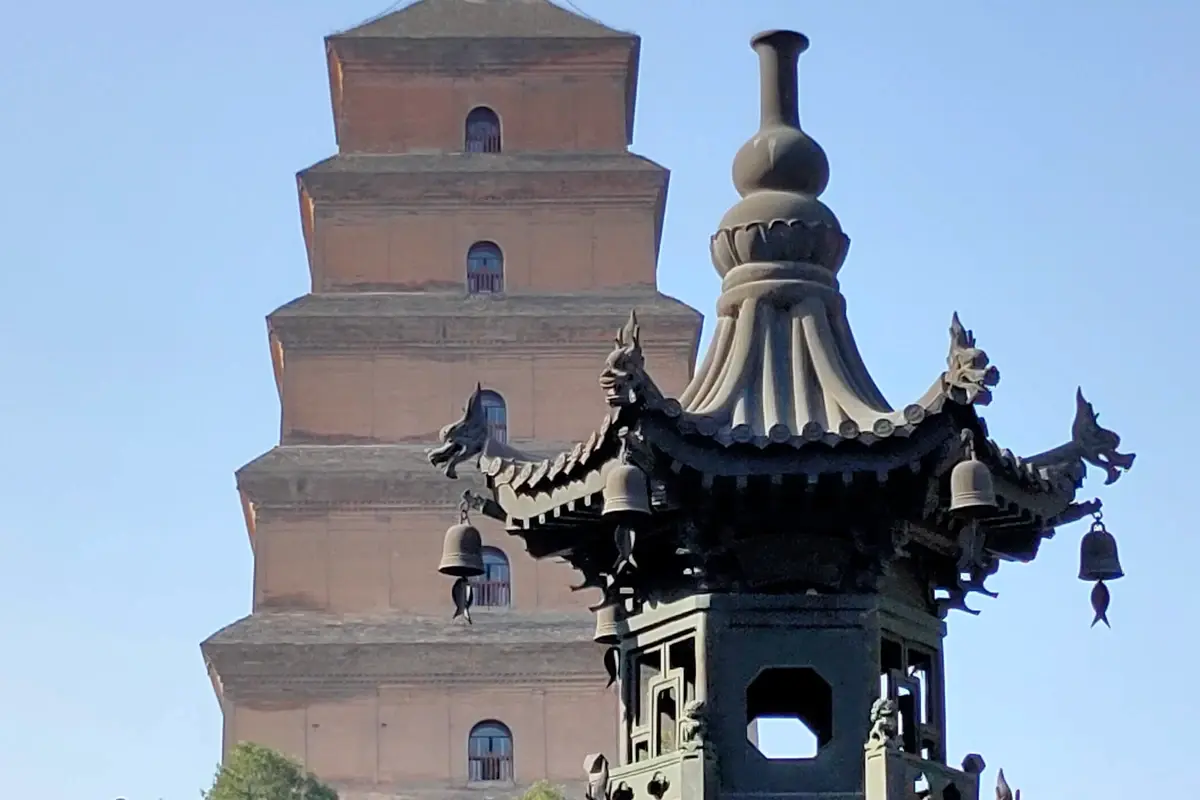
In the afternoon, we decided to visit the Giant Wild Goose Pagoda. Other places like Tang Paradise are all modern constructions and not very interesting. The pagoda is within the Daci'en Temple in the south of Xi'an. It was built under the supervision of the Tang Dynasty monk Xuanzang after he returned from his journey to the West, and he spent eleven years here sorting Buddhist scriptures and preaching. In the square before the temple stands a statue of Xuanzang. Inside, the Giant Wild Goose Pagoda is at the rear; you can buy an extra ticket to climb it.
After dinner at the nearby 'Yuanjiacun Guanzhong Impression Experience Zone,' the night fell and the lights came on, and the Great Tang Ever-Bright City came alive. Lights streamed everywhere, trees sparkled like silver, and crowds thronged. It was just as down-to-earth as the Muslim Quarter we had strolled the night before.
Tomorrow morning we'll fly back to Nanchang. Over ten-plus days, we've covered four provinces. The most beautiful scenery is always on the road. Life isn't just about the mundane—there's poetry and distant places too.