Exploring Lintong and Mount Hua with Old Xia — A Free-and-Easy Tour
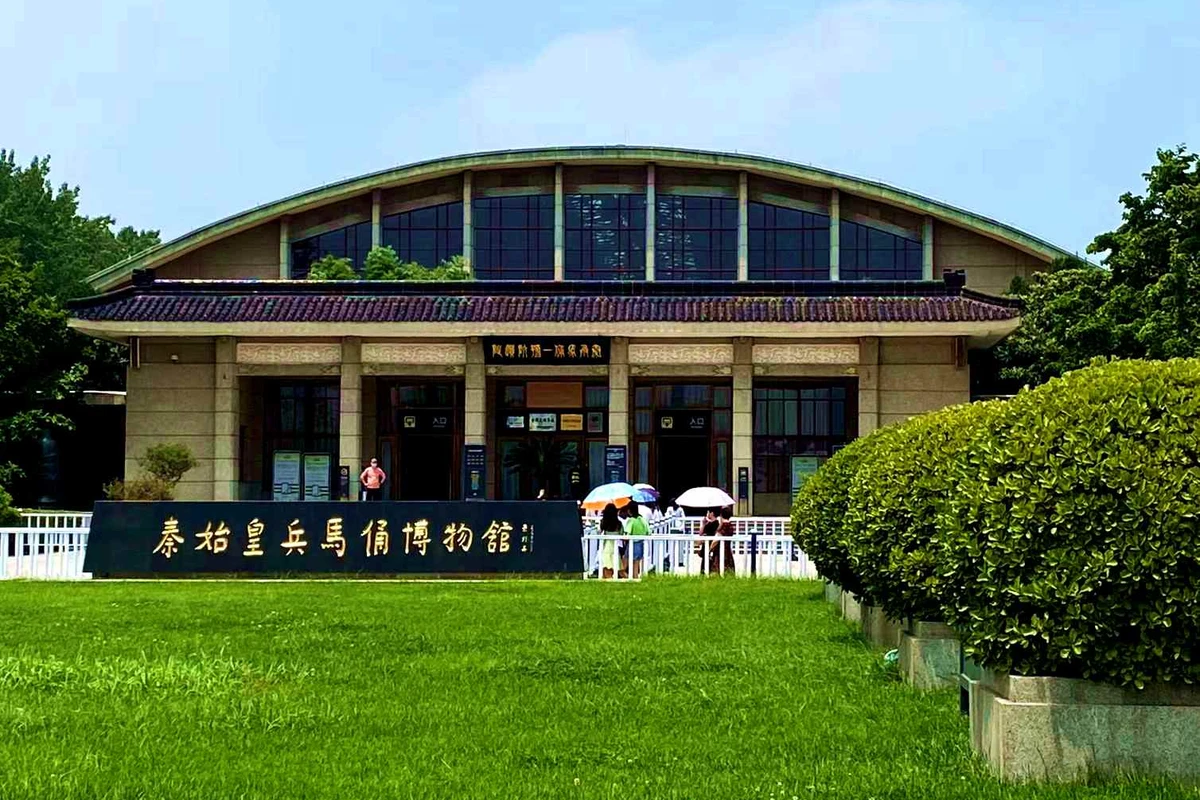
Today we start our journey around Xi’an. First up: the Emperor Qinshihuang’s Terracotta Warriors and Horses Museum. It’s located 1.5 km east of Qin Shi Huang’s mausoleum in Lintong District, Xi’an. The complex is huge, with striking architecture and thoughtfully landscaped grounds planted with trees and flowers — tranquil, elegant, and fronted by a magnificent entrance gate.
The entrance ticket costs 120 yuan. Also known simply as the Terracotta Army, this site is a burial pit of the First Emperor’s tomb and together with the mausoleum forms the Qin Shi Huang Mausoleum Museum. Often called the Eighth Wonder of the World, it yielded over a thousand life-sized pottery soldiers, each with distinct facial expressions and lively postures — a shining gem of ancient Chinese sculpture and hailed as one of the greatest archaeological discoveries of the 20th century.
The Huaqing Palace Scenic Area lies 30 km east of Xi’an, right next door to the Terracotta Warriors. Renowned for its timeless hot-spring resources and a long list of historic events, it has become an iconic cultural-tourism landmark of Tang-dynasty palace life. Ticket: 120 yuan.
Huaqing Palace was a detached palace where Tang emperors came for pleasure. Later it was also called Huaqing Pool and is located in Lintong District, Xi’an. Including the former Lishan National Forest Park, it shares the title of one of China’s Four Great Imperial Gardens along with the Summer Palace, Old Summer Palace and Chengde Mountain Resort. Built against Mount Li and facing the Wei River, the grand complex clings to the slopes, its towers, halls and pavilions scattered all over the mountain. Originally named Hot-Spring Palace, it was later renamed Warm-Spring Palace, and Emperor Xuanzong of Tang finally gave it the name Huaqing Palace. Because it sits on Mount Li, it was also called Li Palace, Li Mountain Palace or Xiuling Palace. Construction began in the early Tang period and reached its peak during Xuanzong’s reign. He lavished care on this magnificent retreat and came almost every October, returning to Chang’an only at year’s end. After the An Lushan Rebellion, the political situation changed abruptly, visits declined sharply, and later emperors rarely came. Successive dynasties did some maintenance, but by the mid 20th century the pools lay dilapidated and the halls desolate. The People’s Government has carried out large-scale expansion since 1959.
Inside Huaqing Palace, you’ll find the Tang Imperial Soup Relics Museum, the Five-Room Hall — a site linked to the Xi’an Incident, the Jiulong Lake and Furong Lake scenic areas, the Tang Pear Garden Site Museum, and such signature buildings as Feishuang Hall, Wanshou Hall, Changsheng Hall, Huanyuan Garden and King Yu Hall. Mount Li rises to 1,302 metres above sea level, dotted with the Laomu Temple, Laojun Temple, Beacon Tower, Bingjian Pavilion (the Remonstrance Pavilion), Stone Urn Temple, Immortal-Encounter Bridge, and more. ‘Mount Li in the Evening Glow’ is counted as one of the ‘Eight Famous Scenes of the Guanzhong Region’.
Next, we went to Qianling Mausoleum. One of the eighteen Tang tombs in the Guanzhong region, it’s located on Liangshan Mountain, 6 km north of the county seat of Qian County, Xianyang City, Shaanxi Province. This is the joint tomb of Emperor Gaozong (Li Zhi) and Empress Wu Zetian, covering over 30,000 mu (approx. 20 sq km). The mausoleum was completed in the first year of the Guangzhai reign (684 AD), and the covering was added in the second year of the Shenlong reign (706 AD). Following the ‘mountain-as-tomb’ method, the tomb precinct imitates the layout of the Tang capital Chang’an. Besides the main tomb, there are seventeen smaller satellite tombs for other royal family members and meritorious officials. Qianling is the best-preserved main tomb among the eighteen Tang imperial tombs and the only one never plundered. On 4 March 1961, it was declared a Major National Historical and Cultural Site by the State Council.
In the first year of the Hongdao reign (683 AD), Wu Zetian ordered Wei Daijia, Minister of Personnel, to oversee the project. Emperor Gaozong was buried in August the following year, after which construction continued. In May 706 AD, Emperor Zhongzong had Wu Zetian interred. A year earlier, he had pardoned royal relatives persecuted under Wu Zetian’s rule and reburied them with full honours, among them Princess Yongtai (Li Xianhui), Crown Prince Yide (Li Chongrun) and Crown Prince Zhanghuai (Li Xian). Additionally, in 706 AD, satellite tombs were built for Prince Xu (Li Sujie), Prince Ze (Li Shangjin), Princess Yiyang (Li Xiayu) and others.
According to the ‘Tang Huiyao’ records, during renovation in the 14th year of the Zhenyuan reign (798 AD) of Emperor Dezong, 378 rooms were built. At the end of the Tang dynasty, during Huang Chao’s rebellion, Huang Chao deployed 400,000 troops to plunder the tomb. They dug a trench over 40 metres deep but never found the tomb passageway, and had to withdraw in frustration. To this day, a deep gully known as ‘Huang Chao Trench’ remains on the west side of the main peak of Liangshan.
During the Five Dynasties period, Wen Tao, military governor of Chongzhou under the Later Liang, sent his troops to excavate all Tang imperial tombs. ‘Every Tang tomb in his jurisdiction was opened; their gold and treasures were taken… Only Qianling, though attempts were made, could not be opened because bad weather always arose.’ Qianling was saved by its solid construction.
We then went to Famen Temple, also known as Fayun Temple, located in Famen Town, Fufeng County, Baoji City, Shaanxi Province. It is hailed as the ‘ancestor of pagoda temples in the Guanzhong region’. According to legend, it was first built in the 11th year of the Yongping reign (68 AD) of Emperor Ming of the Eastern Han. Before the Zhou and Wei dynasties it was called Ashoka Temple, in the Sui dynasty it was renamed Chengshi Daochang, and in the early Tang it acquired the name Famen Temple. Known as a ‘royal temple’, it became a national centre of Buddhist pilgrimage because it enshrined the finger-bone relic of Sakyamuni Buddha.
This is Mount Hua (Huashan). Also known as Flower Mountain or East Mount Hua, it lies within Zhangyuan Township, 16 km north of Qinxian County seat. The ranges here are gentle and rolling, with graceful, emerald-green ridges stretching for tens of square kilometres. Only the main peak rises abruptly to 1,300.2 metres above sea level. At the summit, trees enfold an ancient temple; the rocks all around, weathered by wind and rain through the ages, are grotesquely shaped and steep as if sliced with a knife. A poem describes it: ‘A green lotus bloom hewn against the sky, could this be the foremost peak of Penglai? Jagged boulders crouch like tigers and leopards, wind-twisted pines spring up like dragons.’ The mountain is covered with rare flowers and unusual plants. From top to bottom, ancient temples and shrines stack upon one another, while a divine spring bubbles forth at the foot — a scene straight out of a fairyland. It is especially celebrated for its spring camellia blossoms (the only place in the Shangdang region where they grow). Historically, ‘Layered Green of Hua Peak’ was ranked first among the ‘Tongge Eight Scenes’.
On the western side of the main peak, from bottom to top, you’ll find the Jingye Nunnery, a stage, a pool, the Divine Spring, stone steps, and the Temple of the Holy Mother. According to inscriptions, they were all rebuilt in the first year of the Daoguang reign (1821). The Divine Spring contains a variety of minerals that replenish elements missing from the human body. In ancient times, people built the Temple of the Holy Mother above it, signifying that the spring water was a gift from the Holy Mother. In front of the temple they added the Jingye Nunnery as a place for female devotees to cultivate themselves, and later expanded the complex and added a stage and other auxiliary structures.
Two hundred metres up from the Divine Spring, you reach the mountainside, and the only way to the summit starts here. Precipitous cliffs rise on all sides — a dramatic sight. Winding upward and passing through the ‘One Heavenly Grotto’ gate, you arrive at Zhenwu Temple, a timber-and-stone structure facing south, three bays wide and deep, in Ming-dynasty style. By the right side of the gate stand several steles, including ‘Record of Reading the Canon and Constructing the Western Paradise Scenery at Mount Hua’ and ‘Record of Building the Sutra Repository.’ About ten metres up to the right behind Zhenwu Temple is the Jade Emperor Temple, demolished during the War of Resistance Against Japan, but its ruins remain, with three steles kept in the corridors. Further up behind Zhenwu Temple lies the summit, where, built into the terrain, stands a square, pagoda-shaped Laojun Temple (also called Laojun Peak) of brick and stone. From the outside it appears to be two storeys, but inside the structure opens into clear pavilions with exquisite workmanship and strong local character.
About 75 metres down the northern side from the summit there is the Bone-Wrapped Shrine of Wang Xianweng, a stone structure. According to legend, after the eminent monk Wang Xian — who oversaw the construction of the summit buildings during the Ming dynasty — entered nirvana, devotees plastered his mortal remains with clay to form a statue and enshrined it here, giving the shrine its name. Mount Hua is blessed with beautiful scenery and temples nestling among the trees. Climbing to the top feels like stepping into an immortal realm; looking down, the whole city of Tongge lies at your feet. As one poem praises: ‘Many mountains crouch before this rugged peak, the heavens carve a blue lotus rising emerald.’ After its complete restoration, this scenic area will become a major tourist destination in the Shangdang region.
Mount Hua (the famous one with the cable cars) has several cable car routes. Usually, visitors take the West Peak cable car up and descend from the North Peak — the most relaxed option.
Shaanxi has so many wonderful places to explore. Time was limited, so this is all we could manage.