A Weekend Escape to Shijingli: Exploring the Language of Literature
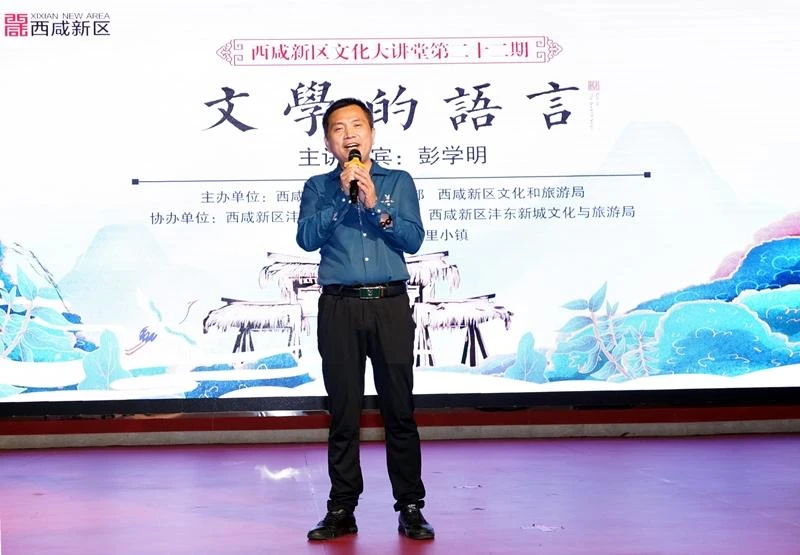
The reeds grow green and thick, the white dew turns to frost. In this lovely season of boundless autumn breezes and crisp mountain air, Shijingli Town hosted the 22nd Xixian New Area Cultural Lecture, themed "The Language of Literature." Renowned scholar, writer, and literary critic Peng Xueming took culture lovers on an inspiring journey into the art of literary thought.
Opening the lecture, Peng Xueming said, "The Book of Songs is the most beautiful literature in Chinese history, and its language is the most beautiful language of Chinese literature. I never imagined I would be invited here, in the birthplace of the Book of Songs, to speak about literary language and exchange ideas with all of you. I believe this is fate, asking me to join you in passing down the literary and artistic beauty of the Book of Songs."
Drawing on his own experience in literary creation, reading, and editing, Peng Xueming shared his reflections on the beauty of Chinese literary language in a simple yet profound way. He combined clear analysis with excerpts from masterworks, leading the audience to appreciate the vitality, energy, and poetry of words. The lecture was frequently interrupted by enthusiastic applause.
Peng Xueming said, "The beauty of Chinese literary language falls into two broad camps: the beauty of phonetics and the beauty of context." On phonetic beauty, he explored three dimensions: one-directional, multi-directional, and bi-directional. He explained that one-directional phonetic beauty is a plain, elegant charm, much like everyday small talk or plain vernacular — but not empty chatter. It is like a line drawing that still reveals colour, or a cup of weak tea that still has flavour.
He then read and analysed a classic essay, "The Idler," by Jia Pingwa:
"Nobody quite knows when idlers first appeared in society.
Idlers always wear a grin. 'Hey, mate!' He'll come skipping over, shoes half on, a t-shirt thrown over his bare torso, unbuttoned — or else dressed to the nines in a Western suit and tie. In short, they go to extremes in dress, but still want to exude style. They look down on the man with a dirty shirt under a black wool Zhongshan jacket, and sneer at the one who buttons up his suit but wears cloth shoes. When they put on a peaked cap, many scholars stop wearing theirs; when they hang sunglasses on a shirt button, many actors give up the look. 'Long time no see, mate, how about a treat?' they call out, not in a begging tone, and toss over a fancy cigarette. They light one for themselves and start talking about how so-and-so lives way too seriously, face forever creased with worry, as if bearing the world's troubles, or laugh at another who always greets you with 'Are the old folks well? The kids good?' Finally they chat about the weather, the cigarette wagging at the corner of their mouth, now and then blowing an enormous smoke ring, while the little toe in one slipper flicks open and shut."
— excerpt from "The Idler"
"Jia Pingwa's 'The Idler' has a light tone, the language is plain and unadorned – no heavy-handed brushwork, yet it penetrates the page. His words give life to a frank, vain, yet somewhat helpful idler: a figure utterly carefree and cheerful, vividly sketched with just a few strokes," Peng commented.
He then moved to the second kind of phonetic beauty — gorgeous, poetic beauty — through Bi Feiyu's novella "Corn." "The language of poetic beauty is the most creative and imaginative, the most dynamic, vivid, and lyrical. It is radiant, colourful, brilliant, and deeply emotional."
The third type of phonetic beauty he shared was delicate and graceful beauty. Peng explained that such language has a musical line and a curve; it is graceful, winding, and full of twists and turns. A skilled writer can bring out this beauty through well-arranged rhythms, rises and falls, and a natural flow of long and short, fast and slow.
The fourth and fifth types — bold and expansive, and fresh and bright — along with the sixth, majestic and steady, were also discussed. Bold and expansive language, with its sense of openness, distance, and elevation, gives readers the feeling of a great river rushing open and closed, much like Shi Tiesheng's "I and the Temple of Earth," which is remarkably open and expansive.
Fresh and bright language is crisp, clean, and refreshing, like the morning after rain, when water drips from the eaves onto tips of grass sparkling with dew.
Peng Xueming's lecture delved into the six layers of one-directional phonetic beauty, offering the audience a literary feast. His talk on bi-directional beauty, blending linguistic signs and hybrid charm, also won widespread praise and left the audience feeling enriched.
Yang Binbin, Deputy Director of the Publicity Department of the Xixian New Area Party Working Committee and Deputy Director of the Culture and Tourism Bureau, said: "The Xixian New Area Cultural Lecture is committed to 'promoting traditional culture and revitalising literary classics.' With its rich content and diverse forms, it has become a beloved cultural IP. Xixian New Area is endowed with abundant cultural resources from the Zhou, Qin, Han, and Tang dynasties, and it was here that the first collection of Chinese poetry, the Book of Songs, was born. Over a millennium later, the country's first thematic cultural town centred on the Book of Songs has been built and opened, tirelessly passing down fine traditional Chinese culture. Here we can deeply experience the ten elegant joys of life: music, chess, calligraphy, painting, poetry, wine, flowers, incense, tea, and ritual."
She continued, "Today we are privileged to listen to renowned scholar Peng Xueming share 'The Language of Literature.' Through beautiful language, wonderful stories, classic excerpts, and profound life insights, Teacher Peng has presented us with a rich cultural feast."
Indeed, a single conversation with a wise person can surpass ten years of reading.
Peng Xueming's talk not only invited the audience into Shijingli, but also into the graceful heart of literary language. His analysis of words and sentences let everyone appreciate the elegance and charm of the written word.
Wang Hai, Vice Chairman of the Shaanxi Writers’ Association and Chairman of the Xixian New Area Writers’ Association, said: "Listening to Teacher Peng was a delight. One lecture is worth a decade of reading. His language is vibrant, spirited, and alive. He gave the writers of Xixian a wonderfully witty and lively literary lesson."
Du Fangchuan noted: "Teacher Peng's teaching was lively, moving, and touched the soul. Through 'Why Literature Shines,' he released the warmth, heat, depth, and strength of literature. Through 'The Language of Literature,' he illuminated the unique charm of Chinese writing, making words vivid, fresh, and touching. Listening to him has been hugely beneficial, able to fuel the passion for life and creative spirit of those chasing their literary dreams, and helping literature lovers release their life’s enthusiasm and positive energy."
Mr. Zhou remarked: "With witty language and textual evidence, Teacher Peng explained to us Xixian writers the importance of phonetic and contextual beauty, making us all the clearer about how to 'strive for lines so stunning they hold you breathless.'"
Mr. Li said: "Peng Xueming's brilliant lecture furthered our understanding of the charm of the Chinese language and a writer's most basic duty: to master the linguistic gate. While immersing oneself in life, one must first understand and grasp the characteristics of words, continuously learn, practise writing, and build a command of language. Like a marshal or general, a writer must be able to move and assemble words to make them more vivid, living, and expressive, enhancing the work’s appeal and touching readers with original, creative phrasing."
Ms. Zhang added: "Teacher Peng's sharing greatly inspired me. It made me realise even more that outstanding literary works come from life, yet they are more refined and profound than real life. Only when a writer can turn simple life details into absorbing reading, and describe ordinary scenes so beautifully they captivate the imagination, can a work reach true excellence."
I will end with a quote from Peng Xueming: "Whether you love literature or not, whether you engage in literary creation or not, I sincerely hope everyone will truly read literature — read more books, more literary works, especially the good ones. Let beautiful literature enrich our lives, so that our lives are filled with poetry and song!"