A 6-Day Travel Guide to Xi’an and Huashan
Departing from Beijing on the evening of August 5, 2020, arriving back on the morning of August 13, 2020. Excluding train travel time, that makes 6 days. I explored the city of Xi’an and the Huashan (Mount Hua) area.
This was a spur-of-the-moment trip that happened to coincide with the rainy season, forcing the temporary closure of Huashan’s trails. I had to make all kinds of last-minute adjustments to my itinerary, and it was full of improvisation and little surprises.
1. Planned Itinerary
August 5: Take the 8:40 p.m. sleeper train (so I didn’t miss that day’s work and used one fewer vacation day).
August 6: Arrive in Xi’an in the morning, visit two or three sights in the city, then get to the Yuquan Temple (Yuquanyuan) at Huashan before 4:00 p.m. Buy some food and drinks for the ascent, then scout out the route to the mountain gate in advance. The Yuquan Temple is along the way, so it’s better to enjoy it that day instead of using time the next day.
August 7 (Friday): Head up the mountain first thing. Friday might have fewer visitors. Stay overnight at the Middle Peak. Roam the various peaks: because I planned to watch the sunset from the West Peak and check out the East Peak for the sunrise the next morning, in theory I should have covered all the main summits. If time is tight, the two famous cliff-side attractions—Harness Flip (Yaozi Fanshen) and the Long Sky Plank Walk (Changkong Zhandao)—might be closed, so I’d leave them for the following morning.
August 8: Get up early, watch the sunrise from the East Peak, revisit any spots I missed the day before, then descend. Head straight to Xi’an and visit the Grand Tang Dynasty Ever-Bright City (Datang Everbright City).
August 9: Explore Xi’an city, take a night train, and arrive back early the next morning (Monday) to go straight to work.
2. Actual Itinerary and Tips
August 5 (Wednesday)
Took the 8:40 p.m. sleeper. Booked a hiking entry ticket for Huashan on the 7th via Ctrip, 160 yuan.
August 6 (Thursday)
Arrived in Xi’an in the morning. At the train station, I bought a shared-bike monthly pass (10 yuan). First, I cycled about 3.5 km to the Qingzhen Yijunzhai Paomo Restaurant (northeast corner of Wenjing Road and Longshou North Road) for a lamb paomo (flatbread soaked in lamb soup). There was hardly any crowd, the taste was fragrant, and it kept me full until evening when I finally felt a bit hungry. The restaurant had an adorable little kitten. While eating, it started raining—not heavy but steady. I waited a bit, then put on a disposable rain poncho and set off again.
I planned to visit the Muslim Quarter (Huimin Street), about 4 km away by bike. I intended to enter from Sajinqiao Road, but there were too many stalls and crowds, so I turned around and gave up. I thought of heading to the Giant Wild Goose Pagoda, but on the way I passed Lianhu Park, where lotus flowers were in full bloom. I went straight in for a stroll—adding an impromptu stop.
Around 1:30 p.m., I cycled to the Fangzhicheng Bus Station in the east (13 km). Many roads in Xi’an were under construction; bike lanes sometimes ran alongside the road, sometimes jumped onto the curb next to the sidewalk, constantly squeezed and encroached upon. I took a coach to Huashan’s Yuquan Temple, arriving at 4:30 p.m. Found a small family-run inn (80 yuan), then went to the big supermarket at the northwest corner of the crossroads at Yuquan Road to buy water and snacks for the next day.
After dropping off my things, I visited Yuquan Temple at the foot of Huashan, then wandered all the way to the Huashan gate. Just as I was admiring the clouds and mist among the mountains, I received a message from Ctrip: due to a forecast of heavy rain the next day, the scenic area would be closed, reopening time to be announced. So I had to change my plans on the fly and head back to Xi’an first thing in the morning. I quickly searched for sights online and pre-booked a free ticket for the Tang Paradise through its official WeChat account.
August 7 (Friday)
Took the high-speed train back to Xi’an. Tang Paradise, a 5A scenic area, was actually free (from August 1, 2020, Xi’an Tang Paradise is open free of charge, 9:00–22:00). The park is huge, and many buildings house Tang Dynasty murals and exhibitions. Various shows take place in its sub-districts at different times. We caught an intangible heritage Dongcang drum music performance, a musical fountain show, the drama “Thousand-Autumn Birthday Banquet,” the Imperial Guard cavalry patrol, and dancers in the Hu Ji Tavern area gently swaying on a small bridge. Many girls in Hanfu (traditional Chinese dress) were ambling about with little fans, blending beautifully with the scenery. In the evening, we sat facing the musical fountain and watched the “Dreams of the Great Tang” light show from a distance (show tickets ranged from 300 to 600 yuan, with VIP seating on boats).
Around 9:30 p.m., we exited the park and walked about 1 km west to the famous Grand Tang Dynasty Ever-Bright City pedestrian street, which stretches over 1 km from south to north. I recommend walking south first—it’s lively and bustling. I especially loved the lanterns hanging from the trees, like fiery blooms against the night sky. From a distance, I heard a roar of voices—turns out it was a voice-activated fountain, and visitors were shouting at the top of their lungs, having a blast. All along the way were performances and snacks, the lights dazzling both north and south, all the way to the entrance of Daci’en Temple. We finished exploring around 11:30 p.m.
August 8 (Saturday)
Visited the Xi’an Museum. Originally I wanted to go to the Shaanxi History Museum, but checking their official WeChat account I learned that free tickets for the permanent exhibitions must be booked 5 days in advance, and the paid Tang Dynasty Treasures and Mural Hall tickets 3 days ahead, with 6,000 tickets released daily at 6, 7, 8, 9, and 10 p.m. on the hour, 1,100 slots per time. The free tickets were completely gone, and as soon as the paid tickets were released, the good time slots quickly vanished. And then there was the Monday closure. I figured I had to visit anyway, so I might as well aim for Tuesday. I set my alarm—could I really fail to snag one? Luckily, Xi’an Museum didn’t have such restrictions, so I booked for the 8th and took my time exploring. The Xi’an Museum mainly presents the historical changes of Xi’an city and various unearthed artifacts. Around noon, I confirmed that Huashan had reopened, so I quickly booked a guesthouse on the mountain for that night and reserved a hiking entry ticket for the 9th. After leaving the museum, I cycled to the Drum Tower. Right behind it is the Muslim Quarter, so I went in for a spin, making up for missing it the first day. Then I checked out the Bell Tower. In the evening, I took a high-speed train to Huashan and bought supplies for the next day’s climb.
August 9 (Sunday)
Entered the mountain gate at 7:30 a.m. to begin the hike. Followed the classic “one path since ancient times up Huashan.” There are plenty of signs, so just follow the route. At each pass, there are markers showing the distance and estimated time to other scenic spots—very clear. Originally I planned to stay at the Middle Peak, but ran into hikers coming down who said the accommodation there was closed. To watch the sunrise, I changed to the East Peak. From the mountain gate, past Wuli Pass to Qingkeping, there are vendors selling water and snacks along the way; if you’re carrying little, you can restock anytime. Prices start at 10 yuan for 4 bottles, then gradually become 3 bottles, then 2, and near the summit, it’s 11 yuan per bottle.
Following the route, the early part wasn’t too bad, just mountain steps. After Huixin Stone (“Turning Back Stone”), things got challenging: Qianchi Gorge and Baichi Tower, like a steep path split through the mountain. Further on was Laojun Plough Ditch, with over 300 continuous steep steps, each step narrow. But after these, the North Peak was not far ahead. On the way to North Peak, there’s the Sky Ladder—stairs chiseled into a rock face that can fit about five or six people. A few steps have a slightly negative angle; you need to grip the iron chains on both sides tightly and climb up. For the timid, there’s a detour with winding stairs nearby.
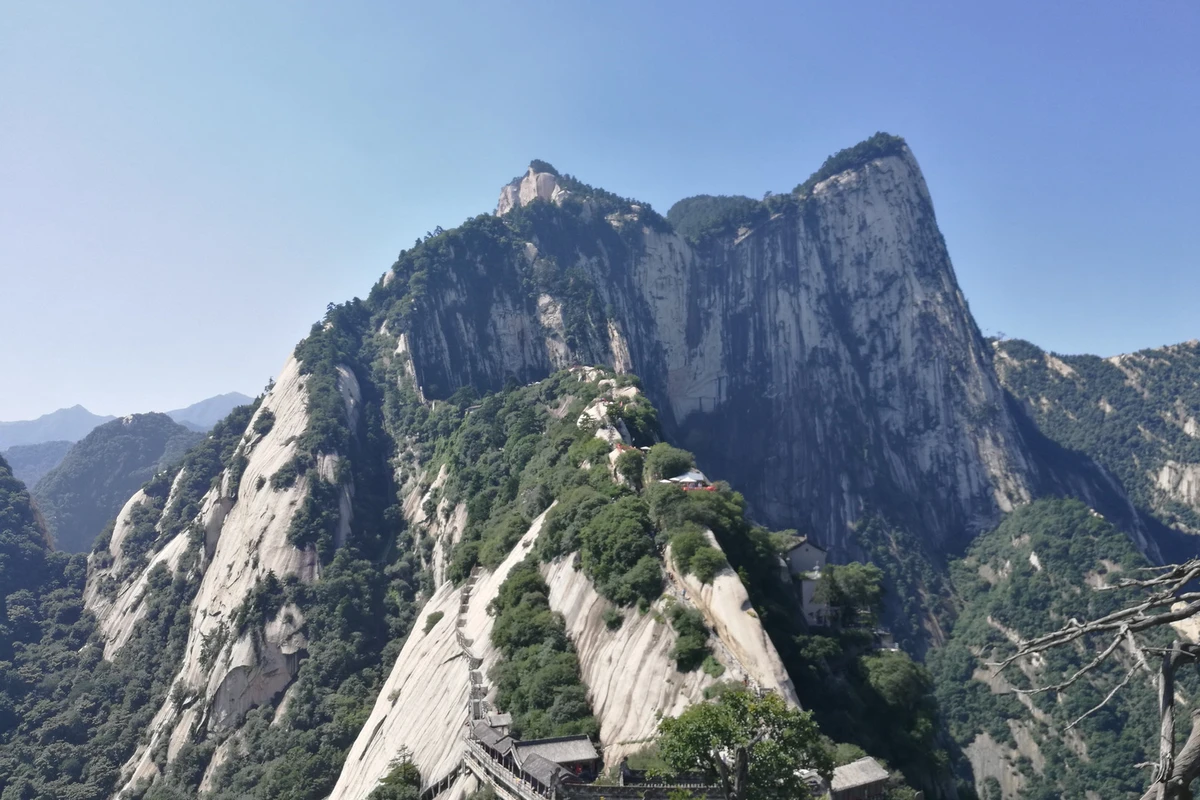
Looking out from North Peak, on the Canglong Ridge, it seemed as if people were walking along a spine, with cliffs on both sides.
From North Peak to Canglong Ridge to the Golden Lock Pass, you have two choices: go west towards the West Peak direction, or go east towards the Middle and East Peaks. Since finding lodging was the priority, I chose east, heading toward the East Peak. The East Peak Hotel had dorm rooms with five bunk beds, 10 people, 160 yuan per bed—a bit like a youth hostel. After reserving a bed and dropping unnecessary gear, I immediately queued for Harness Flip, which costs a 30-yuan safety harness rental fee. Harness Flip is basically descending a cliff: you need to lean over and look for footholds, but now there are staff members guiding you. Just follow their instructions—left foot here, right foot there, shift left, shift right. Their guidance is very precise and efficient, but it spoils the fun of finding your own way. From the bottom of Harness Flip, you reach Chess Pavilion, where legend says Emperor Taizu of Song and the sage Chen Tuan played chess. Surrounded by emptiness on three sides, it feels ethereal and free.
After climbing back up from Harness Flip, I headed toward the South Peak, planning to catch the sunset at the West Peak. By 5:30 p.m., the Long Sky Plank Walk at the South Peak was already closed. Then I went to the West Peak, known for the legend of Chenxiang splitting the mountain to rescue his mother. I waited for sunset there, then turned back toward the East Peak. As soon as the sun set, the temperature dropped, and it got dark quickly. By the time I got back to the East Peak, it was pitch dark.
There’s a small tap outside the East Peak Hotel with a thin stream of water good for washing your face and brushing your teeth—just a quick wipe-down. Fortunately, I had brought plenty of wet wipes; you only realize how convenient they are when you need them. The check-in office had a water boiler where you could get hot water. The open space nearby was full of tents (some people carry rented tents up) and people playing cards and chatting until late. Some rented coats and dozed off on chairs.
August 10 (Monday)
Woke early for sunrise, which came around 6:40. It was a little chilly in the morning, so a thin down jacket was perfect (a windbreaker would work, but down jackets are lighter. I had prepared my gear like for a trail race, only to find a windbreaker wasn’t necessary). For both sunset and sunrise, some people flew drones to capture the moment, then smiled and waved at the lens—beautiful scenes!
I took a quick stroll around the East Peak summit, packed my stuff, and went to the South Peak’s Long Sky Plank Walk. By the time I got there, a long queue had formed—about 100 people ahead. I didn’t expect it to take so long. After waiting my turn, having my ID checked, signing a waiver, and donning the harness, by the time I finished it was around noon. Tips for the Long Sky Plank Walk: bring cash; no skirts, slippers, or high heels; it’s off-limits to those over 55; minimum height 1.5 meters; solo visitors also can’t do it.
For the descent, I planned to take the Feiyu Ridge, Guibei Stone, and Feilong Ladder route to the cable car entrance, which is also the spot where the People’s Liberation Army once scaled Huashan. But they said a landslide had closed that path, so I only walked Feiyu Ridge. After passing North Peak and descending Laojun Plough Ditch, just as I was bracing for the steep Baichi Tower and Qianchi Gorge, I discovered Qinghu Road, which conveniently bypasses those sheer sections. From there it was an easy descent along the mountain. Outside the Yuquan Temple gate, there’s a bus stop on the right-hand side with free shuttles to the West Peak cable car, North Peak cable car, and visitor center, as well as long-distance buses back to Xi’an’s Fangzhicheng station. I took one back to Xi’an.
I tracked the route using my Garmin in hiking mode. Here are the basic stats; I didn’t stop the recording during breaks, so data is for reference only.
Route - Distance (km) - Total Time - Moving Time - Elevation Gain (m)
Yuquan Temple – East Peak: 12.54 – 7.5 hrs – 3.5 hrs – 1,582
East Peak – West Peak: 2.65 – 2 hrs – 40 min – 244
East Peak – South Peak: 1 – 28 min – 20 min – 82
South Peak – Yuquan Temple: 8.88 – 3.6 hrs – 2.6 hrs – 58
August 12 (Tuesday)
Visited the Shaanxi History Museum. Note: the queue for free reservation tickets and the queue for paid tickets are at different points—be sure to ask before lining up. In the evening, took a night train back to Beijing.
3. Summary Itinerary
Day 1: Train station – Qingzhen Yijunzhai Paomo Restaurant (northeast corner of Wenjing Road and Longshou North Road) for lamb paomo – Lianhu Park – long-distance bus to Huashan, Yuquan Temple.
Day 2: High-speed train back to Xi’an North – afternoon at Tang Paradise – Grand Tang Dynasty Ever-Bright City.
Day 3: Xi’an Museum – Drum Tower – Muslim Quarter – Bell Tower – high-speed train to Huashan.
Day 4: Hiking: depart Yuquan Temple, via Wuli Pass, Sha Luo Ping, Huixin Stone… to North Peak, then past Ear-Touching Cliff, Canglong Ridge, Golden Lock Pass. After Golden Lock Pass, climb Middle Peak, then East Peak to book a bed, do Harness Flip, South Peak, West Peak for sunset.
Day 5: Summit: East Peak sunrise, queue for Long Sky Plank Walk at South Peak, descend, from Golden Lock Pass switch to Feiyu Ridge, then North Peak, Laojun Plough Ditch, Qunxian Temple, switch to Qinghu Road, Huixin Stone, finally back to Yuquan Temple.
4. Tips
(1) Bring 200 yuan in cash—the deposit for audio guides at the museum requires cash, and the Long Sky Plank Walk also requires cash.
(2) Pack light: ideally a backpack, ready to go anytime. Trail running shoes, quick-dry athletic wear preferred. Pay attention to sun protection, bring plenty of wet wipes. If you have trekking poles and anti-slip gloves, bring them along.
(3) Some guesthouse owners offer free pick-up/drop-off or luggage storage—ask when you make contact.