Body and Soul, One on the Road: My Travelogue (Part 8)
I recall the glorious days of Kaiyuan,
When small towns housed ten thousand homes.
Rice was glossy, millet white,
Public and private granaries piled high.
The highways were free of jackals and tigers,
No need for lucky days when traveling far.
Silk-laden carts from Qi and Lu rumbled by,
Men plowed, women wove, none lost their place.
In the palace, the sage emperor played Cloud Gate music,
All under heaven were close as glue and lacquer.
Over a hundred years, no calamity struck,
Rituals and laws were perfect.
Du Fu’s “Recalling the Past” — we all read this poem back in high school. As a poet-historian, he vividly rendered the Kaiyuan heyday in words. But the poem was written after the An Lushan Rebellion, when the Tang Empire’s power was waning. Suppressing the rebellion required borrowing Uighur troops, and Chang’an lay in ruins. The former global economic center was no more.
Day 3, Dec 31
China has seen two periods of unprecedented strength: the Han and Tang dynasties. The Silk Road and Maritime Silk Road spread the fame of Han and Tang far and wide. Both empires shared the same political, economic, and cultural heart: Chang’an.
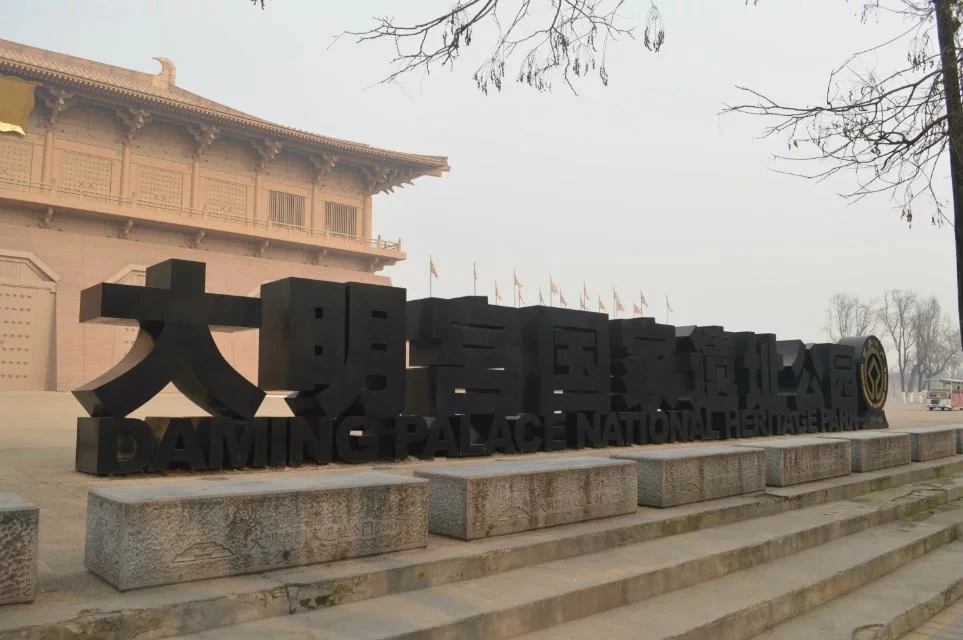
Daming Palace was first built under Emperor Taizong, originally called Yong’an Palace, a temporary palace built by Emperor Taizong for his retired father, Emperor Gaozu Li Yuan. From Emperor Gaozong onwards, 17 Tang emperors handled state affairs here. Daming Palace was the most magnificent palace complex in the world at the time, hailed as the Palace of Palaces—4.5 times the size of the Forbidden City. Unfortunately, with the Tang dynasty’s fall, the palace was consumed by war.
The Daming Palace Heritage Park entrance fee is 60 yuan (a combo ticket costs 95 yuan, covering all scenic spots, sightseeing cars, and a 3D movie). The park uses the Hanyuan Hall ruins as a dividing line: Danfeng Gate and the green corridor out front are free, while the rear section requires a ticket.
Danfeng Gate is Daming Palace’s main southern gate, hailed as the First Gate of the High Tang. Inside, the original gate ruins are preserved and rebuilt at a 1:1 scale. The park largely keeps the original gate site intact. Past Danfeng Gate lies a long green belt. Before renovation, this area was Xi’an’s largest urban village. The state invested over 20 billion yuan to relocate it and build a heritage park for public enjoyment—protecting the relics while engaging the people.
On the right side of the avenue is the park’s cinema. The combo ticket includes a 3D movie, “The Legend of Daming Palace.” Showings start at noon every hour, a standalone ticket costs 35 yuan. The plot: during Empress Wu Zetian’s reign, a prince from a small Western Region kingdom falls for a Tang marchioness and, after relentless pursuit, wins her over. Though terribly clichéd, my companions surprisingly said it was good... and the 3D effects were impressive.
The free area offers a mini-train ride for 30 yuan per person; it can’t enter the paid zone. Bicycles are also available for rent, roughly 1 yuan per minute.
After ticket inspection, the first sight is the Hanyuan Hall ruins. Hanyuan was the main hall for grand ceremonies and audiences, commonly called the “Outer Court.” Wang Wei’s line, “Heaven’s gates open wide to the palace, envoys from myriad states bow to the crown,” captures its former majesty. In building the park, the original foundations were preserved deep underground using modern technology, then re-covered and restored according to historical records. The current base isn’t exactly how it looked in Tang times—historians and archaeologists value either buried remains or visible ruins immensely, but average citizens and tourists want a tangible recreation of Tang splendor, so it was constructed this way.
The model in front of Hanyuan Hall was made based on Tang-era paintings. Looking from Hanyuan toward Danfeng Gate, you can barely see anything thanks to Xi’an’s awful winter smog.
The Daming Palace Site Museum, built underground behind Hanyuan Hall. A gilt-bronze door knocker unearthed from Danfeng Gate’s ruins. Square bricks from Daming Palace. Each brick on Hanyuan Hall bears 108 lotus seeds—everyone knows Master Xuanzang brought back superior Buddhist teachings from India, and 108 seeds are deeply tied to Buddhist doctrine, showing how widespread Buddhism was then. A model recreates the massive scale of building Hanyuan Hall. “All nations pay tribute to the Heavenly Khan.” Emperor Shenwu entertaining his officials. Model of Zichen Hall, the imperial bedchamber. Excavated Tang pottery women figurines—Tang ladies were fashionably open, plump, and graceful, just like on TV. A Tang tri-colored camel.
To the right of the museum is a miniature diorama of Daming Palace built from historical records. This is just Daming Palace, not counting the imperial city and Taiji Palace.
The Zichen Hall ruins are outlined with trees and crumbling walls. Taiye Lake Square occasionally hosts grand song and dance shows. When tired, you can take the park’s sightseeing car. Because the park must both protect relics and give visitors visual impact, many structures recreate past splendors.
From Hanyuan Hall, gazing toward Zichen Hall: Danfeng Gate–Hanyuan Hall–Zichen Hall forms Daming Palace’s central axis. Even Japan’s Heijo Palace and the Korean royal palaces were modeled after Daming Palace, though their scale and opulence can’t compare.
The archaeology center sits on the left greenway from Danfeng Gate to Hanyuan Hall—great for bringing kids to learn. The photo I took there shows the Hanyuan Hall ruins before conservation. Displays of Chinese dynasty costumes across eras; the Han-style robes look best.
We finished touring around 4 or 5 pm. My friend was starving, so we rushed by taxi to Fenxiang to queue for hotpot—we’d tried yesterday but couldn’t get in due to the holiday. Such foodies... Dalong Yi Hotpot, recently featured on “Day Day Up.” The queue was enormous. Honestly, as a Yibin native, I had to laugh at us going to Xi’an for Chengdu-style hotpot. The funny part? We were destroyed by the “mild spicy” level. I thought northerners couldn’t handle chili! Spicy beef, their signature. Tianwei sausage was the third must-order, but isn’t that made in Yibin? It flew all the way to Xi’an, 24 yuan per portion... We ate so happily I forgot to photograph the other dishes. After that, New Year’s Eve on Xi’an’s South Street. Siyu’s 18th birthday cake, tiramisu. Previous birthdays and New Years were spent in Yibin, but this Xi’an one wasn’t bad either.
Day 4, Jan 1, 2017
Last night, the three of them partied hard, so on New Year’s Day they wanted to sleep in. Me, I can’t sit still, so I grabbed my DSLR and headed out. My plan: Shaanxi History Museum — Giant Wild Goose Pagoda — Tang Paradise — Xi’an City Wall. These spots are all clustered together.
Xi’an is a city of history. If you don’t visit the Shaanxi History Museum, you haven’t really been to Xi’an. It houses nearly 2,000 national treasure-level artifacts, showcasing 7,000 years of cultural heritage. The collection divides into seven sections: Prehistoric, Zhou, Qin, Han, Wei-Jin Southern-Northern Dynasties, Sui-Tang, and Song-Yuan-Ming-Qing. Among them, the Prehistoric, Zhou, Qin, Han, and Sui-Tang sections are the absolute gems—most of the artifact photos in our history textbooks came from here.
Because it was New Year’s Day and tickets are free, the place was mobbed. You can also book online, but it’s a hassle. The left side of the entrance is the free-ticket queue; the right side is the ticket window where you can buy a 20-yuan ticket without queuing, giving access to four exhibitions (free tickets cover three). I bought the 20-yuan ticket, thinking it wouldn’t be too crowded. Haha, wrong—it was a sea of people. The zero-degree cold didn’t stop me from sweating, I was squeezed so hard.
Inside the lobby, guide services are available. I’d recommend hiring one—they’re licensed by Shaanxi tourism authorities, clearly priced at 100 yuan. If you’re alone, you can tag along with a group guide, but it was so crowded I couldn’t hear much; groups used earpieces. Interestingly, guides don’t solicit; you have to queue to request one, the opposite of most sights. I rented an audio guide instead. Each significant artifact has a number; enter it and it plays the commentary. 30 yuan rental, 100 yuan deposit.
The star treasure beast—too crowded to squeeze in and see which emperor’s tomb it came from.
Lantian Man skullcap, unearthed in Lantian County, Shaanxi, an Old Stone Age hominid contemporaneous with Peking Man and Yuanmou Man.
Beast-face patterned narrow-necked jar, from the Neolithic matriarchal society, Yangshao culture at the Banpo site in Xi’an, Yellow River civilization. The Yangtze River’s Hemudu culture flourished in the same period. Yes, the pot in our middle school history textbook—the only one like it.
Human-face fish basin—both national treasures featured in our textbooks. These are pottery from the flood era, 5000–3000 BCE, astonishingly beautiful.
The Western Zhou was China’s bronze zenith. The museum holds many exquisite bronzes and ritual implements. Legend says Yu the Great gathered metals from the Nine Provinces to cast nine tripods, symbolizing the land. Tang of Shang banished Jie of Xia and moved the tripods to Yin; King Wu of Zhou after defeating Shang relocated them to Haojing and displayed them to the feudal lords. By the Eastern Zhou, Zhou power declined, giving rise to the Five Hegemons and Seven Warring States. King Zhuang of Chu once dared to ask about the tripods’ weight, but ritual propriety blocked him—he was merely a hegemon, how could he act like the Son of Heaven? By the late Spring and Autumn period, the nine tripods had vanished.
Zhou’s ritual hierarchy was the strictest. This is a tripod (bowl) for a scholar-official’s meal; only the Son of Heaven rated nine tripods, feudal lords seven. Eating utensils and wine vessels; musical instruments were another Zhou hallmark—the set bells from the textbook, the real thing!
After Zhou came the First Emperor sweeping the six states. This bronze dragon from Emperor Qin’s tomb was originally a lamp base; experts believe after unifying the six states, he collected all weapons and cast them into metal figures—this is a relic of that. Of course, Qin’s most famous legacy is the Terracotta Warriors: 4 horses and 8 figurines brought here from the mausoleum.
Qin’s greatest contribution was unification. The Qin army’s crossbow trigger—advanced weapons made them fierce. The picture beside it shows a tiger tally, used for troop mobilization: a general held half, the emperor the other half; combined, they could command armies. This tally is extremely rare, not on display, and only half survives, unearthed from the mausoleum. The other half likely rests with the emperor.
The Han dynasty—during this Xi’an trip, I felt we saw little Han memory. Han palaces mostly lie beneath Xi’an’s city center, buried for two millennia, not much excavated, so fewer artifacts surfaced.
The Empress’s Seal—the first empress’s seal in history, signaling growing harem power. Only Empress Lü Zhi, wife of Emperor Gaozu, had this clout. The mirror reflection clearly shows the characters “Empress.” Writing holds such fascination: after 2000 years, it still records events vividly. A fun story: a primary school kid picked it up on his way to school in the 1960s; I can only think, a small pennant in exchange for a huge treasure.
Western Han gold cakes—records say Emperor Wu loved rewarding gold. Recently, 187 gold cakes were unearthed from the Marquis of Haihun’s tomb; he was the deposed ninth Han emperor and Emperor Wu’s grandson.
Now the Sui-Tang splendor: a comparison of ancient Chang’an with today’s Xi’an; the yellow section not captured in the photo is Daming Palace.
Tang tri-colored pottery spread worldwide via the Silk Roads. The twelve zodiac Buddha figurines are interesting—Daoist zodiac signs on a Buddha’s body, showing religious fusion in Tang times. Buddhism was no mere foreign faith from India; it had been sinicized into China’s own belief.
A ceramic camel surveys the Tang realm, especially the protectorates—if only our map still looked like that! Artifacts from this period teem with foreign motifs woven together.
The paid Hall 4, the Hejiacun treasure trove, mostly bears traces of Western Regions, Arab, and Persian origins. These treasures reflect that Chang’an and the Tang Empire were the world’s economic center. Lucky me—the museum was also exhibiting an extra hall of Eastern Zhou (Spring and Autumn, Warring States) bronzes. Beyond awe, I could hardly imagine how such intricate bronzes were crafted with the techniques of that time.
Exiting the museum, you can walk straight to the Giant Wild Goose Pagoda. On the way, I had lunch at “Number One Noodles Under Heaven” near the pagoda square. Qishan saozi noodles—meh, just so-so. I didn’t even take a photo; it can’t compare to any random noodle shop in Yibin. I tried yangrou paomo, cold skin noodles, saozi noodles, biangbiang noodles; they were all just okay. Not recommended.
The Giant Wild Goose Pagoda Square’s musical fountain is huge. Maybe I got lucky—as soon as I arrived, the show started. Performances are at 2, 4, 6, and 8 pm daily. Because of other plans, I didn’t come back at night; it would’ve been lovelier with lights. Watching the fountain while waiting for my late-rising friends... The square blasted grand music, and the fountain danced, drawing crowds of locals and tourists—a reenactment of Chang’an’s vibrant bustle.
After the show, they finally turned up after 3 pm. We reached Ci’en Temple only to learn the pagoda was under maintenance and closed. Just a photo to say we were here.
So we headed to Tang Paradise, but at the gate they said no performances were on recently. Going inside would just mean man-made Tang-style palace scenery, a 120-yuan ticket, and not enough time, so we skipped it. Again, a quick photo. Tang Paradise is huge; you’d need at least half a day.
Since we weren’t entering, we changed course to Xi’an City Wall. Yongning Gate, the southern main gate. Wall admission is 78 yuan; you can rent bikes on top. But Xi’an’s smog was so thick, barely any tourists were up there. People just milled around the gate square and left, so I took a photo out of respect.
Wandering around until dinnertime. The moment food was mentioned, nobody objected, so we went for hotpot again... Black fish hotpot, called “Lotus Pond Moonlight,” a Jiangsu-Zhejiang style. It was good, the atmosphere fresh and clean. Mainly black fish.
That’s the beauty of independent travel: play when you like, eat when you like, sleep when you like. Travel is for relaxation; group tours are rushed, like going to battle. Full and content, we declared we’d sleep in the next day, then climb Mount Hua.