Hukou Waterfall Ushers in Its Best Viewing Season: Straddling Two Provinces, These Underrated Scenic Spots Can't Stay Hidden!
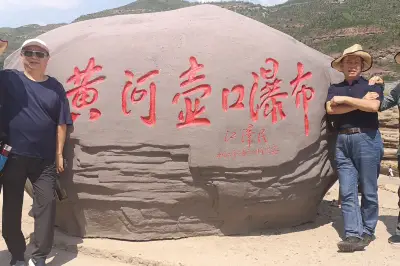
It is the world’s largest yellow waterfall.
The Yellow River passes through the Loess Plateau and flows into the Qin-Jin Gorge.
Its nearly 500-meter-wide riverbed
suddenly narrows to just 40 or 50 meters,
and the endlessly rushing waters of the Yellow River
seem to be funneled into a narrow spout, like a teapot.
You can't truly know the Yellow River without seeing Hukou Waterfall.
At 1,000 cubic meters per second, the river
plunges over a cliff more than 20 meters high,
with a breathtaking force that seems to gather all the Yellow River’s might into one cauldron.
Witnessing this grandeur, you'll feel the mother river’s embrace
and its breathtaking spectacle can bring tears to your eyes.
The mist even creates a light rain along the banks.
Gazing at the roaring, surging water,
you suddenly grasp the famous verse:
"The Yellow River's waters come from the sky, rushing to the sea never to return."
What a profound shock it is!
Here, the Yellow River
seems to bellow and struggle,
making everything around it seem insignificant,
with an added sense of desolation and tragic grandeur.
It perfectly echoes the lyrics of the Yellow River Cantata:
"The wind is howling, the horses are neighing,
the Yellow River is roaring, roaring..."
Hukou Waterfall straddles both banks of the Yellow River;
one side is Shanxi, the other Shaanxi,
right at the border of the two provinces.
To the west lies Yan'an in Shaanxi, to the east, Linfen in Shanxi.
Head south for 350 km and you'll reach Xi'an, Shaanxi;
head north for 387 km and you'll arrive at Taiyuan, Shanxi.
People say Hukou boasts splendid scenery,
with Shaanxi on the left and Shanxi on the right.
(陕西·延安)
About a three-hour drive from Hukou Waterfall,
near Yan'an, there's another wonder:
You don’t need to go to Arizona in the U.S.
to check off an Antelope Canyon-like view.
The flowing patterns on the rock surfaces
look like waves from ten thousand years ago, frozen in time.
Sunlight pours down from above the canyon,
creating a mesmerizing palette of colors.
This is Yucha Village in Ganquan County, Shaanxi,
a natural fissure wonder on the Loess Plateau,
often called China's own Antelope Canyon.
Hundreds of millions of years ago, a violent earthquake
split the earth’s surface,
and over millions of years, wind and rain
carved their marks here, stroke by stroke,
sculpting this magical world.
The undulating walls of the canyon
feel as smooth as silk,
and most astonishingly, the hard rock
shows a graceful, enchanting elegance in its lines.
Yucha Grand Canyon consists of seven gorges,
but currently, only four are accessible:
Huashugou, Nanhe Mudangou, Longbagou, and Huabaocha.
The most beautiful among them is Huashugou.
Note that
these gorges are not clustered together;
there’s about a half-hour drive between each.
秦始皇兵马俑
(陕西·西安)
Xi’an is not only a trendy social media city today
but also more than two thousand years ago,
it was the site of the Qin Dynasty’s grandest palace, the Epang Palace.
Here stands a man-made wonder that amazes the world:
the Terracotta Warriors and Horses,
hidden underground in obscurity for over two millennia.
They encapsulate the glory of ancient Chinese civilization,
the dominance of Qin Shi Huang, who unified the central plains,
and the unshakable authority of feudal kingship.
In earlier times, kings were buried with living human sacrifices,
but because this was extremely brutal and cruel,
the custom gradually changed to burial with pottery and wooden figurines.
The Qin terracotta army represents the pinnacle of this evolution,
both in its vast scale and the exquisite craftsmanship of each figure.
They reached an unprecedented level.
Pit No. 1 alone contains more than 8,000 warriors,
and every figure’s attire and expression
is truly unique.
(山西·晋中)
This is the most complete ancient county seat still standing in China,
with a history of 2,700 years.
It has perfectly preserved the look of the Ming and Qing dynasties.
The layout of the entire old town is perfectly orderly;
all streets crisscross in a well-arranged grid—
four main streets, eight lesser streets, and 72 winding lanes.
The history of Shanxi merchants is everywhere in the old town:
exchange shops, security escort agencies, county offices, Confucian temples...
Every building exudes an antique charm.
Ming-Qing Street, on the central axis of the old city,
still holds many age-old shop relics:
exchange houses, money shops, pawnshops, medicinal stores,
butcher shops, tobacco stores, groceries, silk shops...
You can buy a pack of the famous Pingyao beef
or visit Rishengchang, China’s first bank.
This Pingyao Ancient City is even more intriguing
than authentic Shanxi aged vinegar.
(山西·晋中)
While the Qiao Family Compound is a merchant residence,
the Wang Family Compound is an official mansion.
The Wang family rose from farming to trade, and from trade to officialdom,
gradually expanding their family estate, wealth, and reputation,
until decline set in during the late Qing dynasty.
The Wang Family Compound has been hailed as a 'folk Forbidden City.'
Built against the mountain, it is a fully enclosed fortress
comprising five lanes, six forts, and one street,
covering 45,000 square meters —
a full ten times the size of the Qiao Compound.
The layout of the five forts is likened to five auspicious beasts:
dragon, phoenix, tortoise, qilin, and tiger,
imbued with lucky meanings and hopes for descendants.
The architectural style follows the traditional pattern
of a front hall and rear chambers;
every hall has couplets, every doorway a plaque,
fully displaying orderly traditional etiquette
and the solemn dignity of an official household.
No wonder the folk saying goes:
'After Wang’s compound, other courtyards pale.'
(山西·忻州)
This is the largest ice cave discovered so far in China,
and one of the rare giant ice caves in the world.
Formed during the Quaternary glaciation of the Cenozoic Era,
it is three million years old,
hence the name 'Wannian Ice Cave' (Ten-Thousand-Year Ice Cave).
Its peculiar feature is that,
given the outside climate conditions,
ice should not form at all,
yet ice stalactites never melt inside,
no matter the season.
The deeper you go, the thicker the ice.
Usually, ice caves are found only in extremely cold, high-latitude places
like the poles, Siberia, or certain snowy mountains,
and even then they are few and small.
So how could there be a perpetually icy cave
in Ningwu County, Shanxi, a place with distinct four seasons?
Less than 200 meters from the ice cave,
there is also an underground fire that has been burning for a thousand years,
called the 'Thousand-Year Volcano' by locals.
Ice and fire, typically incompatible,
miraculously coexist on the same mountain.
(山西·大同)
Xuankong Temple, which looks as if it might collapse at any moment,
is built into a recess on a sheer cliff.
It was once named by Time Magazine
as one of the world's top ten most precarious buildings.
Perched on the edge of an abyss,
it ranks first among the eighteen scenic wonders of Mount Heng.
A local saying goes:
'Xuankong Temple, half as high as the sky,
hangs by three horse-tail hairs in the air.'
This ancient structure has endured countless landslides, earthquakes,
and erosion by rain,
yet it has stood firm for over 1,500 years.
Hukou Waterfall is about to welcome its best viewing season each autumn.
Yet the beauty doesn't stop at Hukou — both Shaanxi and Shanxi are brimming with hidden treasures.