Xi'an RV Adventure: Seeking Traces of the Flourishing Tang Dynasty, Witnessing the Eighth Wonder of the World—Terracotta Warriors, and Admiring a World-Class Museum
When I was a child, a friend told me that the places he most wanted to visit were the Great Wall and the Terracotta Warriors; each one is a continuation of Chinese civilization and our pride. Now, as adults, we have fulfilled those childhood wishes one by one. Last year, we climbed the Great Wall and witnessed the greatest ancient military fortification. Last week, we visited the Terracotta Warriors and saw one of the world's top ten ancient tombs. We chose to explore Xi'an on an RV for a two-day, one-night trip. We experienced the Datang Furong Garden, which represents the prosperity of the Tang Dynasty; we saw the Dayan Pagoda, designed and supervised by Xuanzang himself; we visited the Shaanxi History Museum, which had the largest crowd; and at night, we had a BBQ at the campsite. Friends gathered together, completing our childhood dreams. Next, I'll share with you my spontaneous weekend trip; writing is hard work, please do not repost.
Day 1: Arrived in Xi'an at night
Day 2: Datang Furong Garden – Shaanxi History Museum – Dayan Pagoda
Day 3: Emperor Qinshihuang's Terracotta Warriors Museum – Hangzhou
Xi'an is one of the oldest cities in China, having witnessed the rise and fall of 13 dynasties, with a history of over 3,000 years. Some say Xi'an is like a giant museum, filled with traces of history everywhere you look. Here you'll find the ancient city wall, the Terracotta Warriors, and the Dayan Pagoda.
Historically, Xi'an had a beautiful name: Chang'an, the capital of the Tang Dynasty. Xi'an and the Tang Dynasty are inextricably linked. Today, many ancient Tang-era buildings remain, the most famous being the ancient city wall, and many Tang-themed tourist attractions have been built, such as Datang Furong Garden, Datang Everbright City, and the Dayan Pagoda.
We can hardly imagine the grandeur of the Tang Dynasty, but today's nightscape in Xi'an reflects that 'great Tang glory,' with dazzling lights and bustling crowds. Though it's a scaled-down version, the most representative is Datang Furong Garden.
Datang Furong Garden is China's first large-scale imperial garden cultural theme park that fully showcases the essence of the flourishing Tang Dynasty. It was built to the north of the original Tang Dynasty Furong Garden site. Historically, Furong Garden covered 7,000 mu (about 467 hectares); today it's only one-seventh that size, at 1,000 mu (about 67 hectares), with 300 mu of water area.
Originally in the Qin Dynasty, it was a royal forbidden garden called Yichun Garden. In the third year of Emperor Wen of Sui's reign (583 AD), after moving the capital, he thought the old name was unlucky, so he renamed it Furong Garden. During the Tang Dynasty, it was not only expanded in scale but also enriched with cultural significance. Many famous literary anecdotes, such as 'Qujiang Floating Wine Cups,' 'Apricot Garden Banquet,' 'Inscribing Names at the Wild Goose Pagoda,' and 'Ascending Leyou Plateau,' are associated with this place.
At its height, it became the only public garden in Chang'an. After the prosperous reign of Emperor Taizong, it laid the foundation for Tang cultural flourishing. Later, Emperor Xuanzong undertook massive expansions, making it an unparalleled spectacle.
With the fall of the Tang Dynasty and the destruction of Chang'an, urban gardens and buildings were devastated. Furong Garden was no exception, reduced to rubble. The timber used in its construction was taken to Luoyang. The garden suffered a catastrophic blow and vanished from sight, its glorious history turning into a legend.
A thousand years later, to recreate this history, Datang Furong Garden was built with an investment of 1.3 billion yuan and opened in 2004 after two years of construction. Though it's only one-seventh of the original size, it's still spectacular. It is divided into 14 scenic cultural zones, showcasing the spirit of the Tang Dynasty from multiple angles. Its landmark is the Ziyun Tower (Purple Cloud Tower), which epitomizes the Tang imperial majesty with the saying 'Rising in form and spirit like purple clouds, all under heaven bow to the emperor's will.'
The Ziyun Tower is a faithful reconstruction based on historical records. It has four floors, each displaying different aspects of Tang imperial culture. The first floor features sculptures and murals of the 'Reign of Zhenguan,' along with restoration models; the second floor presents a large colored sculpture group depicting Emperor Xuanzong hosting a grand banquet for his officials, with envoys from all directions paying tribute; the third floor is a performance space for singing and dancing; and the fourth floor is a museum.
Emperor Xuanzong once held a 'Money Banquet' at Ziyun Tower, where only officials of the fifth rank and above could scramble for gold coins. These coins were not for circulation but only for collection. Today, they are preserved in the Shaanxi History Museum, and a huge map of Chang'an stands on the square.
At night, Furong Garden features the world's largest water-screen film, staged on the lake in front of the Guanlan Platform at Ziyun Tower. There are performances both day and night. Be sure to check the schedule on the official website in advance so you don't miss them. Boating on the lake is also a great way to enjoy the garden's scenery.
Since August 1st, Datang Furong Garden is free to visit with a reservation. Have you been here? Would you like to see what the prosperous Tang Dynasty looked like?
Every city's museum carries its past and present. Whenever I visit a city, I love wandering through its museum to feel the artifacts and history from a thousand years ago. This trip to Xi'an, I found that the Shaanxi History Museum had the largest crowds of any museum I've visited.
The Shaanxi History Museum is China's first large-scale modern national museum, renowned as the 'Pearl of the Ancient Capital' and 'Treasure House of China.' Its architectural style highlights Tang Dynasty elegance, with a unique Shaanxi historical and cultural flavor. Every exhibit is exquisite, many being national treasures. A stroll here offers a deep dive into Shaanxi's history and culture.
Its predecessor was the Shaanxi Provincial History Museum established in June 1944 (the 33rd year of the Republic of China). It was originally a small museum. When Premier Zhou Enlai inspected it, he felt it didn't match Shaanxi's character, so it was renamed the Shaanxi History Museum. Rebuilt in 1986 and opened in 1991, it has been recognized by UNESCO as a world-class museum.
The rebuilt museum is in a prime location on the tourist route, surrounded by the Dayan Pagoda, Datang Furong Garden, and other attractions, with very convenient transportation.
The museum was designed by master architect Zhang Jinqiu. The complex not only highlights the grandeur of the Tang Dynasty but also reflects its vast and brilliant spirit. It embodies the spatial composition of traditional Chinese palace architecture—'the supreme ultimate at the center, extending in all directions'—and the Eastern cosmic philosophy that has been ingrained in Chinese spatial awareness for millennia: 'transcending imagery and capturing the essence within.'
It is a comprehensive history museum, and you can visit by reserving with your ID card. Two exhibition halls require paid tickets: the Tang Dynasty Treasures Exhibition, only 30 yuan, which draws the largest crowds—you often have to wait for the group ahead to finish before you can get close; and the Tang Dynasty Mural Treasures Gallery, which costs a hefty 270 yuan, so very few people go, and many visitors are deterred by the price.
The Tang Dynasty Treasures Exhibition displays items unearthed in October 1970 from the Hejiacun hoard: two pottery urns and a jar. Though only three containers, they held over 1,000 precious gold and silver vessels. Experts say it was extremely difficult to restore these artifacts after they were removed.
As we know, the Tang Dynasty was one of the most powerful periods in ancient China. Experts estimate the value of these treasures at 38.3 million coins, equivalent to the annual tax of 1.5 million adult men paid to the Tang government. Among them is the museum's 'crown jewel,' the Beast-headed Agate Cup.
Although we didn't visit the Tang Dynasty Mural Treasures Gallery, the guide told us it exhibits murals from over 20 Tang tombs, nearly 600 pieces in total, with 18 rated as national treasures and 82 as first-grade cultural relics. The museum has three free permanent exhibition halls, plus two paid ones: the Tang Dynasty Mural Treasures Gallery and the Tang Dynasty Treasures Exhibition. There are also occasional temporary exhibitions.
The cultural relic value here is extremely high. In 1996, a grading was conducted: 762 artifacts were classified as first-grade relics, 18 as national treasures, and two were among the first batch of cultural relics prohibited from being exhibited abroad.
A few of the museum's artifacts were featured on the TV show 'National Treasure,' bringing them to wider attention. During this visit, I was fortunate to see these precious items in person, recalling their histories and gaining a deeper appreciation.
I used to know only of the Dayan Pagoda as a tourist spot but had no idea it was inside the Da Ci'en Temple. Truly, the pagoda is more famous than the temple itself.
The Tang monk Xuanzang from 'Journey to the West,' which accompanied us through childhood, is not a fictional character. The story was written by Wu Cheng'en based on the real Master Xuanzang's experiences. You can see these at the Xuanzang Memorial Hall in Da Ci'en Temple, which is the largest memorial hall for Xuanzang in the country.
The temple was built in the twenty-second year of the Zhenguan reign (648 AD) on the site of the Jingjue Temple built by Emperor Daowu of the Northern Wei. It was commissioned by Crown Prince Li Zhi to honor his mother, Empress Wende (née Zhangsun). Today, it has a history of 1,350 years. The temple was grand in scale but suffered many wars. What we see now was rebuilt in the second year of the Chenghua reign during the Ming Dynasty (1466 AD).
In Tang Dynasty Chang'an, it was the most famous and magnificent Buddhist temple, and the largest in scale, said to cover half of the Jincheng Ward. As one of the three major translation centers in Tang Chang'an and the birthplace of the Weishi (Consciousness-Only) School, one of the eight schools of Chinese Buddhism, it holds an important place in the history of Buddhist dissemination.
On the square in front of Da Ci'en Temple, there's a statue of Xuanzang. After entering, you'll see the Bell Tower with a large bell cast in the 27th year of the Jiajing reign (1548 AD), known as the 'Dayan Pagoda Morning Bell,' one of the famous Eight Sceneries of Guanzhong. In the Tang Dynasty, successful jinshi (imperial examination) candidates would inscribe their names beneath the pagoda.
Ascending the steps leads to the Mahavira Hall, the main hall of the temple. On both sides are several halls dedicated to different Buddhas. Beside the Mahavira Hall is the Jialan Hall, enshrining the Bodhisattva who protects the temple grounds.
Behind the Mahavira Hall is the Tushita Palace, dedicated to Maitreya Bodhisattva. It is said that Maitreya resides in the Tushita Heaven and will appear in the human world when the time is right, transforming according to conditions.
Behind the Tushita Palace is the Dayan Pagoda, the main structure of Da Ci'en Temple. It was personally designed by Xuanzang to preserve the scriptures and relics he brought back from India. Since its completion, it has been a landmark of Chang'an and is now the earliest and largest surviving Tang dynasty square pagoda with multi-eaved brick tower style.
The Dayan Pagoda stands as high as a 21-story building. Climbing it requires an extra ticket. In the afternoon, sunlight bathes it in gold. This thousand-year-old pagoda has weathered countless storms and still stands before us. Legend has it that during a massive earthquake in the Ming Dynasty, nearly all buildings were destroyed, but the Dayan Pagoda remained standing as before.
In ancient times, climbing the pagoda was not allowed casually; only with the emperor's permission. When Bai Juyi passed the imperial exam, he climbed the Dayan Pagoda and wrote the verse, 'At the place beneath the Ci'en Pagoda where names are inscribed, among the seventeen I am the youngest.' He is the most famous among those who climbed it and a poet we all know.
Behind the Dayan Pagoda is the Xuanzang Memorial Hall, a Tang-style complex consisting of the central memorial hall, an east exhibition hall, and a west lecture hall. The walls of the side rooms are covered with paintings depicting Xuanzang's journey to India. It vividly conveys the hardships he endured. Many stories in 'Journey to the West' are based on his real experiences.
Da Ci'en Temple is located in a bustling area, with vibrant incense offerings. It is not just a temple but a symbol of Xi'an, even appearing on the city's logo. It's a must-visit for every traveler to Xi'an.
Xi'an's night is especially brilliant. A friend says he prefers Xi'an at night to daytime. The dazzling lights illuminate entire streets as if it were daytime, in all colors. On the square in front of the Dayan Pagoda is the world's largest fountain show. The famous 'tumbler lady' who went viral online performs at the North Square.
The North Square is centered on the Dayan Pagoda, with a fountain waterway in the middle and various landscapes on both sides. It not only has Asia's largest fountain square but also the largest sculpture square in Asia, featuring two 100-meter-long sculpture groups, over forty ground reliefs, and eight sets of figure sculptures.
Every night at 7 p.m., the square is packed. Fortunately, the fountain jets reach over 100 meters, so even those at the back can see. If you want a close-up view, get there early. We arrived ten minutes early and were already on the periphery. The whole show lasts about 10 minutes, with narrations. Under different colored lights, the fountain takes on various forms—truly beautiful. The eight-level variable-frequency matrix in the eight-tier cascade pool is the world's largest.
The Dayan Pagoda has two squares, north and south. The fountain show is at the North Square, while the South Square is where you enter Da Ci'en Temple after ticket check. The elevation difference between the two is nine meters, gradually rising from north to south as an act of reverence toward the pagoda, divided into nine levels, each step has five stairs—symbolizing the 'Nine-Five Supreme.' These architectural details are meticulous.
After the fountain show, many visitors head toward Datang Everbright City next to the South Square, passing a cultural and creative market selling trinkets and plenty of snacks.
The trees on both sides are adorned with tiny star-like lights, and you can still capture the Dayan Pagoda in the background. You can follow the crowd to the Everbright City or linger here a while—both are great spots to enjoy Xi'an's nightscape.
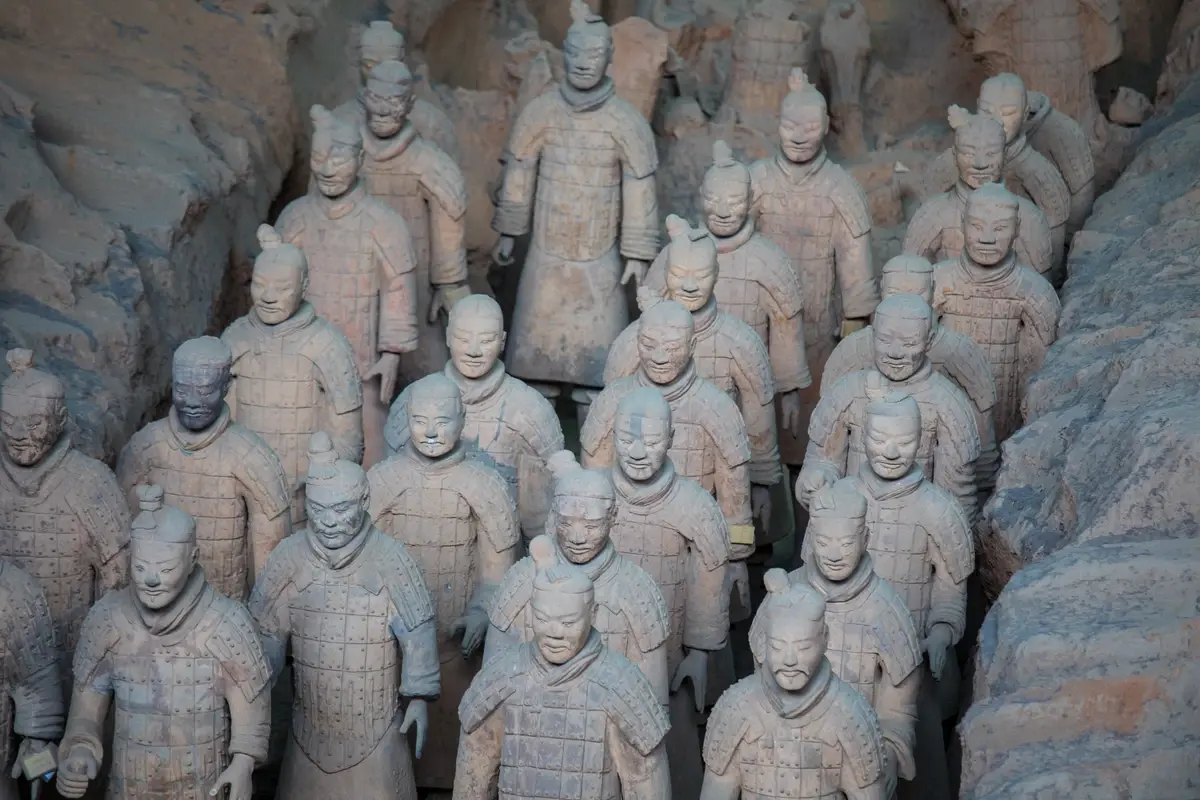
Once there were only seven wonders of the world, but after French President Jacques Chirac visited the Museum of Qin Terracotta Warriors and Horses in Xi'an, an eighth wonder was added, making the Terracotta Warriors known worldwide and attracting countless visitors from home and abroad.
The Terracotta Warriors are a form of ancient tomb burial. Those unfamiliar with the term might wonder if they were live human sacrifices. I once had the same question. But after visiting and seeing the restoration work and hearing the guide's explanations, I gained a much deeper understanding.
Qin Shi Huang believed that whatever he possessed in life, he should have in death. So from the start of his reign, he began building his own mausoleum. It is said that each of the burial pottery figures has a unique appearance. He spent 37 years constructing it, and after his death, his son continued the work, totaling 39 years of construction.
Since the Shang Dynasty, human sacrifice had been a cruel and barbaric funeral practice. Qin Shi Huang initially wanted to use it, but thanks to ministers' persuasion and social reforms, he abandoned the idea of live human burial and instead used wooden and pottery figures as substitutes.
In 206 BC, the mausoleum suffered its first and greatest calamity—a massive fire. It wasn't until 1974 that they were rediscovered. Experts spent five years on restoration and excavation, and in 1975, it opened to the public. To this day, it's a must-visit for every traveler in Xi'an.
When visiting the Terracotta Warriors Museum, there are three pits and one exhibition hall. The largest is Pit 1, containing over 8,000 warriors. It was the first to be discovered and draws the most visitors.
The pits are underground tunnel-like wooden-earth structures. They dug a 5-meter-deep pit, then built parallel earthen partition walls in the middle. Wooden pillars were placed on either side of the walls, with horizontal beams on top. Over the beams and earthen walls, a dense layer of canopy wood was laid, then a layer of reeds, and finally a layer of loess to form the pit roof.
In Pit 1, besides countless warriors, you can also learn about restoration. Many unrestored figures still await the meticulous work of experts.
The pit roof structure can be seen in Pit 2, which has not been excavated. When first unearthed, the warriors were colored, but due to inadequate preservation technology, the colors faded within 24 hours, leaving the current terracotta hue. To preserve the original colors and await future advancements, Pit 2 remains unexcavated.
In Pit 2, several well-preserved warriors are displayed separately. One of them is the only completely intact figure ever found: the Kneeling Archer. Experts speculate that because he is kneeling, the collapsing soil didn't hit him directly, preserving him perfectly. Even red pigment remains on his back armor—extremely precious.
Other figures on display include the Standing Archer, Cavalryman, Senior Officer, Civil Official, and more, each vividly detailed. Even the stitching on their shoe soles is meticulously carved by the craftsmen.
Pit 3 is U-shaped. Its layout suggests it might have been a command post, as it was guarded by officers and soldiers. Notably, it's the only pit not ravaged by fire; Pits 1 and 2 show blackened clay from burning.
The last is the Bronze Chariot Exhibition Hall, displaying two chariots, considered the pinnacle of bronze craftsmanship and world-renowned. They are so intricate that even modern technology might struggle to replicate them. Chariot No. 1 is a standing chariot, and No. 2 is a seated chariot. Currently, the original No. 1 is on display at the World Expo, so what we saw was a replica.
After visiting, President Chirac not only called it the eighth wonder but also said, 'You haven't truly come to China if you haven't seen the Terracotta Warriors.' It's a representative of Chinese civilization, a great step forward in ancient history, and a source of national pride. Hailed as one of the world's top ten rare ancient tomb treasures, it has attracted over 200 dignitaries.
This trip was an RV road trip. Everyone knows the advantages of self-driving: go wherever you want, stop whenever you like—so convenient. An RV has more capacity than a regular car, so you can pack a lot. And at night, we had a BBQ, which was great fun.
You can sleep in the RV if you like; it's equipped with a toilet, water, table, beds, etc. You can park at a campsite or check into a hotel—the choice is yours. The biggest advantage of an RV is that friends can stay together. One RV can seat six people, including the driver, which is more than a regular car—perfect for groups traveling together.
Xi'an is perfect for an impromptu weekend getaway. You could spend a weekend thoroughly exploring the city, or also visit nearby Mount Hua. Attractions like Huaqing Pool and the Terracotta Warriors take a whole day since they're outside downtown. Climbing Mount Hua requires two days. Don't miss Xi'an's nights; the city has many spots to enjoy. This time we visited the most essential sights, basically the must-see attractions that tour groups also bring visitors to. Now, here are some travel tips.
Transportation: Hangzhou–Xi’an round trip can be done for 600 yuan.
Accommodation: A comfortable business hotel costs just over 200 yuan per night.
Food: There are tons of food streets—Yong'anfang, Muslim Quarter, Sajinqiao... prices are reasonable.
1. Shaanxi History Museum
Address: No. 91 Xiaozhai East Road, Yanta District, Xi’an, Shaanxi Province
Transportation: Bus routes: 21, 105, 259, get off at Cuihua Road (Shaanxi History Museum) stop. Metro: Line 1 or Line 2, get off at Xiaozhai Station (Northeast Exit)
Tickets: Free (advance reservation required). Tang Dynasty Treasures Exhibition: 30 yuan; Mural Treasures Gallery: 270 yuan, purchase on site.
Opening hours: Low season: 09:00-17:30 (last entry 16:00), Nov 15–Mar 14, Tue–Sun; High season: 08:30-18:00 (last entry 16:30), Nov 14–next Nov 14, Tue–Sun.
2. Museum of Qin Terracotta Warriors and Horses (Emperor Qinshihuang's Mausoleum Site Museum)
Address: 1.5 km east of Emperor Qinshihuang's Mausoleum, Qinling North Road, Lintong District, Xi’an, Shaanxi Province
Transportation: From Sanfuwan Bus Station near the train station, take bus 914 or 915. Xi'an Bus Station has a direct shuttle to the Terracotta Warriors for 15 yuan, very convenient, with a guide on board.
Ticket: 120 yuan (Jan 1–Dec 31, Mon–Sun). Tickets are real-name, one per person, so it's recommended to purchase in advance and carry ID for verification. You'll need to scan your ID twice for entry.
Opening hours: Mar 16–Nov 15: 08:30-18:00 (ticket sales end at 17:00), Mon–Sun; Nov 16–Mar 15: 08:30-17:30 (ticket sales end at 16:30).
3. Datang Furong Garden (Tang Paradise)
Address: No. 99 Furong West Road, Yanta District, Xi’an, Shaanxi Province
Transportation: From downtown, take bus 21, 22, 23, 24, 44, 212, 224, 237, 526, 609, 715, 720, Night Bus 4, Tourist Bus 4, or Tourist Bus 9, get off at Datang Furong Garden West Gate (Yuyuan Gate) bus stop, then walk 10 meters.
Ticket: Free since August 1, 2020
Opening hours: 09:00-21:00
4. Da Ci'en Temple
Address: No. 1 Ci'en Road, Yanta District, Xi’an, Shaanxi Province
Bus: Take bus 5, 21, 22, 27, or 41 to Yanta West Road East Entrance stop, then walk.
Metro: Take Line 3 to 'Dayanta' (Dayan Pagoda) station, then walk south for 8 minutes.
Peak season: 50 yuan (Mar 1–Oct 31, Mon–Sun); Off-season: 40 yuan (Nov 1–Feb 29, Mon–Sun).
Climbing the Dayan Pagoda: 25 yuan, purchase on site.
Opening hours: 09:00-17:00 (Jan 1–Dec 31, Mon–Sun)
Travelogue Directory
1. 'Ancient Capital Journey'
2. 'Xi'an Itinerary'
3. 'Datang Furong Garden' recreates the glory of the Tang Dynasty
4. 'Shaanxi History Museum' Pearl of the Ancient Capital, Treasure House of China
5. 'Dayan Pagoda' personally designed and supervised by Master Xuanzang
6. 'Chang’an Nightscape' Cultural and Creative Market
7. 'Museum of Qin Terracotta Warriors and Horses' Eighth Wonder of the World
8. 'RV Campsite' Nighttime BBQ
9. 'Travel Tips' Tourism Information
Hotel Index Guide Index Flight Index Website Navigation Travel Index Cruise Index Corporate Travel Index Join Cooperation Distribution Alliance Friendly Links Corporate Gift Cards Procurement Insurance Agency Agent Cooperation Hotel Joining Destination and Scenic Spot Cooperation More Join Cooperation About Ctrip About Ctrip Ctrip Hotspots Contact Us Careers User Agreement Privacy Policy Business License Security Center Ctrip Content Center Intellectual Property Trip.com Group Algorithm Disclosure