Give Me a Day, I’ll Give You Ten Thousand Years: An RV Road Trip in Xi’an
Xi’an is probably a city you never tire of, no matter how many times you visit. Each trip reveals something different, yet its profound history remains the same. As the ancient capital of thirteen dynasties, there are countless ways to explore Xi’an. This time, we toured the city in an RV—the trendiest way to experience this ancient city, offering a whole new perspective.
Terracotta Army of Emperor Qin Shi Huang
For a popular tourist destination like Xi’an, planning this self-drive trip took some thought. I deliberately scheduled it right after the National Day holiday, avoiding the crowds and reducing virus-related risks. I also wanted to revisit places I hadn’t fully appreciated before. Before setting off, I felt a strange excitement—a premonition of new insights to be gained.
In front of the Ci’en Temple at the Giant Wild Goose Pagoda Square. The main gate of the Great Ci’en Temple faces the South Square of the Giant Wild Goose Pagoda, not far from a bronze statue of Master Xuanzang. Locals say that every spring, all kinds of kites fly over the South Square, vying in beauty and creating a lively scene. Paired with the ginkgo trees lining the square, in autumn, their fan-shaped leaves flutter down, painting a stunning view.
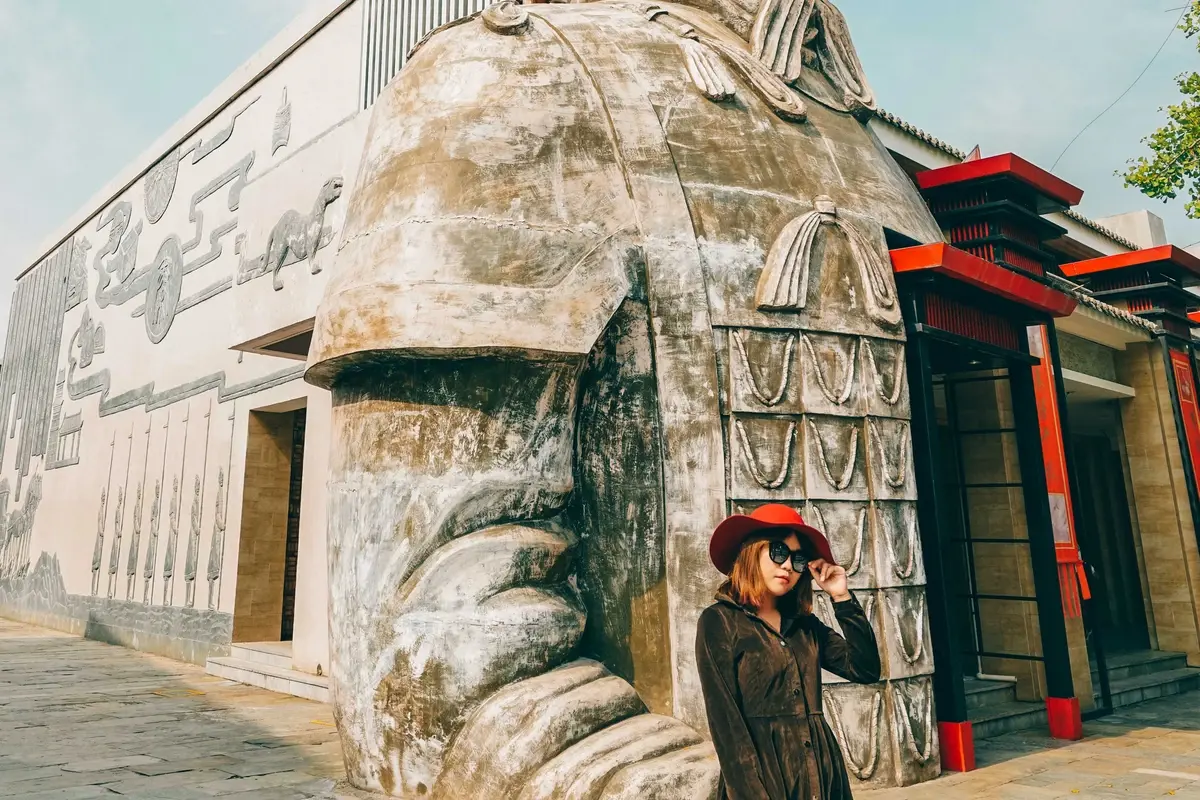
Tang Paradise—a Tang Dynasty-style royal garden cultural park.
The pagoda stands majestic on the earth, while Quchi’s winding streams invite drinking.
The Giant Wild Goose Pagoda is inside the Great Ci’en Temple on its namesake square, also known as the “Ci’en Temple Pagoda.” It’s the earliest and largest surviving square brick pagoda from the Tang Dynasty, a landmark symbolizing Buddhism’s introduction into China’s Central Plains. In the third year of Emperor Yonghui’s reign, Xuanzang oversaw its construction to house scriptures and Buddha statues brought from India via the Silk Road. Initially five stories, it was later raised to nine, underwent several more changes in height and layers, and finally settled into the seven-story structure we see today. In 2014, it was inscribed on the UNESCO World Heritage List.
📍 Address: Inside the Great Ci’en Temple, Yanta District, Xi’an
🈺️ Hours: 08:00–17:30
🚄 Transport: Subway Line 3 or Line 4, Giant Wild Goose Pagoda Station, Exits B and C
🎫 Tickets: 40 yuan/person, off-season 30 yuan/person
⚠️ Tips: Go just before closing time so you can snap photos of the pagoda without anyone else (like the picture above). Otherwise it’s packed!
A square pagoda imitating timber structures, it consists of a base, body, and spire. The whole tower is over 60 meters tall, shaped like a square pyramid, with arched doors on each side of every floor. Climbing the interior stairs, you can glimpse the bustling Great Tang All Day Mall through those arched doorways.
Apart from the Wild Goose Pagoda, the Great Ci’en Temple also draws streams of visitors who come to burn incense.
On the third floor of the pagoda, right in the center, is a model of the pagoda containing Buddhist relics. However, these relics aren’t from Master Xuanzang’s cremation; they were gifted in 1998 by Master Shi Wuqian, the Indonesian-Chinese abbot of the Xuanzang Temple in India. That day, he presented a red paper envelope stamped with golden characters reading “One Vehicle Buddha Treasure” and a lotus motif, inside were two precious Buddha relics, bestowed to the pagoda as a One Vehicle treasure. It’s a touching make-up for the mystery of the missing relics.
For this trip, we chose an RV. As RVs gain popularity, more RV camps are popping up everywhere, making RV travel incredibly convenient. Step out and you’re in the scenery—living within the landscape is pure bliss. In Xi’an, the Hancheng Lake Camp is a well-established RV site. Water hookups are available, you open the door to a view, and at night you can set up the awning, grill skewers with a few friends, chat, and enjoy a perfect weekend.
The RV sleeps three—one above the driver’s seat, two at the back.
Dream back to the Tang Dynasty’s glory, see all of Chang’an’s flowers in a day.
Tang Paradise is located in Qujiang Development Zone, south of Xi’an city, southeast of the Giant Wild Goose Pagoda. Rebuilt on the north side of the original Tang Dynasty Lotus Park ruins, it’s modeled after a Tang royal garden—China’s first large-scale cultural park showcasing the full grandeur of the prosperous Tang Dynasty. It features many replica ancient structures like Ziyun Tower, Ladies’ Pavilion, Imperial Banquet Hall, Apricot Garden, Fanglin Garden, Fengming Jiutian Theatre, and the Tang Market, making it the country’s largest imitation Tang royal complex.
📍 Address: 99 Furong West Road, Yanta District, Xi’an
🈺️ Hours: 08:00–17:30
🚄 Transport: Subway Line 3 or Line 4, Tang Paradise Station, Exits C and D
🎫 Tickets: Free!!!
⚠️ Important Tips: During the pandemic, Tang Paradise is free! Make sure to explore it thoroughly. It’s best to book two days in advance via the Tang Paradise mini-program on WeChat. At the entrance, you can get a free park map with a performance schedule—plan your visit around it. I think Tang Paradise looks better at night, more magnificent, not as bustling as the Great Tang All Day Mall, but exuding a stately elegance and grandeur that photographs beautifully. I suggest arriving at dusk, stepping back into the Tang Dynasty, with no regrets in life.
I should have worn Hanfu here—I’m regretting it already. Next time, I’ll definitely come back in Hanfu for photos! It would be so atmospheric!
Blue sky, verdant trees, rippling water, and a gray-white tour boat—this looks like an oil painting on film. I suddenly realized I might be falling in love with this city, Xi’an.
Ziyun Tower is the park’s iconic landmark, embodying the Tang emperors’ majesty: “Rising clouds in shape and spirit mirror Ziyun’s splendor, all hearts under heaven submit to the Emperor’s will.” In history, Emperor Xuanzong would ascend this tower during the Qujiang gatherings to enjoy music and dance, feast his ministers, and celebrate with the people. Rebuilt according to ancient texts, Ziyun Tower stands at the heart of the park, one of the main Tang-style architectural ensembles. On the fourth floor, there’s a Ru-yi Copper Pagoda coin toss game—highly recommended, everyone coming here must give it a try!
The water show I had long anticipated takes place on the lake in front of Ziyun Tower’s Guanlan Platform. It includes a water screen movie, musical fountain, lasers, flames, water mines, mist, and more. The water screen movie is the world’s largest, enhanced by lasers and set to music with fountains, creating flames, water mines, and shifting mists—an unparalleled spectacle of sound, light, electricity, water, and fire. I heard that after the water movie, there’s a fire dragon and steel flower performance; don’t leave early like I foolishly did.
Eight hundred li of Qinchuan is a land of abundant treasures; five thousand years of history brings outstanding people.
Shaanxi History Museum, China’s first large modern national museum, is an early “AAAA” tourist site, praised as “the Pearl of the Ancient Capital, the Treasure House of China.” It’s very close to the North Square of the Giant Wild Goose Pagoda, just a ten-minute walk. On Cuihua Road near the museum, there’s a Ziwulu Zhangji Roujiamo shop that’s excellent—recommended by a friend, I tried it before and found it quite good. After a tiring museum visit, step out and buy a roujiamo with an Ice Peak soda—truly “Liao Za Lie”!
📍 Address: 91 Xiaozhai East Road, Yanta District, Xi’an
🈺️ Hours: 9:00–17:30 (closed Mondays)
🚄 Transport: Subway Line 2, Xiaozhai Station, Exit D
🎫 Tickets: Three types: Basic Exhibition Hall (free); Tang Dynasty Treasures (30 yuan); Exhibition of Precious Mural Paintings (270 yuan, includes the first two)
⚠️ Tips: Remember to book tickets 3–5 days in advance on the “Shaanxi History Museum” platform—the earlier the better. Arrive punctually at your reserved time; if you’re over half an hour late, you won’t be allowed in. If the mural exhibition seems pricey, the Tang Dynasty Treasures are still well worth seeing. The Treasure Gallery is the most important section, displaying over 30 pieces of jade, gems, and other artifacts unearthed at Hejiacun, including the museum’s “crown jewel,” the Agate Cup in the Shape of an Animal Head. Also on show are 466 gold, silver, and copper coins from the Warring States period to the Tang Dynasty, along with Japanese silver coins, Persian Sassanid silver coins, and Eastern Roman gold coins spanning over a thousand years.
If you want souvenir coins, as soon as you enter the museum, you’ll see an information desk. You can ask the friendly young lady there, or ask where the restroom is—a vending machine for souvenir coins is right next to the restroom, no queue needed, just buy directly.
Westward along the Tongguan Road, still embracing the First Emperor of Qin.
The Mausoleum of the First Qin Emperor and the Terracotta Army pits are in Lintong, Xi’an, Shaanxi Province. It’s hailed as one of the “Eight Wonders of the World.”
The Terracotta Army pits, located east of the Emperor’s tomb, are a massive funerary complex. Four pits have been excavated so far, containing thousands of life-sized, painted terracotta warriors and horses, along with actual weapons used in battles. Over ten thousand artifacts have been unearthed. It was inscribed on the UNESCO World Heritage List in 1987. In 2007, the Museum of the Terracotta Army of Emperor Qin Shi Huang was approved as a national 5A tourist attraction. A vaulted exhibition hall built over Pit One now houses the “Museum of the Terracotta Army of Emperor Qin Shi Huang,” open to tourists from home and abroad. Our group visited Pit One.
📍 Address: Terracotta Army of Emperor Qin Shi Huang
🎫 Tickets: Adults 120 yuan, students 60 yuan.
🈺️ Hours: 08:30–17:00
🚄 Transport: From downtown, take Subway Line 1 to Fangzhicheng Hub Station, then transfer to bus Tourist 5 to the Terracotta Army; or take a taxi from downtown (over 100 yuan); or catch a direct bus from the train station. Whatever you do, don’t mistakenly go to the World’s Eight Wonders Simulation Hall next door! Though that might be fun too, hahaha.
📷 Photo Tips: There are three pits and a chariot and horse museum inside. The lighting is generally dim and it’s crowded, so forget about taking great selfies. Inside, just admire the warriors and listen to the guide’s explanations to learn some history—it’s quite fascinating. The cover photo was taken outside the Terracotta Army exit, in front of a shop next to the Emperor Qin Shi Huang Grand Theatre. It’s also the exit of the snack street.
⚠️ Tips: Definitely hire a guide! That way, you can ask any historical questions and get immediate answers.
Seeing the simulated military formation conjures images of the Qin army sweeping through the six states to unify China over two thousand years ago—mighty and invincible. The pottery figures are tall, generally around 1.8 meters. Maybe I was too far away, but without checking the info, I would have guessed they were only about 1.5 meters.
Every terracotta warrior has a unique facial expression, different attire, and distinct hairstyles and belts; they’re incredibly lifelike. Some carry bows and arrows, others hold crossbows, appearing to be an advance unit ready for orders. The formation is orderly, fully equipped, awe-inspiring, and magnificent. Even from a distance, you can still feel a chilling air of ruthless power.
Legend says that to prevent theft, Emperor Qin Shi Huang had crossbow traps installed inside his tomb. The vaulted ceiling is encrusted with jewels and pearls representing celestial bodies; below are the five sacred mountains, rivers, and seas modeled with mechanically driven mercury, symbolizing endlessly flowing rivers and seas, with gilded pheasants floating on top. Inside, “ever-burning lamps” made of whale oil light up the tomb. Around it, a massive terracotta army stands guard. Readers of “Ya She” will recall similar descriptions. To this day, the Emperor’s tomb has not been fully excavated, as current technology cannot perfectly preserve the relics. I look forward to seeing more ancient treasures revealed in the near future.
Most of the terracotta figures were made using a combination of molding and assembling: first, rough shapes were formed with clay molds, then a fine clay layer was applied for detailing and painting. Some were fired before assembly, others assembled before firing, with consistent heat, simple coloring, and high hardness.
In 1978, former French Prime Minister Jacques Chirac said after his visit: “The world had seven wonders; the discovery of the Terracotta Army makes it an eighth. You haven’t been to Egypt if you haven’t seen the pyramids; you haven’t been to China if you haven’t seen the Terracotta Army.” Since then, they’ve been acclaimed as the eighth wonder.
If the ancient Egyptian pyramids are the world’s largest above-ground royal tomb, then China’s Mausoleum of the First Qin Emperor is the largest underground imperial mausoleum.
Give me a day, I’ll give you ten thousand years. Next time, I’ll set aside more days to fully soak in this cultural city. In one sense, our generation is fortunate—we still have the chance to encounter artifacts thousands of years old. As time passes, what we can experience now will only become less tangible for future generations. During this drive, a sudden inexplicable sadness welled up. Although I dearly love the splendor of Tang Paradise, it’s ultimately a recreation. If the original buildings vanish, the city’s essence will vanish with them. I remember there used to be wind chimes on all four corners of the Giant Wild Goose Pagoda; this time, when I returned to Chang’an, they were gone. I don’t know why. Looking from the North Square, if you look closely, you can see the pagoda is tilting slightly to the right—I heard it’s due to over-extraction of groundwater causing the ground to slant. Chang’an in history, Xi’an today—I only hope the profound cultural and historical weight I feel here grows ever richer, not more superficial.
Travelogue Contents 1. Giant Wild Goose Pagoda 2. Tang Paradise 3. Shaanxi History Museum 4. Terracotta Army of Emperor Qin Shi Huang Travel Information Hotel Index Guide Index Flight Index Website Navigation Travel Index Cruise Index Corporate Travel Index Partnership & Cooperation Distribution Alliance Friendly Links Corporate Gift Card Procurement Insurance Agent Agency Cooperation Hotel Joining Destination & Scenic Spot Cooperation More Cooperation About Ctrip About Ctrip Ctrip Hot Topics Contact Us Talent Recruitment User Agreement Privacy Policy Business License Security Center Ctrip Content Center Intellectual Property Trip.com Group Algorithm Disclosure