A Weekend Trip to Xi'an: Reliving the Twelve Hours of Chang'an in Two Days and One Night
A short weekend, a two-hour flight, transporting us from Tianjin to Chang'an—let's step back into the glorious Tang Dynasty together.
I'm not sure when it happened, but Xi'an, this endlessly charming ancient capital of thirteen dynasties, has once again captured everyone's attention, quickly becoming a sensation. Here, profound history collides with lively modern technology, yet everything feels incredibly harmonious.
This wave swept me up, making me itch to reach out and touch this magical city. And so, this "time-traveling journey" began.
Xi'an's ancient charm flows from every corner of the city, completely unpretentious. Like a well-bred lady who never flaunts her pedigree. The city wall, with over 600 years of history, rests quietly in the heart of downtown, watching passersby come and go—dynasty after dynasty, generation after generation. Bearing witness to history, but never intruding upon it.
To step into the prosperous Chang'an where nations came to pay homage, we decided to start our first stop at Tang Paradise.
During the Sui and Tang dynasties, Chang'an was the world's only international metropolis with a population exceeding one million—more than twice the size of present-day Beijing. Tang Paradise was the imperial garden of that era.
The Ziyun Tower in the garden is where Emperor Xuanzong of Tang hosted banquets for his officials. On festivals, he would reward his ministers there by scattering gold coins from the tower.
The Qujiang Floating Wine Cups is where successful scholars, after passing the imperial exams, would drift on boats across the lake to celebrate. Servants would place wine cups on trays and set them adrift; the scholars would casually scoop one up and drink in one go—it sounds wonderfully exhilarating.
The Ladies' Hall was the gathering place for talented women and socialites of that time. The Tang Dynasty was an unprecedentedly open era, when women were free-spirited and no less talented than men. Women could go out, enjoy spring outings, play ball games, just like men...
Tang Paradise is huge. Besides pavilions and lake boating, there are food areas, experience zones, performance areas, and more—easily keeping you entertained for a whole day... You'll often see many visitors dressed in Tang-era costumes, which itself is a charming sight.
I'm sure many have heard the saying: to understand a city, the best way is to visit its museum. So for our second stop, we went to the Shaanxi History Museum.
The museum was incredibly crowded—it felt even busier than the National Museum of China.
With a guide accompanying us, I felt this visit was truly enriching. I'm someone who loves listening to explanations; without one, a museum trip feels like a waste. Facing a pile of artifacts, with them not knowing me and me not knowing them, what's there to see?
Even spending two hours at the Shaanxi History Museum was just a fleeting glimpse because there are simply too many exhibits. Now, writing about it, I honestly don't know where to begin—I could easily write twenty thousand words and still not cover all the stories I heard. Let me pick a few that I found fascinating:
[Beast-Head Agate Cup]
A museum treasure. There's no need to say it's exquisitely crafted—the vast majority of exhibits here deserve that description. So just how precious is it? It's a national treasure, listed among those prohibited from being exhibited abroad.
"A Chinese Snow White and the Seven Dwarfs"
Although Tang Sancai doesn't mean only three colors but rather many colors, pieces with blue are still quite rare. This exhibit is one of those, and it's incredibly delicate. It's said that a camel's maximum load is two to three people, but this camel is carrying eight! A Tang court lady and seven musicians.
Dugu Xin is known as history's most impressive father-in-law. Three of his sons-in-law became emperors, and his youngest daughter Dugu Jialuo was the famous Empress Dugu (Empress Wenxian). Because he held so many titles, he had this polyhedral seal made. Crafted from coal crystal, the seal has 26 faces, 14 of which are square surfaces engraved with different inscriptions, each for a specific purpose.
These two pottery jars are even more remarkable.
It's said that when archaeologists discovered and opened them, they found jars within jars, boxes within boxes—containing over a thousand treasures. All the treasures displayed in the Tang Dynasty Treasures Exhibition came from these two jars, and that's only a third of what they held.
But after experts carefully took out and catalogued every treasure, no matter how they tried, they simply couldn't fit those thousand-plus pieces back inside. They just wouldn't all go in! Isn't that incredible??
See that notch on the right jar? That's where an archaeologist accidentally chipped it while probing with a Luoyang shovel. So, experts use Luoyang shovels too???
Currently, apart from the Tang Dynasty Treasures Exhibition, which requires a ticket, the other galleries are free with advance reservation. As for guides, you'll see them as soon as you enter the main hall, with clear rates based on the length of the tour. I strongly, strongly recommend hiring a guide—it's so fun and you learn so much!
From the museum, our next stop was Dayan Pagoda, just a short distance away.
Dayan Pagoda, also known as the Great Ci'en Temple Pagoda. Seven stories high, it's equivalent to a 21-story modern building.
Speaking of Dayan Pagoda's master, everyone knows him—it's the protagonist of the classic "Journey to the West" who "deceived" us for so many years, the monk Xuanzang (Tripitaka). So before entering the pagoda, right at the most prominent spot, you'll see a statue of the Master. Why "deceived"? Because Master Xuanzang did journey west, and he did collect scriptures, but he didn't take three monk disciples with him. However, the real dangers of his journey were no less than those in the novel. You can find the story of Xuanzang's pilgrimage in the Xuanzang Sanzang Memorial Hall behind the pagoda.
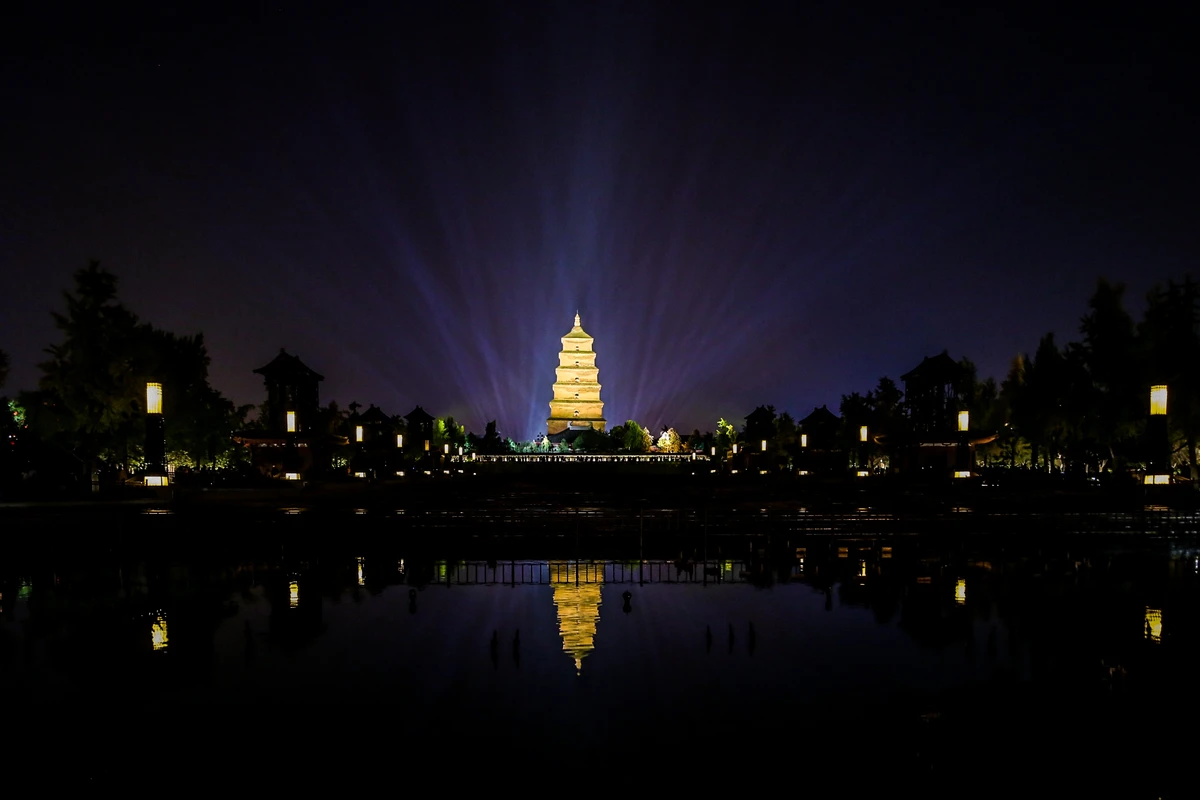
We came out of Dayan Pagoda as dusk was falling. We had dinner nearby, wanting to stay close, because there was an even more exciting nightlife awaiting us at the pagoda.
On the North Square of Dayan Pagoda, there's a musical fountain show every evening. When we arrived half an hour before the performance started, the square was already packed with crowds.
As the show began, the fountains transformed with the music into majestic waves, butterfly-dancing mist patterns, and dazzling, flowing colors. It's said that one of the octave-variable fountain arrays is the largest in the world.
Traveling in Xi'an, you really don't need to plan too much. After the fountain show, just follow the crowds and you'll reach Tang Dynasty Everbright City. Along this 1,500-meter pedestrian street stretching north to south, there's a scenic view at every turn. The internet-famous "Tumbler Lady" is here too, but catching a glimpse of her is no easy feat—the queue stretches on and on, an absolute sea of people.
As the first day's exploration ended, do you feel like we covered a lot of ground? Actually, all these spots are in the Dayan Pagoda area, within walking distance. If you get tired, hop on a shared bike and you'll be there in minutes—so convenient, right?
On the second day, we visited just one place—the Terracotta Army.
Xi'an has so many attractions, each with its own history, culture, and character. But if you had to pick just one to represent the city, I believe many would choose the Terracotta Warriors.
What's there to see in the Terracotta Army? Honestly, a quick look might seem enough, and I even overheard a visitor joking, "We came all this way just to see these clay dolls?"
But the stories behind the Terracotta Army are fascinating...
As everyone knows, the Terracotta Army is part of Emperor Qinshihuang's mausoleum. Qin Shihuang became king at 13, and from that very year, construction on his tomb began. It lasted until his death at 50—a full 37 years.
The underground palace was dug through three layers of spring water, with the emperor's coffin placed beneath them. The ceiling was studded with pearls and agates to represent the sun, moon, and stars, while mercury flowed through river and sea designs. It also contained the palaces of the six conquered states and seating for his officials—a realm where death mirrored life. What we see today in the Terracotta Army is merely the tip of the iceberg of this vast underground world.
Currently, only Pits 1, 2, and 3 are open to visitors. In Pit 1, you can see over six thousand terracotta warriors—a truly spectacular sight. The other two, well, to an ordinary person like me, aren't as impressive. However, there's also the "Qin Terracotta Army Relics Exhibition Hall," which we almost missed if not for our guide.
To me, this hall is an absolute must-see, because it houses the most exquisitely unearthed warriors. For example, the kneeling archer is so detailed you can even see the layered stitches on the soles of his shoes.
The Terracotta Army is located in Lintong District, quite far from downtown Xi'an. The round trip alone takes several hours. So when we returned from the site, our weekend trip to Xi'an had effectively come to an end.
Xi'an, of course, is not a city you can truly know in just two days. But those two days were more than enough to leave me deeply awestruck. Some cities are places you must visit once in your life, but Xi'an is a city you must return to again and again.
My knowledge enriched, I headed home with a happy heart. Xi'an, wait for me—I'll be back!
Travelogue Contents
1. Foreword
2. Day One
3. Day Two
4. Afterword
Travel Information Accommodation Guide Strategy Guide Flight Guide Website Navigation Travel Guide Cruise Guide Corporate Travel Guide Affiliate Cooperation Distribution Alliance Friendship Links Corporate Gift Card Procurement Insurance Agency Agent Cooperation Hotel Partnership Destination & Scenic Spot Cooperation More Affiliate Cooperation About Ctrip About Ctrip Ctrip Hot Topics Contact Us Careers User Agreement Privacy Policy Business License Security Center Ctrip Content Centre Intellectual Property Trip.com Group Algorithm Disclosure