Xi'an Travel: Embracing Ancient Charm and Recalling the Prosperous Tang Dynasty
"To see five hundred years of China, go to Beijing; to see five thousand years, go to Xi'an." This saying alone reveals Xi'an's profound history. Xi'an served as the capital for 13 dynasties and is one of China's seven ancient capitals. Together with Athens, Cairo, and Rome, it is hailed as one of the "Four Great Ancient Capitals of World Civilization." Xi'an, known in ancient times as Chang'an, is dotted with imperial tombs, palace ruins, ancient temples, and famous gardens. These countless cultural relics and historic sites showcase its past glory and rich historical and cultural charm. In October, our RV adventure begins as we step into Xi'an to experience the vicissitudes of China's millennia, the evolution of Chinese civilization, and the greatness of the Chinese nation.
Tang Paradise: Originally built along Qujiang in the Qin Dynasty, it was renamed Furong Garden in the Sui Dynasty. Drifting leisurely in a light boat, one follows the current to the depths of blossoms; ascending Ziyun Tower, one gazes out over Chang'an. In the Tang Dynasty, Qujiang entered a period of prosperity. Furong Garden was then designated as the imperial forbidden garden—Furong Yuan (also called Furong Garden). Important structures like Ziyun Tower and Caixia Pavilion were built in the 14th year of the Kaiyuan reign. Emperor Xuanzong, to frequently enjoy Qujiang and Furong Garden, had a walled passage specially built from the palace to the garden. During the grand Qujiang gatherings, Emperor Minghuang, accompanied by his favored consort and officials, would ascend Ziyun Tower to revel with the people. On such days, the entire city of Chang'an would empty out, as everyone gathered to feast and celebrate at Qujiang, offering a glimpse of the Tang Dynasty's magnificence.
Entering the west gate, you are greeted by a giant jade imperial seal carved with the five large characters "Da Tang Furong Yuan" (Tang Furong Garden). Below the seal, the ground is imprinted with the same characters. The jade seal symbolizes feudal imperial power, and Furong Garden was the imperial garden of the Tang Li dynasty. The sculpture of the seal artistically emphasizes the grandeur of the royal garden.
Inside the garden, Furong Lake is wide with shimmering green waves. Its shape, bulging to the north and indented to the south, resembles a crescent moon embracing Ziyun Tower. When the lake is calm, you can see the reflection of Ziyun Tower and surrounding structures. The interplay of motion and stillness creates a myriad of scenes that delight the heart and mind.
At the heart of the garden stands Ziyun Tower, the main structure of Tang Paradise and the largest Tang-style royal building in China. Historically, Ziyun Tower was built in the 14th year of the Kaiyuan reign, a magnificent jade and gold edifice towering high. It overlooked the green oasis with rippling Qujiang waters, and in the distance, the rolling Zhongnan Mountains. During the grand Qujiang assemblies, the emperor would ascend this tower, lean on the railing to enjoy the scenery, watch light songs and graceful dances from the royal opera troupe, and host banquets for his favorite consort and ministers. At the same time, he could watch the common people enjoying themselves around Qujiang Pool, embodying the spirit of sharing joy with the populace.
In the center of the south square, there is a "Map of the Tang Empire's Territory" pieced together from 992 copper plates. The Tang Dynasty was powerful and vast, stretching west to the Aral Sea, north to Lake Baikal, east to the Sikhote-Alin and Sakhalin, and south to southern Vietnam. This map displays the empire's extent and its main prefectures and administrative divisions.
From atop Ziyun Tower, every view is a scenic masterpiece. The ancient royal garden, the surrounding towering modern buildings, and the solemn Big Wild Goose Pagoda in the distance together paint a picture of a prosperous Chang'an spanning a thousand years.
The land of Shaanxi is one of the vital regions where the Chinese nation lived and multiplied, and where Chinese civilization was born and developed. Thirteen of China's most glorious dynasties, including Zhou, Qin, Han, and Tang, established their capitals here. To understand this long history and culture, you must visit the Shaanxi History Museum. Its rich cultural relics and profound heritage have shaped Shaanxi's distinctive historical character. Known as the "Pearl of Ancient Capitals and Treasure House of China," the museum is an artistic hall showcasing Shaanxi's history and China's ancient civilization.
The Shaanxi History Museum is located northwest of the Big Wild Goose Pagoda in Xi'an, and is China's first large modern national museum. The building complex, in Tang style, follows a "central hall with four towering corner buildings" design, orderly in layout, varied in height, and grandly imposing. It integrates national tradition, local characteristics, and contemporary spirit. The museum's collection boasts 1,717,950 items (sets), spanning from simple stone tools used by early humans to various objects of daily life up to 1840, covering over a million years. The artifacts are not only numerous and diverse but also of high quality and great value. Among them, Shang and Zhou bronzes are exquisite, pottery figurines from various dynasties display a myriad of poses, Han and Tang gold and silver wares are unmatched nationwide, and Tang tomb murals are unparalleled. It is truly a dazzling collection of masterpieces.
The special exhibition "Treasures of the Great Tang—Hejiacun Hoard Unearthed Artifacts" is in the fourth gallery. Starting from the astonishing discovery of the Hejiacun Hoard, it brings together 257 precious excavated items (sets) to display the era's culture, economy, and customs of the prosperous Tang Dynasty. Another special exhibition, "Tang Dynasty Mural Masterpieces," located in the basement level of the east hall, concentrates on showcasing 97 exquisite Tang tomb murals following the principle of "displaying instead of storing." These vividly depict Tang ceremonial norms, daily life customs, clothing features, entertainment, and architectural styles, offering a window into Tang society, especially the lives of nobles and their spiritual world.
When in Xi'an, a visit to the Big Wild Goose Pagoda is a must. In the third year of the Yonghui era under Emperor Gaozong, Xuanzang requested to build a pagoda, and it was completed by October. Originally, the pagoda had five stories with a brick exterior and earthen core. During the Chang'an years of Empress Wu Zetian's reign (701–704), it was rebuilt into a seven-story brick pavilion-style pagoda, which has been preserved to this day. The pagoda was built to store the Sanskrit scriptures on palm leaves brought back from India, and it also houses over ten thousand sacred relics (sarira).
The Big Wild Goose Pagoda was built for the temple and has stood within Ci'en Temple for a thousand years. Ci'en Temple is also a must-visit. Enter through the main gate, cross the main hall, and you reach the base of the pagoda. The temple thrives with worshippers; many visitors come out of admiration and to pray devoutly.
The Big Wild Goose Pagoda is a square pyramidal brick pagoda in traditional Chinese architectural style. It is 64 meters tall with seven stories, built entirely of brick, with a spiral staircase inside. Each story has arched doorways on all four sides; leaning on the railing, you can take in the full view of Chang'an. The bottom floor has stone doors on each side, and the lintels feature exquisite line-carved Buddha images, said to be the work of the great Tang painter Yan Liben.
On either side of the south gate at the base stand steles. On the left is the "Preface to the Sacred Teaching of the Tripitaka of the Great Tang" written by Emperor Taizong Li Shimin and inscribed by the great calligrapher Chu Suiliang. On the right is the "Record of the Preface to the Sacred Teaching" written by Emperor Gaozong Li Zhi and also inscribed by Chu Suiliang. These steles were personally erected by Xuanzang in October of the fourth year of the Yonghui era (653) and remain well preserved. It's worth noting that Tang painters like Wu Daozi and Wang Wei created many murals for Ci'en Temple, but they have unfortunately faded into history. However, the stone lintels and door frames of the four archways at the pagoda's base still retain exquisite Tang line engravings.
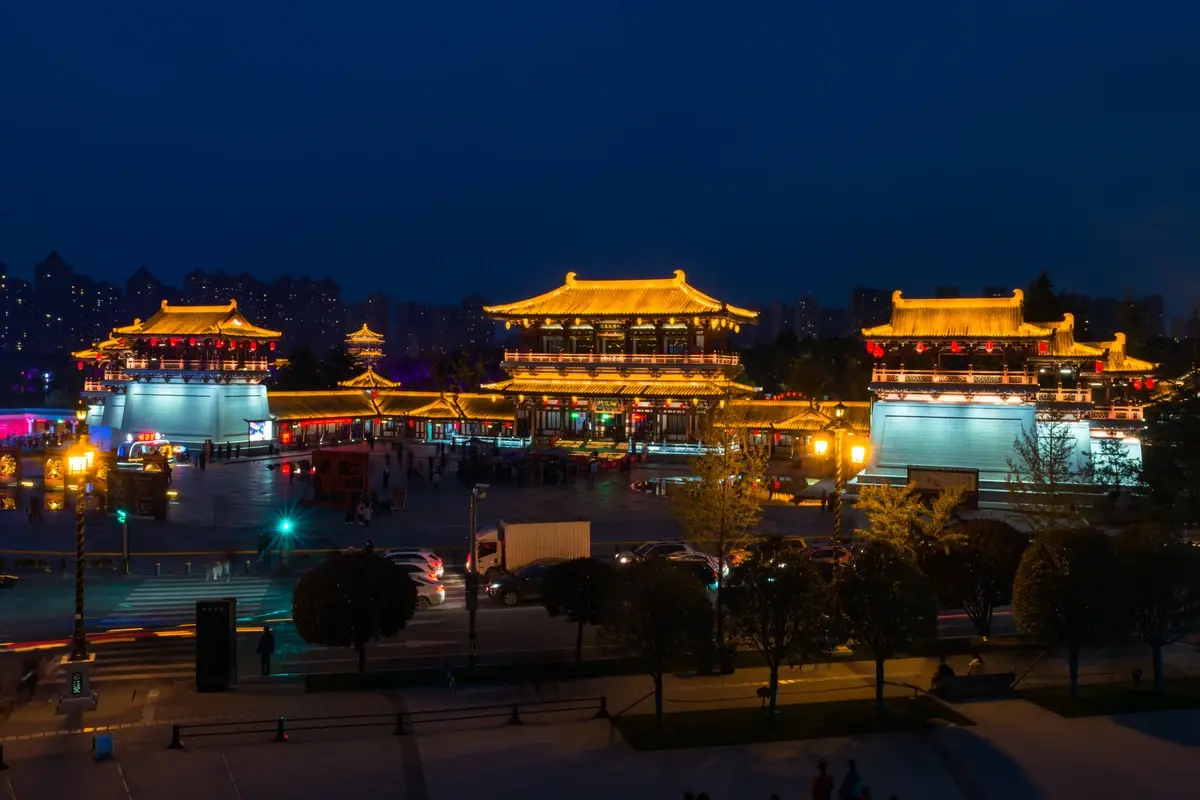
The charm of Xi'an extends beyond its graceful ancient elegance in the day. At night, the bustling prosperity of the Tang era seems to spread, turning Xi'an into a city that never sleeps. The square in front of Ci'en Temple is teeming with crowds, even livelier and more crowded than during the day.
The Big Wild Goose Pagoda square fills with waiting tourists early on, as a grand light and water dance show is about to begin. Light and shadow interplay, water dances gracefully, and music echoes long over the city of Xi'an.
The performance of the internet-famous "tumbler lady" follows the light show, with long queues forming two or three hours in advance. Unfortunately, we couldn't see it. The Grand Tang Allure pedestrian street is always extremely crowded, with bright lights and neon flashing, making you feel as if you've truly stepped back into the flourishing Tang Dynasty.
The Mausoleum of Qin Shi Huang lies in the Lintong district of Xi'an, Shaanxi Province, leaning against Mount Li to the south and facing the Wei River to the north. The tomb mound is grand and towering, looking like a majestic hill from afar. The Terracotta Warrior pits are located 1.5 kilometers east of the mausoleum. Pit 1 was accidentally discovered in the spring of 1974 by local farmers digging a well, and subsequent archaeological excavations and surveys revealed two more pits. They were numbered Pits 1, 2, and 3 in order of discovery. All three pits are underground tunnel-like wooden structures covering over 20,000 square meters, containing nearly 8,000 ceramic warriors and horses, and over a hundred chariots. They simulate the battle formation of an ancient army, creating an immense military spectacle rarely seen in history anywhere in the world.
Among the three pits, Pit 1 is the largest, covering 14,260 square meters. It is estimated to contain over 6,000 ceramic warriors and horses, arranged in a rectangular battle formation mixing chariots and infantry. It consists of a vanguard, main body, flanks, and rearguard. At the eastern corridor, there are three rows of east-facing warriors, 68 in each row for a total of 204. These warriors, mostly wearing battle robes and holding crossbows, face east and form the vanguard. On the south and north sides, there is a line of warriors facing south and north respectively, forming the flanks. At the west end, a line of west-facing warriors forms the rearguard. In the middle, 38 columns of infantry and charioteers are arranged, showing the tight organization of the formation, embodying the ancient military maxim of "neat front and back, four sides aligned" for a square formation.
Pit 2 is the most complex, covering 6,000 square meters. Based on drilling and partial excavations, it is estimated to contain over 1,300 ceramic warriors and horses, and over 80 wooden chariots. It is a large mixed formation of chariots, infantry, cavalry, and crossbowmen.
Pit 3 is the smallest, at only 520 square meters. Experts believe it may have been the command headquarters for the entire underground army. These three pits simulate ancient military formations, creating a vast martial display that symbolizes the guard troops protecting the Qin mausoleum. With powerful battle formations to "decide victory a thousand miles away" and a command center for "devising strategies within a tent," the arrangement is thoughtful and meticulously planned. After seeing the Terracotta Warriors, the erudite American Dr. Henry Kissinger remarked, "China's military level in the Qin Dynasty was 300 years ahead of ancient Rome."
In addition to the three pits, there is a Bronze Chariot and Horse Exhibition Hall. These bronze chariots were part of Qin Shi Huang's burial goods, representing a portion of his imperial procession. They were modeled after real chariots; previously discovered chariots were wooden and decayed upon excavation, but the bronze ones allow us to see clearly the true form of ancient royal chariots. The bronze chariots are half-scale replicas of the emperor's actual vehicles, with beautifully painted patterns inside and on the canopies. The gold and silver ornaments on the two chariots weigh 14 kilograms, indicating their high status.
Like the spring breeze that lifts the horseman's spirits to see all of Chang'an's flowers in one day, we witness the ancient charm and recall the glory of the Tang Dynasty. This autumn, we enter the dream of Chang'an.