Visiting the Potala in Lhasa, Tibet in October 2020 and Crossing the Qinghai-Tibet Plateau by Train
The Story of First Seeing the Potala in October 2020
2020 was such a special year. The pandemic that started at the beginning of the year changed the world and everyone's lives. For a travel lover like me, the pandemic simply shackled my free-wandering feet—I couldn't go anywhere.
In the blink of an eye, it was golden October, with crisp autumn air—a perfect season for travel. Seeing the domestic pandemic situation getting better and better, one day in late September, I said to my feet: Let's go, it's time to have some fun!
On September 23, I first went to Shanghai to let my body get a feel for travel again. I visited the Sihang Warehouse, Jing'an Temple, and Qibao Old Street.
From September 28 to 29, I flew to Nanjing to quickly adapt to the rhythm of traveling. I visited Jiming Temple (the foremost of the 480 temples of the Southern Dynasties), the Ming City Wall (preserved from the Ming Dynasty), Xuanwu Lake (the largest imperial garden-style lake in China), Meiling Palace (dubbed the No.1 Villa in the Far East), Ming Xiaoling Mausoleum (where Zhu Yuanzhang rests), the Nanjing Museum, Zhan Garden (one of the Four Famous Gardens of Jiangnan), and Yuhuatai.
After returning from Nanjing, the eight-day Golden Week holiday was about to begin. Based on years of travel experience, traveling during Golden Week is still a bit painful—the sea of people greatly diminishes the joy of traveling. So, I told my restless feet: Don’t rush, after the holiday I’ll take you to a place I’ve always wanted to go.
That’s right, Lhasa.
I don’t know if everyone has a few must-visit places in life, but I have such dreams. For example, seeing the Louvre and Arc de Triomphe in Paris, visiting Rome and Venice in Italy, seeing St. Peter's Basilica in the Vatican, the pyramids in Egypt, Tokyo and Kyoto in Japan, Mayan ruins in Mexico, Niagara Falls in Canada, and the moai on Easter Island. Even though these are very hard to achieve, they are my future travel dreams.
Comparatively, there was another place I wanted to visit that wasn’t so difficult—Lhasa. Because of the long distance and high altitude, I had never been. Originally I planned to go after retirement, but thinking it over, if I were in my 70s or 80s and wanted to travel to Jiangnan, I’m sure I could manage by gritting my teeth. But a trip to Tibet would definitely be impossible at that age. So, while my body is still fairly strong, I decided to make this wish come true.
Lhasa is not a place you can just decide to go to on a whim. Because it’s on the high plateau, you must be fully prepared mentally and physically and have a thorough travel plan.
Before the holiday, I read many Tibet travel guides and researched routes suitable for me. The original plan was to fly to Xining first, then take the train to Lhasa, and fly back from Lhasa. The goal was to gradually adapt to the high altitude by train, reducing the impact of altitude sickness—the mainstream advice in most guides.
But then I read an article with an opposing view. The author was an expert from a Beijing hospital. Simply put, he argued that when taking the train into Tibet, the train first crosses high-altitude areas like Kunlun Pass and Tanggula Pass, quickly reaching elevations above 5,000 meters, where over 70% of tourists experience altitude sickness. If the condition becomes critical, timely medical help is not available in the vast plateau, making it dangerous. Lhasa’s elevation is only 3,650 meters. Flying to Lhasa first means even if altitude sickness causes discomfort, you are in the city and can get to a hospital quickly, so the risk is actually lower.
This subversive view convinced me after reading it, so I planned my route based on this idea.
This trip to Lhasa was my second time on a high plateau. Many years ago, I went to Shangri-La; I remember the elevation was 3,900 meters, and then I visited Pudacuo National Park nearby, which is at 4,100 meters. I had altitude sickness then, so I had some experience with the plateau. Lhasa is only 3,650 meters, so the psychological pressure for this trip wasn’t great.
After making a detailed itinerary, I went to the pharmacy to buy Rhodiola rosea and glucose powder, and started taking Rhodiola a week in advance as preparation. Rhodiola is a commonly used drug for preventing altitude sickness; it can temporarily increase the oxygen-carrying capacity of red blood cells. Even though I took Rhodiola before my Shangri-La trip and still got altitude sickness, I decided to give it another chance this time.
Considering flight connections, ticket prices, flight times, and the guidebook suggestion to land in Lhasa in the morning, I decided to fly to Xi’an on October 12 and then to Lhasa early the next morning.
On the morning of October 12, before leaving, I checked the weather forecast for Dalian that day: 9–16°C, with a blue gale warning, north wind force 6–7, gusts 8–9.
Wow, the wind has picked up!
The flight to Xi’an was smooth. After taking the airport bus to Xishaomen, since I had to get up early to catch the flight the next day, I booked a hotel right at the Xishaomen bus stop for convenience.
After checking in, I first went to see the Giant Wild Goose Pagoda. Having climbed it before, I didn’t go in this time—just came to see if the Xuanzang statue in front was still as handsome as ever.
Exiting the pagoda area and walking east for about ten minutes, I reached Tang Paradise. I saw that with online reservation in advance, it was free to visit, so I scanned my ID card and entered. Also, at the gate there was a notice for the Tang music and dance performance Dream Back to Tang. VIP tickets were 518 yuan, regular ones 298 and 398 yuan. Considering my identity as a poor person, I decided to skip that show.
Inside, I looked around everywhere. The place was quite large, and I felt it was really well built. The landscape design was distinctive, with a prominent Tang style and a focused display of Tang culture—perfect for a leisurely stroll. 😄
As I walked here, a fine rain began to fall, so I sat in a pavilion to rest for a while and watched ducks and fish competing for food.
There were many sculptures in the park. This one’s theme was "Grinding an Iron Pestle into a Needle."
And this sculpture’s theme? 🤔
After wandering around Tang Paradise for about two hours, I left for Grand Tang All Day Mall.
Since it’s called All Day Mall, it means it’s most beautiful and lively at night.
Because of the rain, there weren’t many tourists, but the lights were still enchanting. The red-themed light show perfectly highlighted the prosperity of the Tang Dynasty.
This statue is of Li Shimin, with the four characters "Zhenguan Governance" inscribed below.
After strolling through the All Day Mall, I kept walking north. Not far away was the North Square of the Giant Wild Goose Pagoda. I timed my arrival here because it has the largest musical fountain in Asia, with scheduled shows every day—especially beautiful at night.
I watched for over ten minutes on site. It was truly spectacular and magnificent, though the fountain’s choreography was a bit stiff, like square dancing. Would’ve been great if it were like Swan Lake. 😆😊
After the fountain show, I went to the place where the viral Xi’an «tumbler» performers appear. Even though a crowd had gathered, there was no performance. I asked the security guard—turns out all performances are canceled when it rains. 😭
Leaving the North Square, I decided to take the subway to see the Xi’an Bell Tower and Drum Tower. I’ve seen bell and drum towers in many places, including Beijing, Kaifeng, Datong, Luoyang, and Xi’an. Each has its own character. I’m deeply impressed by Xi’an’s bell and drum towers, especially at night. So every time I come to Xi’an, if I have time, I come to see them—always feels familiar and heartwarming.
Next to the Drum Tower is the famous Xi’an snack street, Muslim Street. I’ve tasted meat-filled mo and yangrou paomo here before, so this time I skipped eating and just strolled around. Due to the rain, the street wasn’t packed, but the aroma of meat still wafted everywhere.
I got up very early the next day, catching the 5 a.m. airport bus to Xi’an Xianyang Airport. Breakfast at the airport: braised egg + beef noodles = 35 yuan.
After boarding the plane, I noticed it was still raining outside. Not heavy, but foggy with poor visibility—a small worry.
I also noticed that unlike other flights, aside from the female chief purser, all other crew members were male. I guessed the main reason was that this is a high-altitude route requiring good physical condition, so they’d mostly be male.
The plane took off smoothly. I put on my headphones, closed my eyes, and listened to my favorite songs while feeling the warm sun slanting through the window onto my neck—as if the world was filled with only beauty and joy. 😊
As we flew over Tibet, the clouds gradually parted, and through gaps I could see the land densely packed with mountains, with hardly any large flat areas visible. Occasionally, some snow-capped peaks stood proudly among the ranges, their noble aura perfectly captured. 😍
After a smooth landing, the cabin broadcast said the ground temperature was 25°C—much hotter than Dalian. 😅
I checked the map; the airport was 96 km from the city center—probably the farthest airport from a city I’ve ever encountered.
The airport shuttle bus took about an hour to reach the city center. Along the way, I paid special attention to my body’s reaction: just a slight chest tightness, no other discomfort.
This was the Tibetan-style hotel I stayed at; the service was good.
After checking in, I left the hotel and headed straight towards Potala Palace, eager to see that sacred place as soon as possible.
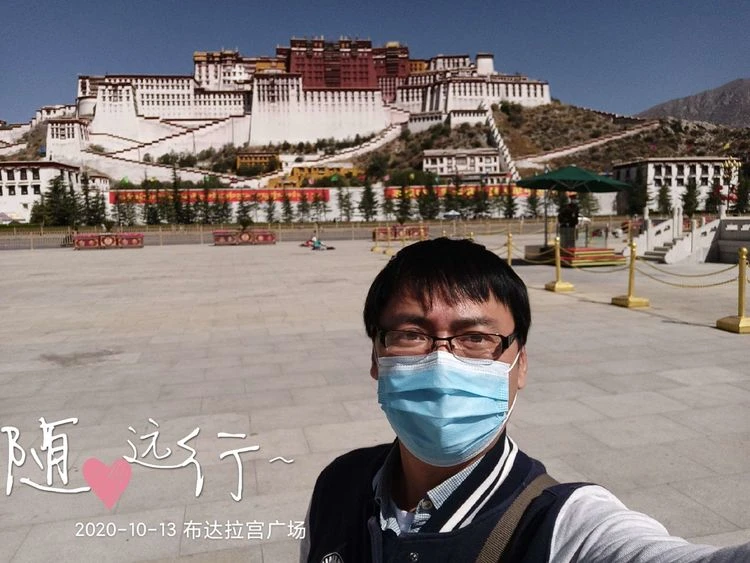
About ten minutes by bus brought me to Potala Palace Square. The square was large and open, with the majestic and sacred Potala Palace right there before me.
Seeing Potala Palace, I felt a surge of emotion. My brain quickly composed a prose poem, which I thought was pretty good.
“First Glimpse of Potala in Lhasa”
Deep within my heart,
there has always been a place,
inexplicably yearning for it,
ever lingering in my thoughts.
With a reverent heart,
I traveled a thousand miles to stand before you,
just to catch a glimpse.
At the moment I looked up,
a kind of emotion
filled my eyes with tears.
(Original work)
Because visiting Potala Palace requires advance reservation, I decided to enter the palace tomorrow morning. In the afternoon, I went to see the famous Jokhang Temple.
Leaving Potala Palace Square and walking east for over 20 minutes, I arrived at the renowned Jokhang Temple.
Jokhang Temple is the holiest place for Tibetan Buddhist believers and a convergence of all Tibetan Buddhist traditions. Not visiting Jokhang is like not coming to Tibet at all.
I went inside to look around. The interior wasn’t large, but I could truly feel the sanctity.
This is monks debating scriptures—a method of mutual learning. The guide said it’s always one-on-one, master and disciple; the one standing is the master, the one sitting is the disciple.
After exploring Jokhang Temple for over an hour, I wandered along Barkhor Street outside. It’s a historic thousand-year-old street with all kinds of Tibetan specialties and souvenirs—unique and distinctive.
After strolling Barkhor Street, I walked back to Potala Palace Square. Beside the square, I had a yak meat hotpot buffet. The grilled yak meat was incredibly tender and delicious.
After the hotpot, night had fallen. At Potala Palace Square, it felt a bit chilly. Tibet has big temperature differences between day and night; nighttime temperatures were already below 10°C.
Under the night sky, Potala Palace stood quietly, silently watching the people coming and going.
Back at the hotel, I felt a slight headache and figured it was probably altitude sickness, so I rested immediately.
After midnight, the headache worsened to the point of affecting sleep. Though not unbearable, I tossed and turned, feeling worried.
The next morning, the headache persisted, and moving around made it worse.
Comparing my resting heart rate and blood pressure before and after arriving in Tibet, I noticed significant changes—likely caused by altitude sickness.
My original plan for that morning was to visit Potala Palace and Drepung Monastery, and in the afternoon, Sera Monastery and Norbulingka. But considering my physical discomfort, I decided to rest at the hotel for the day.
After resting most of the day, around noon I felt slightly better—the headache subsided a bit—so I left the hotel and went to the train station early to rest and wait.
In the station waiting room, a Tibetan man around 40 to 50 years old sat beside me. While waiting, he read from a special Tibetan Buddhist scripture and kept chanting, very devout.
There’s no high-speed rail yet on the Qinghai-Tibet Plateau, only regular green trains. To experience the extraordinary Qinghai-Tibet Railway, I chose to cross the plateau by train and see the magnificent scenery.
Since flights from Xining to Dalian didn’t fit my schedule, I chose the train route from Lhasa to Xining and then to Lanzhou. Total fare: 550 yuan—probably the most expensive train trip I’ve taken.
Due to the plateau’s special nature, passenger trains on the Qinghai-Tibet Railway are equipped with oxygen supply facilities to reduce passengers’ altitude sickness symptoms.
After leaving Lhasa, the train headed north, laboring through mountains. Occasionally, I could see yaks grazing leisurely on slopes or in fields, and sometimes snow peaks flashing into view behind the ridges—beautiful scenery.
After dark, the views outside were swallowed by night. Inside the carriage, people started to warm up to each other.
In the bunk across from mine was a young man who looked in his twenties, from Hunan, occupation unknown. He had a huge suitcase and seemed sharp and efficient; I guessed he might be a soldier. Throughout the trip, aside from sleeping, he kept looking at his phone and occasionally writing in a thick notebook—probably a journal or travelogue. His handwriting was slightly messy.
The two people in the middle bunks: one was a plump middle-aged woman, around forty-something, from Xi’an. A practitioner of TCM acupuncture, she was outgoing and chatted easily with everyone, mainly about the hardships of her business and her experiences in Tibet.
The other middle bunk occupant was a slender young man around thirty. He barely spoke, either sleeping or leaning at the window staring at the scenery. He had a tiny topknot on his head, probably a hipster.
The upper bunks were occupied by two Sichuan men who looked in their fifties, carrying a large empty paint bucket stuffed with instant noodles, bagged chicken feet, and canned beer and bottles of baijiu. I guessed they were migrant workers. Of everyone, they were the most uninhibited. Though I couldn’t fully understand their Sichuan dialect, I caught some snippets. They ate, drank, and chewed the fat (shot the breeze), talking about everything from why the Qinghai-Tibet Railway was built to the current situation in the US—quite in-depth. I really liked that state of mind. When traveling, having fun is most important. Life is so short; getting angry and upset is really a waste of life.
After midnight, the train reached the highest point on the Qinghai-Tibet line: Tanggula Pass, at an elevation of 5,231 meters—much higher than Lhasa. This is also the place where altitude sickness peaks. My headache returned, and the tender spots multiplied. Not severe pain, but definitely affected sleep.
In the darkness, I had to breathe deeply to actively increase oxygen intake and ease the effects of altitude sickness. The carriage was relatively quiet, except for the intermittent hissing of the oxygen supply system. For lack of anything better to do, I tried to figure out its rhythm but after listening for a long time, there really was no pattern. It would release oxygen at random times, sounding a bit like a pressure cooker’s steam vent. In the silent night, it was piercing, but I kept hoping it would release more often.
After a somewhat arduous night, we arrived at Golmud the next morning. Here, the elevation was already lower than Lhasa, and the altitude sickness symptoms had quietly faded away. Checking the temperature, Golmud was only -4°C—like going from Lhasa’s summer, through one night, to Golmud’s winter. 🥶 The Qinghai-Tibet Plateau is truly magical.
With altitude sickness gone, the atmosphere in the carriage livened up again. The Sichuan guys resumed their incomprehensible chatting, and the plump middle-aged woman started striking up conversations again, this time already deeply engaged with people from the neighboring compartment.
That’s the advantage of high EQ. In no time, a small crowd had gathered around her, and the topic had shifted to acupuncture treatments. Soon, she went back to her bunk, fetched a few items, and returned. Suddenly, exclamations started coming from that side. I followed the sound to look—turns out she had already started giving people acupuncture. Her EQ was so high: chat a few sentences and she could stick a needle in you.
I watched for a while; she had already treated three people. One was an old lady in her seventies who had some surgery and needed a few needles to unblock something in the upper or middle burner. One was a 62-year-old man from Zibo, who said he had weak spleen and stomach and needed needling. Another was a 28-year-old girl from Fujian, a makeup artist, who needed her qi and blood regulated—so she got needled.
After watching the lively scene over there, I returned to the window to continue enjoying my scenery. After Golmud, grasslands became more frequent, and herds of cattle and sheep occasionally flashed by the roadside.
Passing one spot, I saw three bright points in the distance. At first I thought they were window reflections. When we got closer, I realized they were solar thermal concentrators for power generation. I’d only seen them in books and online before—this was my first time seeing them in real life.
Near Xining, we passed the beautiful Qinghai Lake. The vast expanse of water rippled gently. It felt like after seeing endless desert all the way, the channel suddenly switched—such a different kind of scenery.
The train was about ten minutes late, arriving at Lanzhou Station around 7:40 p.m. To make it easy to catch my flight the next day, I had booked a hotel near Lanzhou West Station. So after getting off, I bought a ticket and took a train to Lanzhou West Station.
After boarding, I found someone lying across my seat, face completely hidden by a hood, seemingly asleep. Looking at the shoes, it seemed to be a child. Opposite the seat sat an elderly couple who looked to be in their sixties, speaking Lanzhou dialect I could barely understand. They tried to explain: the child was 14, had some strange illness, and was sleeping; they hoped I could switch seats.
Looking into the old couple’s eyes, I felt they were sincere, so I quickly said no problem. Then they kept talking with gestures, most of which I didn’t catch. The little girl woke once, lifted her hood, and stared at me quietly. She had a plump, large face, slightly pale and puffy. After a few glances, I couldn’t bear to look any longer. Life is really hard; I hope she recovers soon.
The next morning, I took the high-speed train to Lanzhou Airport. I had wanted to eat a bowl of authentic Lanzhou lamian noodles, but I couldn’t find any—just various beef noodles and egg noodles, so I gave up.
The flight from Lanzhou to Dalian took about two hours. I had a nice nap on the plane. Approaching Dalian, I was jolted awake by turbulence; I even heard a woman’s scream. This was probably the most violent turbulence I’ve experienced, though it lasted only about two minutes.
Finally, the plane landed steadily. Stepping out, I saw it was drizzling in Dalian. Checking the weather forecast: still a blue warning for gale winds that day, with maximum gusts up to force 7.
Wow, the wind has picked up again.
1. From what I’ve read, altitude sickness is nothing to fear. Normal people living at low altitudes will experience some degree of it when reaching above 2,700 meters. It’s the body’s normal stress response, actively alerting you that oxygen is low. People who don’t get altitude sickness have either adapted to high altitudes or have a problem with their stress response.
2. I don’t recommend going to high altitudes if you have high blood pressure or heart/cerebrovascular diseases—the risk is high. First-timers to the plateau should avoid strenuous exercise to reduce oxygen consumption and minimize altitude sickness effects. Also, rest more, drink plenty of hot water, and be very careful not to catch a cold.
3. Next: DL—WH—SY—XA—BJ—DL.
THE END
Thank you for watching!!