Autumn Trip to China: Shanxi (Pingyao, Hukou, Jinci, Datong), Luoyang, and Xi’an
Our Shanxi trip began in Taiyuan, and from there we circled around the province—Pingyao, Hukou Waterfall, the Li Family Courtyard, Huangcheng Xiangfu, Banshan Scenic Area—before heading off to Luoyang’s Longmen Grottoes, then Datong’s Yungang Grottoes and Huayan Temple.
In Xi’an, of course we couldn’t miss the Terracotta Warriors and Shaanxi Museum. Seeing the ginkgo tree at Zhongnan Temple was a happy coincidence—the leaves were just turning yellow this season.
Our granddaughter Xiaoqing accompanied us two old folks again. While she’s still not in school, we wanted to get out and explore more.
Day 1 (Oct 19): Guangzhou fly to Taiyuan ~ Pingyao Ancient City. We took the 11:30 a.m. Hainan Airlines flight from Guangzhou to Taiyuan, arriving at Taiyuan Wuxu Airport T1 at 3:00 p.m. After picking up our luggage, we called the car rental company’s airport office, and they promptly sent a car to pick us up and take us to their office to complete the rental formalities. We had already booked the car model, paid, and bought full insurance. After checking the windows and tires for any issues, we were ready to drive off.
We first got a temporary QR code for the vehicle registration from the rental company (which can be handled on a mobile phone) and set it up on the 12123 app before starting our road trip. Otherwise, if a traffic violation occurred, dealing with penalty points would be a hassle—we would need the rental company to mail the original vehicle registration certificate to our city’s rental office, and then we’d have to bring our driver’s license, ID card, and rental contract to the traffic bureau. But if we do the vehicle registration right when picking up the car, any violation can be handled directly via the 12123 app. The cities we were visiting—Taiyuan and Luoyang—both have vehicle restriction policies, so after checking, we asked the rental company for a car with a plate number ending in 2 or 7 to avoid restrictions and make driving easier. More and more cities are imposing driving restrictions, so road trips are really a test of wit these days. Anyway, by 3:30 p.m. everything was done, and we officially hit the road for Pingyao. Fortunately, the rental office was very close to the highway entrance; it’s 102 km, took us 1 hour and 51 minutes, and we reached Pingyao Ancient City at 5:30 p.m. We parked outside the old town, contacted the inn, and someone came to pick us up.
To enter the old town you need a ticket—normally 120 yuan per person, but it’s free on weekdays now. You just reserve on the ancient city’s WeChat official account and scan the QR code to get in. We stayed at Pingyao Yonghuage Renwen Inn, in the “Master’s Room” with a traditional kang bed, including breakfast for two. The inn is on a street parallel to South Street, quiet but extremely convenient. After settling in, we went out for dinner. Night had fallen and the streets were brilliantly lit; we ate right on South Street at “Ren Zai Bei Fang” (People in the North), enjoying Pingyao’s local specialties. South Street at night was quite lively. We strolled leisurely with Xiaoqing, savoring the joy of travel, and bought her the cotton candy she loves most.
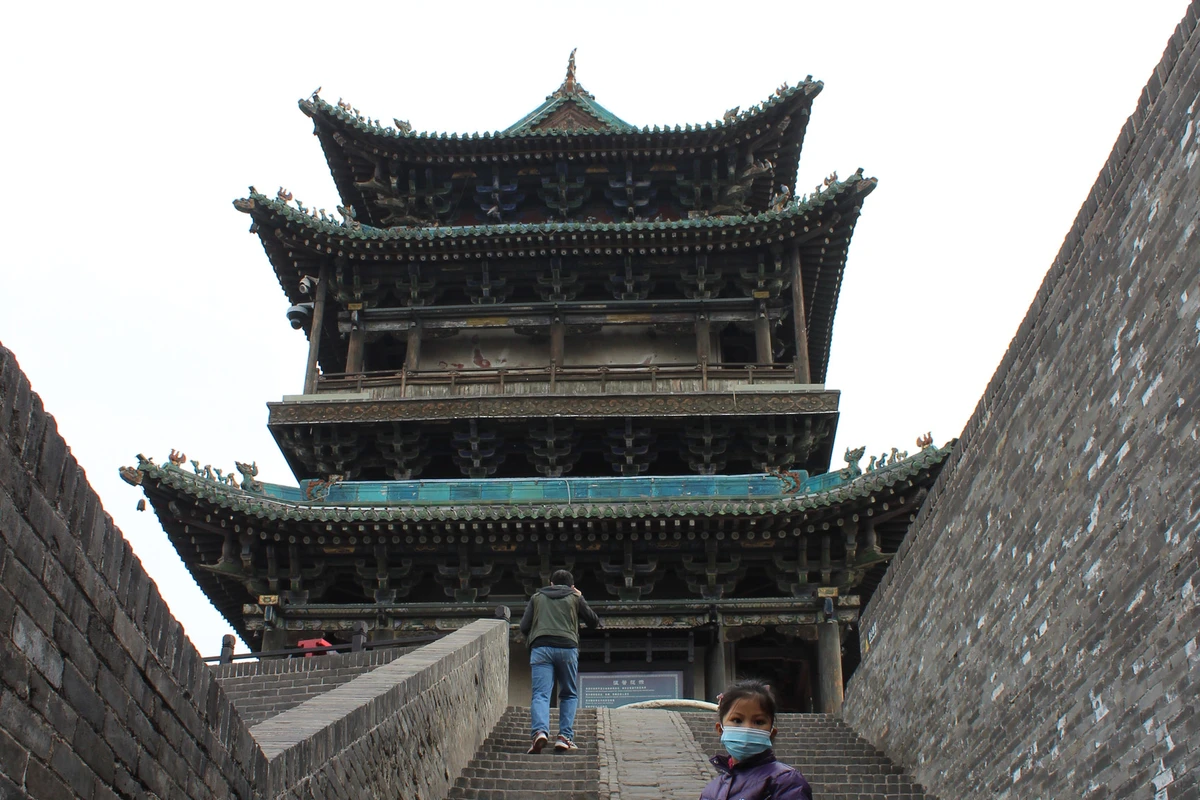
Day 2 (Oct 20): Eating, drinking, and having fun in the old town. After breakfast, we set out at 9:30 a.m. to visit the South Gate, climbing the city wall for a panoramic view of Pingyao. The old city has six gates—one each south and north, two each east and west—and the wall stretches 6.2 km, but only a short section at the South Gate is open now.
Coming down from the wall, we visited the former residence of Lei Lutai, founder of the Rishengchang Draft Bank. It’s a three-courtyard compound, well-laid-out, with a symmetrical layout typical of grand courtyards, self-contained and very comfortable.
Next we visited the Pingyao County Government Office. This was the yamen during the Ming and Qing dynasties; after liberation, it became the seat of the Pingyao county government. Later, most old structures were demolished and rebuilt. In 1996 the yamen gate and main hall were restored, and in 2000 it was opened to the public. Though it’s newly done, it gives a good idea of how an ancient government office functioned. We had lunch at a small eatery right at the yamen gate, then went back to the inn to rest—one of the perks of staying inside the old town. In the afternoon we came out again to stroll around. The sights are concentrated on South Street, West Street, and a short stretch of East Street, with places like the Market Tower, Rishengchang Bank, and North China Bodyguard Agency still preserved. You can just wander and see what catches your eye.
Xiaoqing refused to nap at noon, but as soon as we went out, she fell asleep in the stroller and missed everything, not even waking for dinner. In the evening we ate on South Street at “Hongwu Ji,” trying Pingyao signature dishes like kaolaolao (oat noodle rolls) and Pingyao beef. The two-person set meal cost 98 yuan and included five dishes, with enormous portions—we couldn’t finish it all. Xiaoqing slept for over two hours and finally woke up; she had a little kaolaolao and then said she wanted to go out for a walk again, asking us to take another spin—actually, she just wanted more cotton candy.
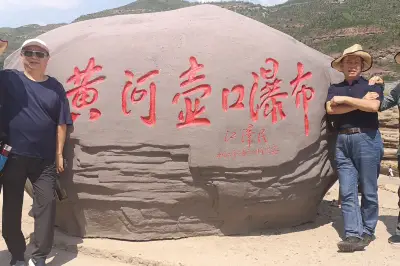
Day 3 (Oct 21): Shanxi Yellow River Hukou Waterfall ~ Hejin city (overnight). After winding through the city for 30 minutes, we finally got onto the highway. From Pingyao, we drove 290 km toward Hukou Waterfall, which took five hours. The trees along the highway were ablaze in gold and red because of autumn, and the mountains were even more beautiful, blanketed in fiery red leaves—a fall road trip truly gives you extraordinary visual treats. At 2:00 p.m. we arrived at Hukou Waterfall on the Shanxi side, in Ji County. We’d seen the waterfall from the Shaanxi side before, but this was our first time viewing it from Shanxi. Here the river surface is broader, making the falls feel particularly spectacular; the wind-blown spray often soaks the visitors.
The Shanxi side was very crowded because admission was free on weekdays (normally 120 yuan/person). The shuttle bus isn’t free, though—20 yuan per person—because the parking lot is 2 km from the scenic area entrance, impossible to walk. Just think, this one natural waterfall costs a total of 140 yuan a person normally… haha, well, there were so many people taking advantage of the free admission while it lasts.
Kids find different things interesting. Xiaoqing wasn’t impressed by the waterfall but instantly fell for the little donkey at the shore for photo ops. She was overjoyed riding the donkey, trotting back and forth on the bank.
After the visit, we drove two hours from Hukou on the highway to our night’s stop in Hejin, 110 km away. We stayed at H Hotel (Hejin Xingeng Street), with breakfast for two, twin beds, spacious room and new facilities—the experience was excellent, exceeding expectations. Right after check-in, the hotel even delivered freshly made pear-and-tremella soup with red dates, delicious and heart-warming.
Dinner was delivered via takeout—tasty, inexpensive, saving time and effort, which is now our standard practice.
Day 3 continued (Oct 22): Li Family Courtyard ~ Luoyang (overnight). It’s only 50 km from Hejin to the Li Family Courtyard in Wanrong County, Yuncheng, a 50-minute drive. Weekday admission free, few visitors, and very peaceful. The Li Family Courtyard is huge, mainly constructed in the “shaft-well” layout of Shanxi’s wealthy siheyuan compounds, with one to four interconnected courtyards, like modern townhouses where each family has a small gate linking to the next.
Inside are an ancestral hall, private school, grain-drying ground, shops, and Baiquan Lake Scenic Area. The most exquisite part is the wood carving on the door lintels—each family’s style is different, all of superb craftsmanship, a rare sight today. Also noteworthy are the stone carvings: pictures and calligraphy carved in relief by the best stonemasons of the time according to the owner’s requests. The mason would slowly carve out the characters and images, creating a unique raised effect called yang carving.
The Li family were famous philanthropists in Shanxi, known as “Li Shanren” (The Good Li). They started from scratch—farmers to merchants to national capitalists—a quintessential rags-to-riches story of Shanxi merchants.
After touring the courtyard, we drove straight to Luoyang, 251 km, 4 hours. We stayed at Luoyang New Friendship Hotel, where we were upgraded to a deluxe king suite, 60 square meters, even with a bathtub and massage chair—absolutely loved it.
Day 4 (Oct 23): Longmen Grottoes ~ Wangcheng Park. At 10:00 a.m. we set off and reached the northeast parking lot of Longmen Grottoes in 45 minutes. Only this parking lot has an electric shuttle to the scenic area entrance. The parking lot is 2 km from the site; walking that distance is truly tiring, especially with Xiaoqing, so we bought one-way shuttle tickets at 10 yuan each and rode to the newly built main gate. We had reserved tickets (90 yuan each). After entering, it’s still 900 meters to the grotto area.
The Longmen Grottoes were built around the time the Northern Wei dynasty moved its capital to Luoyang, with a history of over 400 years. Because court-sponsored, the workmanship is exquisite. The famous Vairocana Buddha in Fengxian Temple, said to be modelled after Empress Wu Zetian’s own appearance, is the largest and most artistically superb group of cliffside carvings at Longmen.
The grottoes have suffered severe human damage over the centuries—many statues, steles, and reliefs have been destroyed or taken abroad.
With Xiaoqing, going up and down was tiring, so we alternated between sitting, looking, listening, and walking, spending over three hours there. After viewing, we crossed the bridge to the East Hill shuttle station and took the electric cart back to the parking lot.
Then we drove to Wangcheng Park. Luck was on our side—just as we pulled up, a car left a spot right at the park entrance. The park has changed a lot: there was a chrysanthemum exhibition at the gate, and on the left a moon gate that now leads to a peony garden, with a pavilion beside it—that same pavilion we played in years ago, still preserved, which lifted our spirits.
Day 6 (Oct 24, Saturday): Jincheng “Huangcheng Xiangfu” ~ Changzhi (overnight). After breakfast, Xiaoqing played briefly at the hotel’s kids’ club. We left at 10:20 a.m., but Luoyang’s subway construction and road repairs meant it took 40 minutes just to reach the highway. From 11:00 a.m. we were on the expressway with a speed limit of 80 km/h—so slow. The 150 km drive took over three hours, arriving at Jincheng’s “Huangcheng Xiangfu” (Royal Prime Minister’s Mansion) at 1:40 p.m.
Surprisingly, the venue was also free on weekdays; you just reserve at the gate. If you only visit the mansion and not the garden, you don’t need to buy the 50-yuan electric cart ticket. The mansion is right at the parking lot entrance; parking is separated for cars and tour buses. Independent travelers can enter and exit directly at the mansion gate, while tour groups must go through the pedestrian street exit.
Huangcheng Xiangfu is the ancestral home of Chen Tingjing, Emperor Kangxi’s tutor. This Ming-Qing architectural complex, built into the hillside, features stacked courtyards and staggered pavilions, surrounded by a 10-meter-high wall with a walkway and guards’ posts. It truly deserves its reputation as China’s premier ancient castle-like residence.
Its landmark, the Heshan Tower, stands over thirty meters tall, the highest structure in the complex. With seven stories, it could shelter over a thousand people at once—a height and scale rarely seen in Ming-Qing buildings. What’s more remarkable is that after nearly four centuries of weathering, it still stands firm, dominating the landscape, with no taller building in the vicinity even today. Too bad it was closed to visitors.
The most treasured item is the original Kangxi Dictionary, first edition, with Chen Tingjing as chief editor. Only three copies exist today: this one, one in the Forbidden City, and a third in Taiwan’s museum. Seeing it was an eye-opener. A thorough visit took about 2.5 hours; we didn’t leave until 4:00 p.m. for Changzhi. It’s 115 km, a 1-hour 40-minute drive to Changzhi Quanji Hotel. We stayed at Changzhi Quanji Hotel with breakfast for two, twin-bed room.
Day 7 (Oct 25, Double Ninth Festival): Banshan Scenic Area ~ Taiyuan. We headed for Taihang Banshan Scenic Area in Wuxiang, 103 km away. After four hours we exited the highway at Xijing and entered Pengzhuang village, once a bullet production base for the Eighth Route Army. The scenery gradually became beautiful as we climbed, with towering red rock formations on both sides—truly striking Danxia landforms, utterly breathtaking.
Reaching the mountaintop, Banshan’s gate was tightly shut; a notice said it was closed due to the pandemic. Honestly, there’s no need to buy a ticket because the views along the mountain road are already stunning. We left contentedly and headed for Taiyuan.
From Xijing to Banshan, though it’s a rural road, the condition is better than many provincial roads—asphalt, two lanes each way. If you go to Taihang Banshan, I recommend approaching from Xijing; the scenery is all on that side. If you don’t backtrack after passing the scenic area, the descent on the other side offers little scenery and is farther from the highway entrance. That’s the route we took—to Taiyuan it was 180 km, a three-and-a-half-hour drive. We stayed at Hampton by Hilton Taiyuan Jinyang with twin beds and breakfast for two. In the evening, we went to the mall next to the hotel to buy toys for Xiaoqing and have dinner.
Day 8 (Oct 26): Taiyuan Jinci Temple ~ Datong. We left at 10:00 a.m. for Jinci. As soon as we entered the park’s main gate, the birch trees lining the path were dazzling golden in the sunlight—a huge, pleasant surprise. All along the way, the ground was carpeted with yellow leaves. Xiaoqing was thrilled, striking all sorts of poses; the sunlight streaming through the branches onto her was just beautiful.
Jinci wasn’t crowded today, so we could quietly appreciate the splendid Song Dynasty architecture. The 33 painted clay sculptures of female officials and attendants inside the Hall of the Holy Mother are true classics: postures vary, expressions and personalities vividly natural, as if they’re awaiting our arrival. For a moment, we seemed to travel through time, back 900 years—they’re still here, unchanged, while we’ve lived through several lifetimes. So, cherish the present; living in the now is the best.
At noon, we ate at Jinci Hotel, a state guesthouse, so the food was excellent. We ordered sweet and sour pork and scallion pancakes that Xiaoqing likes. Well-fed and watered, we continued our journey to Datong.
At Duncun service area, we noticed the right rear tire looked flatter and flatter. Actually, ever since we picked up the car, it had warned of a right rear tire issue, but we didn’t know what to do, so we just checked the tire visually each time we stopped. On the sixth day, the problem became obvious. The service area’s repair shop found a slow leak caused by a screw. We called the rental company; they said get it patched, and they’d reimburse the 100 yuan when we returned the car. With the tire fixed and that worry lifted, we cheerfully continued toward Datong. Night fell, and at 7:30 p.m. we finally arrived.
We stayed at Datong Garden Hotel, and after a chat, they upgraded us to a deluxe twin room. This hotel was the most comfortable of our whole trip: heating was already on when we checked in, the temperature just right, beds 1.3 meters wide, and the bedding was incredibly cozy. After dinner came the important thing: Xiaoqing said she really wanted to play on the stage in Gulou East Street. Haha, but it was freezing—only 2°C at night—and the entire street had just the three of us. All the shops were closed. When we were here in early July, there were playmates on the stage, and Xiaoqing even made friends with an older girl and had a blast. This time, the place was empty. Disappointed, we went back to the hotel to rest.
Day 9 (Oct 27): Huayan Temple ~ Nine-Dragon Screen Wall ~ Yungang Grottoes. After a leisurely breakfast, we walked to Huayan Temple, one of China’s oldest and best-preserved Liao-Jin temple complexes. Today there were very few visitors, and to our luck, both the Grand Hall and the Bhagavad Sutra Hall were open. The glazed chiwen (dragon-like ridge ornaments) on the main hall are huge—4.5 meters tall, made of eight glazed segments. The northern chiwen is an original from the Jin Dynasty; the southern one is from the Ming Dynasty, the largest glazed chiwen on any ancient Chinese building.
Inside the Bhagavad Sutra Hall, the sculptures are all genuine Liao Dynasty works, with 29 painted clay statues. Here you can see the famous “Hands-Clasped Bodhisattva with Bared Teeth,” a smiling figure known as the “Eastern Venus.” Then we climbed the Huayan Pagoda, rebuilt in 2011 based on Liao documents. First, we visited the nearly 500-square-meter Thousand-Buddha underground palace, crafted from 100 tons of pure copper, housing a monk’s relics and thousands of Buddha statues, glittering in gold—a unique all-copper design. Ascending the pagoda gave a panoramic view of the old city.
Without pause, we walked to the Nine-Dragon Screen Wall. It had been closed for repairs in early July, so we couldn’t miss it today. Built in the late Hongwu period of the Ming Dynasty, it was the glazed screen wall in front of the mansion of Zhu Gui, 13th son of Emperor Hongwu, with over 600 years of history. Supposedly the earliest nine-dragon wall in China. In front is a reflection pool, with a stone bridge in the middle for pedestrians to cross. The dragons’ reflections would appear to move in the water, a clever design—but when we visited, the pool was empty.
After lunch, we drove to Yungang Grottoes. Weekday admission free, just reserve and enter with your ID. Round-trip electric cart was 15 yuan. We had assumed there would be no tour groups in the afternoon—haha, we were wrong. After 2:30 p.m., one big group after another arrived, very lively. We dodged the crowds, taking our time. Even though we’d only been here four months ago, everything felt new yet familiar, so we read each cave’s explanation carefully before going in for a closer look—that way the impressions stuck. By the time we finished, it was past 4:00 p.m.
We originally planned to play on the Gulou East Street stage before supper, but Xiaoqing finally gave in to sleepiness after getting in the car and said she didn’t want to go.
Day 10 (Oct 28): Taiyuan South High-Speed Rail Station ~ Xi’an North. We left Datong at 8:45 a.m., arrived at Taiyuan South Station at 12:50 p.m., returned the car, got our refund sorted, and waited at ease for the high-speed train to our last stop, Xi’an. At 6:15 p.m. we reached Xi’an, picked up another rental car, and went straight to our hotel. We stayed at Hampton by Hilton Xi’an North Street, with breakfast for two, twin beds. We had called the hotel while in Taiyuan, requesting a larger and quieter room, and the staff specially arranged it—very satisfying, a generous 35 square meters. The area around the hotel had everything, food and drinks, super convenient.
Day 11 (Oct 29): Zhongnan Temple ~ Terracotta Warriors. In the morning we headed to Zhongnan Temple in the north of the city to see the ginkgo tree, having reserved on the temple’s WeChat official account. The drive took longer than expected, so it was 12:40 p.m. when we arrived. We still had to queue to enter. We rushed straight to the ginkgo tree. The weather in Xi’an wasn’t cold enough yet, so the leaves weren’t very yellow, and not many had fallen—not the peak ginkgo-viewing time—but at least we made it and ticked this off our list. Coming in autumn, we had to see the legendary ginkgo tree said to be planted by Emperor Taizong himself; this trip wouldn’t have been complete without it.
We had reserved a visit to the Terracotta Warriors Museum for 1:00–3:00 p.m. We parked, entered Pit 1 at 2:00 p.m. Xiaoqing was very interested, looked carefully, and asked many questions while Grandpa explained in detail. The most spectacular, dubbed the “Eighth Wonder of the World,” Pit 1’s warriors are all different, none identical, incredibly detailed, with rich hairstyles and expressions—a true marvel. We then visited Pit 2, Pit 3, and the Bronze Chariot Exhibition, not missing a single thing. Xiaoqing’s knowledge grew, her horizons broadened, and she gained a lot.
However, the exit at the museum is a long walk—about 20 minutes—with unclear signs, and parking cost 20 yuan.
Also, in the parking lot, someone tried to fool us, saying we were in the wrong place, that this was just the museum and Pit 1 was still 3 km away, offering to drive us. We looked around—others were also touting self-driving tourists, and some got in. We ignored them. In fact, the entrances to Pits 1, 2, and 3 are right next to the parking lot.
At 5:00 p.m. we headed back, returned the car, went to see the Bell Tower. North Street was bustling. We rushed back by 7:30 p.m. for Xiaoqing’s online English class—another fulfilling day.
Day 12 (Oct 30): Shaanxi Museum ~ Bell Tower. Today’s highlight was visiting the Shaanxi Museum. Because of the pandemic, you now need advance reservations; we had booked tickets, so we got in easily. But this time we also wanted to see the “Tang Dynasty Mural Exhibition,” buying tickets on site at 270 yuan each. It houses mainly Tang tomb murals, reflecting scenes of hunting, daily life, clothing—remarkably well preserved, with vivid colors, especially the red cinnabar clothing and black brushstrokes outlining human figures, all so beautiful. The plump Tang beauties, with their varied hairstyles, truly evoke the prosperity of the Tang. The exhibits were absolutely worth seeing.
Xiaoqing was fascinated by the mural ladies and said she wanted to draw them, so we fetched paper and pen and let her quietly sketch while we continued to Gallery 4’s Tang relics—two large jars and a small pot from Hejia Village containing a whole hall’s worth of Tang treasures. Many museum masterpieces are here, and every visit brings new insights.
Xiaoqing was also interested in these treasures and, imitating the adults, took photos madly with our phones. Next, we carefully toured the second and third-floor exhibitions; there were so many treasures it made your head spin. From Lantian Man in Shaanxi to the splendor of Chang’an to today’s bustling Xi’an, history just keeps moving forward. The Shaanxi Museum is always a must-visit whenever we come to Xi’an. Last time we came with Xiaoqing’s mom; this time we brought Xiaoqing—how the years fly. On the way back, Xiaoqing wanted to play at the Bell Tower. After enough fun, we went to Xi’an Restaurant for dinner, another perennially must-eat spot for us, though the East Street branch was demolished and it’s now behind the Bell Tower Hotel, easily reached via Exit 8 of the metro station. Full, Xiaoqing said she wanted to buy toys. We bought ice cream from the Mixue Bingcheng downstairs, then went to buy toys and stickers. She affixed the princess stickers as a gift for her mom.
Day 13 (Oct 31): Fly to Guangzhou. We rested in the hotel all morning, ordered takeout for lunch too. Then we took the 3:30 p.m. Hainan Airlines flight back to Guangzhou.
Home sweet home.