Xi'an: A Love Affair Across a Thousand Years
This year has been a tough one. The pandemic hit hard in the first half, and the anxiety continues through the second half, with business still up and down and everyone feeling on edge. I had been longing to travel, but worried about safety and had no companion, so I kept suppressing this restless heart. Then one day, an old friend asked, 'Want to go somewhere?' This girl had traveled with me to Dali and Lijiang when she was single, and to Fenghuang and Zhangjiajie when she was dating. Now, after so many years—she's married with an eight-year-old kid—she finally invited me on a trip again. And suddenly, I just wanted to go to Xi'an.
Xi'an, the ancient capital of thirteen dynasties, is most famous for the Qin and Tang dynasties. The thought of a history spanning over a thousand years fascinated me. And then there was Mount Hua—as a martial arts fan, I have a special feeling for it, with its 'Sword Contest on Mount Hua' and the spirit of 'The Smiling, Proud Wanderer.' Just two days before departure, we finally settled on our itinerary.
Day 1, Nov 26: Guangzhou to Xi'an by air
Day 2, Nov 27: Ancient City Wall, Bell and Drum Towers, Yongxingfang, Muslim Quarter
Day 3, Nov 28: Terracotta Warriors, Huaqing Palace, Great Tang All Day Mall
Day 4, Nov 29: Big Wild Goose Pagoda, Shaanxi History Museum, Tang Paradise
Day 5, Nov 30: Mount Hua
Day 6, Dec 1: Xi'an to Guangzhou by air
1. Nov 26: Guangzhou to Xi'an by air
We flew from Guangzhou to Xi'an Xianyang Airport at 8:20 p.m. After landing and collecting luggage it was almost 11 p.m. The online flight booking came with a 40-yuan taxi voucher, so from the airport to the Ibis Styles Hotel near the Bell and Drum Towers on the Muslim Quarter side, we paid only 98 yuan after the voucher—quite a good deal.
The Ibis Styles Hotel has many branches. We stayed right between the Bell Tower and Drum Tower, in a superior twin room for five nights at 1210 yuan. The Muslim Quarter is just next to the Drum Tower, and we ate most of our meals there. The food is heavy on oil and chili but not spicy at all—I guess many people might not be used to it. Near the Bell Tower, there are plenty of shopping malls and food courts with more adapted dishes that suit broader tastes.
2. Nov 27: Ancient City Wall, Bell and Drum Towers, Yongxingfang, Muslim Quarter
A two-minute walk from the hotel to 'Zhonglou' subway station, and one stop to the Ancient City Wall. The most convenient stop is 'Yongningmen'—right outside, you see the south gate of the wall. But we took the other direction, one stop to 'Beidajie,' then walked about seven or eight minutes to the north gate, 'Anyuanmen.' The wall ticket is 54 yuan per person.
It was very windy on the wall. You can rent a bicycle; we thought it was a short section, so we walked. Only later did we realize the wall forms a square loop, and we walked for three to four hours! From Anyuanmen, we passed Shangwumen, Yuxiangmen, Andingmen, Hanguangmen, and Zhuquemen before reaching Yongningmen—still only three-quarters of the way. The reason we walked so far was to exit at Yongningmen, said to have the best views. But it turned out to be under renovation. Luckily, there were two beautiful ginkgo trees and a red maple, so we posed for some quick photos. Later I read that the Xi'an City Wall, also called the Ming Dynasty City Wall, is the most complete ancient city wall in China and the second longest in the country. It has a classic charm, but walking the whole thing is exhausting. If you don't mind bumps, I recommend cycling. If you like a quiet stroll but can't walk too far, just start from Yongningmen, wander a bit, snap photos—no need to do the entire loop. At night, when the lights come on, it's even more beautiful, as I felt every evening we passed it later during the trip.
From the wall, you can see a Lama temple with many newlyweds taking wedding photos nearby. Near Yongningmen, many couples were also posing despite the bitter cold. The brides wore thin red dresses, showing arms or legs—truly 'beautiful but freezing'!
In the morning it didn't feel cold, but the overcast day got colder as we walked. We returned to the hotel to change into down jackets, then took bus No. 32 from 'Zhonglou West Station' to Yongxingfang. The bowl-smashing wine of Yongxingfang became famous on Douyin, so we went there specially. But it was disappointing. The place is small, just a few rows of shops, almost deserted and very bleak. The bowl-smashing wine was 5 yuan a bowl and tasted like water with a bit of coloring. The only eye-catching thing was this persimmon wall, said to be made from tons of fresh persimmons. I don't recommend Yongxingfang.
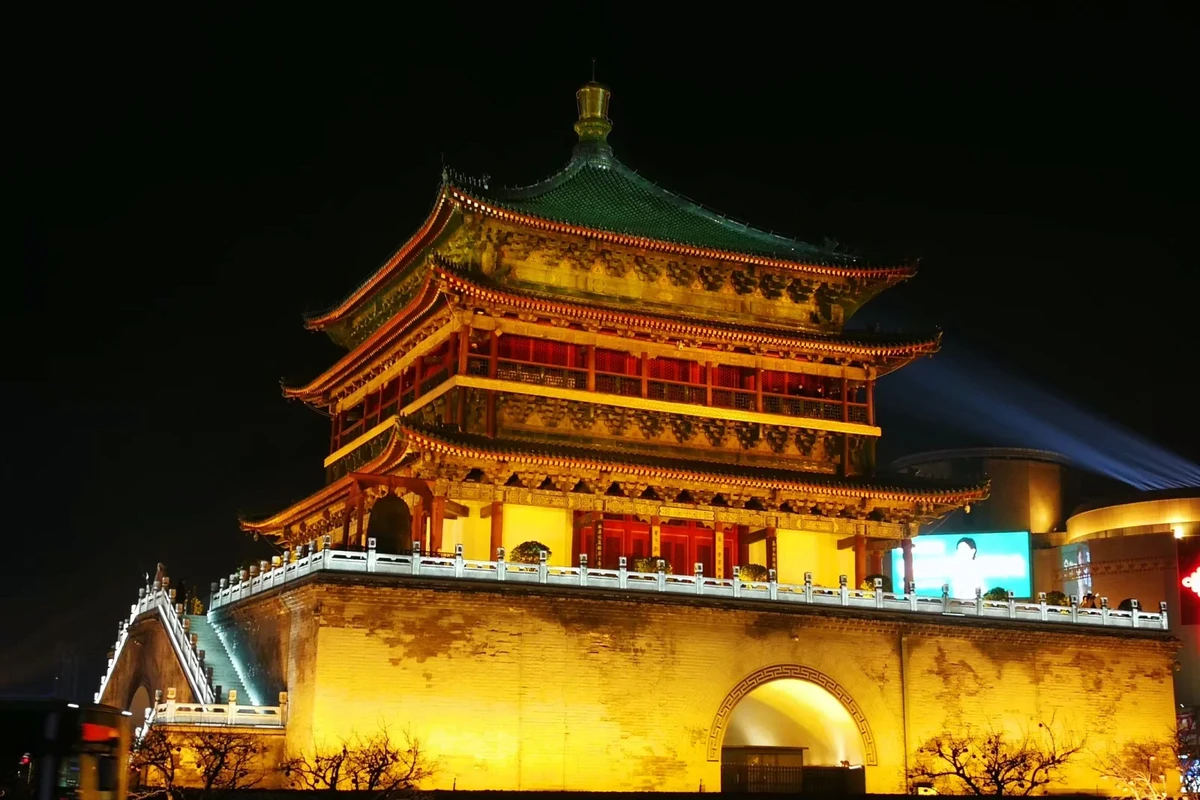
The Bell and Drum Towers are two Ming Dynasty structures—the Drum Tower and the Bell Tower—the largest and best-preserved drum tower relics in China. The whole structure uses no iron nails; it combines Tang style with Song architectural techniques and innovations, making it grand and magnificent.
The two towers are very close, about a three-to-four-minute walk. Since our hotel was right between them, we passed by many times, seeing them by day and night. The difference is huge. How to put it? At night: 'Wow!' By day: 'Meh.' Let the photos speak for themselves. Tickets are 30 yuan each, or 50 yuan for both. We bought only the Drum Tower ticket. Up there, it's small and not much to see. But we luckily caught the last folk music performance of the day. Though short, it was worth the ticket, especially the crisp, melodious sound of the bianzhong (bronze bells). As soon as night falls, Xi'an turns back into Chang'an. The scenes from 'The Longest Day in Chang'an' can truly be felt here.
Dinner was in the Muslim Quarter, the Hui Muslim district of Xi'an, made up of several lanes. Locals also call it 'Huifang.' It's a must-visit for first-timers. The streets are lined with food stalls where you can sample snacks while soaking in the deep cultural vibes. The most famous foods are probably roujiamo (meat buns), zenggao (sticky rice cake), paomo (crumbled flatbread in mutton soup), Biangbiang noodles, and shuipen niurou/yangrou (beef/lamb soup). As a die-hard roujiamo fan, I tasted every variety I could over the next few days: beef, egg-vegetable, chili, beef tendon and eight-treasure... But I still prefer the adapted pork version I had in Guangzhou.
I also loved the eight-treasure porridge in the Muslim Quarter—sweet and sour, often cooked with sunflower seeds, red dates, and goji berries. And I recommend this restaurant: Xi'an Jia San Qingzhen Soup Dumplings. The dumplings have thin skins, plenty of filling, and rich broth. We tried beef and mushroom ones. We ate breakfast and dinner there once, and their steamed fish and greens had a real Cantonese taste. Prices are reasonable; we sampled many local specialties. For two people, breakfast usually cost 40-70 yuan, and a main meal 150-230 yuan.
Here are some of the foods we enjoyed over the days. A friendly warning: be careful when ordering skewers—one skewer here is about five times the size of what we get in Guangzhou. We accidentally ordered too much one night and couldn't finish even though we were stuffed.
3. Nov 28: Terracotta Warriors, Huaqing Palace, Great Tang All Day Mall
It felt like we hadn't really been to Xi'an without seeing the Terracotta Warriors, but it's quite far from the city center—about 50 kilometers, so we joined a day tour. Not wanting to wake early, we picked a group leaving at 10 a.m. Since Huaqing Palace is very close to the Warriors, about a ten-minute drive, these two attractions are usually bundled. So even though I knew there wasn't much to see at Huaqing Palace, we went anyway.
The Qin Terracotta Warriors are hailed as the 'Eighth Wonder of the World' and were listed as a UNESCO World Cultural Heritage site in 1987. The guide said that with that status, even in wartime, no country is allowed to damage or bomb them. Entry is 120 yuan per person. You really need an audio guide here; otherwise, all you see are three pits.
The tomb of Qin Shi Huang hasn't been excavated yet. The Warriors are just a large burial pit within the mausoleum complex. On this site, China's largest ancient military museum was built. The museum's sign is written in Qin small seal script, the standardized script after the Qin unified China, designed by Li Si, so it's also called Li Si style. Without some cultural knowledge, you can barely tell what it says.
There are three warrior pits (actually four, but one was for grain storage and isn't excavated, just marked with a stone tablet). Pit 1 is the main force with alternating chariots and infantry, about 6,000 life-sized terracotta figures, each with a unique face—no two alike—and all with single eyelids. Some say single eyelids were the beauty standard then; others say the double eyelids were painted on and the color didn't survive, so they all look single-lidded now. The terracotta figures also show the craftsmanship of the artisans: the heads, torsos, and hands were fired separately, all hollow to prevent cracking. When unearthed, they were fallen and broken into a muddy mess. The standing figures we see now are all restored by experts, with an identification plaque on the back explaining each figure's role. It's a massive project—the original makers were skilled, and so are the restorers. The guide said one warrior is worth 100 million yuan; looking out, that's a whole 600 billion yuan! Excavation of Pit 1 stopped and started several times due to inadequate technology to protect the relics. There's a backfilled section in the middle where they dug and refilled, and further on are areas yet to be excavated.
Pit 2 is a mixed formation of chariots, cavalry, and crossbowmen. It contains two bronze chariots. The guide explained they are funerary objects, so they're half the size of real chariots. The bronze chariots, inlaid with gold and silver and exquisitely made, are called the 'Crown of Bronze.' The one we see has been restored; two parts couldn't be reattached and are displayed separately. The chariot behind was said not to be authentic, so we just glanced. Here I also learned about the whip and the prod: a whip is a leather strap to drive livestock, soft like a rope; a prod is a bamboo stick with sharp tips. The word 'encourage' (spur on) originally comes from driving a horse!
Pit 3 is the command center of the army. I didn't see much of interest. The pit also shows signs of fire, most likely set by Xiang Yu. It reminded me of the love-hate story between Xiang Shaolong and Qin Shi Huang in 'A Step into the Past.' Qin Shi Huang is often portrayed as a tyrant in films, but think about it—how many emperors matched his achievements? Unifying the six states, standardizing writing, currency, weights and measures, laws, building the Great Wall, fighting the Xiongnu, establishing the prefecture-county system, building national highways, creating centralized power... Even replacing live burials with terracotta figures was an innovation at the time. In 'A Step into the Past,' Xiang Shaolong, time-traveling from the future, suggests this to Qin Shi Huang, perhaps to make it more convincing. Due to technological limits, what's been excavated is just the tip of the iceberg. I look forward to the day when science advances enough to reveal the tomb itself.
Again, when visiting the Warriors, you must have a guide. Without cultural background, they're just big mud pits! And don't ask why I didn't pose in photos here—it's a burial pit, after all. Taking selfies at a tomb just didn't feel right.
In the afternoon we went to Huaqing Palace. Since ancient times, it's been a royal bathing retreat, said to be where Lady Yang bathed. Legend has it that King You of the Western Zhou built a palace here, and the nearby Li Mountain is the very place of the famous 'Beacon fire fooling the feudal lords.' But what made it truly famous are two things: the tragic love story of Emperor Tang Ming Huang and Lady Yang, and the modern Xi'an Incident. I personally scoff at the so-called 'love' of Li Longji and Yang Yuhuan, immortalized in lines like 'In heaven, we wish to be birds flying wing to wing; on earth, vines entwining twig and tendril.' It started with a father-in-law seizing his son's wife and ended with him ordering her death by a length of white silk to save his own skin—hardly a beautiful romance! I'd rather accept the political marriage and mutually respectful affection of Chiang Kai-shek and Soong Mei-ling; a union of interests, but also genuine feeling. During the Xi'an Incident, Chiang survived thanks to many efforts, and Soong Mei-ling certainly played a crucial role.
But the scenery here is very ordinary. Apart from a few persimmon trees full of small fruit, there's little to see. There are several large pools where ancient emperors bathed, with modern buildings constructed above them. Here, take a look at three bathing pools (for Lady Yang, Emperor Xuanzong, and Emperor Taizong). The 120 yuan ticket is totally not worth it!
It's cold now, so the outdoor show 'The Song of Everlasting Sorrow' has stopped, but there's an indoor live performance: '12.12 The Xi'an Incident.' The Xi'an Incident, also called the 'Double Twelve Incident,' occurred on December 12, 1936. To persuade Chiang Kai-shek to abandon his policy of 'internal pacification before external resistance' and form a united front against Japan, Zhang Xueliang and Yang Hucheng staged a 'military remonstrance' in Xi'an, detaining Chiang and leading to the second Kuomintang-Communist cooperation. '12.12' vividly reenacts that breathtaking scene. When entering, I was a bit confused at first, but gradually the emotional atmosphere took hold. The stagecraft and lighting were fantastic—apparently the helicopter on stage really was once used by Chiang. The ticket was 198 yuan, well worth it.
In the evening we went to the Great Tang All Day Mall. This spot is a huge hit on Douyin, featuring the warrior statue guy, the smile-and-hand-holding 'tumbler' lady, and the luxurious, splendid Tang-style architecture with dazzling lights. It was freezing that night. Our car parked near the Big Wild Goose Pagoda hotel (the roads in Xi'an seemed half dug up everywhere; we drove for nearly an hour—I recommend taking the subway: from 'Zhonglou Station' take Line 2 four stops to 'Xiaozhai Station,' transfer to Line 3 one stop to 'Dayanta Station'). First we saw the statue of Master Xuanzang in the square. Walking straight ahead, guided by blazing trees and flowers, we reached the Great Tang All Day Mall. It's basically a pedestrian street blending local culture, with Tang-style architecture and sculptural scenery, all dazzling under the lights, evoking a prosperous Tang atmosphere. No entry fee, gorgeous views, food, drinks, and souvenirs—highly recommended. The nearby Big Wild Goose Pagoda square has a huge musical fountain, but we didn't catch it.
We didn't see the warrior guy or the tumbler lady, but we did spot three fairy-like Dunhuang flying apsaras dancers and a parade float with several pretty performers—possibly including the tumbler lady? The street was packed that night, the freezing cold unable to dampen the lively buzz.
4. Nov 29: Big Wild Goose Pagoda, Shaanxi History Museum (didn't visit, no reservation), Tang Paradise
Since we'd passed the Big Wild Goose Pagoda the night before, we hadn't planned to revisit. But while strolling nearby, we thought—this is Xi'an's landmark—and couldn't resist. Ticket 40 yuan, plus 25 yuan to climb the pagoda. Honestly, not great value, but 'since we're here,' we went in and climbed up.
The Big Wild Goose Pagoda, also called the Great Ci'en Temple Pagoda, was built by Master Xuanzang in the Tang Dynasty to store Buddhist scriptures. It's a seven-story, 64.5-meter-tall pavilion-style square brick pagoda, consisting of a base, body, and top, tapering into a pyramid shape. It's said that from the top, you can take in all of Chang'an. So we climbed straight up, only to find... well, here are photos from the four directions, judge for yourself.
The Shaanxi History Museum, located northwest of the Big Wild Goose Pagoda, is a national-level museum with over 370,000 artifacts, from simple paleolithic tools to everyday objects up to 1840—spanning more than a million years. The Shang and Zhou bronzes are exquisite, the terracotta figures from various dynasties are diverse, the Han and Tang gold and silver ware are unsurpassed in China, and the Tang tomb murals are unparalleled. The museum condenses the essence of Chinese civilization and is hailed as a 'treasure trove of Chinese heritage,' an artistic hall showcasing ancient Chinese civilization and Shaanxi's history.
Such a famous museum is free but requires advance booking. We were there on a weekend and tried to book the night before, but tickets were already gone. A pity, but not really—you need a guide to appreciate such places, and with our limited historical knowledge, we probably wouldn't have gotten much out of it anyway.
Tang Paradise claims to be the largest cultural theme park in Northwest China, with the biggest cluster of Tang-style architecture. It has two 'world's largest' features: the largest outdoor fragrance project and the largest water screen movie show. At night, the illuminated Tang Cultural Corridor, Fanglin Garden, Ziyun Tower, etc., are brilliantly dazzling. (From Big Wild Goose Pagoda to Tang Paradise is just one subway stop—I strongly advise against driving, it's too troublesome.)
Our feeling: underwhelming. We went in the afternoon; it was free. Tired, we took a sightseeing car (30 yuan per person) around the park. It felt deserted, just a plain park with nothing much to see. There is a 'Dream of the Tang Dynasty' evening show, said to be a spectacular performance blending Tang grandeur with song and dance, but we didn't go. I didn't take many photos and don't have much to say—maybe summer would be a better time.
5. Nov 30: Mount Hua
Mount Hua is in Weinan, over 100 kilometers from downtown Xi'an. You can take a high-speed train, but for convenience we joined a day tour—a premium group with only nine people in the vehicle. Because of the distance, we departed at 7 a.m. and arrived by 9:30. The guide bought our shuttle bus and cable car tickets, explained the route in detail, and led us to the mountain base, then we were on our own.
We were lucky: as we started up, snowflakes began to fall. In the cable car, the wind howled fiercely. Looking down at the unfathomable depths below, I felt a sudden fear. The West Peak cable car is so long, even with a midway stop—the longest I've ever ridden. Later I checked online and learned it's the 'Taihua Cableway,' 4,211 meters long, going straight to the West Peak and main summit area. The Mount Hua entry ticket is 180 yuan, one-way shuttle bus 40 yuan, and one-way West Peak cable car 140 yuan—prices are a bit lower in the off-season.
Mount Hua has a spiritual aura. Despite the extreme cold, I saw several cats and dogs on the mountain. There was a little yellow cat that would rub against anyone who teased it—just trying to keep warm, I think.
Because the North Peak cable car was closed for maintenance, we went up and down via the West Peak, following this route: West Peak cable car, the spot where a goddess split a mountain to save her mother, West Peak summit, the Elixir Furnace, South Peak summit, the Plank Walk in the Sky, East Peak summit, the Sparrowhawk Flip, Central Peak summit, then straight back to the West Peak cable car down, skipping the North Peak direction.
West Peak, also called Lotus Flower Peak, is said to be the most scenic spot on Mount Hua. I can't say if it's the most beautiful, but it was our first summit. Snow continued to fall as we carefully held the iron chains and passed through the Axe-Split Rock to reach the top. Eight out of ten people there were on video calls, sharing the snowy winds and steep ridges with family and friends.
South Peak, also known as Wild Goose Landing Peak, is the highest point on Mount Hua, surrounded by pines and cypresses stretching for miles, dense and shady. When we arrived, the snow eased and sunlight began to peek through. Looking out, green mountains capped with white snow extended endlessly—truly beautiful. The Plank Walk in the Sky is here, but it was closed due to snow.
East Peak, or Sunrise Peak, is where many people hike up at night just to see the dawn. At the foot of the peak, the view didn't seem special, and I hesitated about climbing up. Good thing I did: near the Sparrowhawk Flip, I saw what I thought was the most stunning scenery on Mount Hua. Of course, the Sparrowhawk Flip was also closed because of the snow.
Central Peak, also called Jade Maiden Peak, the guide said isn't much to see, and indeed it wasn't. The path to the summit was closed due to wind and snow, so we didn't waste time.
North Peak, or Cloud Terrace Peak, we didn't visit. The description says it's the strategic point for accessing the other four peaks. Though not as high, it's extremely precipitous, with sheer cliffs on three sides and only one ridge leading south—easy to defend, hard to attack. It's said that the late martial arts novelist Jin Yong, after writing beloved stories like 'The Legend of the Condor Heroes' and 'The Smiling, Proud Wanderer,' once took the North Peak cable car in his old age and inscribed the words 'Sword Contest on Mount Hua.' The scenic area then carved this on stone tablets placed at each of the four main peaks, perfect for photo ops.
For martial arts fans like us, Mount Hua embodies both the 'Sword Contest' and the free-spirited world of 'The Smiling, Proud Wanderer.' The three contests from the Condor Heroes trilogy elevated the thrill of top-level duels to perfection, so much so that today people use 'Huashan Sword Contest' to describe any high-level gathering of experts. 'The Smiling, Proud Wanderer' is my favorite Jin Yong novel. If Feng Qingyang really had lived on this impossibly steep mountain, could he really have stayed? The Huashan Sect in the story is Taoist—did that make Linghu Chong a Taoist priest? Ha, ideals are rich, reality is stark; all the romance is in the imagination. Someday, I want to come back and walk the Plank Walk in the Sky and the Sparrowhawk Flip.
Here's the widely circulated guide to climbing Mount Hua—one must try a full route someday:
1. Weakest stamina: West Peak up, North Peak down. Because West Peak is higher, you'll mostly go downhill.
2. Low stamina: North Peak up, West Peak down. Gives a bit of a climbing feel without being too tiring.
3. Moderately low stamina: West Peak up, descend via the traditional Hua Shan Trail. You cover all sights, all downhill.
4. Decent stamina: Up via the traditional Trail, West Peak down. Feels like a real climb, no backtracking.
5. Strong stamina: Up via the traditional Trail, North Peak down. Go to West Peak then turn back to North Peak; advantage is North Peak cable car is cheaper.
6. Ultimate exhaustion: Up via the traditional Trail, down via the Zhihui Huashan Path—all on foot!
6. Dec 1: Xi'an to Guangzhou by air
Starting today, Xi'an entered the off-season for tourism, but that had nothing to do with us—our trip was ending, and rain began to fall. It seemed luck was on our side; the days we played were rain-free, and we even saw snow on Mount Hua.
We slept in, then went to the Muslim Quarter for one last local meal. I absolutely adored that eight-treasure porridge; a bowl of it on a cold day was so warming.
We booked a car through Qunar with a voucher, paying 54 yuan to go from the Drum Tower direct to Xianyang Airport. The driver was a friendly uncle who chatted enthusiastically about how Xi'an's development owes much to people from Guangdong and Zhejiang—including, of course, the property prices. In his eyes, Xi'an is a livable place where it's easy to make money, so many outsiders settle here. I thought of what the Terracotta Warriors guide had said: 'Our Xi'an is a land blessed with outstanding people—not only are there people below ground, there are people above ground too...'
Due to the weather, our flight was delayed nearly an hour. We landed in Guangzhou around 4:30 p.m., and after getting luggage and arriving home, the city lights were already on. The pleasant journey is over; tomorrow it's back to the grind. Looking forward to the next trip—currently, the plan is Huangshan.